Charity pickup beats landfill only for items that are clean, complete, safe and easy to resell, and only when the charity has agreed to take them. Everything else, including worn furniture, broken homewares, office fit-out, e-waste and building debris, ends up in landfill whichever door it is left at, and the charity pays for it if you leave it on their doorstep. The sensible approach is to split the pile: donate what has a real second life, and send the rest to a disposal route that is booked, lawful and recycles where it can. If you are clearing an office, a rental or a worksite in Melbourne, we handle that second pile so nothing gets dumped on a charity’s step.
TL;DR
- Donate only clean, working, complete items you would happily give a friend. Charities can refuse anything based on condition, saleability, space or safety.
- Leaving items outside a charity shop or bin is illegal dumping. In NSW it can attract fines of up to $4,000, and the charity still pays to bin the goods.
- Large pickups from charities usually need weeks of notice, and some will not collect furniture at all.
- Bulk, commercial, construction and damaged items need a booked removal or council service, not a donation drop.
- Sort first: donate the good items, then book removal for everything else in one trip.
Table of Contents
- What really separates charity pickup from landfill
- What charities will and will not take
- What happens to donations that cannot be sold
- Where textiles and small goods fit
- When landfill is the honest answer
- Charity, council or booked removal: which fits your situation
- For businesses, property managers and tenants
- How we handle the pile charities cannot take
- A simple sorting routine before you clear anything
- FAQ
- Sources
What really separates charity pickup from landfill
The difference is not about good intentions. It is about whether someone can resell or reuse the item. The WA Waste Authority explains that charitable recyclers sell donated reusable goods to fund community projects and in doing so keep reusable clothing, household goods and furniture out of landfill. The same guidelines say unusable donations and dumped items are sent to landfill at significant cost to the charity.
So a donation is really a handover of stock. If the stock is good, it goes to a shop shelf. If it is not, the charity becomes your waste contractor, and it did not agree to that.
Landfill, by contrast, is the end point for anything that cannot be reused or recycled. It has a place, but it should be the last step, not the default.
What charities will and will not take
Op shops (charity second-hand shops) want items that sell. Charitable Reuse Australia, the peak body for the sector, lists the usual accepted goods: clothing, shoes, accessories, bags, books, kitchenware, bed linen and towels, games, sports equipment and musical instruments. Clothing should be clean, undamaged, folded and packed in a sturdy bag, with pairs kept together.
The same page notes items can be refused because of condition or saleability, lack of space, transport or lifting equipment, and workplace health and safety rules. That last point matters for bulky furniture: a charity with no truck or no storage simply cannot take it.
Specialist reuse charities are narrower still. Reverse Garbage, a Sydney reuse centre, says it only takes items with a quick turnaround that are safe, clean and suitable for reuse. Its donation page lists what it cannot accept, including mattresses, chemicals, e-waste such as CRT TVs and monitors, glass, MDF and chipboard, white goods and office furniture.
If you are clearing an office, that list is the important one. Desks, workstations, filing cabinets and old monitors are exactly what many charities decline.
The “would you give it to a mate” test
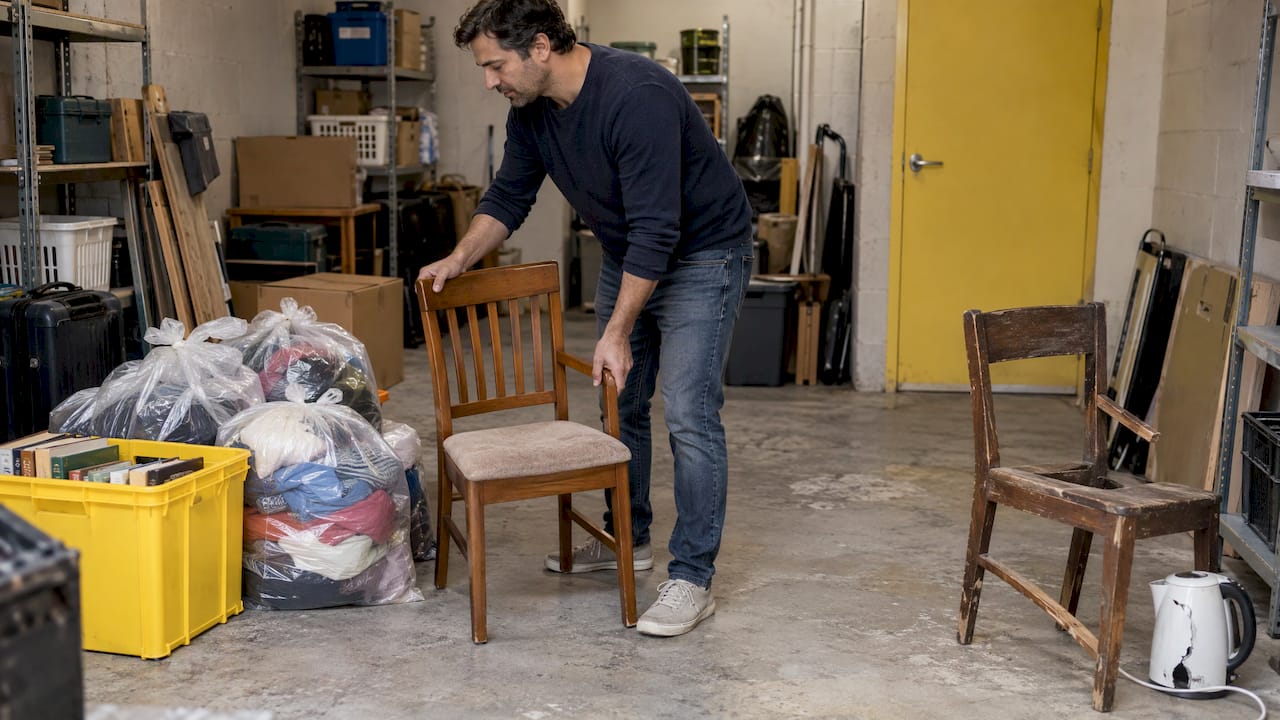
The NSW EPA offers a simple rule: do not donate anything you would not give to a friend. Stained, torn, incomplete or broken items belong in the rubbish, not the charity bin. A jigsaw missing pieces, a kettle with a cracked base or a chair with a wobbly leg fails the test.
Will a charity pick it up?
Sometimes. Charitable Reuse Australia says some charities offer home collection for larger items or estates, and it advises booking at least two weeks ahead and phoning the nearest op shop first to confirm it can store the goods. Reverse Garbage says it usually needs two to three weeks’ notice to add a pickup to its regular schedule.
That timing is the main practical limit. If your lease ends on Friday or the builders arrive Monday, a charity pickup that may or may not be approved in a fortnight is not a plan. It suits a slow, small, high-quality clear-out, such as a household estate with good furniture and plenty of notice.
What happens to donations that cannot be sold
The numbers show why “just donate it” is not always kind.
- The NSW EPA says illegally dumped, damaged and poor-condition donations cost NSW charities millions of dollars a year in clean-up and disposal. It also cites research that half of people who leave items outside charity shops or beside bins do not realise those items often end up in the bin.
- The WA Waste Authority reports that around 40% of what charitable recyclers send to landfill came from illegal dumping, according to a 2013 estimate, and WA charitable recyclers put the cost of disposing of dumped goods at more than $300,000 a year (both figures in its better practice guidelines).
- ABC News reported in December 2025 that St Vincent de Paul sent 376 tonnes of mostly broken or incomplete homewares to ACT landfills in a single financial year, up from 309 tonnes. The same ABC report says only 2% of that landfill waste was textiles, and that its Canberra warehouse cost $3.4 million to run, with about 45 staff sorting roughly 2.8 million kilograms of overflow donations.
The pattern is clear. Clothing and good-quality goods get sold. Broken or incomplete homewares and bulky items are what charities struggle with, and they pay to dispose of them.
Where textiles and small goods fit
Clothing is the strongest donation case because it is light, easy to sort and in steady demand. When a charity cannot sell every garment, there are further reuse markets, and textile reuse and resale options show how worn clothing and shoes can keep circulating rather than going to landfill. Either way, the starting point is the same: clean, bagged, undamaged goods, handed over in person during opening hours.
When landfill is the honest answer
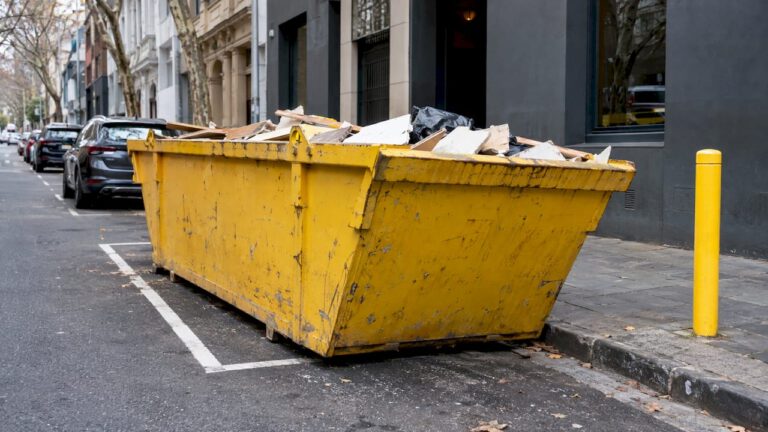
Some items cannot be donated and cannot be reused: damaged furniture, mattresses, broken white goods, building offcuts, carpet, plasterboard, old fit-out. The NSW EPA’s advice for items not suitable for donation is to use council pickup or a waste station, and to put rubbish and damaged items in the garbage bin rather than the charity bin.
Council hard waste is the usual household route, but it has limits. The City of Melbourne’s A–Z waste guide directs residents to book a hard waste collection for bulky items, and says people in high-rise buildings should contact their building manager, who arranges a collection on their behalf. Not every council offers the service: the Victorian Auditor-General found 79 councils, or 54%, provided a hard waste collection in 2019–20. Collection allowances also vary by council, and our guide to hard rubbish limits in Melbourne sets out the rules area by area.
Council collection is not a recycling guarantee either. Willoughby City Council in NSW states that most items from its bulky waste service go to landfill and asks residents to sell or give away good-quality goods first. The lesson is to pull out the reusable items before anything is collected.
Charity, council or booked removal: which fits your situation
| Situation | Best route | Why |
|---|---|---|
| A few bags of clean clothes, books, kitchenware | Charity drop-off in opening hours | Light, saleable, easy to accept |
| Good household furniture, plenty of notice | Charity pickup, booked about two weeks ahead | Only if the charity confirms it can store and lift it |
| Worn or damaged furniture, mattresses | Booked removal or council hard waste | Charities often refuse these on condition and safety grounds |
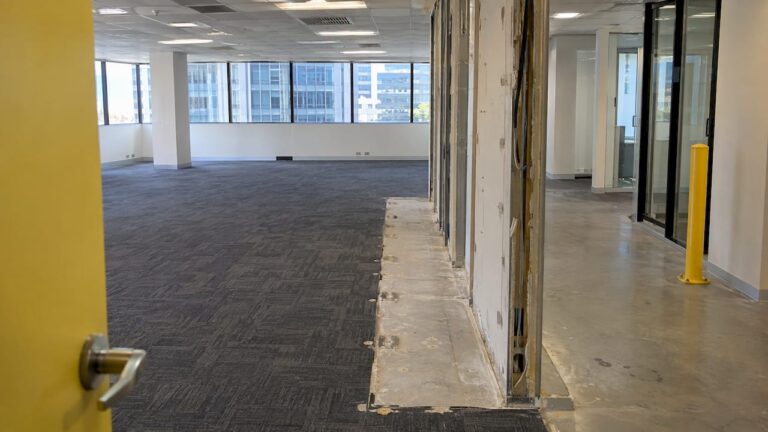
| Office furniture, fit-out, strip-out, make-good | Commercial removal | Volume, lifting and deadlines rule out donation drop-offs |
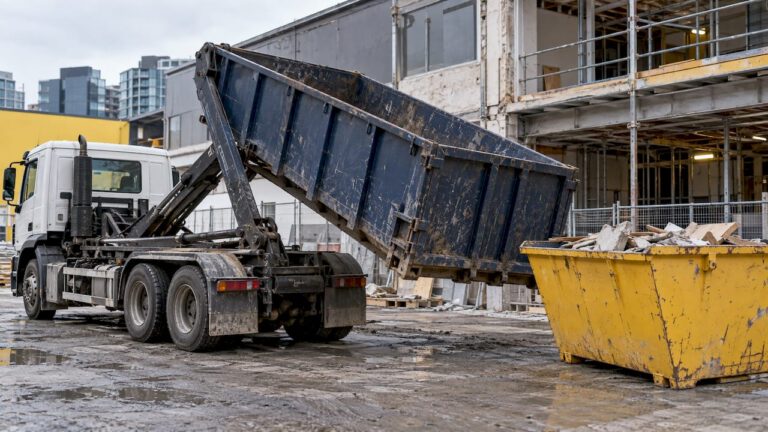
| Construction and demolition debris | Specialist construction waste removal | Not accepted by charities or most council services |
| E-waste and monitors | E-waste recycling service | Commonly refused as donations |
For businesses, property managers and tenants
Commercial clearances are where the charity-or-landfill question goes wrong most often. Volumes are large, timelines are fixed and the goods are often office furniture or fit-out that charities do not want.
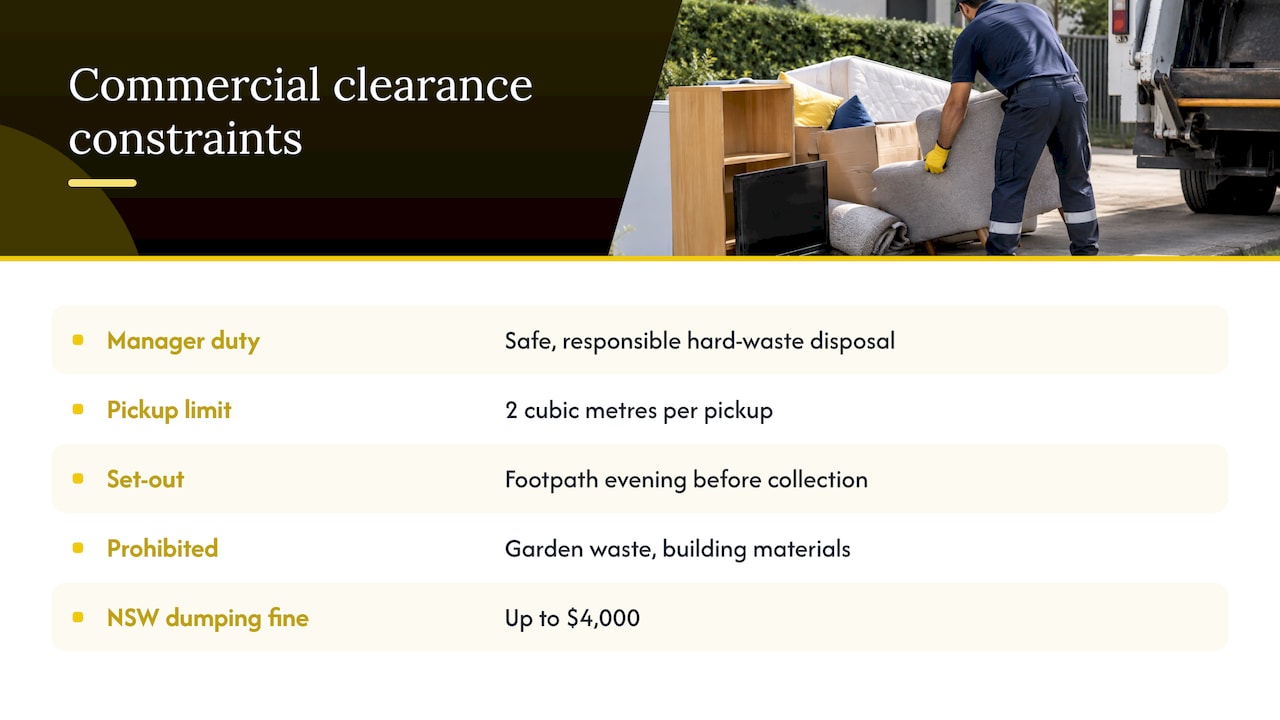
Property managers carry a specific duty. Yarra City Council’s guide says property managers and owners corporations are responsible for ensuring hard waste is disposed of safely and responsibly. Its web bookings are limited to 2 cubic metres per pickup, items go on the footpath outside the property boundary the evening before collection, and garden waste and building materials are prohibited. A single end-of-lease clear-out from a floor of an office building will blow through a limit like that.
For tenants, the end-of-lease deadline is the real constraint. Items left behind can cost you your bond, and a charity pickup booked weeks out may not land before handover. Our rubbish removal preparation checklist covers the checks that stop items being rejected on the day.
Organisations should also remember one more thing: dumping at a charity bin is not a loophole. Leaving goods outside a shop or bin counts as illegal dumping and, in NSW, can attract fines of up to $4,000. Dumped goods also become the charity’s disposal bill.
How we handle the pile charities cannot take
We run rubbish removal across Melbourne for businesses, strata managers, construction firms and tenants, including office cleanouts, strip-outs, make-good and de-fit work, and construction and demolition waste. For furniture, we offer furniture disposal and recycling, and our own guide on donating or recycling old furniture before booking removal explains how to split good pieces from the rest. We also handle e-waste disposal in Melbourne and construction waste removal.
A few things are part of how we work: carbon-neutral disposal is an opt-in option, we promise to beat any written quote by 5%, and punctuality comes with real-time notifications and a lateness credit. We are experienced in all types of Melbourne commercial buildings and aim to leave no mess and no damage to property. Prices are quoted per project, so the quickest way to a figure is our quick quote page.
A simple sorting routine before you clear anything
- Walk the space and make three piles. Good and saleable, recyclable, and rubbish. Be strict on the first pile: clean, complete, working, safe.
- Check your donations against the charity’s own list. Charities publish what they take. Call the nearest op shop before any bulky donation, and confirm it can store and lift it. Charitable Reuse Australia also warns that less than 65% of Australia’s roughly 10,000 donation bins are for charitable purposes, so check a bin’s purpose before using it.
- Bag, fold and deliver in person. Drop clothing and small goods off during opening hours. Never leave items outside a closed shop or beside a bin.
- Keep food donations within the rules. For food, NSW’s Civil Liability Amendment (Food Donations) Act 2005 protects people who donate food in good faith for a charitable purpose, provided it was safe when it left them and not to be sold.
- Book removal for the rest, with a date. Group the recyclable and rubbish piles into one booking so it all leaves in a single visit. Allow extra care for building materials. If the job involves older buildings, read our guide on strip-out versus demolition first.
- Keep the paperwork. If you manage a property or run a business, a booking record shows the waste was disposed of responsibly.
FAQ
Will charity shops pick up furniture?
Some do, but not all. Charitable Reuse Australia advises booking at least two weeks ahead and phoning the nearest op shop to check it can store the item. Pickup depends on condition, space, transport and safety, so damaged or bulky pieces are often declined.
Is it better to donate or throw away items in poor condition?
Throw them away responsibly. The NSW EPA says rubbish and damaged items belong in the garbage bin, not the charity bin, because charities pay to dispose of them. Use council hard waste or a booked removal service instead.
What happens to donations a charity cannot sell?
They go to landfill, and the charity bears the cost. The WA Waste Authority says unusable donations and dumped goods are sent to landfill at significant cost, and Perth charities also pay the waste levy.
Is leaving items outside a charity shop illegal?
Yes. The NSW EPA treats it as illegal dumping, with fines of up to $4,000 at charity bins and shop fronts. Rules differ by state, so check your own council or EPA, but the principle is the same: donate in person, in opening hours.
What is the most environmentally friendly way to dispose of things I cannot donate?
Separate recyclable materials such as metal, timber, e-waste and furniture components from true rubbish, and use a service that disposes of them lawfully. We offer opt-in carbon-neutral disposal on our removals.
Sources
- Better practice guidelines for charitable recyclers, WA Waste Authority
- Donating, Charitable Reuse Australia
- Donate goods, Reverse Garbage
- Please take responsibility for your donations, NSW EPA
- Vinnies sends most charity waste to ACT landfill, ABC News
- A–Z guide to recycling and waste disposal, City of Melbourne
- Council Waste Management Services, Victorian Auditor-General
- Kerbside bulky waste clean-up collections, Willoughby City Council
- Hard waste guide for property managers, Yarra City Council
- Better Practice Guidelines for Waste Management, NSW EPA
- Textile reuse and resale options