A skip bin suits small to mid-sized jobs where space is tight and swaps are frequent. A hooklift bin suits heavy, high-volume work such as demolition and large commercial builds, where one truck trip needs to move a lot of tonnes. Both are containers you hire and fill yourself. If you would rather not manage a container, a permit, a loading schedule and a pile of mixed waste, a full-service removal crew takes the whole job off your hands. That is what we do at Melbourne City Rubbish, for offices, building sites, strip-outs and end-of-lease clear-outs.
This guide explains how the two bin systems differ, when each makes sense, what to check before a bin lands on your site or street, and how to estimate the volume you need to clear.
TL;DR
- A skip bin is lifted by chains on its side lugs. A hooklift bin is pulled onto the truck by a hook at the front. The two systems are not interchangeable.
- Skip loaders suit renovations, small commercial fit-outs and tight sites. Hooklifts suit demolition, large commercial construction and civil projects with heavier, bulkier waste.
- Any bin left on a public road can need a council permit, so check the rules before you book.
- Measure the pile before you choose capacity. Bulky, mixed loads fill containers faster than people expect.
- If you want the waste gone without managing a container, a full-service rubbish removal crew is the simpler route. We quote per project and beat any written quote by 5%.
Table of Contents
- What is the difference between a hooklift bin and a skip bin?
- Which one fits your job?
- The operational trade-off: jobs per day or tonnes per trip
- Skip bin or trailer: how do they compare?
- What to check before a bin goes on your site or street
- How to estimate the volume of junk you need to clear
- Why a full-service crew beats managing a bin yourself
- Get a quote for your job
- FAQ
- Sources
What is the difference between a hooklift bin and a skip bin?
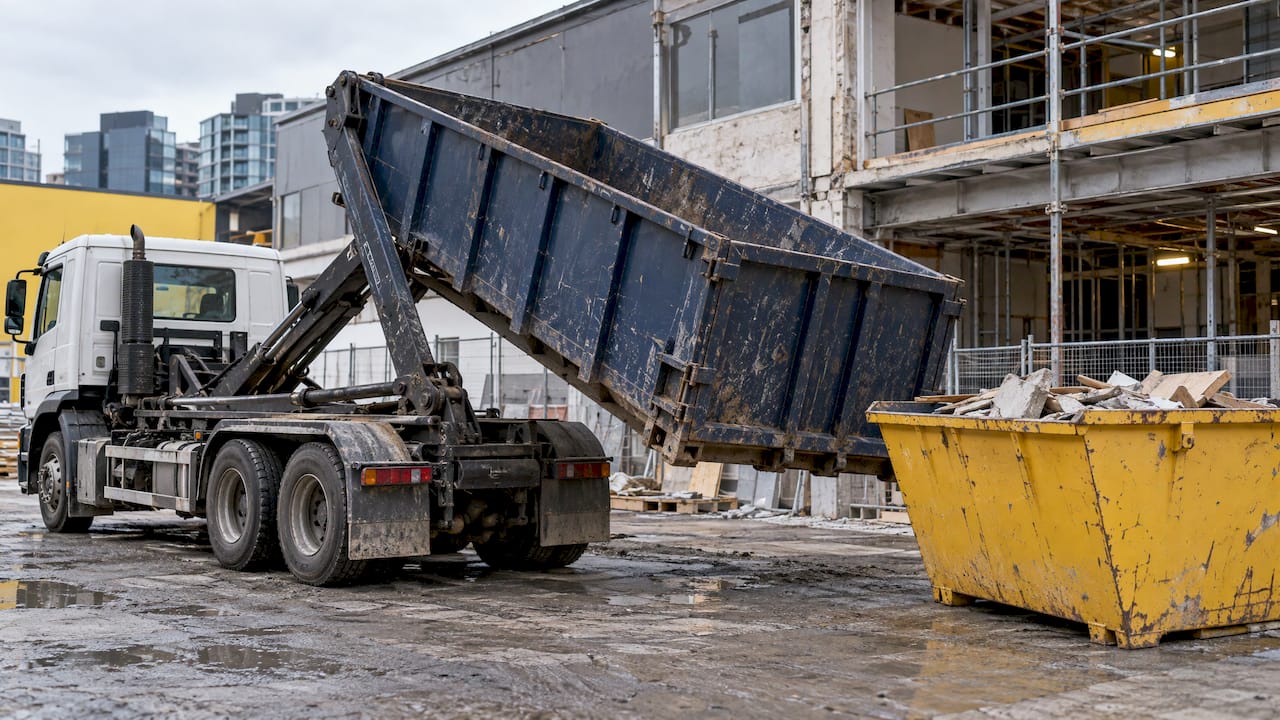
The difference is how the truck picks the bin up. A hooklift bin connects through a hook bar at its front, while a skip bin is lifted by chains attached to lugs on its sides. Because the lifting gear is different, a hooklift truck cannot carry a skip bin, and a skip truck cannot carry a hooklift bin. The same source notes that many operators run both, using hooklift bins for high-volume streams such as rubble and skips for smaller streams such as metal or plasterboard.
In practice that gives you two kinds of container with different strengths:
| Skip bin | Hooklift bin | |
|---|---|---|
| How it is lifted | Chains on side lugs | Hook bar at the front |
| Typical job | Renovations, small commercial builds, office clear-outs | Demolition, large commercial construction, civil works |
| Site space | Works where space is limited | Needs room for a bin zone and truck access |
| Swaps | Frequent swaps are easy to schedule | Fewer, bigger trips |
| Waste profile | Mixed household and light building waste | Heavier, higher-volume waste |
The job profile row follows the guidance from an Australian equipment supplier: skip loaders suit residential construction, renovations and small commercial builds with limited space and frequent swaps, while hooklifts suit demolition, large commercial construction and civil projects where waste is heavier and sites can dedicate space to bin zones.
Which one fits your job?
Start from the waste, not the bin. Three questions settle most decisions.
How much waste, and how fast does it arrive?
A single clear-out that produces a one-off pile suits one container or one collection. A site that produces waste every day for weeks has a different problem: you need containers swapped on a rhythm so work is never blocked. Skip loaders suit that rhythm of frequent swaps. Hooklifts suit sites generating large volumes that justify a bigger container.
How heavy is it?
Rubble, concrete, tiles, bricks and old flooring are dense. Soft office waste such as cardboard, cabinets and desk partitions is bulky but lighter. Heavy streams push you toward the hooklift end of the range, or toward separating the heavy material from the rest so it does not fill a general container with weight.
How much room do you have?
A hooklift bin needs space for the bin and for the truck to reach and pull it. A skip bin is friendlier to constrained sites. In the Melbourne CBD, South Melbourne and Port Melbourne, where loading docks are shared and street space is scarce, the practical question is often not which bin you prefer but whether anything can be left standing at all.
The operational trade-off: jobs per day or tonnes per trip
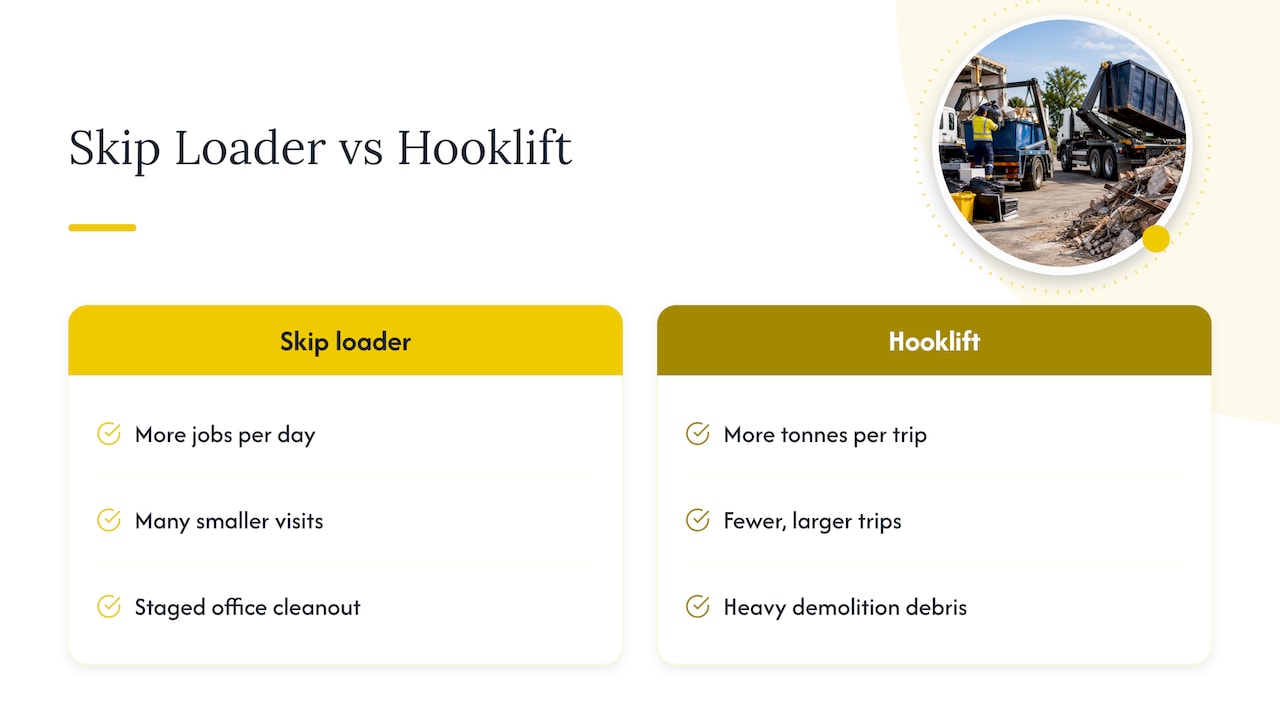
The supplier’s summary is neat: skip loaders help you complete more jobs per day, while hooklifts help you move more tonnes per trip, cutting repeated transport runs, labour time per tonne and wear on the fleet. That is a fleet operator’s view, but it matters to you as a customer too. Fewer, larger trips suit one big, heavy site. Many smaller visits suit many smaller sites or a job with a steady trickle of waste. Anyone running trucks for this kind of work also has to think about the safety of the vehicles themselves, and this fleet guide on wet hosing safety is a good example of the operational detail behind keeping a fleet moving.
You do not need to run a fleet to use the lesson. Ask yourself which cost matters more on your job: the number of visits, or the weight carried each visit. A strip-out with a few days of heavy demolition debris is a tonnes-per-trip problem. A staged office cleanout across several floors is a visits-and-timing problem.
Skip bin or trailer: how do they compare?
A trailer is the other container people consider for smaller jobs. In broad terms, a trailer is something you or a provider tow to the site, load, and take to a tip, while a skip bin is delivered, filled over days, and collected. The trade-off is the same as above, scaled down: a trailer suits a single, compact load, and a skip bin suits waste that builds up over several days.
What both share is that you do the loading, you work out whether everything is allowed, and you are responsible for what ends up inside. For a tenant finishing a lease, a property manager with a deadline or a business that cannot have staff lifting furniture, the loading is the expensive part of the job, not the container.
What to check before a bin goes on your site or street
This is where bin jobs go wrong, and the rules vary by council. Two Australian examples show the kind of conditions you can face.
- Permit and paperwork. Bayside Council in NSW requires a permit before a skip is placed on a roadway. Its application form asks for at least 10 working days to assess, a location plan, an accredited traffic management plan and public liability insurance of at least $20,000,000. For a single dwelling, a skip on the road is capped at 5 days and cannot be extended.
- Where it may sit. Burwood Council’s skips policy says skips belong on private property and go on the roadway only when there is not enough private space. They are not allowed in laneways or on footpaths. Road size depends on street width (up to 4m³ on white streets, up to 8m³ on yellow streets), and a skip cannot stay in time-restricted parking for more than 24 hours or in unrestricted parking for more than three days.
These are NSW councils, so they are not Victorian rules. They are useful because they show how much a council can ask for: lead time, insurance, size limits and time limits. For a Melbourne job, ask the council that controls the street where the bin would stand what applies, and do it before the booking, not after the bin arrives.
A permit is one half of the check. The other half is what you can put in. Asbestos, chemicals, batteries and similar items are commonly restricted, and rules differ by provider and tip. Our guides on items junk removal will not take and on rubbish removal preparation checks walk through what to sort out before collection day. For older buildings, our piece on strip-out versus demolition and asbestos surprises is worth reading before any work begins.
How to estimate the volume of junk you need to clear
Under-sizing is the common mistake. A container that is too small means a second swap and lost time. Here is a plain method that works for any provider.
- Break the job into piles. Group by type: furniture, office fit-out, packaging, building debris, green waste. Mixed waste is harder to judge than separate piles.
- Measure each pile. Multiply length by width by height, in metres, to get cubic metres. Round up. Loose waste does not stack like boxes, so leave margin for gaps.
- Count the awkward items. Desks, workstations, filing cabinets, shelving and partitions are bulky and take up far more space than their weight suggests. Count them as items, then add their volume to your pile total.
- Separate the heavy stuff. Concrete, bricks, tiles and floor finishes are dense. Keep them apart from light waste, because weight limits and tipping charges depend on what you load.
- Add a buffer. If you are unsure, plan for more than your measurement. Fit-outs and strip-outs reveal more waste once the walls and floors are open.
- Match the result to the service. A modest pile suits a standard container or a single collection. A large or heavy pile calls for repeated swaps, a bigger container or a crew with a truck.
A worked example: a small office clear-out has twelve desks, twelve chairs, four filing cabinets and a stack of boxes. You measure the box stack at 2m long, 1m wide and 1.5m high, which is 3m³. You then count the furniture as items, add a margin for gaps, and the total is well above the box stack alone. This is why photos or a walk-through beat guesses: you see the full pile, not the part you remember.
With a quote-based service, you do not have to turn this into a perfect number. You describe the job, we price it per project, and the volume question becomes ours to solve, not yours.
Why a full-service crew beats managing a bin yourself
The bin decision pulls you into a chain of tasks: choosing a system, checking the permit, finding space, loading, watching the weight, keeping banned items out, and arranging pick-up at the right time. For a facility manager or a tenant on a deadline, each link is a way for the job to slip.
Full-service removal compresses that chain into one booking. Here is how it differs for the readers we work with:
- Businesses and organisations. Office junk and cleanouts happen with minimal disruption to operations. We offer commercial office rubbish removal and office cleanout for exactly this.
- Construction firms. Our construction waste removal covers building waste, and we also do strip-outs, demolition, concrete cutting and grinding, so the waste and the work that creates it can be handled together. Our cost guide for construction waste removal explains how these jobs are priced.
- Property managers and tenants. Make-good and de-fit clearances, and end-of-lease rubbish, come with experience working in all types of Melbourne commercial buildings, and we aim to leave no mess and no damage to property.
- Anyone who needs a truck. We also offer truck and driver hire.
Two features matter on deadline jobs. We back punctuality with real-time notifications and a lateness credit. And we promise to beat any written quote by 5%, so comparing a container hire quote with ours costs you nothing but a few minutes. For waste with an environmental brief, our carbon-neutral operations are available as an opt-in.
Get a quote for your job
If you are weighing a hooklift bin, a skip bin or a trailer, send us the details of the job instead: what it is, where it is, how much, and by when. We quote per project, and you can start with our quick quote page. If the job is broader than rubbish, see everything we do, from strip-outs to demolition.
FAQ
What is a hooklift bin?
It is a container with a hook bar at the front, which a hooklift truck uses to pull the bin onto its frame. It is a different system from a chain-lifted skip bin, so the two types need different trucks. Hooklift bins are usually chosen for large, heavy waste volumes.
Is a hooklift or a skip bin better for a renovation?
For most renovations and small commercial builds, a skip bin is the usual fit, because space is limited and swaps are frequent. Hooklifts are better matched to demolition and large commercial or civil projects. If you would rather not manage either, a renovation waste service removes the waste for you.
Do I need a permit to put a skip bin on the street?
Often you do, and the rules depend on the council. As an example, Bayside Council in NSW requires a permit, a location plan, a traffic management plan and insurance for a skip on the roadway. Check with the council for your street in Victoria before you book anything.
How do I know how much waste I have?
Separate the waste into piles by type, measure each in metres to get cubic metres, count bulky items separately and add a buffer. Photos of the pile help any provider quote accurately. We price per project, so a description or photos are enough to start.
What cannot go in a skip bin?
Hazardous items such as asbestos, chemicals and batteries are commonly restricted, and rules differ between providers and tips. Our guide to what Melbourne junk removal will not take lists the common ones. Sort these out before collection day.
Sources
- Hook Lift Bin vs Skip Bin: Differences and How to Choose
- Skip Loader vs Hooklift: Which Is Better for Construction Waste
- Bayside Council: Occupy Road with Unregistered Item Application EP02
- Burwood Council: Rubbish Skips Policy
- Wet Hosing Safety: A Fleet Manager’s Field Guide