No single insurance policy is legally required of every rubbish removal business in Australia. What a contractor must hold depends on whether it has employees, runs vehicles, what waste it carries and which state it works in. On top of the law sit the contract requirements: building managers, principal contractors and councils often set their own minimum cover before a crew can step on site. If you are hiring a removal company for an office, a strip-out or a construction site, those contract requirements are the ones that affect you most.
This guide explains the difference between legal and contractual cover, what each policy type does, what limits Melbourne buildings commonly ask for, and where policy exclusions catch people out. It is written for the people who hire removal crews: business owners, property managers, construction firms and tenants finishing a lease.
TL;DR
- Workers compensation and motor injury cover are the main legal insurance requirements. They depend on whether a business has employees and vehicles, according to business.gov.au.
- Public liability is not a universal legal requirement, but buildings, principal contractors and councils routinely make it a condition of entry.
- A $20 million public liability limit is a common benchmark for commercial and government work. It is market practice, not a law.
- Pollution, spills and hazardous materials are often excluded or capped in standard policies, so waste type matters.
- For a building manager, the practical test is a current certificate of currency that names the contractor and matches the job.
Table of Contents
- Legal requirements versus contract requirements
- The insurance types that matter for rubbish removal
- What limits do Melbourne buildings expect?
- When proof of insurance is asked for
- Waste rules sit alongside insurance
- Exclusions that catch people out
- Residential and home-owner clients
- A practical checklist for hiring a removal contractor
- How we work in Melbourne buildings
- What to expect over the next year
- FAQ
- Sources
Legal requirements versus contract requirements
It helps to separate two questions that searches often blur.
What does the law force a removal business to hold? The Australian Government’s business guidance says workers compensation may be required if you have employees, third-party personal injury insurance may be required if you use motor vehicles, and public liability may be required for some occupations in some states and territories. It does not treat public liability as compulsory for every business.
What does the job force a removal business to hold? This is where the real requirements live. Building owners, strata managers, head contractors and councils write insurance into access agreements, tender documents and permit conditions. A contractor can be fully legal and still be turned away at the loading dock because the certificate does not meet the building’s rules.
For you as the client, the second question is the one that decides whether the job proceeds on the day.
The insurance types that matter for rubbish removal
Workers compensation
If a removal business employs people, it generally must cover them under workers compensation. The schemes are state-based: Safe Work Australia’s comparison notes that each of the eight states and territories runs its own workers compensation arrangements, so eligibility and compliance details differ by jurisdiction. In Victoria the scheme is WorkCover, run by WorkSafe Victoria.
Why it matters to you: removal work involves heavy lifting, stairwells, lifts and loading docks. If a worker is hurt on your premises and is not covered, the dispute can become messy for everyone on site, including the occupier.
Public liability
Public liability responds when a third party, such as a visitor, another tenant or the building owner, claims for injury or property damage caused by the contractor’s work. For removal in a commercial building, think of a scratched stone lobby floor, a damaged lift lining, a cracked glass panel or a bin that rolls into a parked car.
A broker’s overview describes public liability as the cover that can address third-party property damage and personal injury claims. Most building managers treat it as the baseline.
Commercial motor and compulsory third-party
Removal trucks and utes are motor vehicles, so they carry the state’s compulsory third-party injury cover through registration. Separate commercial motor insurance covers damage to the vehicle and, depending on the policy, property damage to others. One 2026 trades policy, for instance, offers a commercial motor option that includes third-party property damage cover, subject to its terms and limits.
If you also care about the fleet’s wider compliance, for example emissions rules for diesel trucks, an ISO 22241 compliance checklist shows the kind of vehicle standards fleet operators work to.
Environmental or pollution liability
This is the cover people most often assume they have and do not. Standard public liability wordings commonly exclude pollution. The 2025 to 2026 Victorian Managed Insurance Authority public and products liability wording, for example, excludes pollution and clean-up costs except for a sudden, identifiable, unintended and unexpected event at a specific time and place. Commercial motor wordings can contain the same type of exclusion, so a spill from a truck is not automatically covered.
The same trades policy that offers motor cover also shows how narrow vehicle debris cover can be: it states a $10,000 limit for clean-up of specified fallen or leaked goods. That is a clean-up allowance, not broad environmental remediation cover.
For ordinary office junk, furniture and cleanout work, pollution risk is low. It rises with demolition, strip-outs, asbestos-adjacent building materials, chemicals, fuels, batteries and electronic waste.
What limits do Melbourne buildings expect?
There is no national legal figure for public liability, but $20 million is the number you will see most. Two examples from Victoria:
- The City of Melbourne requires a certificate of currency for permits to work in public space, such as road works. It states that cover must be at least $20 million for a single claim, and that the permit applicant must be named on the certificate and the cover kept current for the life of the permit.
- One Australian trades insurer’s rubbish-removal product page says its non-hazardous commercial option offers $10 million or $20 million liability choices, and notes that many principal contractors and government projects require $20 million. That is market guidance, not a legal minimum.
In practice, a CBD office tower, a shopping centre or a head contractor’s site will state its own figure in its contractor induction pack. Your building manager will tell you what it is. A smaller suburban cleanout may have no stated minimum at all.
When proof of insurance is asked for
The typical triggers are:
- Building access. Managers of commercial buildings usually require a certificate of currency, a site induction and often a booked loading dock or lift before any removal starts.
- Head contracts. If you are a subcontractor or a tenant under a head lease, your contract may require every trade on site to meet the head contractor’s insurance schedule.
- Make-good and end-of-lease. Leases commonly require the tenant to restore the premises, and landlords want assurance that damage during the clearance will be covered.
- Council permits. Skips or vehicles placed on public land, or works in the road, trigger permit conditions like the City of Melbourne’s.
- Tenders. Larger organisations list insurance as a compliance item in procurement documents.
A certificate of currency is a one or two page document issued by the insurer or broker. It shows who is insured, the type of cover, the limit, and the policy’s start and end dates. When a building asks for one, check four things: the name matches the company you are engaging, the policy type matches the job, the limit meets the building’s figure, and the period covers the day of the work.
Waste rules sit alongside insurance
Insurance is not the only compliance layer. In Victoria, Environment Protection Authority rules apply to how waste is moved. The EPA states that for most reportable priority waste you must track the waste in Waste Tracker and get permission to transport it, and that industrial waste must only go to a place authorised to receive it. Reasonable steps for transport include safely containing the waste, keeping incompatible wastes apart and planning for spills.
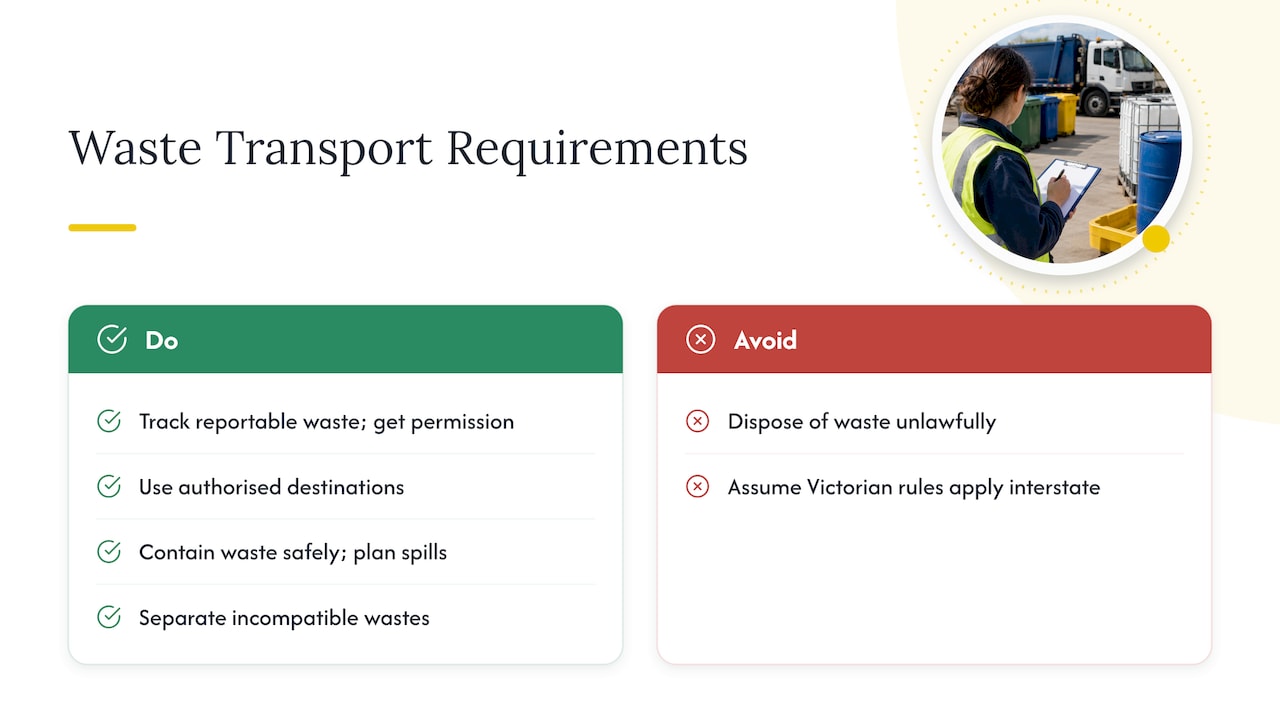
This matters for insurance because a policy responds to accidents, not to unlawful disposal. Insurance does not fix a load that ends up at the wrong site. The EPA also notes that the requirements depend on the type of waste, which is why classification of a strip-out or demolition load matters before it leaves your premises.
Other states have their own licensing. One industry summary describes the position as activity- and waste-category-specific, noting that New South Wales licence conditions may require pollution insurance and Western Australia licenses controlled-waste carriers, drivers and vehicles separately. If you have sites in several states, do not assume Victorian practice carries across.
Exclusions that catch people out
A certificate shows that a policy exists. The wording shows what it does. These are the points where cover most often falls short of what a client assumes:
- Pollution and clean-up. As above, usually excluded with a narrow sudden-event exception.
- Hazardous materials. Insurers may exclude or restrict asbestos, chemicals and similar material. Work involving them generally needs licensed specialists, not general removal crews.
- Subcontractors. If your removal company engages another firm for part of a job, such as concrete cutting or demolition, the policy may treat subcontracted work differently.
- Higher-risk tasks. Insurance information aimed at waste businesses lists demolition and excavation among the higher-risk tasks, which is why strip-out and demolition jobs get more attention than a desk clearance.
- Limits per claim versus aggregate. A $20 million per-claim limit is not the same as $20 million for the year.
- Loss of the client’s own property. Your own fixtures, stock or records are generally not what a contractor’s public liability is designed to protect. Check your own property and contents policy.
Residential and home-owner clients
If you are a householder, you will rarely need to see a certificate, but a tidy contract still matters. Your home and contents policy generally covers your own building and belongings, while damage caused by a contractor is a claim against the contractor’s liability cover. For anything involving fences, concrete or structural items, the waste rules above still apply to the load.
A practical checklist for hiring a removal contractor
Use this before you book any commercial job:
- Ask your building manager for the contractor requirements: minimum public liability, any workers compensation evidence, induction, access hours and lift or dock bookings.
- Match the job to the risk. Office furniture and general junk is low risk. Strip-out, make-good, demolition, concrete work and electronic waste carry more.
- Confirm the contractor names the right entity on the certificate and that dates cover your job day.
- Confirm where the waste goes and that the destination is authorised for that waste type.
- Get the scope and quote in writing, including what is excluded.
- Photograph the area before and after, particularly lifts, loading docks and floors.
Our Rubbish Removal Prep checklist covers the preparation side, and the guide to dealing with business waste in Melbourne covers how commercial waste streams are handled.
How we work in Melbourne buildings
We clear offices, strip-outs, make-goods and construction sites across Melbourne, and we have experience working in all types of Melbourne commercial buildings. Our aim on every job is no mess and no damage to property. We back punctuality with real-time notifications and a lateness credit, so building managers can plan lift and dock bookings around a crew that arrives when it says it will. Carbon-neutral disposal is available as an option, which suits property managers with sustainability targets. See our eco-friendly rubbish removal for Melbourne businesses.
For office work, start with commercial office rubbish removal. For construction and demolition debris, see construction waste removal. Quotes are per project, and we promise to beat any written quote by 5%. You can start with a quick quote, and if your building has specific contractor requirements, send them with your request so the job is planned around them from the start.
What to expect over the next year
Insurance wordings, state waste rules and building requirements change. Insurers reissue policy documents each year, EPA Victoria updates its waste guidance, and workers compensation settings are reviewed by each state. Treat the figures in this article as a guide to the usual pattern, and confirm the current requirement with your building manager, your insurer or broker, and the relevant authority before a major job.
FAQ
Is public liability insurance compulsory for a rubbish removal business in Australia?
Not as a blanket legal rule. Business.gov.au says it may be required for certain occupations in some states and territories. In practice, most commercial buildings, councils and head contractors make it a condition of work.
How much public liability cover do commercial jobs ask for?
The figure that appears most often is $20 million per claim, such as in the City of Melbourne’s permit rules. Some smaller jobs accept $10 million, and the building or contract sets the actual minimum.
Does standard insurance cover spills and pollution?
Often not. Standard public liability and motor wordings commonly exclude pollution and clean-up costs apart from a sudden, unexpected event, as the VMIA wording shows. Jobs with hazardous materials need specialist handling and specialist cover.
What is a certificate of currency?
It is the insurer’s summary of a policy: who is insured, what type of cover, the limit and the dates. Buildings and councils ask for it before work starts, and it must be current on the day of the job.
Do workers compensation rules differ by state?
Yes. Each state and territory runs its own scheme, as Safe Work Australia’s comparison explains. In Victoria, employers register with WorkSafe Victoria.
Sources
- Types of business insurance, business.gov.au
- Comparison of workers compensation arrangements in Australia and New Zealand, Safe Work Australia
- Public and Products Liability Policy Wording 2025 to 2026, VMIA
- Public liability insurance, City of Melbourne
- Transport industrial waste, EPA Victoria
- Trades and Services Pack policy document, 2026
- Trades liability insurance for rubbish removal, non-hazardous commercial
- Waste contractors: insurance requirements in Australia
- Waste and recycling industry insurance
- Skip bin and rubbish removal insurance overview
- ISO 22241 compliance checklist for fleet operators