There is no single Melbourne hard rubbish limit. Each council sets its own, so the volume, item weight, length and number of free collections depend on your address. The City of Melbourne allows one free collection of one cubic metre per financial year. Yarra allows two cubic metres per pick-up. Wyndham allows three cubic metres, up to three times a year. If your pile is bigger than your council allows, or it contains items the council refuses, a booked removal is the simplest way to clear all of it in one visit. Our hard waste collection service is built for that situation.
TL;DR
- Limits are set by your local council, not by Melbourne as a whole. Check the council that collects your rates, not the suburb name on your mail.
- City of Melbourne residents get one free collection of one cubic metre (1m x 1m x 1m) per financial year, from 1 July to 30 June.
- Typical item limits are 1.5 to 2 metres in length and 20 to 55 kg in weight, and the load must be liftable by two people.
- Paint, chemicals, asbestos, rubble, garden waste and building or business waste are refused by most councils.
- Over the limit, or with refused items? Book a private removal that takes everything in one go.
Table of Contents
- Which council’s rules apply to your address
- What counts as hard rubbish
- Hard rubbish limits by council
- How big is a cubic metre, really
- Item size and weight limits
- What councils will not take
- Quantity limits within a collection
- Booking and putting items out
- Apartments, owners corporations and property managers
- Is it illegal to take items from hard rubbish
- Business, renovation and construction waste
- When your rubbish exceeds the limit
- Reuse before you throw
- A quick pre-booking checklist
- FAQ
- Sources
Which council’s rules apply to your address
Greater Melbourne has dozens of councils, and hard waste is a council service. The same couch can be collected free in one suburb and refused two streets over if a boundary runs between them. Start with the council that issues your rates notice.
The City of Melbourne covers the CBD, Southbank, Docklands, Carlton, North Melbourne, Parkville, West Melbourne and other inner areas. Its residents are entitled to one free hard waste collection of one cubic metre per financial year, and high-rise residents ask their building manager to book on their behalf. That last point catches many apartment dwellers out. You may not be able to book yourself at all.
Commercial and retail addresses are not entitled to a council hard waste collection in the City of Melbourne. If you run a business, or you are clearing a tenancy, the council service is not the route.
What counts as hard rubbish
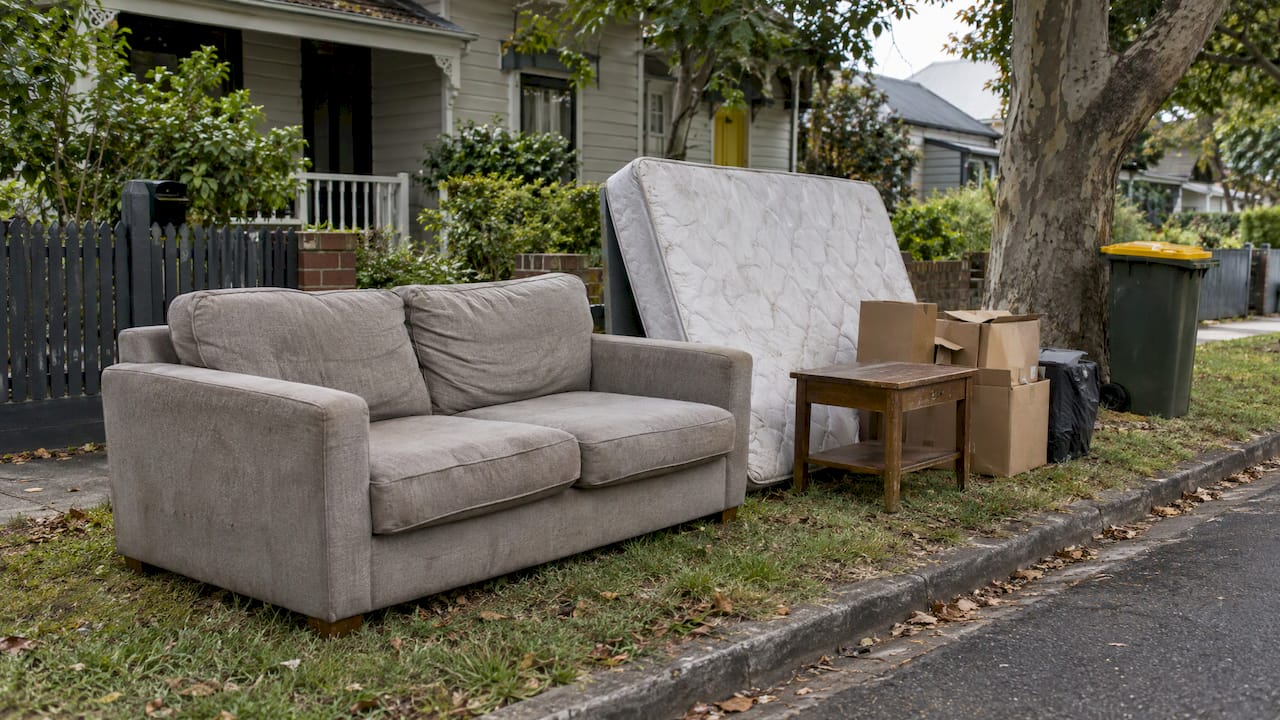
Hard rubbish is bulky household waste that does not fit in your bins. In the City of Melbourne that covers household appliances and furniture, e-waste, mattresses, scrap metal and similar material of a household nature. The council’s list of accepted items includes:
- Household furniture, tools, toys, bicycles and sporting equipment
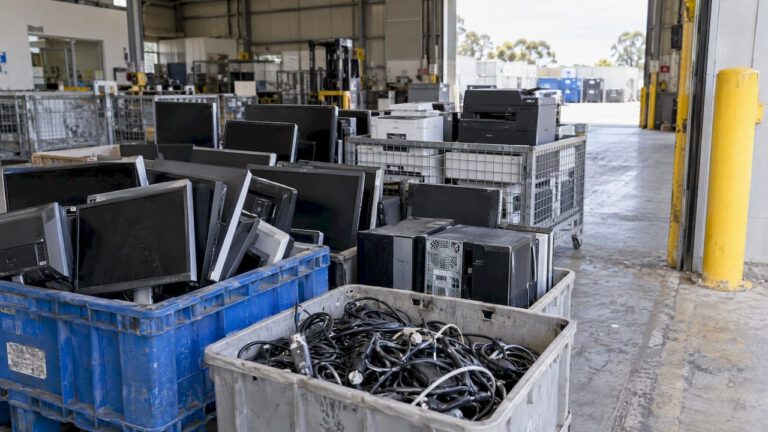
- E-waste of all sizes and types, and household appliances
- Mattresses and small rugs no more than 1.5 metres long
- Scrap metal, including barbecues, and hot water units
- Pottery and chinaware
- Sheet glass, securely wrapped and marked “glass”
- Timber under one metre long, up to 10 pieces per premises
That list comes from the City of Melbourne hard waste page. Other councils vary in detail but follow the same idea: household goods that two people can safely lift.
Hard rubbish limits by council
The table compares the limits published by several councils. Check your own council’s page before you book, because allowances and fees are reviewed.
| Council | Free collections | Volume per collection | Item limits |
|---|---|---|---|
| City of Melbourne | 1 per financial year | 1 cubic metre (1m x 1m x 1m) | Items over 30 kg not collected |
| Yarra | Up to 2 per household per calendar year | 2 cubic metres (2m x 1m x 1m) | Up to 2 m long, under 50 kg, liftable by 2 people |
| Stonnington | 2 scheduled collections a year (spring and autumn) | Under 5 cubic metres in total | Items under 20 kg, shorter than 1.5 m (except mattresses) |
| Hobsons Bay | 1 per financial year, second for $98.57 | 3 cubic metres | Max 1.5 m, max 20 kg per item, container or bundle |
| Whitehorse | 2 booked per financial year | 3 cubic metres (1m x 3m x 1m), or 6 cubic metres using both entitlements | Items not longer than 2 m |
| Wyndham | Up to 3 hard and green collections per financial year | 3 cubic metres each | Max 55 kg, max 1.5 m, safely liftable by two people |
| Maroondah | 2 single (2 m³ each) or 1 double (4 m³) per financial year, with up to two paid extras | 2 or 4 cubic metres | Items over 1.5 m refused, except mattresses and large furniture |
| Merri-bek | 2 per financial year | 1 cubic metre each, or a double booking up to 2 cubic metres | Excess over 2 m³ is left behind |
Three things stand out. The free allowance is small in the inner city and larger in the outer suburbs. Some councils count by financial year and others by calendar year. And some run fixed scheduled collections, so you cannot choose your date.
How big is a cubic metre, really
One cubic metre is a box one metre wide, one metre deep and one metre high. That is about the size of a two-seater couch standing on end, or a single mattress plus a small bedside table and a few boxes. A queen mattress alone takes a big share of it.
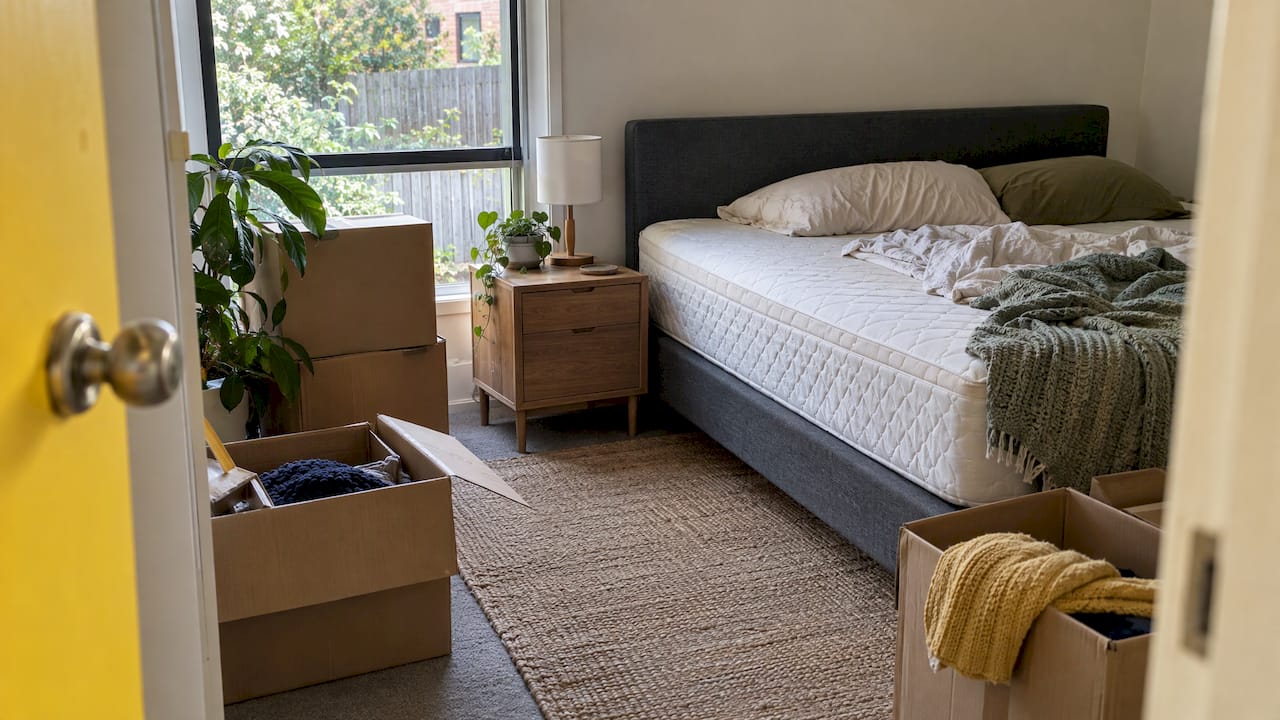
The City of Melbourne limit of one cubic metre is easy to exceed in a single room clean-out. A fridge, a mattress and a desk can exceed it before you add anything else. Yarra’s two-cubic-metre limit (2m x 1m x 1m) gives you double the room, but the same logic applies: measure the pile before you book, not after.
A practical way to check:
- Tape out a 1m x 1m square on the garage floor.
- Stack the items inside it and see how high they reach.
- If the stack is above one metre, or you have to leave items out, you are over a one-cubic-metre allowance.
Item size and weight limits
Volume is only one limit. Collection crews also refuse single items that are too long or too heavy, and the numbers differ: 20 kg in Stonnington and Hobsons Bay, 30 kg in the City of Melbourne, 50 kg in Yarra and Port Phillip, 55 kg in Wyndham. Length limits are commonly 1.5 metres, rising to 2 metres in Yarra and Whitehorse.
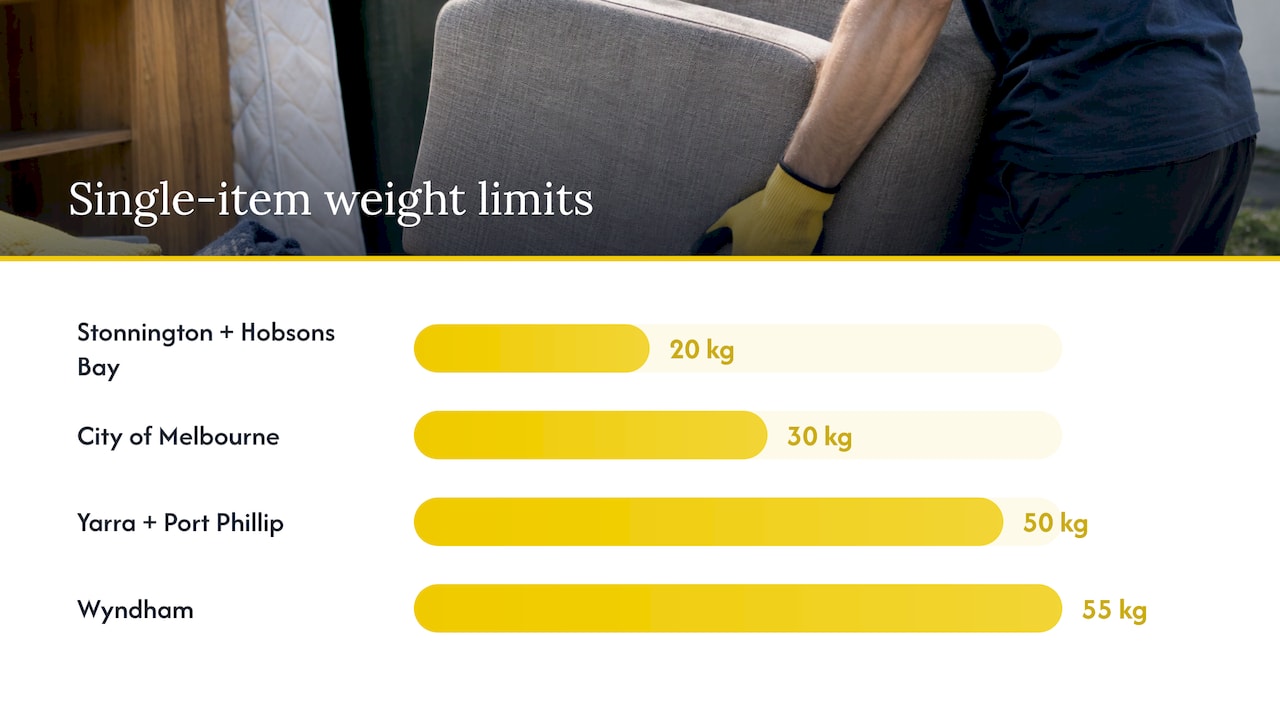
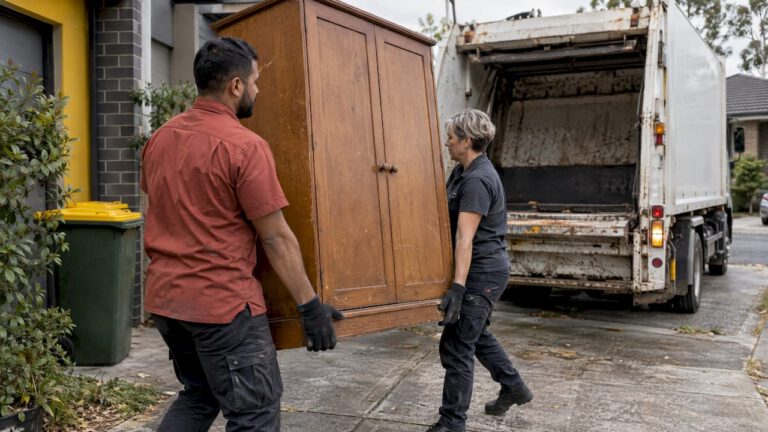
The rule of thumb behind most of them is that two people must be able to lift the item safely. A solid timber wardrobe or a large commercial-grade appliance often fails that test. If an item is too heavy or long to qualify, it will be left behind with a sticker, and you may be required to remove it from the nature strip.
The weight limits that apply to private junk removal work differently from council rules, which is useful to know if a single heavy item is what is holding up your clean-out.
What councils will not take
Refused items are the most common reason a collection goes wrong. Across the councils above, the same categories turn up again and again.
The City of Melbourne will not collect:
- Liquid waste, including chemicals, paint and motor oil
- Trade waste from industrial or commercial premises, including pallets
- Waste from building, renovation or demolition work, and fencing
- Bricks, concrete, rubble, excavation material, dirt and stones
- Asbestos and other hazardous or offensive waste
- Garden waste, tree roots and branches
- Car bodies and car, truck and tractor tyres
- Polystyrene and styrofoam
- Unwrapped panes of broken glass
All of that is on the City of Melbourne hard waste page. Yarra’s list is similar and adds items over 50 kg, 4WD or truck tyres and large car parts, per its hard rubbish page. Maroondah also refuses batteries, gas bottles, plasterboard, fibro and business waste, even if the business is home-based.
Our guide to prohibited items in junk removal shows how this carries across to private jobs, and our six-check preparation guide lists what to sort before the truck arrives.
Can paint tins go in hard rubbish?
The answer depends on the council. Hobsons Bay accepts empty, dry paint tins with the lids removed, but does not accept paint, even if fully dry. Maroondah accepts empty paint tins with lids removed, but refuses cans with residual liquid. Yarra accepts paint within limits: up to five 20 litre containers in original tins with lids secured. The City of Melbourne refuses liquid waste including paint. Read your own council’s rule before you put tins out.
Quantity limits within a collection
Even accepted items often carry per-collection caps. Yarra allows one king-size mattress per booking, four car tyres, one gas bottle and five 20 litre containers of paint. Maroondah allows up to three mattresses and three internal doors, carpet rolled and tied no longer than 1.5 metres and covering no more than two rooms, and up to ten pieces of timber at most 1.5 metres long. The City of Melbourne caps timber under one metre long at ten pieces per premises.
These caps explain why a pile that looks legal on volume can still be partly refused.
Booking and putting items out
The City of Melbourne requires bookings, with dates available two months in advance. Items go on the kerbside or in an accessible location the day before collection, and crews do not enter private property. Stonnington requires bookings from businesses, non-residential properties, residents of large apartment buildings and people living on main roads.
A few habits prevent most problems:
- Keep items together in a tidy pile, not spread along the frontage.
- Do not place items in plastic bags where the council refuses bagged material.
- Keep walkways, bins and driveways clear.
- Take photos of the pile in case you need to report a missed collection.
Timing matters too. Merri-bek states that putting goods on the nature strip outside the collection period is illegal and can attract a fine of up to $9,000, and if you receive a knock-back notice you must remove the incorrect items within 24 hours or risk a fine, per its hard waste page. Maroondah asks residents to report uncollected items within one week of the scheduled date.
Apartments, owners corporations and property managers
Apartment living changes the rules. In the City of Melbourne, high-rise residents need the building manager to organise the collection. In Yarra, eligibility is set out in a building’s Waste Management Plan, and if the plan requires private contractors, the building may not be eligible for council hard waste. Property managers book by email or phone, website bookings are capped at two cubic metres per pick-up, and excess items must be removed from within the property boundary.
For strata managers and owners corporations clearing a communal area or a vacated unit, a booked private removal avoids the eligibility questions. Our furniture disposal and recycling service handles bulky furniture and fittings.
Is it illegal to take items from hard rubbish
Council rules say yes in some areas. Stonnington states that it is an offence to look through or take items from other people’s hard waste, and that everything must be collected by the authorised collection service. Other councils have similar rules, so if you want to pass on something usable, offer it before it reaches the kerb.
Business, renovation and construction waste
Council hard rubbish is for households. Business waste, building waste and renovation offcuts are refused in the City of Melbourne, Yarra and Maroondah alike. Merri-bek is a partial exception: commercial and non-residential properties are eligible if the waste charge is paid and Council bins are in use.
For larger volumes, the City of Melbourne notes that a bin or skip may be needed for building and construction waste, and a bins and skips permit is required for any placed on a road or council land. A full-service pick-up does not need a skip on the street. We clear office junk, construction debris, strip-outs and make-good jobs across Melbourne, and our pages on construction waste removal and disposing of building waste explain what goes where.
When your rubbish exceeds the limit
You will usually hit one of four walls: too much volume, an item that is too heavy or long, a refused material, or no free collections left. Councils handle the leftover in different ways. Merri-bek leaves the excess behind and issues a knock-back notice. Maroondah places a sticker on items it did not collect. Port Phillip tells residents who have used their free collections for the year to find a commercial service. In every case the rubbish stays at your kerb until you deal with it.
That is where a booked removal fits. Melbourne City Rubbish removes general bulk rubbish, furniture, e-waste, green waste and construction debris for residential and commercial customers. A few facts about how we work:
- Jobs are billed per job or by the volume of waste collected, with a quote for each project. We do not publish a fixed price list.
- We promise to beat any written quote by 5%.
- Punctuality is backed by real-time notifications and a lateness credit.
- We leave no mess and no damage to property, and we have worked in all types of Melbourne commercial buildings.
- Carbon-neutral disposal is available as an opt-in.
If you are ready to price a job, our quick quote page is the place to start, and our General Bulk Rubbish Removal and related services are listed on one page.
Reuse before you throw
The City of Melbourne advises residents to consider donating, giving away or selling items in good condition before using the collection service. Knox City Council suggests small items such as electronics, crockery or metal tools can go to local charity stores, and furniture in reasonable condition can be donated to charities such as the Brotherhood of St Laurence or the St Vincent de Paul Society, per its hard rubbish page. Whatever remains can be booked for removal. Our guide to old furniture disposal in Melbourne walks through that order, and our sustainable disposal guide covers the wider picture.
A quick pre-booking checklist
- Confirm which council collects your rates, and whether you are eligible (apartments and businesses often are not).
- Measure the pile against your council’s cubic-metre limit.
- Weigh or test-lift each large item against the weight and length limits.
- Remove paint, chemicals, gas bottles, asbestos-containing material, rubble and garden waste from the pile.
- Put items out only on the permitted day, usually the day before collection.
- If any step fails, book a private removal for the whole job rather than splitting it.
FAQ
What is the hard rubbish limit in the City of Melbourne?
City of Melbourne residents are entitled to one free hard waste collection of one cubic metre (1m x 1m x 1m) per financial year. Items weighing more than 30 kg each are not collected. Commercial and retail addresses are not entitled to a collection.
What can go in hard rubbish in Victoria?
Most councils take household furniture, appliances, mattresses, e-waste, scrap metal, toys and sporting equipment. Liquid waste, asbestos, rubble, garden waste, building waste and business waste are commonly refused. Check your own council’s list, because accepted items and quantity caps differ.
Can paint tins go in hard rubbish?
It depends on the council. Hobsons Bay and Maroondah accept empty, dry tins with the lids removed, while Yarra accepts limited quantities in original tins with lids secured. The City of Melbourne refuses liquid waste including paint. Never put out tins that still contain liquid.
What happens if I put out more than the limit?
The council usually leaves the excess. Merri-bek issues a knock-back notice and expects the items removed within 24 hours, and Maroondah leaves a sticker explaining why items were not collected. The rest of your rubbish stays on your property until you arrange removal.
Can I put hard rubbish out whenever I like?
No. Put it out only for your booked or scheduled collection. In the City of Melbourne that means the day before. Merri-bek states that leaving goods on the nature strip outside the collection period is illegal and can carry a fine of up to $9,000.
Sources
- Hard waste, City of Melbourne
- A-Z guide to recycling and waste disposal, City of Melbourne
- Find your hard waste dates, City of Stonnington
- Hard waste, Hobsons Bay City Council
- Book a hard rubbish collection, Yarra City Council
- Hard waste guide for property managers, Yarra City Council
- Hard waste collection, Whitehorse City Council
- Hard and green waste collection service, Wyndham City
- Hard rubbish and bundled prunings, Maroondah City Council
- Hard waste collection, Merri-bek City Council
- Hard rubbish collection, Knox City Council