You’ve got three real routes: book your council’s free seasonal collection, drop it at a resource recovery centre yourself, or pay for private removal when timing or access won’t cooperate. Councils are fastest if you’re inside the booking window; drop-off suits anyone with a car and proof of address; a full-service option like Melbourne City Rubbish Removal covers indoor trees, apartments and jobs council trucks can’t reach.
TL;DR:
- Council seasonal collection is free and effective if booked within the correct January window, but missed bookings require drop-off or private removal.
- Trees must be stripped of decorations and placed on the nature strip, not behind gates, and cut to size if restrictions exist, to ensure pickup.
- Drop-off at resource recovery centers is free with proof of residency and offers control over timing, making it a reliable backup.
- Private removal is the best option for indoor trees, multiple trees, or access-restricted locations, and should be arranged with insurance and proof of disposal.
- Apartment, strata, and commercial sites often require pre-booked bulk collection or private services because communal green bins are not designed for large trees.
Table of Contents
- How do you dispose of a Christmas tree in Melbourne?
- How do you prep a tree for collection or drop-off?
- What do the councils in your area actually offer?
- Where do apartments, strata and commercial sites fit in?
- When should you book a private removal instead?
- Private rubbish removal services: the option when council collection won’t cut it
- Sources
- FAQ
How do you dispose of a Christmas tree in Melbourne?
The right method depends on timing, access and whether you’re dealing with one tree or ten. All three options work, but they solve different problems.
Council seasonal collection is usually free for eligible residents, but only during a set January booking window, and most councils cap how many trees you can put out. Miss the cutoff and you’re looking at a different route entirely.
Resource recovery centre drop-off puts you in control of the timing. Load the tree, bring proof you live locally, and you’re usually not paying a cent. It’s the best backup when you’ve missed your council’s window or your street pickup got skipped.
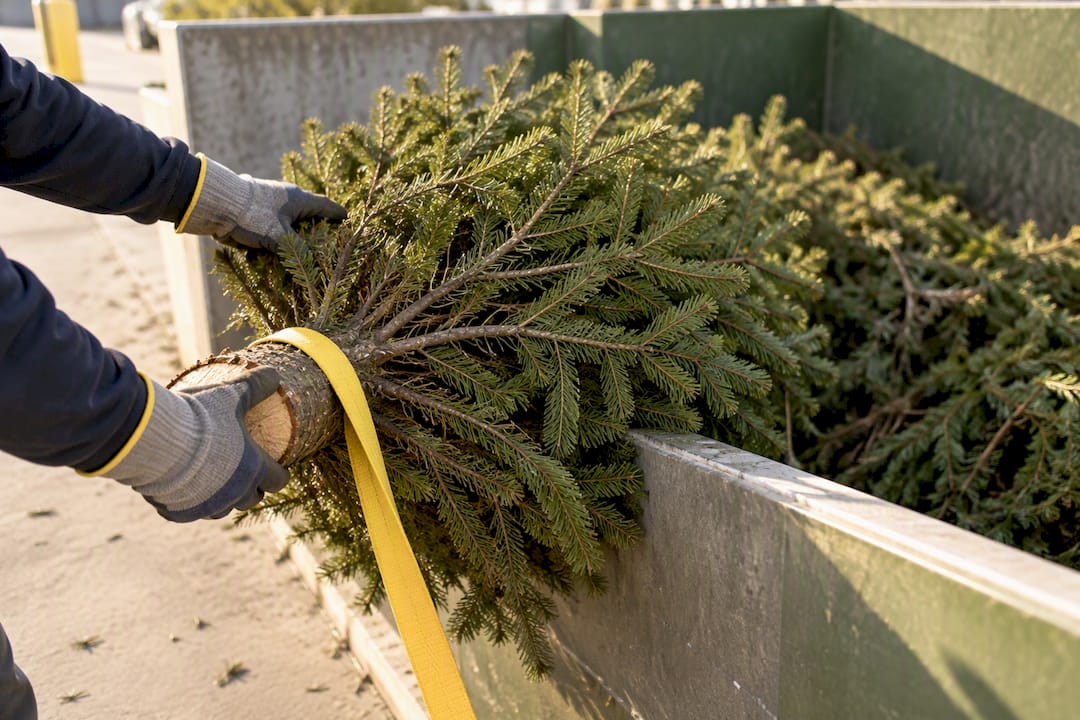
Private removal costs money but solves problems the other two can’t. Indoor trees that never touched a nature strip, apartment blocks with no bulk pickup booked, multiple trees from a business or event, or a tree wedged behind a locked gate where a council truck can’t reach it: that’s private removal territory.
A few things worth knowing before you pick:
- Council collections and drop-off are typically free, so try those first if your timing allows.
- Booking windows open and close quickly in the seasonal period. Check your council’s page for current dates.
- Proof of residency (a rates notice, licence or utility bill) is standard for free drop-off at most recovery centres.
- If your tree is inside, in an apartment, or part of a bulk clear-out, private removal is often the only practical option.
If you’re unsure which applies to you, start with your council’s website. If nothing lines up with your situation, a green waste disposal service can usually take it from there.
How do you prep a tree for collection or drop-off?
Trees get rejected or left on the nature strip more often than you’d think, almost always because of how they were presented, not because collection crews are fussy. Follow this order and you’ll avoid the comeback trip.
- Strip everything off first. Decorations, lights, tinsel, the stand, any netting or plastic wrap. Crews mulch these trees, and plastic or metal contaminates the whole batch.
- Check the size limit for your council. Some services want trees cut down if they’re too tall. Knox City Council, for example, asks residents to cut trees taller than 1.5 metres into sections no longer than 1.5 metres each, and other councils run similar rules.
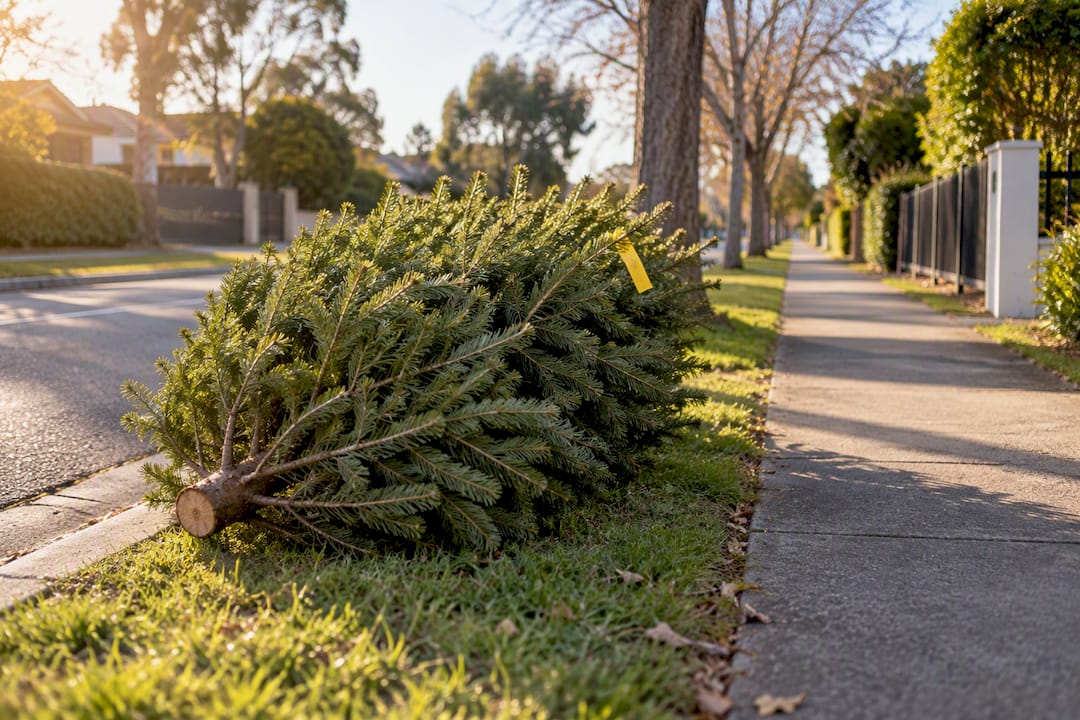
- Put it on the nature strip, not behind the gate. This is the single biggest reason collections get missed. Trees left in driveways, behind fences or tucked down a laneway simply don’t get seen by the truck. Boroondara’s own guidance makes nature-strip placement a condition of the free collection.
- Skip the bag. No plastic sacks, no soil still attached to the stump, no loose ornaments hiding in the branches.
Artificial tree? Different pathway entirely. If it still works, donate it rather than binning it. If it’s broken or falling apart, it goes through hard-waste, not garden organics.
Pro Tip: Snap a photo of the tree on the nature strip after you’ve stripped it. If a collection gets missed and you need to query it with council, you’ve got proof it was presented correctly.
What do the councils in your area actually offer?
Each Melbourne council runs its own version of this, and the rules genuinely differ enough that it’s worth checking before you assume your neighbour’s approach applies to you.
City of Melbourne runs a free monthly garden-waste collection that you book ahead of time, plus a drop-off option at the Dynon Road recovery centre. Dynon Road takes green waste free of charge if you show a current rates notice, driver’s licence or utility bill as proof of residency.
Port Phillip adds seasonal extra hard and green-waste collections specifically for live Christmas trees, running through to the end of January. Port Phillip’s guidance splits by dwelling type: houses can use their FOGO bin or a drop-off centre, while apartment residents need their owners corporation to arrange a booked collection.
Boroondara bundles Christmas tree pickups into its January green-waste program. The standout detail: residents can drop off a small number of live trees free during the seasonal collection period with proof of residency, on top of the booked collection service.
A few practical notes that apply across all three:
- Booking dates shift year to year, so check the live page rather than relying on last January’s dates.
- Free drop-off almost always requires proof of residency. Bring it or get turned away.
- FOGO bins accept trees in some areas only if cut down to fit, and any decoration left on will contaminate the load.
Where do apartments, strata and commercial sites fit in?
Communal FOGO bins are not built for whole Christmas trees, and assuming otherwise is how trees end up dumped in a corridor or car park.
- Apartment residents: don’t put a tree near the communal organics bin and hope. Talk to your building manager or owners corporation about booking a bulk pickup, the same way you’d handle any oversized item.
- Strata managers: book a hard-waste or green-waste collection ahead of the rush, then tell residents exactly where and when to leave trees so nothing sits in a lobby for a week.
- Commercial sites: if you’re clearing several trees, or trees mixed in with other waste from an office or retail fit-out, a booked council service usually won’t cut it. Private removal that can handle site access and provide disposal documentation is the more realistic path, and it’s the same logic used for broader apartment building rubbish removal jobs across the CBD.
When should you book a private removal instead?
Private removal earns its cost when council collection simply isn’t built for your situation. Think indoor trees that never reached a nature strip, a missed booking window, tight or gated access, or multiple trees from a business, event space or apartment complex.
Before you book anyone, run through this checklist:
- Ask whether the tree goes to green-waste recycling or straight to landfill. Not every provider handles it the same way.
- Confirm they carry insurance for on-site work, particularly if there’s any risk to fencing, paving or garden beds.
- Ask about scheduling flexibility. Same-day matters if you’re clearing an office before a new tenant moves in.
- Request proof of disposal if you need it for a strata report or a sustainability record. Legitimate operators can provide this without fuss.
Pro Tip: Get the price structure in writing before the truck arrives. Some operators quote per item, others per load volume, and the difference matters if you’re clearing a single tree versus a whole office lobby setup.
Private rubbish removal services: the option when council collection won’t cut it
There are genuine free routes through council and recovery centres, and for a single tree sitting on a nature strip in January, take them. But once you’re dealing with an indoor tree, a missed booking window, an apartment building with no pickup arranged, or a commercial site with multiple trees and mixed waste, Private rubbish removal services handle what council trucks can’t reach.
The service covers scheduled and same-day tree and green-waste removal across Melbourne, with a carbon-neutral disposal option if that matters to your household or business, and a promise to beat any written quote by 5% if you’ve already got one on hand.
- Get a fast price on the quick quote page, or browse the full services list if your clear-out involves more than just the tree.
Sources
- Book a Christmas tree collection | City of Boroondara
- A–Z guide to recycling and waste disposal | City of Melbourne
FAQ
How do I get rid of my old Christmas tree?
Book your council’s free seasonal collection if you’re inside the January window, or drop it at a resource recovery centre with proof of residency. If neither works for your timing or access, a private service like Melbourne City Rubbish Removal can collect it on a scheduled or same-day basis.
When should I take down the Christmas tree in 2026?
There’s no fixed rule, but most Melbourne households take theirs down in early January to line up with council collection windows before they close. Checking your council’s booking page as soon as the new year starts gives you the best shot at a free pickup.
How much does a Christmas tree typically cost in Melbourne?
Retail prices vary widely by size, species and where you buy, and current pricing isn’t something councils or recovery centres publish. If you need a quote for tree removal rather than purchase, Melbourne City Rubbish Removal’s pricing is available directly through its quick quote page.
What do I do with an old artificial Christmas tree?
If it’s still in working order, donate it rather than throwing it out, since artificial trees don’t belong in green waste or FOGO bins at all. Broken ones need to go through hard-waste channels or a general rubbish removal service, not the seasonal tree collections councils run for live trees.