Australia has no single e-waste law. It has a national product stewardship scheme for TVs and computers, state and territory landfill rules that differ from place to place, and a national position that e-waste does not belong in any kerbside bin. For a business, property manager or tenant clearing out an office in Melbourne, the practical answer is simple: keep electronics out of general rubbish and send them to a collector who moves them on to proper recycling. Our e-waste collection service in Melbourne is built for exactly that job.
TL;DR
- The National Television and Computer Recycling Scheme (NTCRS) funds free collection and recycling of TVs, computers, printers and peripherals for households and small businesses.
- Victoria lists e-waste among its Category A landfill bans, so it cannot go to landfill in Melbourne. Other states have their own rules, and Western Australia’s ban took effect on 1 July 2024.
- E-waste and batteries must not go in any kerbside recycling, organics or general waste bin.
- Large clear-outs, such as offices, fit-outs and make-goods, are where mistakes happen. Plan the electronics separately from the general rubbish.
Table of Contents
- How Australia regulates e-waste
- The national TV and computer scheme
- Landfill rules by state and territory
- Can e-waste go in the bin?
- What this means for an office, fit-out or make-good
- A practical routine for property managers and business owners
- Why a patchwork of rules is a reason to book properly
- Exports and the wider system
- FAQ
- Sources
How Australia regulates e-waste
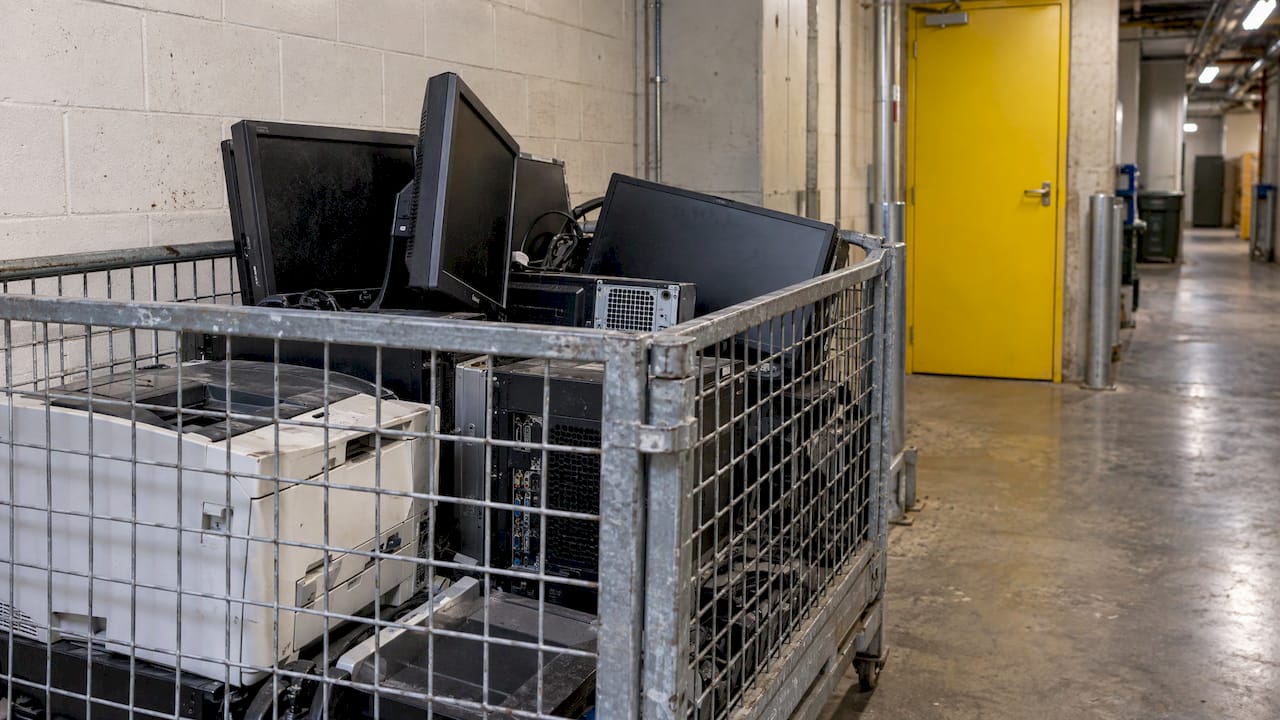
E-waste means anything with a plug, battery or circuit board that has reached the end of its life: computers, monitors, TVs, printers, phones, servers, cables and chargers. Regulation comes in three layers.
- Federal product stewardship. Stewardship means the industry that sells a product pays for its collection and recycling. The federal government sets this up.
- State and territory rules. These cover landfill bans, recycler licensing and enforcement.
- Local council services. These determine what drop-off points and collections are on offer near you.
The Department of Climate Change, Energy, the Environment and Water (DCCEEW) notes that improving e-waste stewardship is complex because most electronic products are made overseas, new products are released often, and states and territories have different disposal rules. That is why a business operating across borders cannot assume one rule fits every site.
The national TV and computer scheme
The NTCRS began in 2011 and now operates under the Recycling and Waste Reduction Act 2020 and its 2021 Rules. It gives households and small businesses free access to industry-funded collection and recycling of televisions and computers, including printers, computer parts and peripherals such as keyboards and mice.
The scheme is designed to give around 98 per cent of Australians reasonable access to free collection. That may be a permanent site at a waste transfer station or retail outlet, or a one-off event run by a council.
Who pays and who is liable
The cost sits with importers and manufacturers, not with you. Under the roles and responsibilities page, liable parties are constitutional corporations that imported or manufactured more than 5,000 televisions, 5,000 printers or computers, or 15,000 computer parts or peripherals in a financial year. They must:
- make sure their import information is correct;
- follow the Customs Act 1901;
- join a co-regulatory arrangement that organises collection and recycling for them.
State and territory agencies license recyclers to make sure they meet environmental and work health and safety requirements.
What the recycling must achieve
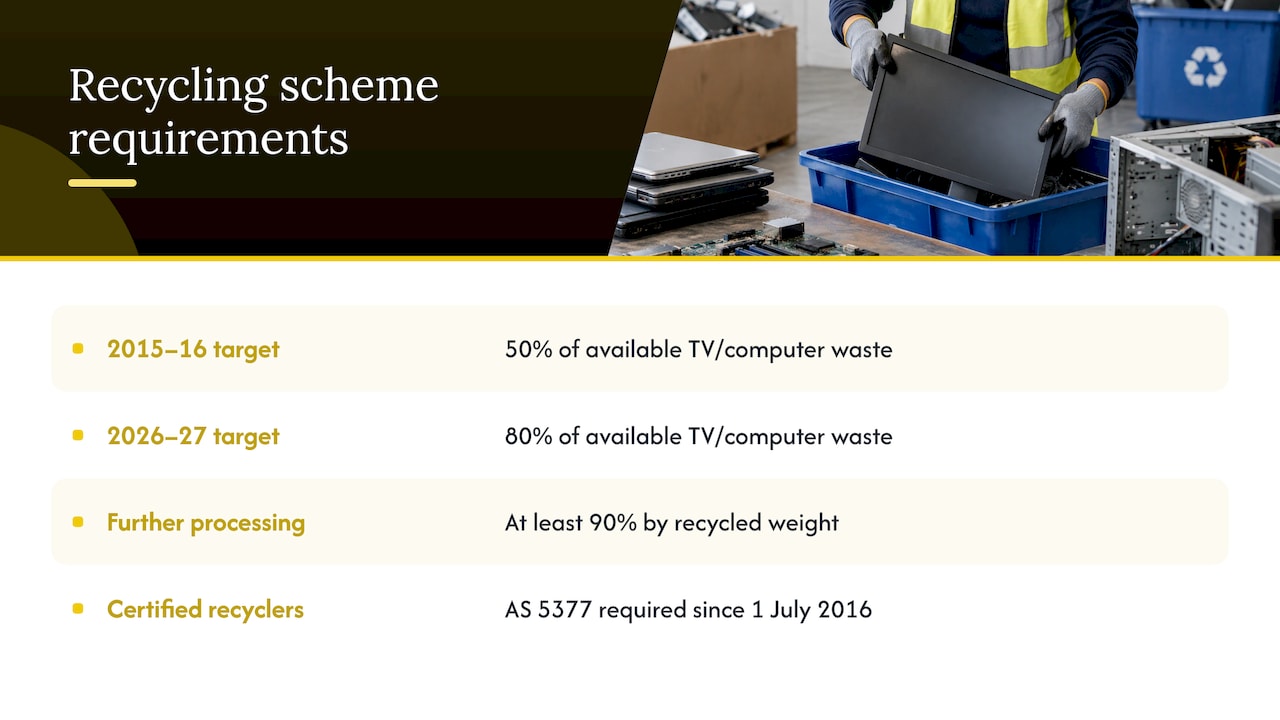
According to the DCCEEW fact sheet on co-regulatory arrangements, these arrangements must deliver reasonable access to collection, meet annual recycling targets, and send at least 90 per cent of recycled material by weight on for further processing into usable materials. The target rises from 50 per cent of available TV and computer waste in 2015-16 to 80 per cent in 2026-27. Since 1 July 2016, all scheme recycling must be done by recyclers certified to AS 5377, the Australian Standard for end-of-life electrical and electronic equipment.
Why this matters to you: a recycler that holds this certification is one whose processing meets the standard the scheme itself requires. It is a sensible thing to look for in any collector you hire.
Phones and other products
The scheme covers TVs and computers only. DCCEEW’s product stewardship page notes that MobileMuster, run through the Australian Mobile Telecommunications Association, collects and recycles mobile phones and their accessories. Batteries are a separate stream again. Our battery disposal service handles them, so they never end up mixed into a skip.
Landfill rules by state and territory
The NTCRS is national, but landfill bans are not. DCCEEW’s state summary records that:
| Jurisdiction | E-waste landfill position |
|---|---|
| Victoria | E-waste is a Category A landfill ban |
| Western Australia | Ban introduced July 2024 |
| South Australia | Most e-waste banned |
| ACT | Computers banned from 2005, televisions from 2010 |
| NSW and Queensland | No landfill ban listed |
A peer-reviewed review makes the same point: significant variation exists between federal and state regulation, and state and local governments manage e-waste outside the NTCRS targets with no obligation to support the co-regulatory arrangements.
Victoria
In Victoria, e-waste being a Category A ban means it cannot go to landfill at all. For a Melbourne business, that makes the question of where your electronics go a compliance matter, not a preference. For the wider picture of local obligations, see our guide to Melbourne waste regulations and your business obligations.
Western Australia
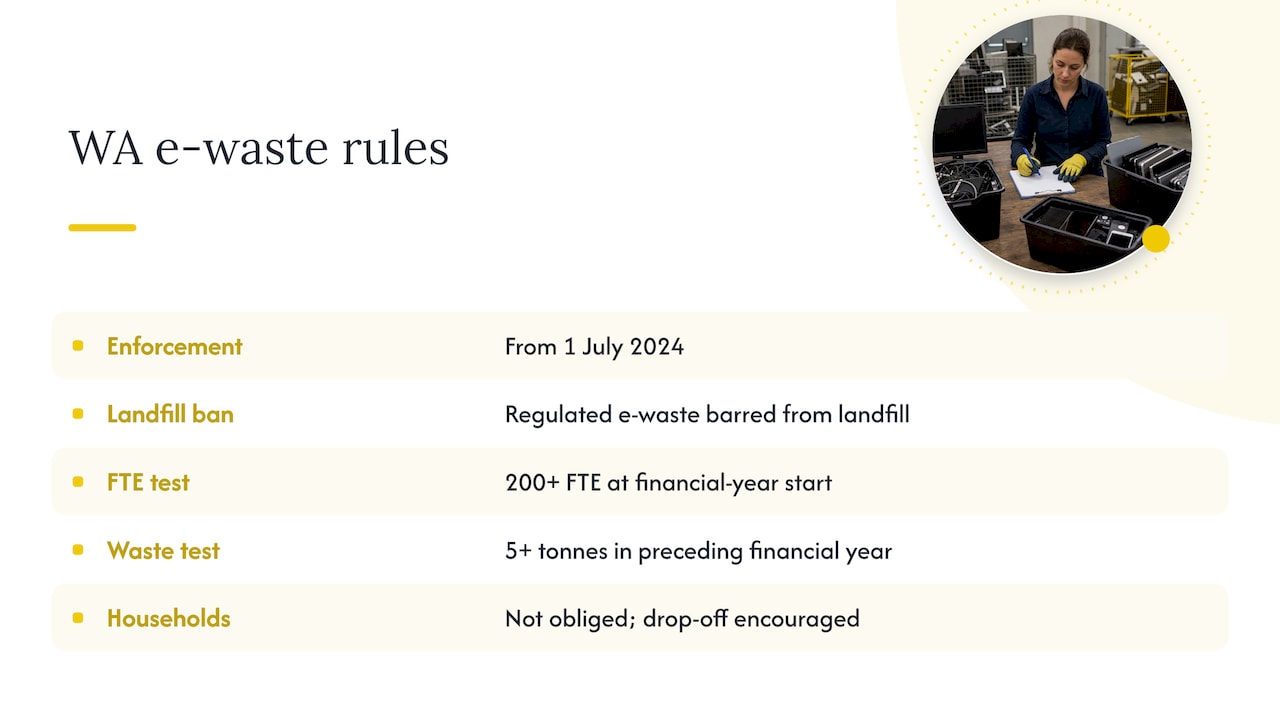
If your business also operates in Perth or elsewhere in WA, the rules are specific. On 1 July 2024 the state began enforcing the Waste Avoidance and Resource Recovery (e-waste) Regulations 2024, as set out on the WA Government e-waste ban page. The ban prohibits disposal of regulated e-waste to landfill by e-waste service providers, significant business or public entities, and landfill operators.
A significant entity is a business or public entity with 200 or more full-time equivalent employees at the start of a financial year, or one that created five or more tonnes of regulated e-waste in the preceding financial year. Households are not obliged, but are encouraged to use drop-off points and keep e-waste out of kerbside bins. The government expects businesses and public entities to demonstrate reasonable efforts to comply.
The WA Waste Authority’s 2024-25 plan also put a statewide campaign on lithium-ion and embedded batteries at the centre of the rollout.
Can e-waste go in the bin?
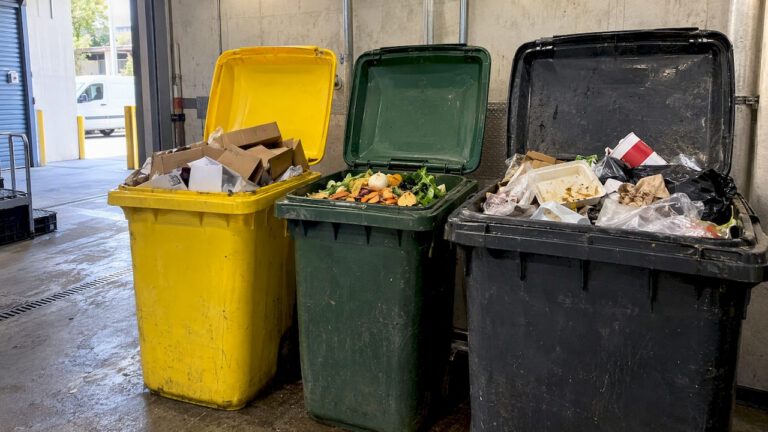
No. The National Kerbside Collections Roadmap says e-waste, including anything with a cord, battery or charger, and batteries of any kind, must not be collected in any kerbside recycling, organics or general waste bin. The reason is safety: batteries are known to cause fires in collection trucks and at recycling facilities.
That applies to commercial bins too in practice. A skip or bulk bin that contains a monitor with a battery-backed device or a stray power bank carries the same fire risk and, in Victoria, the same landfill problem.
What this means for an office, fit-out or make-good
The national scheme is free to collect from households and small businesses, and disposal outside NTCRS services may incur a fee, according to DCCEEW. Larger volumes, mixed loads and site clearances usually sit outside what a drop-off point is set up for. Three situations come up most often.
- Office clean-outs and relocations. Old PCs, monitors, printers, phones, docking stations and cables all turn up at once. Bagging them separately from furniture and paper makes sorting simple. Our office cleanout service covers this kind of job.
- End-of-lease make-goods. Landlords expect a tenancy returned empty. Abandoned equipment, cabling and old AV gear is e-waste, and it has to be dealt with before handover. We offer make-good and de-fit clearances across Melbourne.
- Building strip-outs and construction. Wiring, lighting and electronics get pulled out with everything else. Separating them early keeps the rest of the debris recyclable. See our construction waste removal.
Before anything leaves the building
Computers, printers with storage and phones hold business data. Wipe or remove drives before collection. Our guide to data wiping before e-waste sets out the steps, and the office printer disposal guide covers devices that keep scanned documents in memory. For monitors, see monitor disposal options.
A practical routine for property managers and business owners
- Count and group. List the electronics by type: computers, screens, printers, phones, batteries, cables.
- Separate batteries. Keep loose batteries, power banks and anything lithium-ion in their own container, away from paper and furniture.
- Wipe data. Do this before the equipment is moved.
- Book a single collection. One pickup for the electronics alongside the general clear-out avoids loose ends on the day.
- Keep the paperwork. Retain the booking confirmation and quote for your records, particularly if you manage a building for several tenants.
We handle collection and disposal through our e-waste collection service, with carbon-neutral disposal available as an option, and we promise to beat any written quote by 5%. Our punctuality is backed by real-time notifications and a lateness credit, and we leave sites with no mess and no damage to property. For a quote, use our quick quote page.
Why a patchwork of rules is a reason to book properly
DCCEEW’s own operational review warns that where states bring in landfill bans, alternative disposal methods must be available to the community, or there is a serious risk of illegal dumping. For a business, the lesson is practical: the ban places the burden of finding a lawful pathway on whoever has the equipment. Handing it to a collector that routes it to recycling gives you that pathway in one booking.
If your clear-out also includes other materials, our recycling centre versus landfill guide and business recycling plan help you decide what goes where.
Exports and the wider system
Australia also controls e-waste crossing its borders. As reported to the OECD in January 2026, certain e-waste categories are amber-controlled for export where the importing country controls them. This sits behind the recycler, not the business customer, but it is one more reason to use a collector whose downstream processing is accountable.
FAQ
Is it illegal to put e-waste in general rubbish in Australia?
There is no single national ban, but the national kerbside roadmap says e-waste must not go in any kerbside bin. Victoria lists e-waste among its Category A landfill bans, and Western Australia, South Australia and the ACT have their own bans. In Melbourne, treat electronics as something that must be recycled.
Does the national scheme cover phones and batteries?
No. The NTCRS covers TVs, computers, printers and computer parts and peripherals. Mobile phones are handled through MobileMuster, and batteries are a separate stream that should never go into general waste.
Do businesses pay to recycle TVs and computers?
Households and small businesses can use NTCRS collection points for free. Disposal outside those services may incur a fee, and larger clear-outs are usually quoted per job.
What changed in Western Australia in 2024?
From 1 July 2024, regulated e-waste could not be disposed of to landfill by e-waste service providers, significant business or public entities, and landfill operators. A significant entity has 200 or more full-time equivalent employees, or created five or more tonnes of regulated e-waste in the prior financial year.
Sources
- National Television and Computer Recycling Scheme, DCCEEW
- NTCRS roles and responsibilities, DCCEEW
- NTCRS co-regulatory arrangements fact sheet, DCCEEW
- Product stewardship schemes and priorities, DCCEEW
- E-Stewardship in Australia, DCCEEW
- States, territories and local government, DCCEEW
- E-waste to landfill ban in WA, WA Government
- Waste Authority business and action plan 2024-25
- National Kerbside Collections Roadmap, DCCEEW
- E-Waste Recycling and Resource Recovery: A Review, MDPI
- Controls for transboundary movements of e-waste, OECD