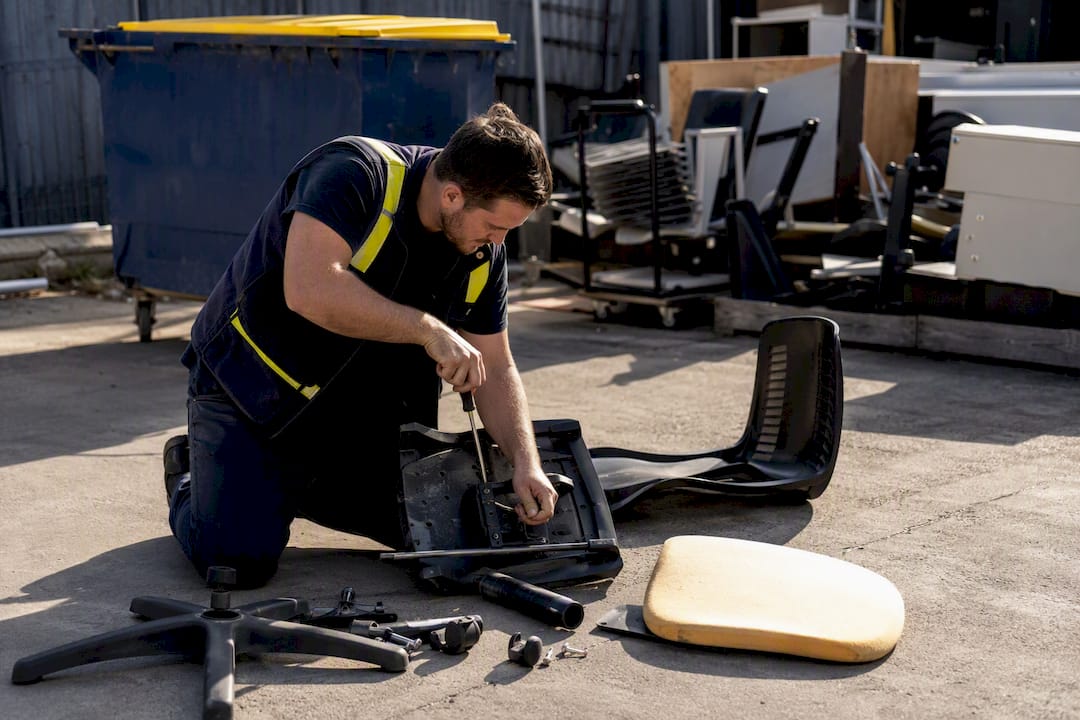
The fastest, most responsible fix for old office chairs is simple: donate anything reusable, and book a specialist de-fit or recycling partner for anything damaged beyond repair. Skip bins are the last resort, not the first call.
Two things to do today:
- Audit your chairs. Sort them into “reusable,” “repairable” and “recycle only” piles.
- Contact a charity like the Salvation Army for good stock, or a commercial furniture recovery programme for bulk or damaged items.
Success looks like chairs back in circulation with a community group, or a documented diversion certificate proving they never hit landfill.
Key Takeaways
Reuse-first triage, backed by a diversion certificate from a specialist programme or removal partner, is the most cost-effective way for businesses to keep office chairs out of landfill.
| Point | Details |
|---|---|
| Sort before you call anyone | Split chairs into reusable, repairable and recycle-only piles to speed up every downstream option. |
| Donate first, recycle second | Charities and programmes like GreenChair want structurally sound, clean chairs; damaged stock goes to specialist recovery. |
| Book early for bulk jobs | Corporate programmes such as GIVIT, Project Net Zero and Furniture Fund need lead time to schedule collection and reporting. |
| Request formal diversion reporting | Ask for kilograms diverted and CO2e saved so your ESG team has auditable evidence, not anecdotes. |
| Use one supplier for mixed clean-outs | Melbournecityrubbish audits, sorts and removes chairs alongside other office waste with carbon-neutral options and a 5% quote-beat guarantee. |
Table of Contents
- What are the best office chair recycling and disposal options?
- How do you prepare office chairs for collection?
- Who do you contact for office furniture recycling and donation?
- What do office chair recycling and de-fit services cost?
- What documentation should you request for ESG reporting?
- Do local councils offer office furniture recycling programs?
- How do you spot recyclable materials in an office chair?
- Can you upcycle or DIY-recycle old office chairs?
- How Melbourne City Rubbish handles audits, removal and reporting
- Sources
What are the best office chair recycling and disposal options?
Office chair recycling isn’t one process. It’s a decision tree, and getting the order right saves money and keeps more chairs out of landfill.
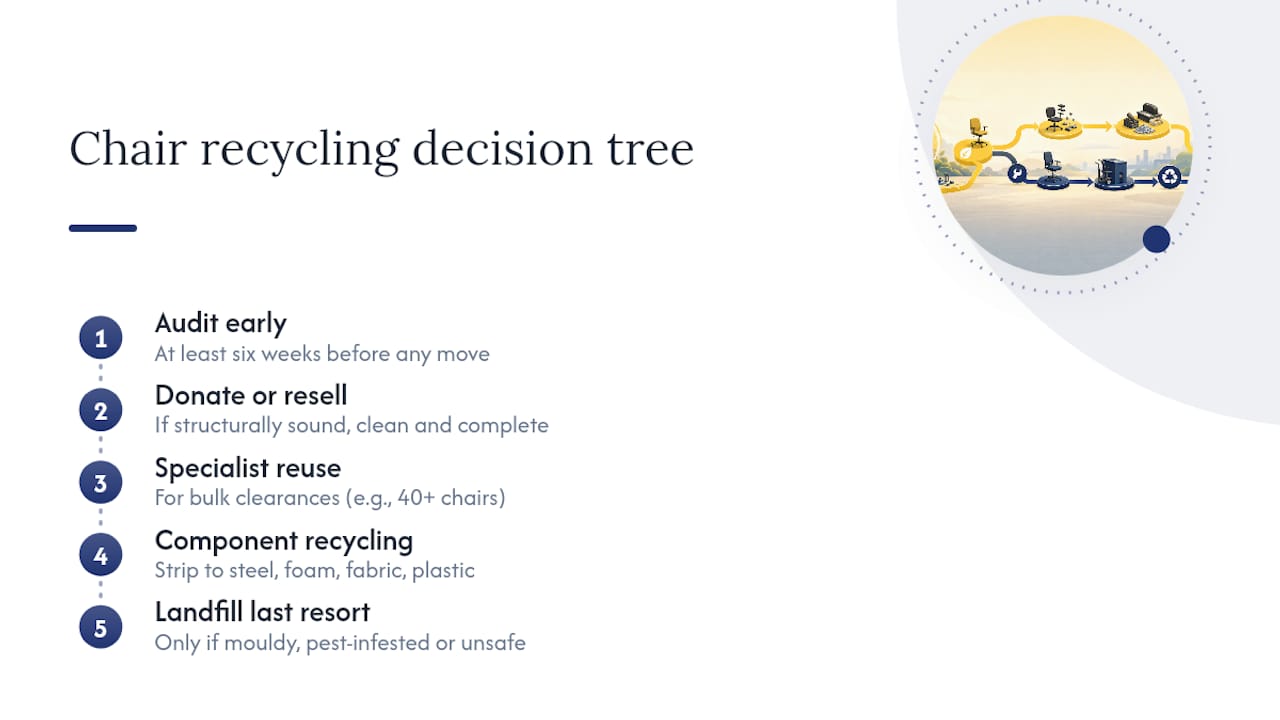
Donate or resell first. Charities and specialist reuse programmes want chairs that are structurally sound, clean and complete. Torn upholstery, broken castors or missing arms usually rule a chair out for direct donation, though some programmes will still take them for parts. GreenChair, for instance, audits corporate furniture and matches it to not-for-profits, issuing a certificate that details waste avoided and CO2e saved.
Specialist reuse programmes handle scale. If you’re clearing 40 chairs from a floor, not four, corporate de-fit programmes like GreenChair, Furniture Fund and Project Net Zero exist specifically for that job. They assess, collect and rehome items in bulk, which a single charity shop often can’t absorb in one visit.
Recycling breaks chairs into components. When a chair can’t be reused, specialist recyclers strip it into steel frames, aluminium bases, foam, fabric and plastic shells. Recovery rates vary by material. Metal is straightforward; mixed foam and fabric composites are harder and sometimes non-recyclable, which is why prevention (buying chairs designed for disassembly) matters long term.
Skip or landfill stays last resort. It’s occasionally unavoidable for chairs contaminated with mould, pests or structural failure that makes them unsafe to handle. For everything else, a circular de-fit strategy planned before lease end lifts reuse rates and cuts disposal costs compared with a last-minute clearance.
Pro Tip: Run your chair audit at least six weeks before any office move. Charities and reuse programmes need lead time to schedule pickups, and rushed jobs almost always end up in a skip.
How do you prepare office chairs for collection?
A little prep work is the difference between a chair being accepted and being turned away at the door.
- Inspect each chair for structural soundness, stains, odour and missing parts. Charities won’t take anything that looks unsafe or unhygienic.
- Clean upholstery and wipe down frames. A quick clean often turns a “recycle only” chair back into a donation candidate.
- Remove gas cylinders if a programme requests it, and detach bases for palletised bulk jobs.
- Label chairs for bulk collections so drivers can identify what’s going where, particularly when donation and recycling loads are mixed on the same truck.
- Follow manual handling basics — team lifts for heavy executive chairs, clear pathways, and secure loading for transport.
Who do you contact for office furniture recycling and donation?
Different programmes suit different volumes and conditions. Here’s who handles what.
- The Salvation Army (Salvos Stores) offers free large-item collection for items too big for a car, though pickup depends on store capacity and local logistics. Call 13 SALVOS (13 72 58) or book online. Salvos asks donors to phone ahead for bulk or commercial items rather than leaving them outside a store, since disposal costs and safety liabilities for dumped goods fall on the charity.
- GIVIT, in partnership with Project Net Zero, runs a corporate furniture resource recovery programme that rehomes office furniture to charities nationwide and provides sustainability reporting at the end of the job. This is the route for larger de-fits where you need auditable outcomes.
- GreenChair audits your items, matches them to charities, and issues a certificate showing waste avoided and CO2e saved. It typically charges a nominal admin fee for commercial pickups, which covers logistics rather than functioning as a straight junk-removal charge.
- Furniture Fund, run by the Property Industry Foundation, assesses and recovers office furniture for resale or recycling and reports landfill-avoidance outcomes, useful if your ESG team wants a formal percentage diverted.
- Council guidance (Recyclopaedia-style pages) recommends reuse first and lists local drop-off points for smaller volumes. For anything beyond a handful of chairs, most councils point you straight to a specialist reseller or commercial collection service.
For genuine bulk clearances where reuse isn’t viable, a skip bin sized for your job handles the non-recyclable remainder efficiently.
What do office chair recycling and de-fit services cost?
Charities aren’t running a free removal service when they charge a fee for commercial pickups. That fee funds the audit, storage and transport that keep donated goods free for the community groups on the receiving end. It’s a different cost model to paying a rubbish removalist for volume.
A typical corporate job runs: site audit → written quote → collection → diversion report, usually spanning one to three weeks depending on volume and access. Cost drivers include how many chairs you’re clearing, whether the building has lift access or loading dock restrictions, item condition, and whether chairs are staged and ready or scattered across floors.
- Stage removals in batches rather than one chaotic clean-out day.
- Ask about drop-off discounts if you can deliver chairs yourself.
- Audit early. Furniture assessed before lease end reduces disposal costs compared with a rushed exit.
What documentation should you request for ESG reporting?
If your sustainability team needs auditable proof, not anecdotes, ask providers for a formal report before you sign off on a job.
- A diversion or chain-of-custody report showing kilograms diverted, estimated CO2e saved and, where relevant, how many people or organisations benefited.
- An updated asset register, which supports lease make-good negotiations and internal audits when furniture assets are decommissioned.
- Confirmation from the provider on how they’ll deliver this reporting. GIVIT and Project Net Zero typically supply chain-of-custody outcomes as standard for corporate de-fits, and Furniture Fund reports landfill-avoidance percentages for larger jobs. Make this a line item in your quote request, not an afterthought.
Do local councils offer office furniture recycling programs?
Most councils treat office furniture as a “reuse first” category rather than a straight recycling stream, and the practical support on offer varies a lot by area. Some run dedicated drop-off points for usable furniture, others simply direct businesses toward charities or private collection services once volumes exceed a few items.
Council guidance consistently points the same direction: check local drop-off options for small quantities, but contact a specialist reseller or collection service for anything commercial in scale. That’s a sensible split. Council infrastructure is built around household quantities, not a 60-chair office fit-out.
The bigger structural point sits in national data: furniture is flagged as a significant waste stream in national waste reporting, with resource recovery approaches recommended over landfill disposal. That’s the policy backdrop pushing councils, charities and private programmes to build out better reuse pathways rather than treating chairs as bulk waste.
Before you call your council, check two things: whether they list office furniture specifically (some only cover household items), and whether there’s a volume cap on what their drop-off points can handle. If either answer is no, you’re better off going straight to a corporate reuse programme or a removalist who handles documented commercial disposal.
How do you spot recyclable materials in an office chair?
Most task chairs are a mix of five material families, and knowing which is which tells you what’s genuinely recyclable versus what needs specialist processing.
Steel and aluminium frames, bases and gas cylinder housings are the easiest win. Metal recyclers take these readily, and separating them from foam and fabric before collection speeds up processing.

Hard plastics (shells, armrests, castors) are often recyclable, but check for a resin identification code stamped somewhere on the underside. Mixed or unlabelled plastics are harder to place with standard recyclers.
Foam padding is the trickiest component. It’s rarely recyclable through standard channels because it’s usually bonded to fabric and frame, and polyurethane foam degrades in ways that make mechanical recycling difficult.
Fabric and mesh upholstery can sometimes be separated and recycled as textile waste, but only if it’s removable rather than glued or stapled into the frame.
Gas lift cylinders need separate handling. They’re pressurised, and most kerbside or general recycling streams won’t accept them intact.
If you’re assessing a batch of chairs for a specialist recycler, a rough visual check (metal frame condition, plastic shell integrity, whether upholstery is removable) helps you sort “recycle ready” from “needs disassembly” before the truck arrives, which speeds up processing and often lowers the quoted price.
Can you upcycle or DIY-recycle old office chairs?
For smaller quantities, or chairs that don’t meet a charity’s donation standards but aren’t total write offs, DIY options are worth considering before defaulting to disposal.
Reupholstering is the most accessible option. A chair with a sound frame but tired or stained fabric can often be restored with new upholstery fabric and basic tools, extending its working life by years. Swapping castors, gas cylinders or armrests is another low-cost fix. These parts are commonly sold separately and can turn a “recycle only” chair back into a usable one.
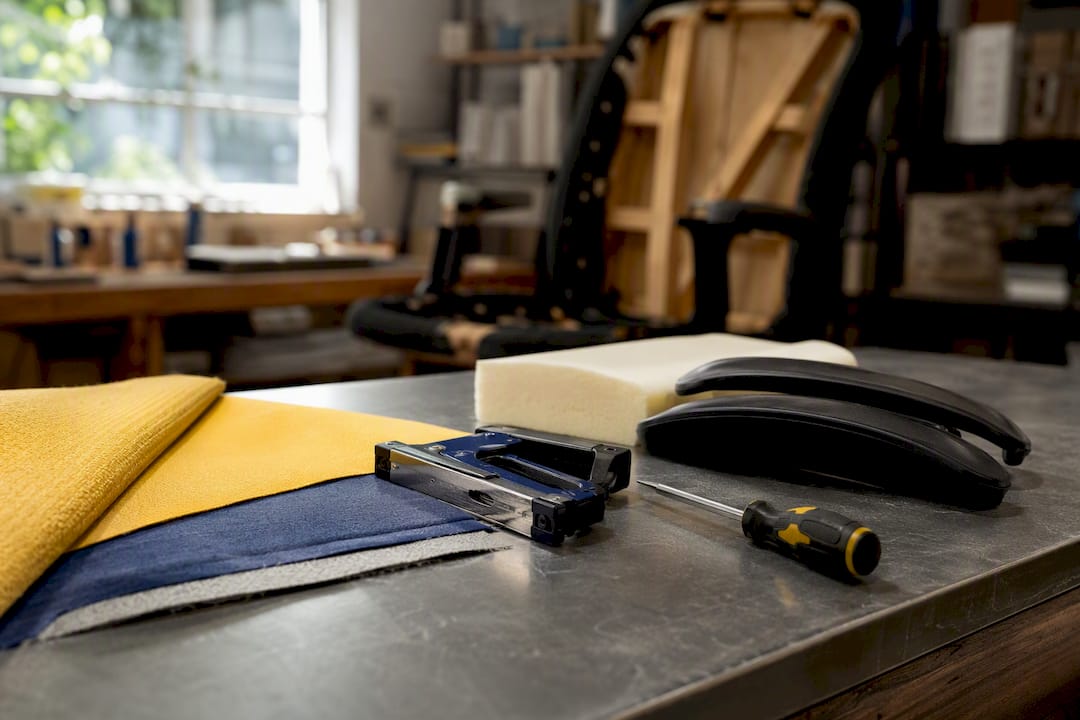
Component salvage suits businesses with a maintenance team or a handy staff member. Steel frames get a second life as shelving brackets or workbench legs, and foam padding can be repurposed for packing material or simple cushioning projects.
None of this scales to a 50 chair office clearance, and that’s fine. DIY and upcycling work best for the odd chair or two that falls outside a charity’s quality bar. For anything beyond that, the labour cost of DIY disassembly usually outweighs what you’d save versus a professional recovery service.
How Melbourne City Rubbish handles audits, removal and reporting
Charities and reuse programmes are the right first call for chairs in good condition, but once you’re dealing with a mixed office clean-out (some donatable, some damaged, some just old carpet tiles and desk junk alongside the chairs), coordinating three separate providers eats up your week. Melbournecityrubbish exists for exactly that gap: one supplier who audits the site, sorts what can be diverted, and removes the rest, instead of you chasing charities, recyclers and a skip company separately.
The service covers a site audit, sorting on-site, and carbon-neutral removal options for businesses that want documented, responsible disposal without managing multiple bookings. Melbournecityrubbish also guarantees to beat any written quote by 5%, and its team works around business hours to keep disruption minimal. If you’re planning a floor clean-out or full office de-fit, start with a request for a quote or site visit, or read the guide on choosing a rubbish removal service if you’re comparing options first.