Make good in Melbourne means returning your leased office to the condition your lease requires, usually by removing the fit-out, repairing damage beyond fair wear and tear, and repainting or cleaning the space. The exact scope depends entirely on your lease wording, so your first move isn’t calling a contractor. It’s finding your lease document and the entry condition report that came with it.
Do these three things this week:
- Read the make-good clause in your lease and note whether it says “reinstatement,” “repair,” or allows a cash settlement.
- Locate your entry condition report and any photos taken when you moved in.
- Ask your landlord or agent for a pre-exit inspection to agree on scope in writing before any work starts.
Tenants should ideally start this process 3 to 6 months before lease expiry, according to Victorian Small Business Commission guidance. If your lease wording is vague or your landlord is disputing scope, get legal advice now. If the obligation is clear, skip straight to contractor quotes.
Key Takeaways
Office make good in Melbourne depends on your specific lease wording, and getting a condition report, timeline, and written quotes sorted early is what separates a smooth handover from a costly dispute.
| Point | Details |
|---|---|
| Check the lease clause first | “Reinstatement,” “repair,” and “cash-in-lieu” carry different obligations, so read the exact wording before planning any work. |
| Secure your condition report | A dated, photographic entry condition report is your main evidence if fair wear and tear is disputed. |
| Start 3 to 6 months out | The Victorian Small Business Commission recommends beginning inspections and trade bookings this far ahead of lease end. |
| Budget for hidden costs | ESM checks, service certification, and after-hours access fees often sit outside the first quote you receive. |
| Book waste removal early | Melbourne City Rubbish offers full-service office strip-out, carbon-neutral disposal, and a 5% quote-beat guarantee for Melbourne tenants. |
Table of Contents
- What ‘make good’ means in Melbourne leases and the legal baseline to check
- What does office make good cost in Melbourne?
- When should you start planning your office make good?
- How do you get fair quotes and choose the right contractor?
- How can you manage make-good waste sustainably in Melbourne?
- How Melbourne City Rubbish can help your office make good
- Sources
What ‘make good’ means in Melbourne leases and the legal baseline to check
Your lease decides everything. Two tenants in identical buildings can have completely different obligations depending on three words buried in a schedule.
“Reinstatement” typically means returning the premises to base building condition, stripping out everything you installed. “Repair” is narrower and usually just means fixing damage. Some leases allow “cash-in-lieu,” where you pay the landlord an agreed sum instead of physically doing the work, which can be the most pragmatic outcome when the next tenant wants a different fit-out anyway.
Retail tenancies in Victoria get statutory protection under the Retail Leases Act, but most office leases sit outside that regime and rely on contract law and whatever your lease actually says. That’s why the document in your hand matters more than what you assume is “standard.”
- Check whether the clause says “reinstatement,” “repair,” or “condition as at commencement.”
- Confirm whether a cash settlement option exists.
- Find out if the Retail Leases Act applies to your premises.
- Locate your entry condition report and time-stamped photos.
Fair wear and tear is where most arguments start. Worn carpet from five years of foot traffic is wear and tear. A cracked partition wall from a forklift incident is not. RICS Australia’s make-good guidance recommends a properly prepared schedule of condition specifically because these disputes hinge on evidence, not opinion.
Pro Tip: Take your own photos on the day you sign the lease and again the day you hand back the keys, even if the landlord has their own report. A second, independent record is the cheapest insurance you’ll ever buy against a make-good dispute.
What does office make good cost in Melbourne?
Costs swing enormously depending on how much of the fit-out has to go and what’s underneath it. Published Australian industry figures put make-good work anywhere from around $80 up to $450 or more per square metre, depending on the scope and any remediation required.
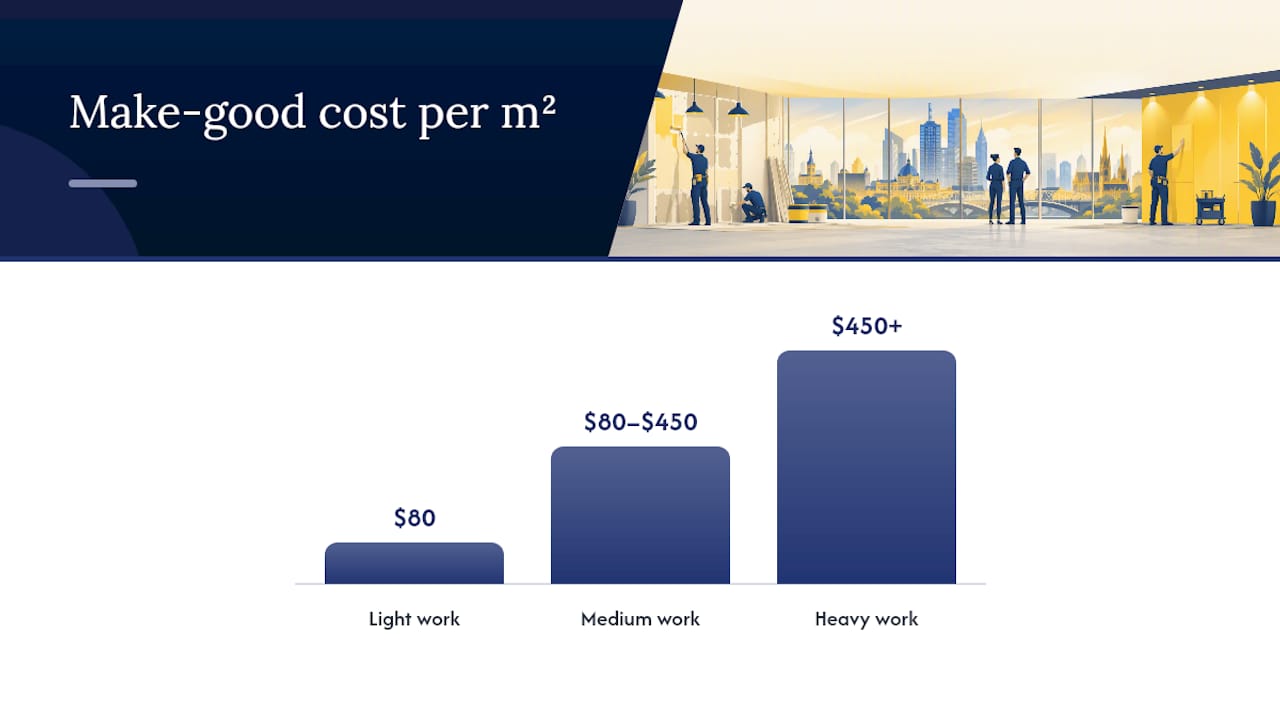
A basic clean-and-patch job at the low end covers touch-up painting, carpet cleaning, and minor patching. A full reinstatement at the top end covers demolition of partitions, removal of services, structural patching, and reinstating base-building finishes.
The work usually includes:
- Strip-out of partitions, joinery, cabling, and signage.
- Patching and plastering walls and ceilings.
- Repainting to base-building specification.
- Flooring removal or replacement.
- Testing and certification of services such as fire and electrical systems.
Watch for costs that don’t show up in the first quote. Essential Safety Measures (ESM) checks, smoke and fire service compliance records, after-hours building access fees, and any hazardous materials like old asbestos-containing panels can all add unbudgeted weeks and dollars. Disputes over these costs frequently end up harder to resolve than the physical works themselves, largely because poor documentation makes it difficult to prove what was actually agreed. If a dispute escalates, VCAT is the likely venue, and that process costs more in time and legal fees than most make-good jobs themselves. A negotiated cash settlement is often cheaper for everyone once you factor that risk in.
When should you start planning your office make good?
Rushed make-goods cost more. Trades charge premiums for tight turnarounds, and rubbish removal booked at the last minute rarely gets the best rate.
- Six months out: Review the lease clause, gather your condition report, and flag any ambiguity to a lawyer.
- Four to five months out: Request a pre-exit inspection with your landlord or agent and get scope agreed in writing.
- Three months out: Get at least three written quotes and book your preferred contractor’s schedule slot.
- Six to eight weeks out: Arrange any permits, ESM checks, and confirm dates for service disconnections.
- Final two to three weeks: Coordinate trades, rubbish removal, and cleaning in sequence, finishing with a joint walkthrough before key handover.
The Victorian Small Business Commission recommends starting this whole process three to six months before your lease actually ends, which lines up with how long trades and waste removal bookings typically need to lock in.
Pro Tip: Book your rubbish removal provider before you book your trades, not after. Skip bins and site clearance windows fill up fast around common lease-end dates like the end of financial year.

How do you get fair quotes and choose the right contractor?
Write your scope of works down before you call anyone. A vague brief gets vague quotes, and vague quotes are where cost blowouts hide.
Get at least three written quotes covering the same scope, so you’re comparing apples with apples rather than one contractor’s assumptions against another’s. Ask each one:
- Are you licensed, and can you show current public liability insurance?
- How do you handle asbestos or other hazardous materials if found?
- What’s your recycling and disposal method for stripped-out materials?
- What’s your realistic timeline, including lead time for materials?
- How are variations to scope priced and approved?
If your lease wording is genuinely ambiguous, or the landlord is pushing for a scope well beyond what the condition report supports, bring in a quantity surveyor or make-good consultant to price the actual obligation independently. A structured make-good schedule listing each alleged issue against its remedial cost, the format RICS Australia recommends, turns a heated argument into a line-by-line negotiation.
Get everything in the contract: the agreed scope, how variations are raised and approved, what photographic evidence gets collected at each milestone, and payment terms tied to completion stages rather than a single lump sum. Reviewing what to ask a rubbish removal service before booking helps you apply the same scrutiny to waste contractors, who are often the most overlooked line item in a make-good budget.
Pro Tip: Ask every contractor for their asbestos handling process even if your building is newer. Buildings constructed or fitted out before the mid 2000s can still have legacy materials in ceiling tiles or old adhesives.
How can you manage make-good waste sustainably in Melbourne?
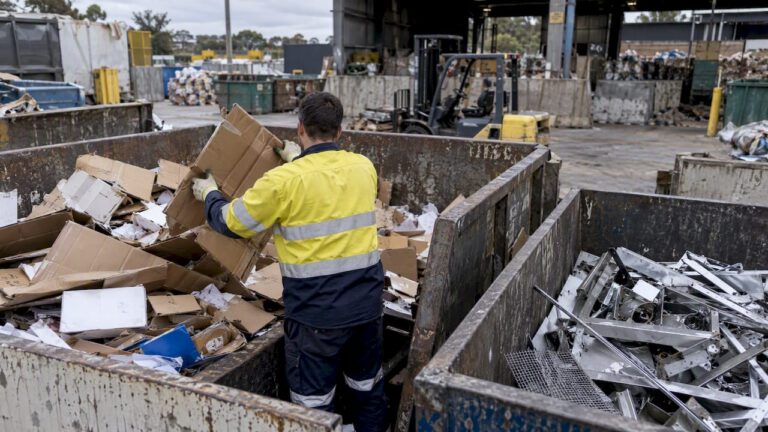
Segregating materials at the point of strip-out, rather than skip-bagging everything together, cuts both landfill volume and your disposal bill. Timber, metal partitions, carpet tiles, and clean plasterboard can often be diverted for reuse or recycling instead of going straight to landfill.
Greening make good practices, planned from day one rather than bolted on afterwards, can meaningfully cut what RICS Australia terms “triple waste”: the material cost, the disposal cost, and the embedded carbon of manufacturing replacement fit-out for the next tenant. E-waste and any hazardous material need a licensed handler under local rules, not a general skip.
- Separate timber, metal, plasterboard, and carpet for recycling where possible.
- Route old monitors, cabling, and electronics to licensed e-waste handlers.
- Ask your waste contractor for their actual recycling rate, not just a “we recycle” claim.
- Request evidence, such as weighbridge dockets or recycling receipts, so any green claim is verifiable.
Melbourne City Rubbish handles full office strip-outs across Melbourne with a carbon-neutral disposal option, which matters if your landlord or head office is tracking sustainability commitments as part of the handover. Combined with quick quoting, it removes one of the more unpredictable line items from a make-good budget.
How Melbourne City Rubbish can help your office make good
There’s no shortage of ways to handle a make-good clear-out yourself, hire multiple trades, or piece together your own skip bin logistics. Melbourne City Rubbish gives you one call instead of five: a single provider that handles office strip-out debris, construction waste, e-waste, and leftover green waste from fit-out demolition, all under one booking.
That last point matters when you’re already juggling three trade quotes and don’t want a fourth headache over price.
To get a fast, accurate quote, have your approximate floor area, a rough list of what’s being removed (partitions, carpet, joinery, e-waste), and your target completion date ready. Get a quote for your office strip-out today and lock in a removal date before the last-minute rush pushes prices up.
Sources
- Preparing for end of lease | Victorian Small Business Commission
- Make-Good Obligations Explained: What Tenants Must Know
- Make good: practice guidance for Australia (RICS, October 2023)