
Regular scheduled council collections work best for small, non-urgent loads that fit within your council’s volume caps and accepted-items list. One-off paid removals or skip bins are the better call when you’re facing a tight deadline, a heavy or mixed load, or items your council simply won’t touch.
TL;DR:
- Council collection is limited to small volumes, often one free pickup per year, with strict time windows and item restrictions, making it suitable for minor, non-urgent loads.
- Paid removal services offer flexible scheduling, handle larger, heavier, and more varied loads, and include heavy lifting, but at a higher cost.
- Volume limits for council pickups typically equate to about 2 cubic meters, and certain items like mattresses and chemicals are increasingly excluded from free collections.
- For urgent, large, or complex waste, same-day paid options or skip bins are more cost-effective once volume exceeds about 3 cubic meters or during ongoing renovations.
- Always verify exact collection windows, access rules, and item restrictions beforehand, and photograph items before collection to avoid disputes or fines.
Table of Contents
- What’s the difference between regular and one-off collection?
- Weighing up the pros and cons of each option
- What can you actually put out, and how?
- How much does each option cost, and how fast can you get it done?
- A quick checklist before you book anything
- When speed and flexibility matter more than saving a few dollars
- Sources
- FAQ
What’s the difference between regular and one-off collection?
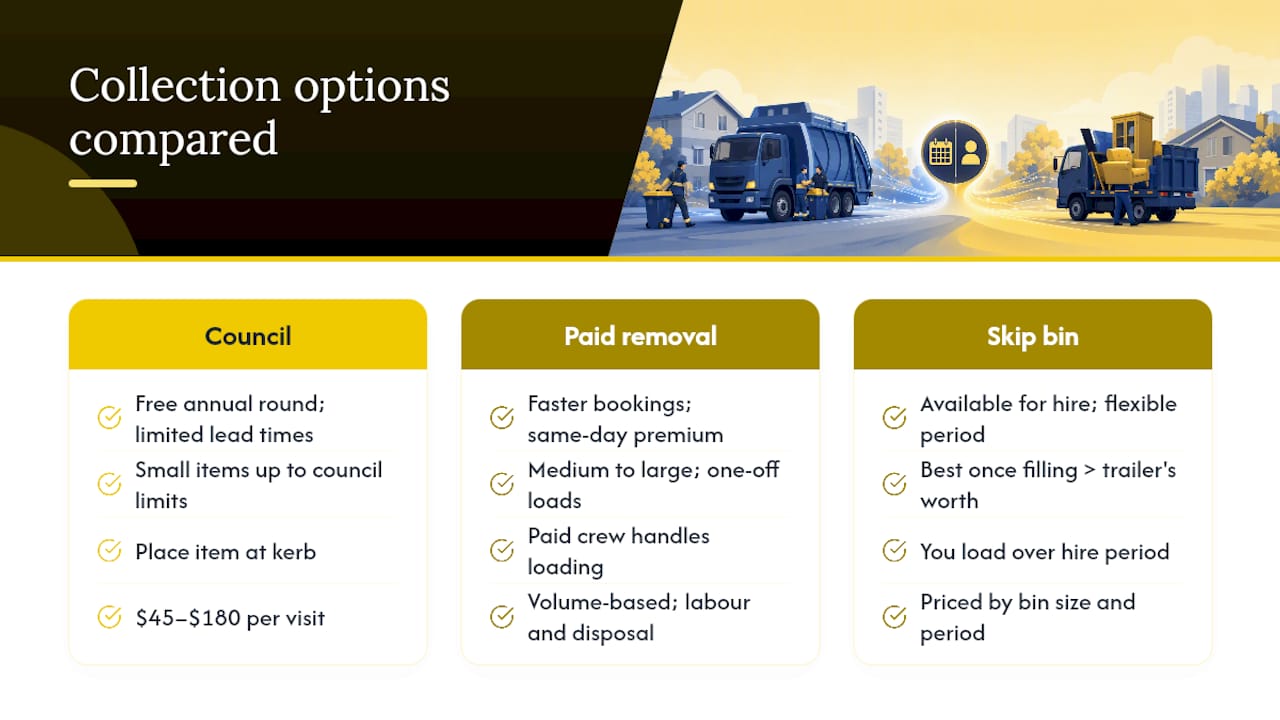
Regular scheduled collection is a council-run program, usually an annual bulky waste pickup, where you’re allocated a fixed window (often once every 12 months) to put out a capped volume of household items. Some councils also run limited on-demand booking systems, where you request a pickup date rather than waiting for the annual round, though availability and fees vary by area without a standard rate.
Paid rubbish removal and skip-bin hire sit outside the council system entirely. With a paid removal service, a crew turns up at a time you book, physically lifts and loads the waste (including from inside a property, garage or upstairs unit), and takes it away the same visit. Skip-bin hire instead drops a bin on your property for a set period, and you load it yourself. Both accept far more than councils typically allow, including construction debris, mixed materials and larger volumes, which is why council bulk waste collection tends to suit small, occasional clean-ups rather than full clearouts.
Weighing up the pros and cons of each option
Cost is usually the first thing that decides this for people, but it isn’t the only factor worth weighing.
Council scheduled or annual collection:
- Often free or low-cost, with many councils offering one collection per financial year
- Feeds established reuse and recycling streams, since councils frequently separate usable items before they hit landfill
- Requires lead time, sometimes weeks, and a fixed booking window you can’t move
- Comes with strict volume caps and a list of excluded items
- You do the lifting and carrying to the kerb yourself
Paid rubbish removal or skip bins:
- Available on short notice, including same-day in many cases
- A crew does the heavy lifting, including awkward or bulky items inside the property
- Accepts larger and more varied loads, including things councils won’t collect
- Costs more per job than a free council pickup
- Skip bins become the more economical option once you’re generating ongoing waste, such as during a renovation, rather than a single load
If you’re clearing out one wardrobe, council collection usually wins on price. If you’re gutting a kitchen, it won’t.
What can you actually put out, and how?
Councils generally accept furniture, whitegoods, and general household bulky items, but the exclusion list catches people out more often than the accepted list helps them. Common no-gos include e-waste, chemicals, tyres, and, in a growing number of council areas, mattresses. Some councils, including Newcastle City Council, have tightened mattress rules due to disposal costs, so check before you drag one to the nature strip.
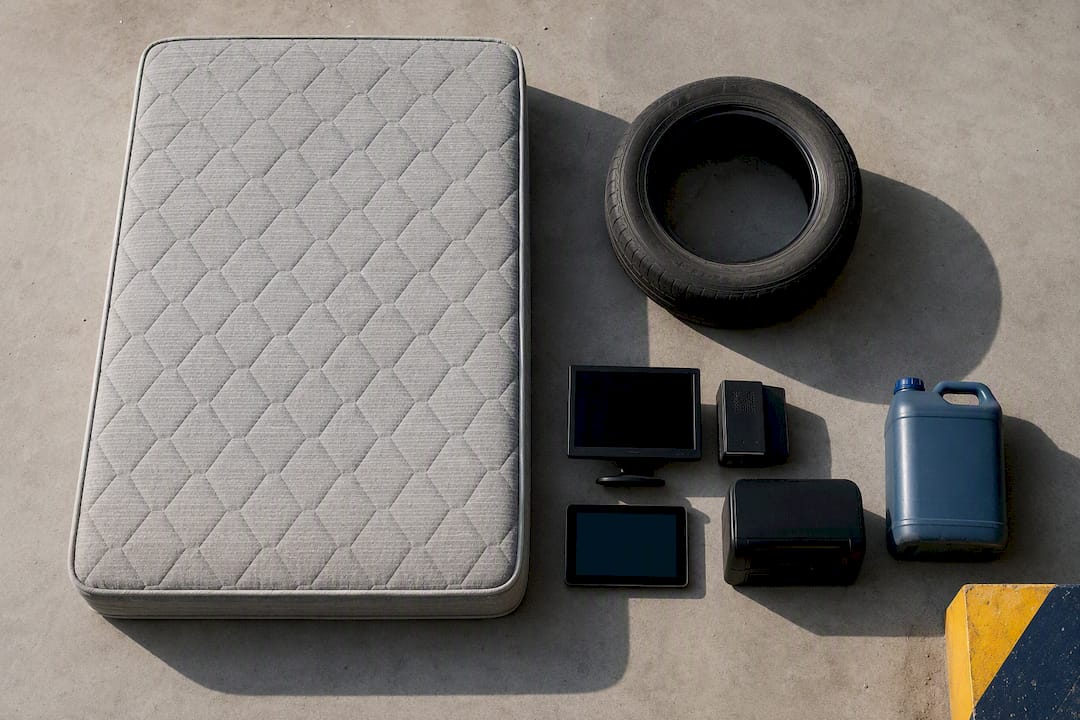
Volume caps are usually expressed in cubic metres, and it’s worth picturing what that looks like: 2 cubic metres is roughly a small trailer load, about the size of a queen mattress stacked with a couch. Go beyond that, and you’re often into paid-removal territory anyway.
A few practical rules make the difference between a smooth pickup and a wasted trip:
- Confirm your exact collection window with your council; some require items out the night before, others have a strict same-day rule.
- Group like items together (whitegoods separate from furniture) since councils often run separate reuse and landfill crews.
- Check with building management first if you’re in an apartment or strata property, since lift access and common-area rules can block a straightforward kerbside drop.
- Never place items out early. Councils treat premature or overdue dumping as illegal dumping, and fines apply.
Pro Tip: Photograph your pile before collection day. If council crews leave something behind for breaching the rules, you’ll have proof of what was actually presented when you follow up.
How much does each option cost, and how fast can you get it done?
Where councils charge for on-demand bulky pickups outside the free annual round, fees typically sit somewhere between $45 and $180 per visit, depending on local policy and how much you’re putting out. Many areas still offer that one free collection a year, with Canberra’s program capped at about 2 cubic metres as one example of how these limits work in practice.
Paid removal pricing runs differently: it’s volume-based, factors in labour and disposal, and can carry a premium for same-day bookings, especially when involving specialist contractors like those in concrete cutting in Melbourne for heavy or fixed debris. Skip bins price by bin size and hire period, which makes them cost-effective once you’re filling more than a trailer’s worth.
Three quick scenarios show how this plays out. A single armchair heading to the kerb next month suits the free council round. A vacate clean with a two-day deadline needs a paid crew, because council lead times won’t get there in time. A kitchen renovation generating debris over three weeks calls for a skip bin, since a one-off truck won’t keep pace with what you’re producing.
A quick checklist before you book anything
Work through these questions before you commit to a collection type:
- How urgent is this? If your deadline is under seven days, council scheduling probably won’t get there in time.
- How much volume are you dealing with? Over 3 cubic metres generally pushes you toward paid removal or a skip bin.
- What are the items? Chemicals, asbestos and other regulated waste need licensed contractors, not a council pickup or a general removalist.
- Who’s doing the lifting? If nobody can carry a fridge to the kerb, that decides it for you.
- Does your building have access rules? Strata properties often need lift bookings or site inductions arranged in advance.
- What’s the presentation window? Confirm the exact night-before or same-day rule your council enforces.
Bookmark your council’s bulky waste page now, before you need it. When you do request a paid quote, have rough measurements and photos ready. It’s the fastest way to get an accurate price without a site visit.
When speed and flexibility matter more than saving a few dollars
Council collections work well when you’ve got time on your side and a small, compliant load. When you don’t, that’s where a service like Melbournecityrubbish fits in. Crews handle the lifting, quote by volume rather than guesswork, and can often turn a job around same-day when a council booking window simply won’t cut it.
For heavier renovation debris or a hard rubbish load that’s outgrown the council’s limits, paid removal services also handle the categories councils routinely knock back, from e-waste through to construction material, with eco-friendly disposal options available if reducing landfill impact matters to you.
If you’re staring down a deadline or a pile too big for the kerb, get a quick quote and find out what a same-day removal actually costs before you commit to waiting for the next council round.
Sources
- Bulk waste kerbside collection — Central Coast Council
- Bulky waste collections — City Services (ACT)
- Bulk pickup vs junk removal service — Remoov blog
- Skip bin vs council: cost guide — HireSkipBins
- Bulky goods collection rules — Northern Beaches Council
FAQ
What are the new bin rules for 2026?
Bin and bulky-waste rules are set locally, so check your own council’s website for current volume caps, accepted items and collection windows rather than relying on a national standard.
What are the different bin types available for waste collection?
Most councils run separate streams for general waste, recycling, green waste and a periodic bulky item collection, though the exact split and colour-coding varies between local government areas.
Does council collection accept mattresses?
Increasingly, no. Several councils have restricted or removed mattresses from their bulky collection accepted-items lists due to rising disposal costs, so it’s worth confirming before collection day.
What counts as general waste?
General waste is household rubbish that can’t be recycled, composted, or diverted through a special stream, such as broken items, soiled materials and non-recyclable packaging.
Is a paid rubbish removal service worth it over council collection?
For small, compliant loads with no time pressure, council collection is usually cheaper. For urgent jobs, large volumes, or items councils exclude, a paid removal service is generally faster and handles a wider range of waste.