Proof of disposal is a disposal docket, receipt or certificate from a licensed facility confirming the date, quantity and location where your waste was legally received and processed. Get it at job completion, before final payment, not as a verbal assurance. Some waste types (controlled or trackable waste) legally require a formal transport certificate rather than a simple receipt.
TL;DR:
- Obtain a disposal docket or facility receipt showing date, waste type, weight, and facility details at job completion to ensure proper proof of disposal.
- For controlled waste, always secure a waste transport certificate and verify the license status of the disposal facility before payment.
- Match the tonnage on weighbridge tickets with the disposal documentation and escalate if discrepancies, vague info, or missing certificates are found.
- Retain records such as WTCs, weighbridge tickets, and receipts for at least three to five years, stored securely and linked via a unique job ID.
- Verify contractor claims upfront, withhold final payment until documented proof is received, and be prepared to escalate or report irregularities to authorities.
Table of Contents
- What counts as proof of disposal?
- How do you get proof from your contractor?
- What should you check on the disposal document itself?
- What about controlled waste and interstate moves?
- How long should you keep proof of disposal on file?
- Who checks your paperwork, and how?
- What happens if you can’t produce proof of disposal?
- What if the proof doesn’t add up?
- How Melbourne City Rubbish gets you proof, not promises
- Sources
What counts as proof of disposal?
A disposal docket or facility receipt is the baseline document. It should show the date of drop off, the receiving facility’s name and address, the type of waste, and the weight or volume processed. Without those four fields, you don’t have proof, you have a piece of paper.
For controlled or trackable waste, the bar is higher. A waste transport certificate (sometimes called a WTC or CWTF) is legally required, and generators must retain copies for several years to meet compliance obligations. This document tracks the waste from the point it leaves your site to the point it’s received, and it carries a unique certificate number that regulators can trace.
Weighbridge tickets and electronic waste-tracker outputs aren’t a replacement for either document, but they’re valuable corroborating evidence. They let you cross-check the tonnage on your invoice against what the facility actually logged.
The documents you should be collecting:
- Disposal docket or facility receipt, showing date, facility, waste type and quantity
- Waste transport certificate (WTC/CWTF), for controlled or trackable waste
- Weighbridge ticket, confirming the recorded weight at the receiving facility
- Waste tracker system printout, where the jurisdiction runs an electronic tracking platform
How do you get proof from your contractor?
Don’t wait until the truck has left to think about paperwork. Ask before the job starts.
- Get the facility name in writing. Before work begins, ask your contractor which facility they’ll use and how the waste will be processed, whether that’s recycling, landfill, or a specialist facility for e-waste or hazardous material.
- Withhold final payment until documentation lands. Make it a term of the job, not an afterthought. The NSW EPA recommends obtaining proof of lawful disposal before paying a contractor, and checking that the disposal location on the paperwork matches what the contractor told you upfront.
- Verify the facility is authorised. Most state EPAs publish a public register of licensed waste facilities. A five-minute search confirms the site named on your docket is actually allowed to take that waste type.
- Reconcile the numbers. Match the tonnage on the weighbridge ticket against what’s written on the docket. If a WTC/CWTF number is quoted, you can query it against the issuing agency’s records or the relevant waste-tracker system.
- Escalate if something’s off. If paperwork is missing, vague, or the numbers don’t add up, hold payment and ask direct questions before you release the final cheque.
Pro Tip: Keep a simple spreadsheet logging job date, contractor, facility name and docket number for every collection. It takes two minutes per job and turns into an instant audit trail if a regulator or an ESG auditor ever asks for evidence.
If a contractor wants to use a private site instead of a licensed facility, that’s a red flag unless the landowner can produce a statutory declaration confirming the site is lawfully permitted to receive that waste type.
What should you check on the disposal document itself?
Not every receipt that looks official actually holds up. Run through the same checklist every time.
Fields that must be present:
- Date and time of disposal
- Facility name and full address
- Vehicle or trip identification number
- Description of the waste type
- Recorded weight or volume
- Signature and a unique document reference number
Red flags that should stop you signing off on payment:
- A facility name that’s vague, generic, or doesn’t appear on any public licence register
- No signature, or a signature that doesn’t match the contractor’s business name
- Tonnage on the docket that doesn’t match the weighbridge ticket
- No WTC or CWTF number where the waste type clearly requires one
- A receipt date that doesn’t line up with when the truck actually left your site
Practitioners who deal with this daily talk about building a full chain of custody: dispatch note, then weighbridge ticket, then transport certificate, then the facility’s own receiving receipt. Any break in that chain, a weight that doesn’t match, a certificate number that doesn’t exist, is one of the clearest indicators of illegal dumping, because genuine disposal leaves a consistent paper trail at every handoff.
What about controlled waste and interstate moves?
Trackable or controlled waste (think asbestos, certain chemical residues, or specific industrial by-products) sits under a stricter regime than your standard skip bin load. A formal waste transport certificate and consignment authorisation are mandatory for this category, not optional extras.
Move that same waste across a state border and the requirements tighten further. Interstate movements need their own consignment authorisation, and moving trackable waste interstate without one is an offence in several jurisdictions. This catches out businesses more often than you’d expect, particularly head offices coordinating clean-outs across multiple sites in different states.
Retention periods matter just as much as collection. Generators are generally expected to keep CWTF or WTC records for multiple years, and receiving facilities and carriers carry their own recording obligations, with some jurisdictions requiring closing entries in an online tracking system within a set number of days after unloading.
Practical points to lock in before you commission any job involving flagged waste streams:
- Confirm with your contractor upfront whether the waste is classified as trackable or controlled
- Ask for the consignment authorisation number, not just a generic receipt
- Set a calendar reminder tied to your jurisdiction’s retention period, not a vague “keep it a while”
- If waste is heading interstate, confirm the interstate consignment number before the truck leaves, not after
How long should you keep proof of disposal on file?
Retention periods vary by document type and jurisdiction, so build your filing system around the longest requirement you’re likely to face rather than the shortest. As a working rule, keep CWTF or WTC copies for at least three years, and some regulators expect up to five years of records for higher-risk waste streams.
Digital storage beats a folder in a filing cabinet, every time. Best practice looks like this:
- Link the dispatch note, weighbridge ticket, transport certificate and receiving receipt under one unique job ID
- Store everything as tamper-evident PDFs, not editable documents
- Restrict edit access by role, so only authorised staff can add or amend a record
- Back up offsite or to cloud storage, separate from your day-to-day accounting files
This isn’t just filing for filing’s sake. State guidance requires producers and transporters to keep records and confirm receiving facilities are lawfully authorised, and regulators can enforce against gaps in that trail. A clean digital record also feeds directly into ESG reporting, giving you a verifiable chain from dispatch to final receipt rather than a self-reported claim. For landlords and property owners, that same paperwork is protection: tenants who abandon hazardous waste can leave the property owner exposed to enforcement action and remediation costs, and a documented disposal history is often the difference between a quick resolution and a drawn-out dispute. Our guide to Melbourne waste regulations and business obligations covers retention expectations in more detail.
Who checks your paperwork, and how?
Proof of disposal doesn’t just sit in a drawer waiting for a rainy day. It gets tested, sometimes by a regulator, sometimes by an ESG auditor, sometimes by your own head office running a compliance sweep across multiple sites.
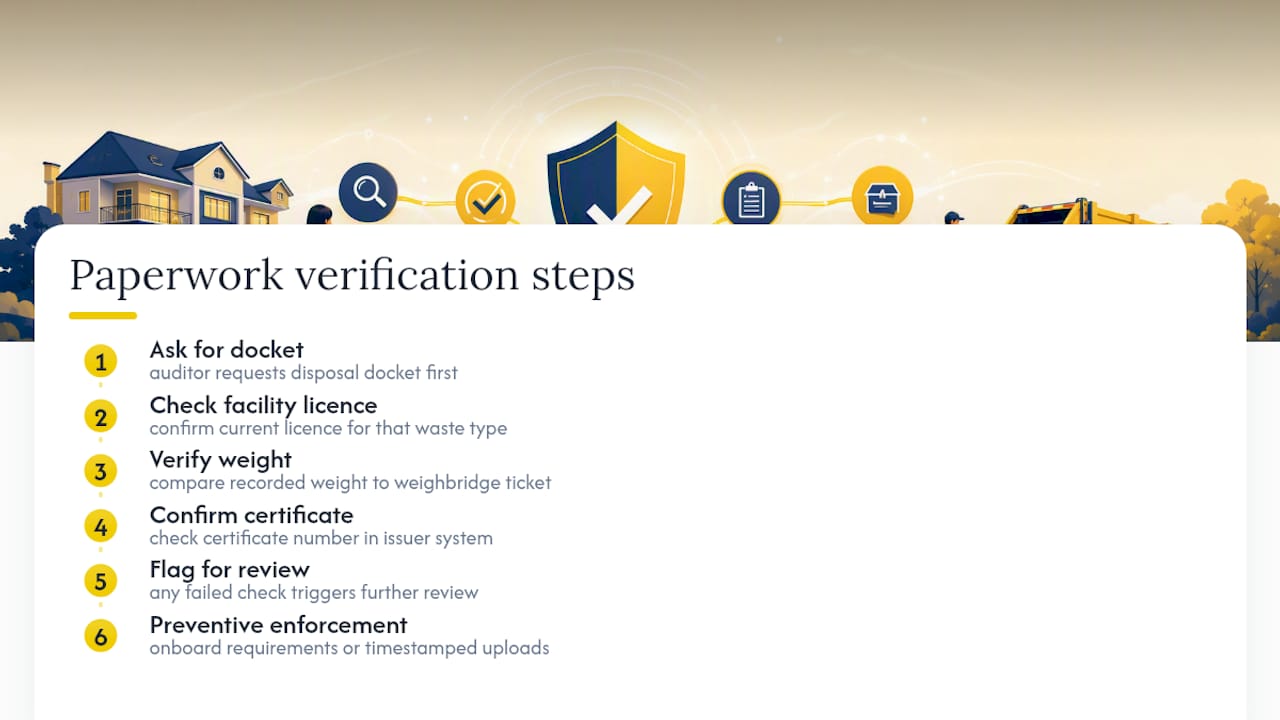
Third-party verification usually works in layers. An auditor will ask for the docket first, then trace it backwards: does the facility named on the receipt hold a current licence for that waste type? Does the weight recorded match the weighbridge ticket? Does the certificate number, if one applies, actually exist in the issuing agency’s system? Any one of those checks failing is enough to flag the whole job for further review.
Some larger facility management groups now build this verification into their contractor onboarding, requiring proof of disposal as a standing condition of every purchase order rather than a one-off request. That shifts the audit burden earlier, before the waste even leaves the site, rather than after the fact when records might be incomplete.
For businesses managing multiple properties or frequent collections, a property management platform that timestamps and stores documents automatically removes a lot of the manual chasing. Tools like Throughline Automation’s property workflow software can be configured to flag a job as incomplete until the disposal document is uploaded, which turns a policy into something that’s actually enforced rather than just written down.
Whoever does the checking, the principle is the same: a document that can’t be independently verified against a licence register, a weighbridge log, or a tracking system isn’t proof. It’s just paper.
What happens if you can’t produce proof of disposal?
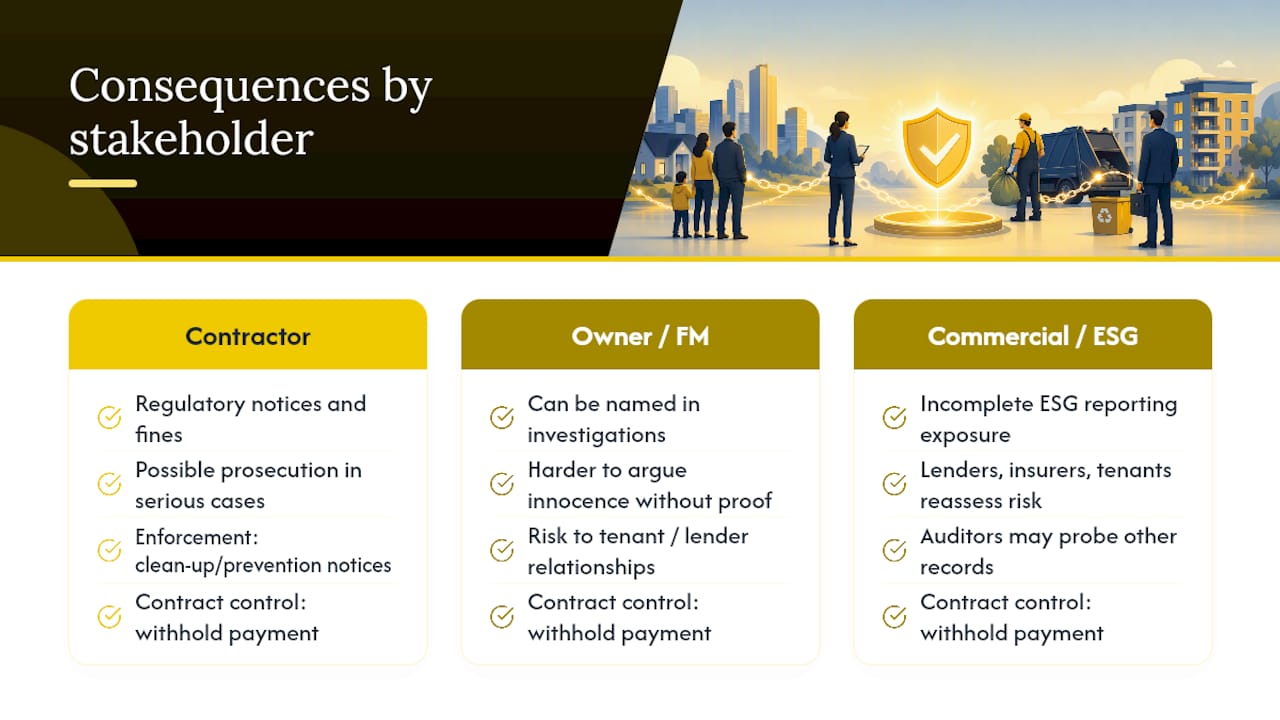
The consequences land differently depending on who you are in the chain. For contractors, operating without proper documentation, or dumping waste at an unlicensed site, can trigger regulatory notices, fines, and in serious cases prosecution. Regulators across Australian states hold enforcement powers that include clean-up notices and prevention notices when lawful disposal can’t be demonstrated.
For property owners and facility managers, the exposure is different but no less real. If a contractor you hired dumps waste illegally and you can’t produce evidence you checked their credentials or received valid disposal proof, you can find yourself named in the investigation, even if you never touched the waste yourself. That’s a harder position to argue from than simply having the docket on file.
There’s a commercial cost too, separate from any regulatory one. Missing paperwork makes ESG reporting incomplete, which matters increasingly to lenders, insurers, and corporate tenants doing due diligence on a building or a supply chain. A facility manager who can’t produce three years of disposal records when asked isn’t just inconvenienced, they’re handing an auditor a reason to dig further into everything else.
Withholding payment until proof is supplied is a straightforward contract-level control that shifts this risk back onto the party actually doing the disposal, which is exactly where it belongs.
What if the proof doesn’t add up?
Discrepancies happen. A docket weight that’s off by a few hundred kilograms from the weighbridge ticket, a facility name that’s spelled differently across two documents, a certificate number that doesn’t match your dispatch note. The question is how you respond, not whether you’ll ever encounter one.
Start by going back to the contractor directly and asking for clarification, in writing. A genuine administrative error, a data entry mistake, a printer that clipped a digit, should be correctable within a day or two, and the contractor should be able to produce a corrected document or a supporting weighbridge printout.
If the explanation doesn’t stack up, or the contractor is slow or evasive, hold the final payment and escalate. Contact the facility named on the docket directly to confirm the load was actually received. If a WTC or CWTF number is in dispute, the issuing agency can usually confirm whether that certificate number exists and matches the details you’ve been given.
Document every step of the dispute yourself, the original paperwork, your written query, the contractor’s response, and any correction issued. If the matter can’t be resolved and you suspect the waste was never lawfully disposed of, that’s the point to report the discrepancy to your state EPA rather than accepting a shrug and an invoice.
How Melbourne City Rubbish gets you proof, not promises
Melbourne City Rubbish supplies disposal dockets as standard, matched to the actual waste streams collected from your site, whether that’s office fit out debris, construction material, green waste or e-waste. If your job involves regulated or higher-risk waste, ask upfront and we’ll talk you through what documentation applies before the truck arrives, not after.
For businesses tracking ESG commitments, some rubbish removal services offer carbon-neutral disposal options, with a promise of punctual arrival, no mess left behind, and paperwork that matches what was actually removed.
Before you book, get a quick quote for your rubbish removal job and ask that proof-of-disposal paperwork be included as a condition of the job, not an optional extra tacked on at invoicing.
Sources
- Construction and demolition waste: an owner’s guide to lawful disposal
- Waste tracking guideline: completing waste tracking certificates
- Waste tracking for receiving facilities (EPA SA)
- EPA Victoria guidance: lawful place and record-keeping