Expect to pay somewhere between $50 and $150 per cubic metre for general household rubbish, with most operators setting a minimum charge for small loads regardless of volume. Dense materials like soil, concrete, or bricks often get weighed and charged separately, since they blow out a truck’s weight limit long before they fill its space. The fastest way to lock in an exact figure is to send clear photos of the pile or book an on-site inspection.
TL;DR:
- Rubbish removal costs range from $50 to $150 per cubic metre, but small loads often incur a minimum charge regardless of volume.
- Dense materials like soil and bricks are typically charged by weight, not volume, due to their high density and impact on truck capacity.
- Accurate measurement involves calculating length times width times height, with adjustments made for irregular or loose materials, and sending multiple photos helps obtain precise quotes.
- Different waste types such as green waste, e-waste, and hardfill attract varying disposal fees and may require separate handling streams to avoid extra costs.
- Regional differences, landfill levies, and local facility access significantly influence overall prices, making fixed quotes after inspection essential.
Table of Contents
- How much does cubic metre rubbish removal cost?
- What factors decide your rubbish removal price?
- How do you measure cubic metres before booking?
- DIY tip run, skip bin, or professional crew: which wins?
- How do you prepare a load and question a quote properly?
- What are the environmental and legal rules around rubbish removal?
- What waste is accepted and what gets excluded?
- What recycling and disposal options actually exist?
- What health and safety issues come up during rubbish removal?
- How does pricing and service vary by region?
- Getting a fixed quote without the guesswork
- Sources
How much does cubic metre rubbish removal cost?
Light, bulky household rubbish (furniture, boxes, general clutter) typically runs a broad range per cubic metre across the country, though your final number depends heavily on where you live and what’s in the pile. That’s a wide range, and there’s a reason for it: a cubic metre of empty cardboard boxes weighs almost nothing, while a cubic metre of wet garden clippings can push past 500 kilograms.
Green waste and garden clippings often sit at the lower end of the range when they’re dry and loose, but wet, compacted loads get priced closer to weight than volume. Soil, concrete, bricks and other hardfill rarely get quoted per cubic metre at all. Once material gets that heavy, providers switch to weight-based pricing because some dense materials can weigh multiple times more per cubic metre than typical rubbish.
Most companies also charge a minimum fee for small jobs. Even if your load only measures 0.5 m³, you’ll likely pay the same as someone booking a full cubic metre, because the truck trip and disposal fee don’t shrink with the load.
Quick pricing snapshot:
- General household rubbish: $50 to $150 per m³
- Green waste (dry, loose): often at the lower end of the range
- Soil, concrete, hardfill: usually priced by weight, not volume
- Small loads: minimum charge typically applies regardless of exact volume
Gate fees at Sydney transfer stations range from around from a low fee for small car boot loads up to several hundred dollars for large truck loads. That gap alone explains why two “small” jobs in different postcodes can land on wildly different invoices, since local landfill levies and gate fees flow straight into your final price.
What factors decide your rubbish removal price?
Providers build a quote from four core ingredients: volume, weight, material type and access. Understanding each one lets you compare two quotes properly instead of just picking the cheaper number.
- Volume versus weight. Space in the truck matters for bulky, light items. Weight matters once you’re dealing with soil, tiles, or anything dense enough to trip a landfill levy.
- Material destination. General waste, green waste, hardfill and e-waste all get sorted and disposed of differently, and each stream carries its own gate fee.
- Access and labour. Stairs, lifts, long carry distances, or furniture that needs dismantling all add time, and time is what you’re really paying for.
- Transport distance. A job near a transfer station costs less to service than one requiring a long drive each way.
- Sorting and notice period. A pile that’s already separated into waste streams is faster to load and cheaper to process than a mixed heap.
- Landfill levies and gate fees. These government and facility charges sit on top of the base service cost and vary by council area.
Pro Tip: If a quote looks suspiciously cheap, ask what happens if the load turns out heavier than expected on the day. A fixed-price quote confirmed after an on-site look protects you from that surprise; a phone estimate with no inspection clause usually doesn’t.
How do you measure cubic metres before booking?
The formula is simple: length × width × height, all in metres, gives you cubic metres. A pile measuring 2 metres long, 1 metre wide, and 0.5 metres high works out to 1 m³.
If picturing that number is hard, think in everyday objects instead:
- 1 m³ — roughly a large fridge, or about eight 500mm × 500mm storage boxes stacked together.
- 3 m³ — a small bedroom clear-out: mattress, bedside tables, a wardrobe’s worth of boxes, and a few bags of miscellaneous junk.
- 6 m³ — roughly half a standard removal truck, enough for a garage clean-out or a small renovation’s worth of debris.
Loose or irregular material rarely packs efficiently. Broken bricks, snapped timber and mixed rubble leave gaps that empty space alone doesn’t account for, so tradespeople apply a packing correction of roughly ×1.3 to ×1.5 on top of the raw measurement for anything loose or rubble-like.
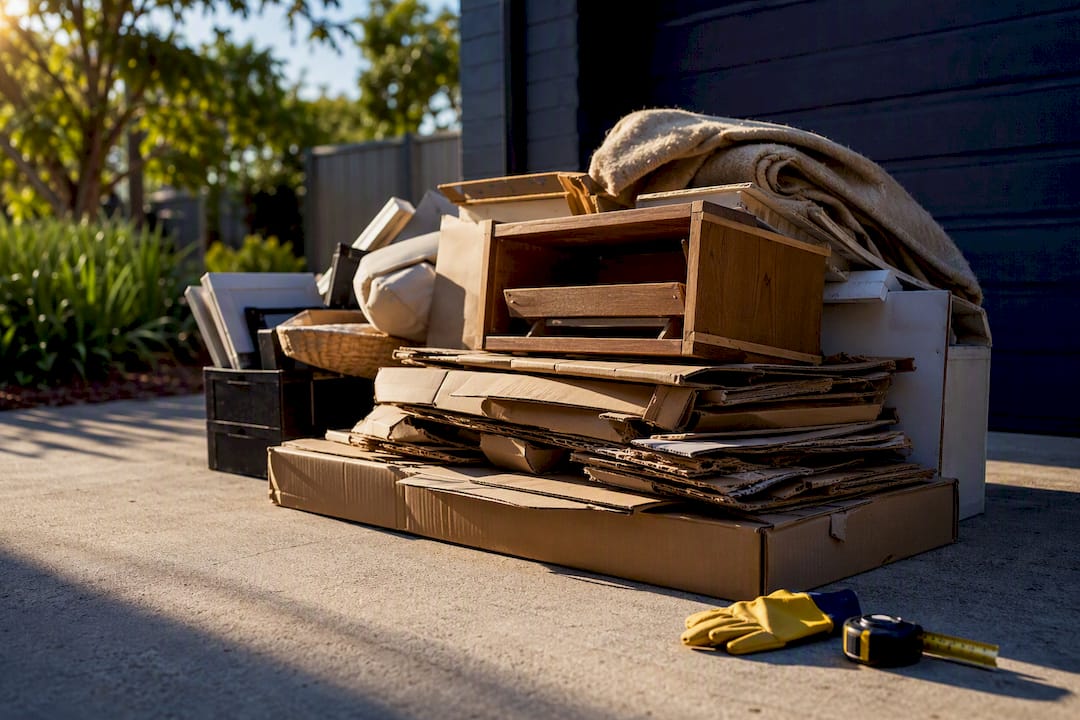
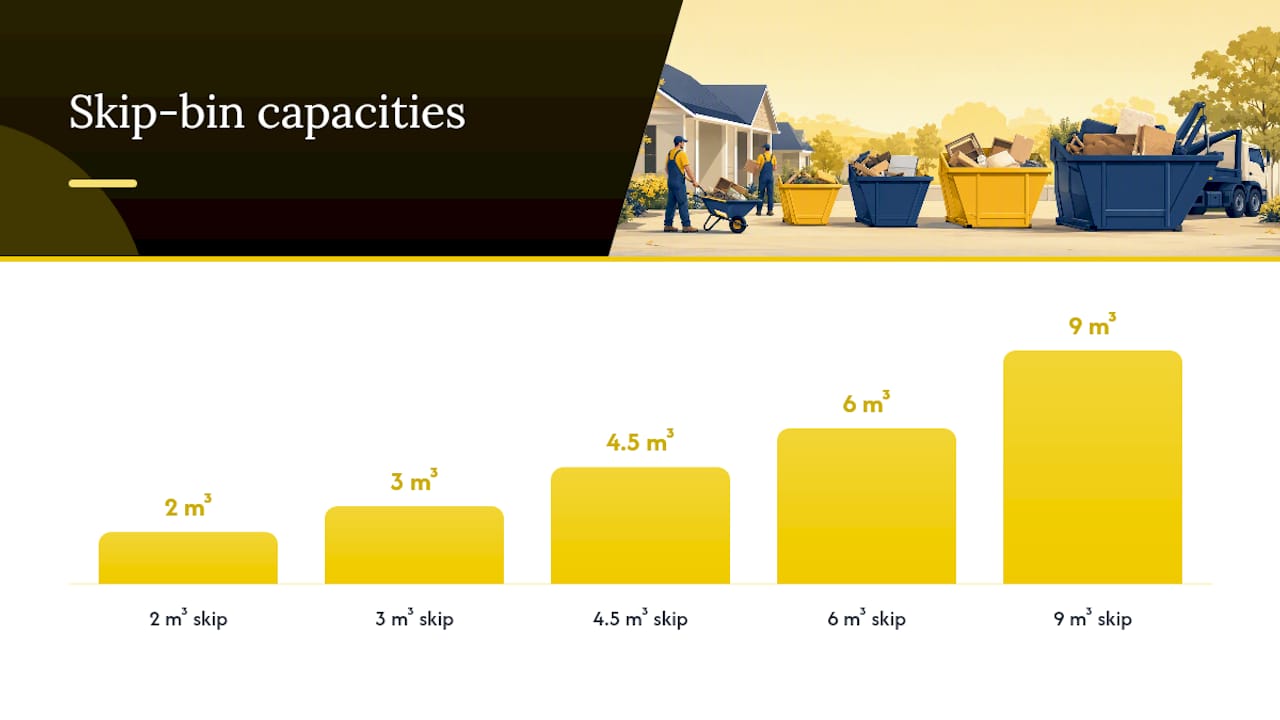
When you’re sending photos for a remote estimate, shoot from a few angles: one wide shot showing the whole pile against a reference object like a doorway, and one closer shot of anything unusually heavy (tiles, soil, appliances). Skip bin sizes commonly run 2 m³, 3 m³, 4.5 m³, 6 m³ and 9 m³, so these benchmarks double as a handy size reference even if you end up going with a removal crew instead.
DIY tip run, skip bin, or professional crew: which wins?
Each option suits a different job, and the wrong choice usually costs more than it saves in either money or time.
- DIY tip run works best for very small loads when a tip is nearby. Total cost often lands under $100, but factor in fuel, your own labour, and the vehicle you’d need to borrow or hire.
- Skip bin hire suits jobs spread over several days where you’ve got space to leave a bin on-site. Expect roughly $250 to $450 for a 2 to 4 m³ bin, and check the weight allowance before you book, since exceeding it triggers extra charges.
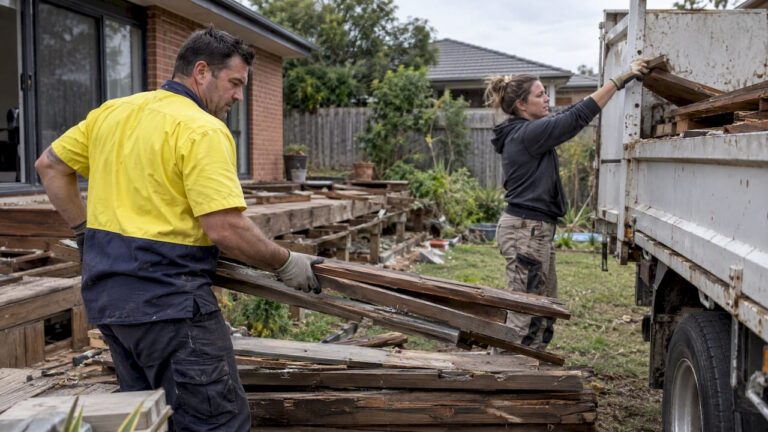
- Professional removal wins for single-day clear-outs, tight access, or anything you don’t want to lift yourself. Pricing for a typical job varies significantly depending on volume and other factors depending on volume, and the per-cubic-metre rate can look higher than a skip on paper, but you’re not paying for a bin sitting empty on your driveway for a week.
Run through this before deciding: how much do you have, can a vehicle get close to it, how heavy is it, how fast do you need it gone, do you have space to store a bin, and will the provider even take what you’re throwing out?
How do you prepare a load and question a quote properly?
A little prep before the crew arrives keeps your final invoice matching the quote you were given.
- Separate the tricky stuff first. Pull out recyclables, hazardous items (paint, batteries, gas bottles) and e-waste, since most general rubbish removal excludes these or charges extra.
- Send accurate measurements and photos. List dense materials like soil or tiles separately from bulky light items, so the estimate reflects both volume and weight.
- Ask direct questions before booking: What’s the minimum charge? What’s included? Is there a weight allowance? What materials are excluded? Where does the waste go? Is the provider insured? Do they need any permits for your street or building?
- Confirm the price is fixed after inspection, not just estimated from a phone call. Providers that only give a firm number after seeing the load in person are being upfront about how hard density is to judge from a photo alone.
Pro Tip: Get quotes from two or three providers before booking. It’s the fastest way to spot whether a number is genuinely competitive or just missing a fee that’ll appear later.
What are the environmental and legal rules around rubbish removal?
Waste disposal in Australia sits under a mix of state environmental protection laws and local council regulations, and they cover more than just where your rubbish physically ends up. Landfill levies, set by state governments, are designed to push waste toward recycling and resource recovery rather than burial, and they’re a big reason disposal costs keep climbing in metro areas.
Certain waste categories carry legal handling requirements. E-waste (old TVs, computers, batteries) is banned from general landfill in several states because of the heavy metals involved, and it needs to go through certified e-waste recycling instead. Asbestos, found in a lot of older home renovations and demolitions, requires licensed removal and disposal; a general rubbish removal job won’t (and shouldn’t) touch it. Green waste often has its own separate processing stream, partly because it composts differently to general rubbish and partly because some councils use it for mulch production.
For businesses, waste obligations extend further. Commercial premises generating construction debris, chemical waste, or bulk quantities of any regulated material need to use licensed carriers and keep records of where that waste was taken. Cutting corners here isn’t just risky, it can attract fines from the relevant state environmental authority. A reputable provider will handle this compliance on your behalf rather than leaving you to work out which stream each item belongs to.
What waste is accepted and what gets excluded?
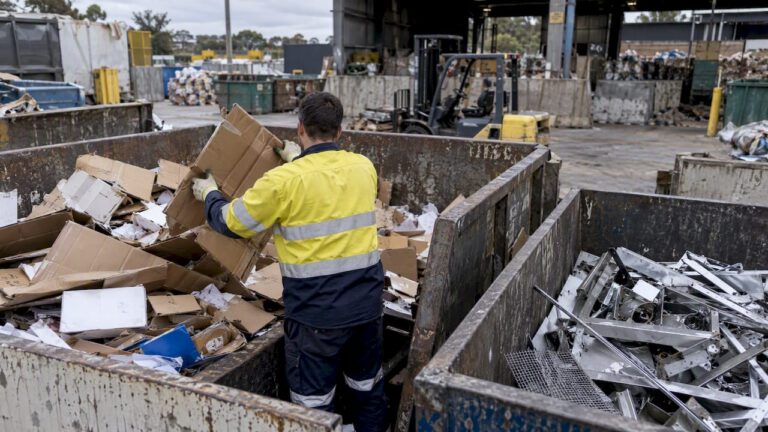
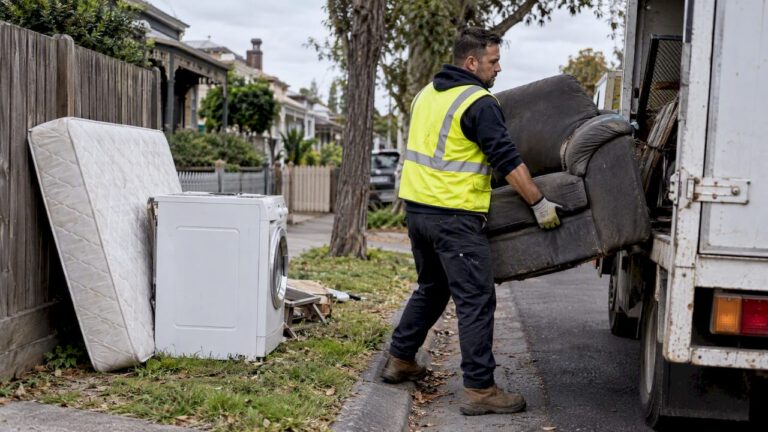
Cubic metre rubbish removal generally covers general household and commercial junk: furniture, appliances, boxes, clothing, general clutter, office fit-out debris and most non-hazardous bulky items. Green waste (branches, leaves, grass clippings) usually gets accepted too, though some providers charge it separately from general waste because it’s processed through a different facility.
What typically gets excluded is a shorter but important list. Asbestos and other hazardous building materials need licensed specialist handling, not a standard rubbish run. Chemicals, paints, solvents and gas bottles usually fall outside standard collection because transfer stations classify them as regulated hazardous waste. Car batteries, tyres, and large quantities of liquid waste often need separate disposal pathways too.
E-waste sits in its own category. Electronics contain materials that can’t legally go to general landfill in most states, so they need dedicated recycling. Many rubbish removal providers, including services covering strip-outs and office clearances, offer e-waste disposal as a separate stream precisely because it can’t be lumped in with general junk.
If you’re unsure whether something’s accepted, ask before the crew turns up. A provider that clearly lists inclusions and exclusions upfront, rather than discovering “extra” items on the day, is the one you want handling your job. It also avoids the awkward situation of a crew arriving and refusing to take half the pile.
What recycling and disposal options actually exist?
Not everything hauled away in a rubbish removal job ends up in landfill, and a decent chunk of it shouldn’t. Timber, metal, and even some furniture can be diverted to recycling or resale rather than buried, depending on condition and what local facilities accept.
Green waste typically goes to a dedicated composting or mulching facility rather than general landfill, which is part of why some operators price it differently to household junk. Construction and demolition debris, particularly concrete, brick and hardfill, often gets crushed and reused as construction aggregate instead of dumped, since it’s one of the easier waste streams to recycle at scale.
E-waste recycling recovers metals, plastics and components from old electronics, which matters because these items are legally excluded from general landfill in several states anyway. Choosing a provider that separates and routes waste properly, rather than sending every load straight to the nearest tip, makes a genuine difference to how much of your rubbish actually gets a second life. Some operators also offer carbon-neutral disposal as an opt-in, which is worth asking about if sustainability factors into your decision.
The upshot for you as a customer: ask where your waste actually goes, not just that it’s “taken away.” A provider that can answer specifically, tip versus recycling facility versus resale, is telling you something real about how they operate.
What health and safety issues come up during rubbish removal?
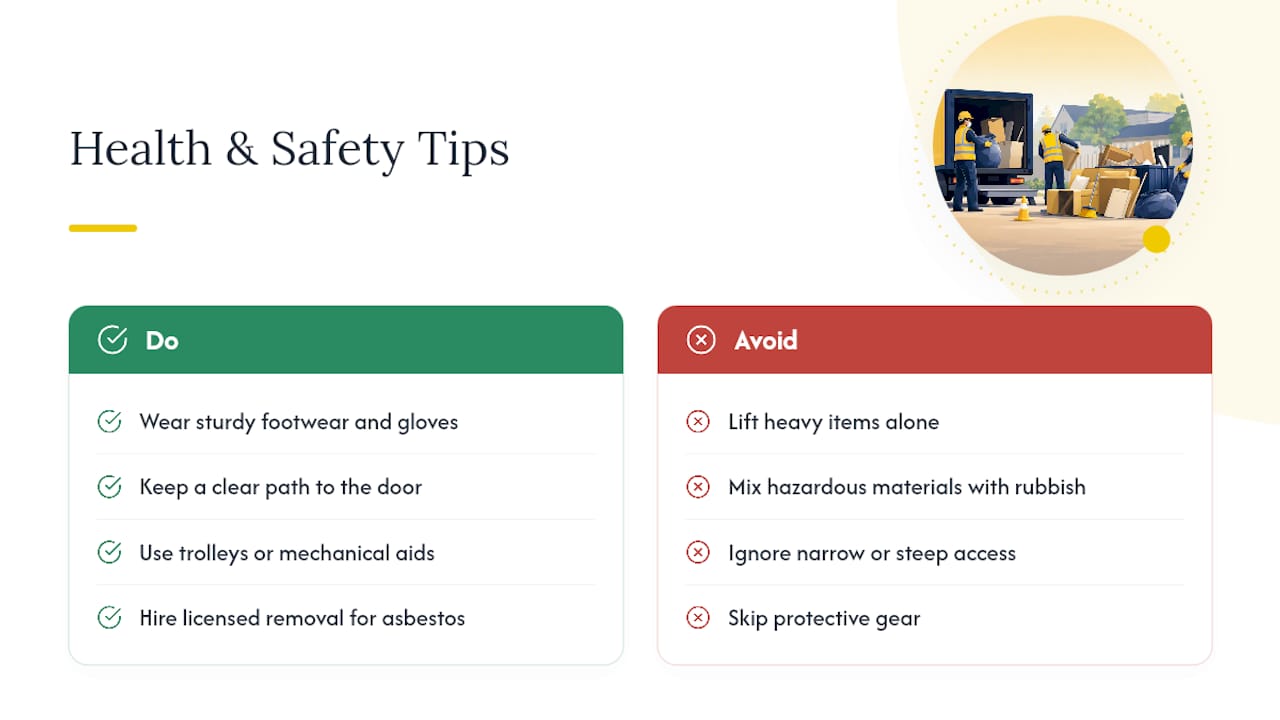
Physical injury risk is the biggest concern on most rubbish removal jobs, and it’s usually not the big obvious hazards that cause problems. Back injuries from lifting heavy or awkwardly shaped items (wardrobes, old fridges, waterlogged furniture) are the most common issue, followed by cuts from broken glass, exposed nails, or sharp metal edges hiding in general clutter.
Hazardous materials pose a different kind of risk. Old paint tins, chemical containers, or unidentified liquids need careful handling and shouldn’t be mixed in with general rubbish, both for legal reasons and because some combinations are genuinely dangerous if they leak or mix. Asbestos is the standout hazard here: it’s invisible once disturbed and requires licensed removal, never a DIY approach, regardless of how confident you feel about identifying it.
Access hazards matter too, particularly in older properties or tight commercial spaces. Stairwells, narrow hallways and cluttered garages increase the chance of a slip, trip or dropped item, which is exactly why professional crews often bring trolleys, protective gear and trained labour rather than just muscle. If you’re doing any part of the clear-out yourself before a crew arrives, sturdy footwear, gloves, and a clear path to the door go a long way toward avoiding an easily preventable injury. For businesses, this also ties into workplace safety obligations. A cluttered office or construction site awaiting clearance is a hazard in its own right, which is one reason facilities managers often schedule regular collections rather than letting waste build up.
How does pricing and service vary by region?
Rubbish removal pricing shifts noticeably depending on where you are, and the biggest driver isn’t distance, it’s local landfill levies and gate fees. States and even individual councils set different levy rates, which means identical loads can cost meaningfully different amounts just a suburb or two apart, let alone between cities.
Metro areas generally have more providers competing for business, which can help keep pricing sharper, but they also tend to carry higher landfill levies than regional areas, which pushes disposal costs the other way. Regional and rural areas often have fewer collection options and longer transport distances to the nearest transfer station, which can offset any levy savings with higher trip costs.
Availability of specific waste streams also varies regionally. Not every council area has a dedicated e-waste drop-off or green waste processing facility nearby, which affects how far a provider needs to travel and what they’ll charge for that stream specifically. If you’re comparing quotes between two providers, checking which council area and transfer station each one uses is worth doing, since that’s often where the real price difference comes from rather than the provider’s base rate.
For commercial clients managing multiple sites, this regional variation matters even more. A waste management strategy that works for one location’s regulations and levy rates might need adjusting for another.
Getting a fixed quote without the guesswork
Melbourne City Rubbish handles the full range covered above: office junk, construction debris, green waste, e-waste, strip-outs and residential clearances, with carbon-neutral disposal available as an opt-in for clients who want it factored into their job. Rather than making you guess at a per-cubic-metre figure from a phone call, the process starts with photos or an on-site look so the number you’re quoted is the number on the invoice.
Getting started is straightforward: send through photos of the load via the quick quote page, and you’ll get a fast estimate without needing to measure anything yourself first. Melbourne City Rubbish also beats any written quote by 5%, so if you’ve already got a number from another provider, it’s worth checking that one against this offer before you book.
When you’re comparing that written quote against what’s on offer here, look past the headline number. Check whether labour, tip fees, and any permit costs are actually included, or whether they’ll show up as extras once the job’s underway. A quote that looks cheaper on paper isn’t always cheaper once everything’s accounted for.
Sources
- How Much Does Rubbish Removal Cost? 2026
- Cost to go to the tip in Sydney 2026 | Rubbish Tip Near Me
- What affects rubbish removal pricing? – OTG Rubbish Removals
- What size skip bin do I need? — BinBookings
- Rubbish removal pricing explained — Cheap Cheap Rubbish Removal (about page)