Carbon neutral rubbish removal means the emissions from collecting, transporting and disposing of your waste are measured, reduced where possible, and the remainder balanced with certified carbon offsets. It does not make the waste vanish, and it does not replace sorting, reuse and recycling. Done properly, it is one layer of a cleaner job. This guide explains what sits behind the label, what to ask a provider before you book, and how Melbourne businesses, property managers and tenants can shrink the footprint of a clearout.
TL;DR
- Carbon neutral removal pairs measured operational emissions with verified offsets. Ask what is measured, which offsets are used and whether you can opt in per job.
- Landfill methane is the main climate problem with waste, so separating materials and diverting them from landfill does more than offsets alone.
- In Victoria you stay legally responsible for your waste until it reaches an authorised facility, so get the disposal site confirmed in writing.
- At Melbourne City Rubbish you can opt in to carbon neutral disposal on commercial and residential jobs, and we aim to beat any written quote by 5%.
- Quotes are per project, so describe the job accurately: volume, access, materials and timing.
Table of Contents
- What carbon neutral rubbish removal actually covers
- Why landfill is the real climate problem
- Carbon neutral does not mean legally covered
- How the landfill levy shapes cost and carbon
- Where the footprint is biggest: five common Melbourne jobs
- A practical plan to cut the footprint of your next clearout
- How to judge a carbon neutral claim
- Carbon neutral removal with Melbourne City Rubbish
- FAQ
- Sources
What carbon neutral rubbish removal actually covers
A rubbish removal job produces emissions in three places. The truck burns fuel getting to your site and then to a transfer station, recycler or landfill. The crew and equipment use energy on site. And the waste itself, once it is landfilled, breaks down and releases greenhouse gases.
A carbon neutral service accounts for those emissions and balances them. The usual method has three steps:
- Measure. Estimate emissions from fuel, vehicles and disposal, often per tonne of waste handled.
- Reduce. Cut what you can: efficient routing, full loads, sorting at the source, sending materials to recyclers instead of landfill.
- Offset. Buy carbon credits for what remains. One credit represents one tonne of CO2-e, and the better schemes are checked by independent auditors.
The Australian Government’s Climate Active program sets out that same sequence for certified carbon neutral organisations: calculate emissions, reduce them where possible, then offset the rest. When a provider says it is carbon neutral, it is fair to ask whether it follows a recognised standard like this or has its own method, and to ask to see the details.
What the offsets are
Offsets vary widely in quality. Some of the strongest in Australia are native reforestation projects. For example, the Yarra Yarra Biodiversity Corridor in Western Australia is described by Carbon Neutral as the first project in Australia certified under the Gold Standard, planting endemic, drought-tolerant species that restore habitat as well as absorb carbon. That is the kind of detail worth asking for: project name, certification body and whether credits are retired on your behalf.
Why landfill is the real climate problem
If you want the footprint of rubbish removal to fall, look at where the waste ends up. According to the 2026 National Waste and Resource Recovery Report, about 67% of Australia’s waste is recovered, 64% through recycling and 3.1% through energy recovery, and the rest goes to landfill. In 2023–24, landfills, composting and incineration released 10.8 Mt of CO2-e, about 2.3% of Australia’s total emissions, and methane from landfills makes up 97% of the emissions from the solid waste sector.
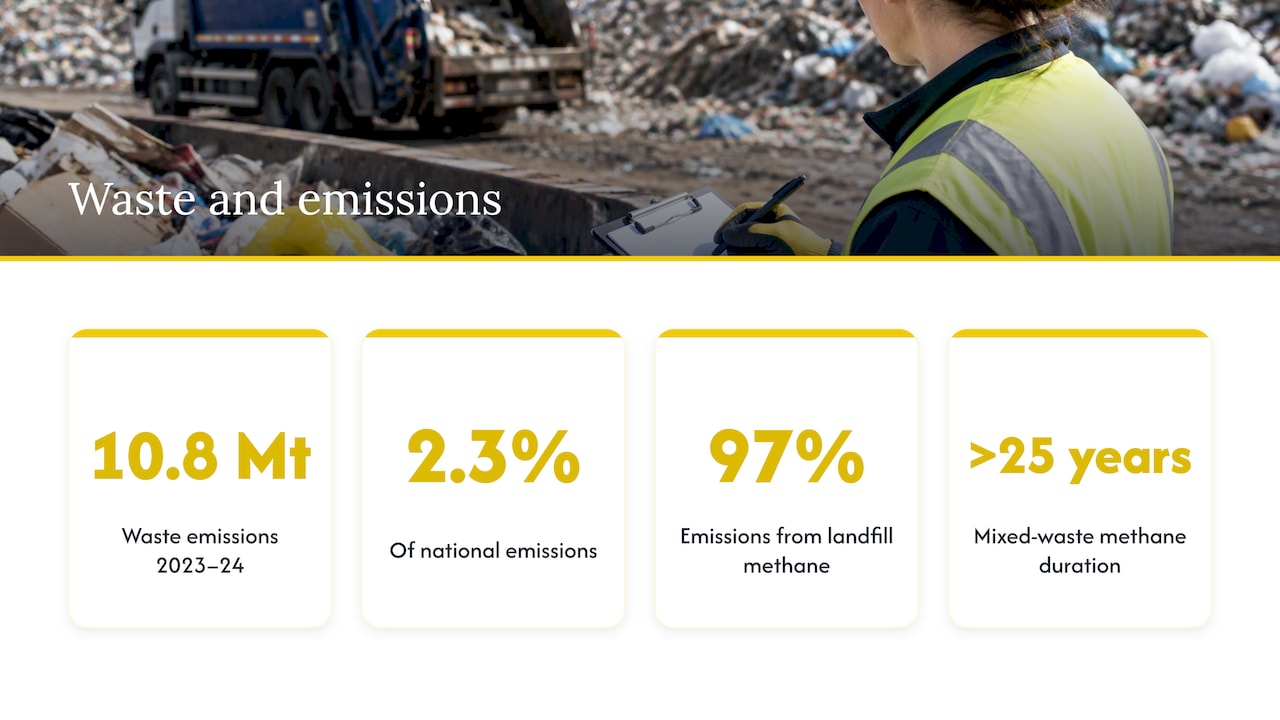
That methane does not stop quickly. The NSW EPA notes that mixed office or construction waste often cannot be recycled and is pushed into landfill, where it generates methane that can be emitted for more than 25 years. The same page points to separate collection of food and garden organics as a way to keep that material out of landfill. NSW guidance, but the physics is the same in Melbourne.
So the honest reading is this: offsets balance emissions you could not avoid, but the biggest avoidable emissions come from what you throw away and how you sort it.
The waste hierarchy in plain terms
Australian policy ranks waste options from best to worst: avoid, reuse, recycle, recover energy, and only then dispose. The National Waste Policy Action Plan is built on that order, and the message to businesses is to climb the hierarchy rather than rely on landfill gas capture alone. In practice:
- Avoid: do not buy the extra fit-out you will strip out in three years.
- Reuse: donate or resell desks, chairs and whiteboards before booking a removal.
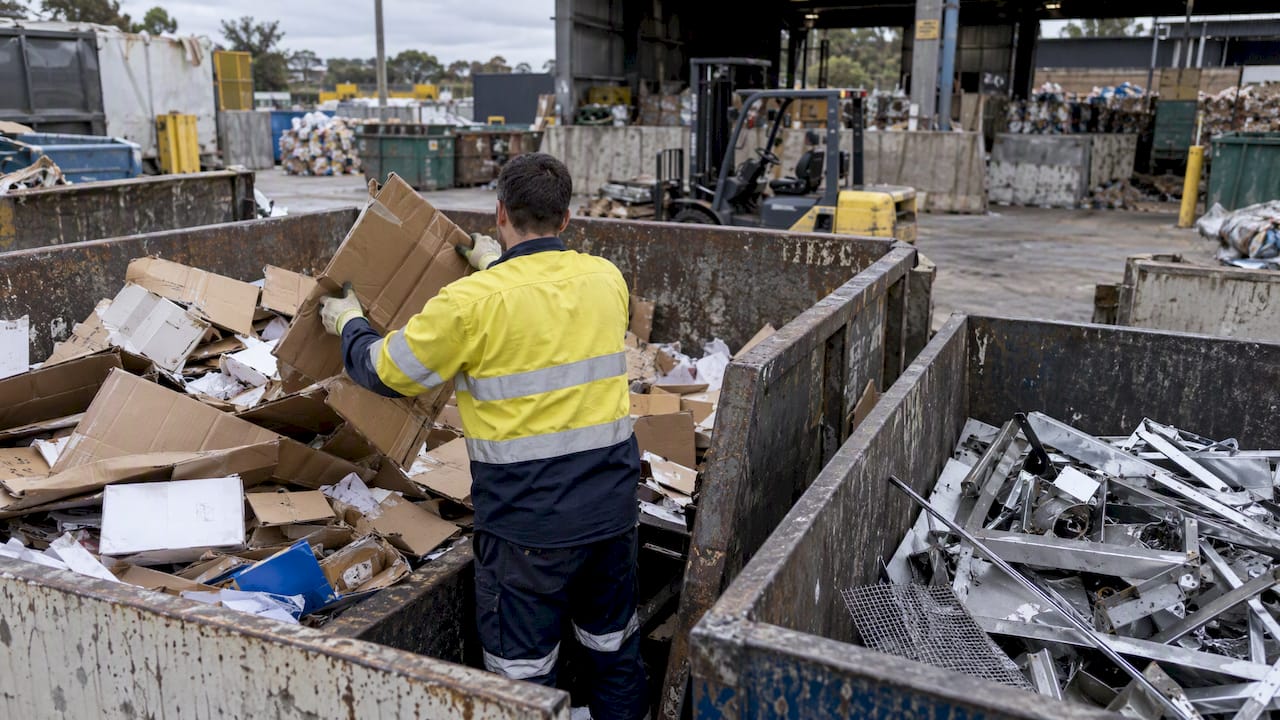
- Recycle: metals, cardboard, e-waste, timber, concrete and clean green waste all have recovery paths.
- Dispose: what is left goes to an authorised facility, ideally with carbon neutral transport and disposal behind it.
Carbon neutral does not mean legally covered
A green label says nothing about whether your waste went to the right place. In Victoria, the EPA states that if you use a contractor you remain responsible for how they manage waste from your site. For business owners, the same duty applies: you are accountable for your waste until it reaches an authorised facility, and hiring a contractor does not remove that.
Under the Environment Protection Act 2017, waste generators must investigate alternatives to disposal and make sure waste goes to a place authorised to receive it. The EPA’s page on your waste obligations and duties explains that industrial waste must be classified so it can be managed correctly.
Questions to ask before you book
- Where will my waste be taken? Ask for the facility name in writing.
- How do you sort on site and how much of a typical load is recovered?
- What exactly is carbon neutral: the truck only, or transport and disposal?
- Which offset projects do you use, and who certifies them?
- Is carbon neutral disposal opt-in per job, and how is it priced on the quote?
- If my waste is a reportable priority waste, will you use EPA’s Waste Tracker?
That last one matters. If your waste is reportable priority waste, the EPA’s Waste Tracker system must be used to record its removal, transport and receipt. If you are not sure whether your material falls in that category, speak to EPA Victoria or an accredited consigner before booking. The EPA’s guidance on waste duties notes that an accredited consigner can help you show you took reasonably practicable steps, which is useful for complex or high-risk materials.
Asbestos, treated timber and similar materials are specialist waste. Do not put them in a general clearout. The EPA’s construction industry page lists how to manage them.
How the landfill levy shapes cost and carbon
Disposal costs in Victoria include a government landfill levy. For 2025–26 it was $169.79 per tonne in the figures councils used for their budgets, and levy rates are reset each year, so check the current EPA schedule when comparing quotes. Because the levy is charged on waste that goes to landfill, it rewards diversion. A heavy skip of mixed demolition waste can cost far more to dispose of than the same material sorted into concrete, metal and timber.
That is where cost and carbon line up. Cleaner, sorted loads cost less to process and emit less. A provider that sorts at the point of collection is not just being virtuous, it is saving you money on the levy component of the quote.
Where the footprint is biggest: five common Melbourne jobs
| Job | Typical waste | Biggest carbon lever |
|---|---|---|
| Office cleanout or relocation | Desks, chairs, partitions, paper, IT gear | Reuse and resale of furniture; separate e-waste |
| Make-good and de-fit | Ceilings, carpet, joinery, cabling | Salvage fixtures; recover metals and timber |
| Construction and demolition | Concrete, brick, timber, plasterboard | Segregate at source; send concrete and metal to recyclers |
| Green waste | Prunings, turf, garden clearouts | Keep organics out of landfill and send to processing |
| End-of-lease household clearout | Furniture, whitegoods, general junk | Donate what is usable; book removal for the rest |
Office cleanouts and junk
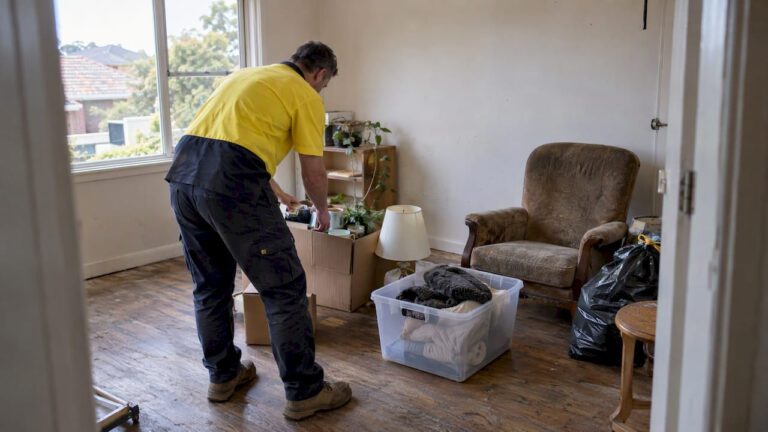
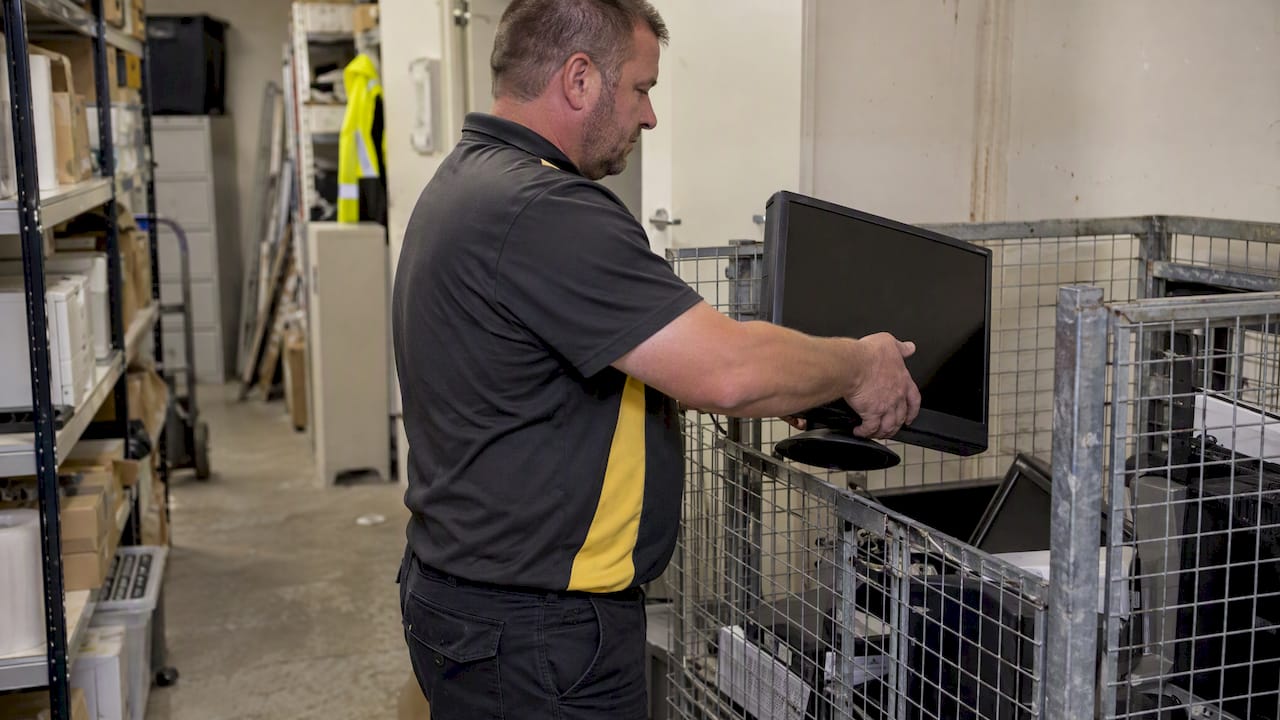
Office jobs generate surprising volumes: old workstations, filing cabinets, monitors and whatever has built up in storerooms. Start by listing what is reusable. Furniture in good condition can be donated or resold, which is the highest rung of the hierarchy. Electronics should go separately, since mixing them with general rubbish contaminates the load. Our guide to disposing of e-waste in Melbourne covers how that works, and our commercial office rubbish removal page explains how we handle larger clearances.
Make-good, strip-outs and demolition
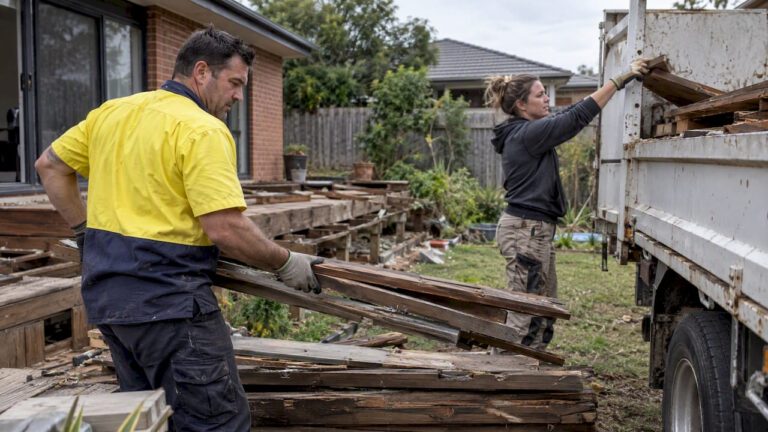
End-of-lease make-good is where mixed waste piles up fast, because ceilings, floor finishes, partitions and cabling all come out in a short window. Sorting as materials come out is far cheaper than separating a mixed bin later. Once the space is cleared, a commercial cleaning crew is usually the last trade in before the handback inspection. Check your own lease for what the landlord requires.
For larger scopes, see our commercial demolition and construction waste removal pages. The EPA’s civil construction, building and demolition guide includes a section on waste collection and removal and the records you should keep.
Furniture
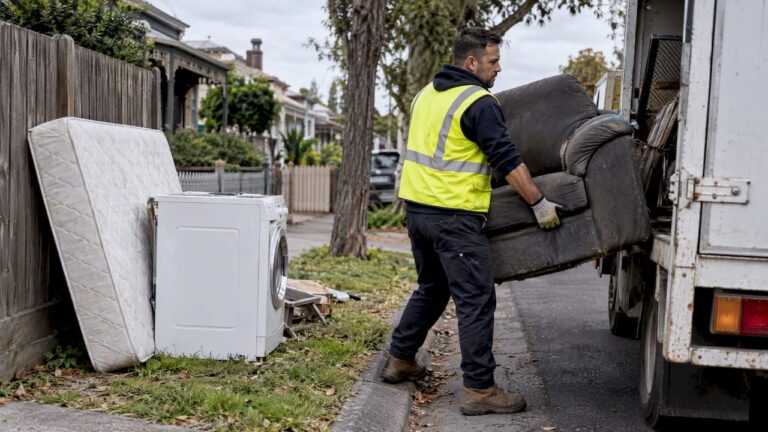
Old furniture is often the easiest win. If it is sound, donate or sell it first. If it is not, recycling beats landfill, since timber, metal and foam have separate recovery paths. See our page on furniture disposal and recycling, or our advice on donating or recycling before you book removal.
A practical plan to cut the footprint of your next clearout
- Walk the site and list the materials. Group them: reusable, recyclable, e-waste, green waste, general, and anything hazardous.
- Remove what can be reused. Donate, resell or redeploy before the truck arrives.
- Segregate as you go. Use separate areas or bins. Mixed loads are what push material into landfill.
- Flag anything regulated. Asbestos, chemicals, refrigerants and priority wastes need specialist handling. Commercial fridges, for example, involve licensing checks, covered in our commercial fridge disposal guide.
- Get a written quote and the disposal site in writing. Compare like with like, including whether carbon neutral disposal is included or an opt-in extra.
- Keep your records. Retain the quote, receipts and any facility confirmations in case you are asked how your waste was managed.
If you manage a workplace or building long term, a recurring approach beats one-off fixes. Our guides on creating a sustainable waste management strategy for your workplace and on business waste in Melbourne go through that in detail, and our business recycling audit is built to find where landfill volumes can be cut.
How to judge a carbon neutral claim
The phrase is easy to print on a ute and harder to back up. Here is a quick test.
- Specific scope. Does the provider say what is covered: fuel, vehicles, disposal emissions?
- Named offsets. Real projects with a named standard are more credible than vague tree-planting promises.
- Reduction first. Look for evidence of sorting, diversion and efficient routing, not offsets alone.
- Choice and clarity. Opt-in per job with a visible line on the quote lets you see exactly what you are paying for.
- Compliance. The provider should be comfortable giving you the destination facility and discussing your duties under Victorian law.
A business that is honest about limits is usually a better bet than one claiming to fix climate change with a sticker. Offsets balance emissions, they do not erase the case for sorting and recovering materials.
Carbon neutral removal with Melbourne City Rubbish
We remove rubbish for commercial and residential clients across Melbourne, including the CBD, South Melbourne, Port Melbourne, West Melbourne and the Melbourne Airport area. That covers office junk, construction debris, green waste, e-waste, strip-outs, demolition debris and make-good clearances, as regular or one-off collections.
Carbon neutral disposal is an option you can opt in to on your job. We also back our service with real-time notifications and a lateness credit, we leave sites with no mess and no damage to property, and we promise to beat any written quote by 5%. Prices are quoted per project, so the fastest route is to send us the details through Quick Quote, or browse everything we do. For more on how we approach sustainability, read our page on eco-friendly rubbish removal for Melbourne businesses.
If you are planning a larger event, our guide to event rubbish removal in Melbourne shows how the same approach scales. For CBD sites with tight access, our overview of recycling in the Melbourne CBD is a useful starting point.
FAQ
Is carbon neutral rubbish removal the same as recycling?
No. Recycling keeps material out of landfill. Carbon neutral removal balances the emissions from the job with offsets. The best result combines both: sort and recycle what you can, then offset what remains.
What is carbon neutral waste disposal in practice?
It means the emissions linked to transporting and disposing of waste are measured and balanced with certified offsets, commonly priced per tonne of waste. Ask the provider what is included and which offset projects it uses, because schemes differ in scope and quality.
Does using a contractor make me free of legal responsibility for my waste?
No. In Victoria, the EPA says you remain responsible for how a contractor manages waste from your site. Ask for the destination facility in writing, and contact EPA Victoria or an accredited consigner if you handle regulated or priority waste.
Does carbon neutral removal cost more?
It can add a line to your quote, and quotes are per project, so there is no single figure. Good sorting can offset some of the cost by reducing the tonnage that attracts the landfill levy. Get a written quote and we will aim to beat it by 5%.
Sources
- Climate Active, DCCEEW
- Gold Standard Australian Native Reforestation, Carbon Neutral
- National Waste and Resource Recovery Report 2026, DCCEEW
- Reducing carbon emissions through better waste and material management, NSW EPA
- National Waste Policy Action Plan 2024, DCCEEW
- Home renovation waste, EPA Victoria
- Understand your waste obligations and duties, EPA Victoria
- What is Waste Tracker, EPA Victoria
- Waste duty guidance, EPA Victoria
- Construction industry, EPA Victoria
- Fees and charges 2025–26, City of Boroondara