If a tenant left rubbish or perishable food behind, you can usually dispose of it straight away without notice. Everything else is treated as the former tenant’s goods. Those need the tenancy to have ended first, then a formal notice and a storage period, commonly 14 days, before disposal. Photograph everything and use lawful routes for regulated waste.
TL;DR:
- Confirm the tenancy has legally ended through the lease, notices, rent records, or possession order; an apparently empty home alone is not enough.
- Photograph and inventory belongings, serve the required notice, and store goods; Victoria sets periods of 14 days for household items and 90 for personal documents.
- Keep receipts for removal and storage costs; former tenants may reclaim belongings before disposal by paying charges, while tribunals can award compensation for improper handling.
- Use council collections, licensed transfer stations, or specialist hazardous waste services, and retain destination receipts because landlords remain responsible for illegal dumping by contractors.
Table of Contents
- How do you tell rubbish from other tenant property?
- Why must you confirm the tenancy has ended first?
- How do you notify the former tenant and store goods?
- What costs can you recover, and what can tenants reclaim?
- How do you dispose of waste lawfully and responsibly?
- What evidence should you collect at each step?
- What happens at the tribunal if you get it wrong?
- How should you talk to the tenant about disposal?
- What does the timeline look like from vacating to a clear property?
- What do local councils require for rubbish removal at rentals?
- How do you handle bulky or hazardous items left behind?
- How can you dispose of tenant waste in an eco-friendly way?
- When should you hire a professional removal service?
- FAQ
- Sources
How do you tell rubbish from other tenant property?
The law treats a tenant’s leftovers in two buckets. Rubbish and perishables can go immediately, while anything with value or personal meaning has to be handled as goods. NSW Government guidance sets out that rubbish and perishable goods can be disposed of without notice, and other belongings follow state-specific processes.
In practice, this is how the line usually falls:
- Rubbish and perishables: rotting food, empty packaging, broken items with no resale value, overflowing bins and obvious refuse.
- Goods that need a process: furniture, appliances, clothing, tools, bikes and anything a reasonable person could want back.
- Items that need extra care: passports, IDs, photographs, paperwork and computer hard drives, which Victoria treats as personal documents.
The immediate disposal rule comes from uncollected goods law, such as the Uncollected Goods Act 1995 in New South Wales, which exempts rubbish and perishables from notice requirements.
Run three quick checks before anything goes in a skip. Open boxes and bags rather than assuming they are junk. Check pockets, drawers and the inside of furniture for documents, keys, cash and devices. And ask whether the item would sell for anything. If you hesitate on any of these, treat it as goods and follow the notice process.
Why must you confirm the tenancy has ended first?
A property that looks abandoned is not the same as a tenancy that has legally ended. The NSW Government guidance warns that landlords must confirm the tenancy has ended before acting. Clearing a home too early can expose you to a compensation claim if the tenant returns and finds their belongings gone.
Consider a tenant who is in hospital, overseas or simply behind on rent but still in possession. The rooms may look empty, the fridge may be bare, and the tenancy can still be live. Acting on appearances is the most common way landlords end up before a tribunal.
Check the paper trail instead:
- The lease and any renewal or periodic agreement.
- Termination notices given by either party, with dates and proof of service.
- The rent ledger, including whether rent is paid past the apparent vacate date.
- Any tribunal order for possession, and a final inspection report with key return.
If those records leave you unsure, pause. Make documented contact attempts first, and handle only clear rubbish until the end date is certain.
How do you notify the former tenant and store goods?
Once the tenancy has ended, non-rubbish goods need a notice and a storage period. In Victoria, Consumer Affairs Victoria says household goods typically need storing for at least 14 days, and personal documents for at least 90 days, with reasonable steps taken to notify the former tenant. Check your own state’s approved notice and timelines before you start.
Follow this sequence:
- Photograph every item and room, then write a dated inventory.
- Prepare the approved notice where one is required, listing the goods, a collection deadline and a collection location.
- Serve it by every channel you have: post to the forwarding address, email and SMS.
- Store the goods somewhere secure and dry, and note where.
- Allow collection during the notice period and record who collected what.
- Dispose only after the deadline passes, and log the date and destination.
Pro Tip: Set the collection deadline a few days beyond the legal minimum. A small buffer costs little and removes any argument about counting days.
Storage must be reasonable. Keep high-value or sentimental items and let obvious low-value bulk go to disposal under the process. Paying for a large storage unit for weeks over a pile of worn furniture is hard to defend.
What costs can you recover, and what can tenants reclaim?
Landlords can generally recover the actual cost of removing and storing goods. The NSW Government notes that these costs are chargeable to the tenant until the goods are collected or disposed of. Some situations are exempt, such as storage fees where the tenancy ended because of domestic and family violence.
Charges must be real and provable. Keep receipts for removal, storage and disposal, and write down how you arrived at each figure. A tribunal will look for the paper trail, not just the total. Occupation fees are narrower again. They are only lawful in limited circumstances, such as goods that prevent you from reletting or that are very large in volume, and you should confirm the rules for your state before charging one.
On the other side, a former tenant can reclaim goods at any time before disposal by paying reasonable removal and storage costs, as Consumer Affairs Victoria explains. If you dispose of goods incorrectly, they can pursue compensation through the tribunal, so hand items back promptly when asked and record the handover.
How do you dispose of waste lawfully and responsibly?
You carry a duty of care for what leaves the property. The EPA Victoria landlord guidance stresses that waste, particularly e-waste and hazardous materials, must go to authorised facilities and never be dumped illegally. Dumping can bring fines and cleanup liability, even if a contractor did the dumping on your behalf.
Match the waste to the route:
- General household rubbish and bulky furniture: a council kerbside collection, an authorised transfer station or a licensed removal service.
- E-waste such as TVs, computers and phones: specialist e-waste drop-off points or a collector that can show where the material ended up. Our e-waste collection page explains how this works.
- Paint, chemicals, gas bottles and batteries: council hazardous waste days or designated drop-off sites.
Duty of care: EPA Victoria says landlords must ensure waste reaches an authorised facility, so keep a record of where each load went.
Hiring a professional makes sense when the volume is large, regulated items are mixed in, or you need the unit empty fast. Ask any contractor for a receipt that names the disposal destination.
What evidence should you collect at each step?
Documentation is your main defence. The NSW Government guidance points to time-stamped photographs or video, inventories and records of notices and contact attempts, and Homes NSW practice includes photographing goods, listing them in detail and recording the collection location and timeframe.
Keep this file for every property:
- Time-stamped photos or video of each room and item before anything moves, with backups.
- A dated inventory, plus copies of every notice you served.
- A log of contact attempts by SMS, email and post, with dates and times.
- Receipts for removal, storage and disposal, with the contractor’s details and the disposal destination.
Pro Tip: Film a slow walk-through of the whole property, narrating the date and address, then store the original file untouched. Edited or compressed footage is easier to challenge.
What happens at the tribunal if you get it wrong?
A tenant who finds belongings disposed of without the right process can apply to the tribunal, such as VCAT in Victoria or NCAT in New South Wales. Legal Aid NSW advises that goods should not be disposed of without notice, and that disputes can be taken to NCAT if they are not resolved. Typical outcomes include compensation for the value of goods disposed of and orders requiring you to prove you followed the notice rules.
Your best protection is the file described above, combined with following each statutory step in order. Landlords who can show a confirmed end date, a served notice, a full storage period and a disposal receipt are in a strong position. Those who cannot are relying on memory against a tenant’s account.
For authoritative advice, contact Consumer Affairs or NSW Fair Trading, a tenancy advice line, or the tribunal itself. Consider legal help when the goods are valuable, the tenant disputes the end date, or a claim has already been lodged.
How should you talk to the tenant about disposal?
Communicate early, in writing, and in a neutral tone. Your messages are evidence, and a calm record of reasonable attempts counts for a great deal later. For roommate situations that often turn messy, this practical guide on handling a roommate moving out covers how clear communication prevents disputes.
Before removal, send a message that lists the items, states the collection deadline and location, and explains what will happen if nothing is collected. Use every contact method you hold, and send the same message by post to the forwarding address if you have one. Keep the wording factual: describe goods, not the tenant’s habits. If the tenant replies, answer promptly and record any agreement about collection times.
On the day, make the call or send a short message confirming that removal is proceeding under the notice already given. This is a courtesy, not a new negotiation.
After removal, send a closing summary. State what was collected, what was stored, what was disposed of and when, and attach or offer the itemised costs if you are charging any. If goods remain in storage, restate the deadline. Keep the tone consistent across every message, because a tribunal will read the whole thread, not just the final note.
Never threaten, never make promises you cannot keep, and never delete messages. If a tenant becomes abusive, keep your replies short and stick to the facts.
What does the timeline look like from vacating to a clear property?
The exact dates depend on your state and the type of goods, but the order stays the same.
Day of vacating. Confirm the tenancy has actually ended: key return, final inspection, termination date. Take photos and video of everything before touching a thing.
Remove clear rubbish and perishables. Photograph them first, so you can show what was thrown away.
Within the first few days. Draft the inventory, prepare and serve the notice, and start your contact log. Move valuables and documents to secure storage.
Notice and storage period. Hold general goods for the statutory minimum, commonly 14 days in Victoria. Personal documents need longer, and Victoria sets that at 90 days. Allow collection and record every handover.
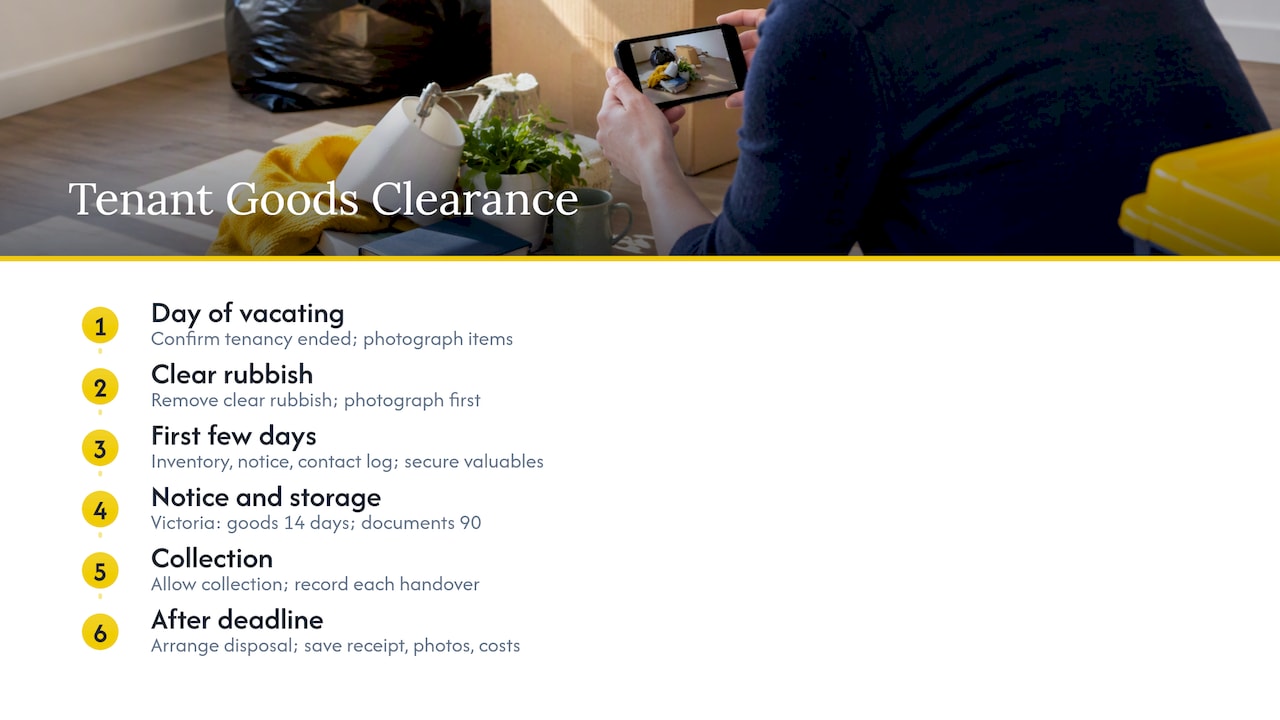
After the deadline. Book removal. Our rubbish removal preparation checklist helps you sort items so nothing is rejected on the day. Collect the receipt showing the disposal destination.
Final step. Add the receipts and photos to your file, and issue any cost summary to the former tenant. If you need the property relet quickly, line up removal in advance so it can happen the day the notice period ends. Our end of lease rubbish removal page describes how fast clearouts fit those timelines.
What do local councils require for rubbish removal at rentals?
Councils set the rules for what you can put out and how. Requirements vary by municipality, so check your own council’s website before booking anything, but a few themes recur.
Kerbside bulky waste collections often have booking requirements, item limits and restrictions on what is accepted. Mattresses, e-waste and hazardous goods are frequently excluded or need separate arrangements. Leaving a pile on the nature strip without a booking can attract a fine and may leave you responsible for cleanup.
Skip bins on the street usually need a council permit, because they occupy public land. If you place one on private property, you generally avoid the permit, but check the rules for your area. Hard rubbish piled on a footpath can also breach local laws on obstruction.
Councils also run hazardous waste days and drop-off sites for paint, chemicals and batteries, and they list authorised transfer stations. These are the destinations the EPA expects you to use for regulated waste.
Rental agents and landlords should also check whether the council has rules about waste left on rental properties generally. If you hire a removal service, ask whether it handles permits and disposal paperwork, so the compliance sits with a documented process rather than a guess.
How do you handle bulky or hazardous items left behind?
Bulky and hazardous items need a plan rather than a quick clearout. Start by identifying what you have, then pick the route.
- Photograph and list. Capture each large item and any container with an unknown substance, including labels.
- Decide whether it is goods or rubbish. A working fridge or a good sofa is goods and follows the notice process. A broken, soiled or mouldy item is usually rubbish.
- Keep hazards secure. Leave paint, solvents, gas bottles and batteries somewhere safe and ventilated. Do not mix chemicals or pour them down drains.
- Choose the authorised route. Council hazardous collections, licensed transfer stations or a specialist collector, as the EPA guidance requires.
- Use specialists for appliances. Fridges and air conditioners contain refrigerant gases and must be handled correctly. Our fridge disposal page explains the legal, eco-friendly options.
- Get proof. Keep the receipt or docket showing where each hazardous item was taken.
If an item looks dangerous, such as asbestos sheeting, leaking containers or syringes, stop. Do not handle it yourself. Contact your council or the relevant state authority for advice on licensed handling.
Heavy furniture and large volumes are a safety issue too. Lifting a wardrobe down narrow stairs is how injuries happen, and a removal crew with the right equipment lowers both the injury risk and the risk of damaging the property.
How can you dispose of tenant waste in an eco-friendly way?
Sending everything to landfill is the lazy option and often the most expensive one. A little sorting cuts disposal volume and cost, and it shows regulators you took your duty of care seriously.
Start by separating items that still have a life. Usable furniture, kitchenware and clothing can go to charity shops, provided the notice period has passed and the goods are legitimately yours to dispose of. Metal, timber, cardboard and clean glass can be recycled through council services or transfer stations. Our old furniture disposal page explains how to donate or recycle before booking removal.
Electronic waste should never go in a general skip. It contains materials that can be recovered and others that are harmful if dumped, so use an e-waste collector that can name its recycling destination.
Check what your council’s recycling policy accepts. Contaminated recycling, such as food-soiled cardboard or mixed loads, is often sent to landfill anyway, so a quick sort at the property pays off.
If you hire a removal service, ask what share of the load they divert from landfill and whether they offer a carbon-neutral option. We offer carbon-neutral operations that clients can opt into, and our team sorts for recycling wherever it is possible. Whoever you use, ask for a disposal record, because it doubles as evidence of responsible handling.
When should you hire a professional removal service?
Hire help when the job is bigger than a weekend. A full house of furniture, e-waste mixed with hazardous items, or a tight turnaround before the next tenant moves in are all good reasons to call us. A clean, documented removal protects you as much as it saves you time.
We handle residential and commercial clearouts across Melbourne, and what you get from us includes:
- Removal of general rubbish, bulky furniture, e-waste and green waste.
- Removal that supports your compliance file.
- Carbon-neutral and eco-friendly disposal options you can opt into.
- Punctual arrival, with no mess or damage left behind.
We can provide a quote for your removal job. Send us your photos and inventory through our quick quote page, and we will discuss a pick-up time for your removal job. You can also browse what we do for the full list of services, then book a documented collection once your storage period has ended.
FAQ
How long before belongings are considered abandoned?
There is no single date. Belongings are treated as goods until the tenancy has ended and the notice and storage period has passed. In Victoria that is commonly 14 days for general goods and 90 days for personal documents, as set out by Consumer Affairs Victoria.
Can you throw out rubbish a tenant left behind straight away?
Yes, rubbish and perishable goods can be disposed of without notice once the tenancy has ended. Anything that could have value or personal significance needs the notice process first. Photograph the rubbish before removal so you can show what it was.
What can a landlord do if a tenant leaves belongings behind?
Confirm the tenancy has ended, photograph and list the goods, serve the required notice, and store them for the statutory period. You can recover reasonable removal and storage costs, as the NSW Government explains. After the deadline, dispose of them through lawful routes and keep receipts.
What counts as abandonment of a rental property?
Abandonment is more than an empty-looking home. It generally means the tenancy has legally ended, whether by notice, agreement or tribunal order, and the tenant has given up possession. The NSW Government warns against treating an apparently abandoned property as a finished tenancy.