Yes, professional crews can clear furniture, workstations and fit out waste from an office overnight or on weekends with minimal disruption to staff or neighbouring tenants. Booking usually starts with a few photos or a short site visit, and ends with a fixed written quote and a confirmed after hours window. Before you lock anything in, confirm building access rules and safety paperwork so the crew isn’t turned away on the night.
TL;DR:
- For after hours entry, secure building approval, reserve the lift or loading dock, verify dimensions, and submit worker identification, insurance, and safety paperwork beforehand.
- A small, single floor clearance may finish overnight, but partition or joinery removal often requires several shifts, so leave contingency before lease handover.
- The final price depends on waste volume, crew hours, specialist disposal fees, and building charges for after hours lift or dock use.
- Electronics require separate handling from general rubbish, while batteries, fluorescent tubes, and refrigerant items need advance disclosure to the clearance provider.
- If your lease requires evidence, request diversion receipts before booking; reuse partners may collect usable furniture and equipment for reuse.
Table of Contents
- What an after hours office clearance actually covers
- How quoting, booking and scheduling for after hours work proceed
- Building access, permits and safety documentation you must arrange
- Recycling, e-waste and evidence for make-good reporting
- A practical checklist to prepare the site for an after hours clearance
- Pricing and timeline: what shapes cost and how quickly the job gets done
- Clear communication during the clearance itself
- What you’re responsible for during an after hours clearance
- Melbourne City Rubbish: booking an after hours office clearance
- FAQ
- Sources
What an after hours office clearance actually covers
A typical after hours clearance removes everything a business leaves behind when it moves, downsizes or hands back a lease. Crews are set up to handle bulky, awkward items as efficiently in the middle of the night as during the day.
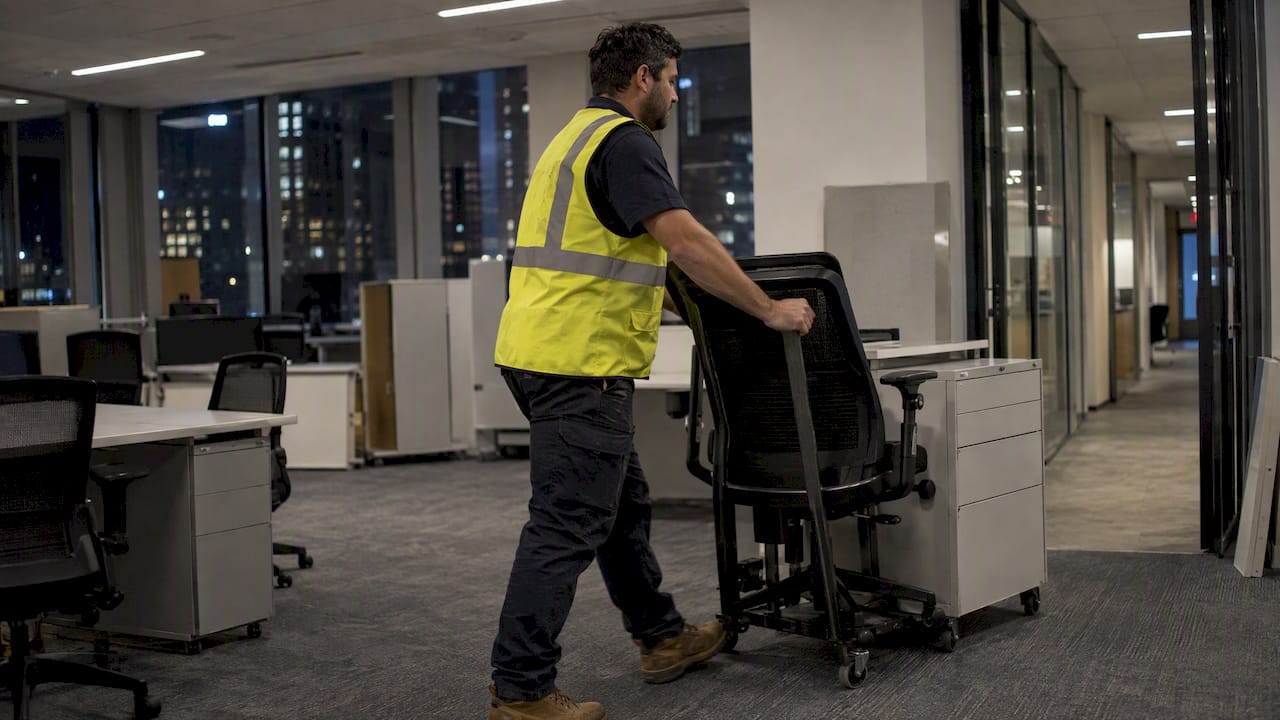
- Desks, chairs, workstations and shelving units
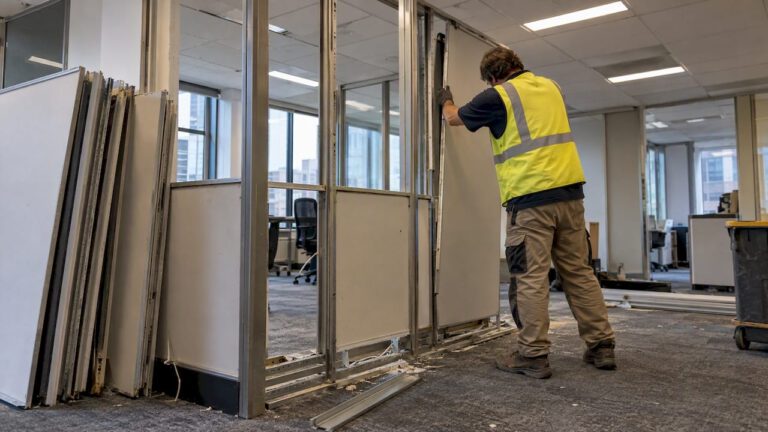
- Partition walls, joinery and built in cabinetry from a strip out
- Filing cabinets, packing materials and general office rubbish
- IT equipment and e-waste, which needs separate handling from general waste
- Confidential paper archives, often requiring secure handling before disposal
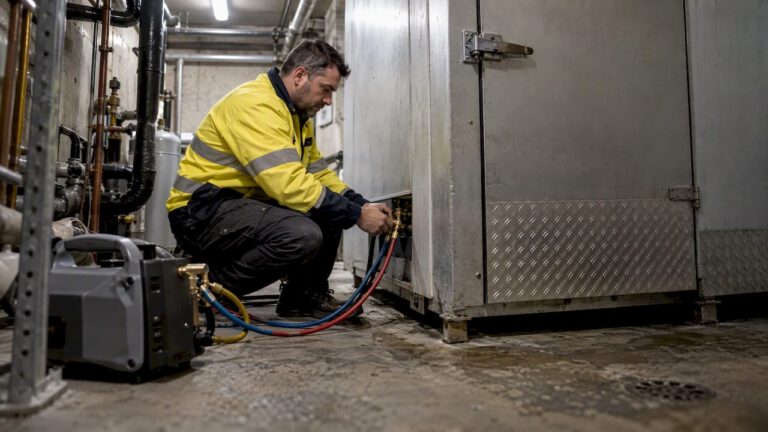
Some items need specialist attention rather than a standard load out. Hazardous or regulated materials, such as old batteries, fluorescent tubes or anything containing refrigerant, should be flagged before the job starts so they’re diverted correctly rather than binned with everything else.
A finished job should leave swept floors, a clear loading path and no leftover debris in corridors or lift lobbies. If your building management requires a signed handover or completion checklist, ask your provider to supply one on the night rather than chasing it afterwards.
How quoting, booking and scheduling for after hours work proceed
Getting an accurate price starts well before the truck arrives. The more detail a provider has upfront, the less likely you are to see extra charges added on the night.
- Send clear photos of every area to be cleared, or request a short site visit for larger jobs.
- Ask for a fixed written quote rather than a rough estimate, so there’s no renegotiation once the crew is on site.
- Choose a scheduling option: a single overnight visit for smaller offices, staged clearances across several nights for larger strip outs, or a weekend window when more time is needed.
- Confirm the booking in writing, including the exact after hours window and who will be on site to let the crew in.
Providers will usually ask for access routes, goods lift dimensions, a single contact person, and whether keys or access cards need to be arranged in advance. Staged clearances suit larger fit outs where the goods lift can only be booked in blocks, or where parts of the floor are still occupied during the day.
Pro Tip: Book the goods lift at the same time as the clearance crew, not after. Lift slots fill quickly in buildings with multiple tenants doing after hours work.
Building access, permits and safety documentation you must arrange
Most commercial buildings treat after hours access as a managed exception, not a default right. City of Melbourne guidance confirms businesses are responsible for arranging suitable collection for their own waste types, and that step starts with building approval.
Expect to provide, well before the booking:
- Advance notice to building management, usually several business days
- A confirmed goods lift or loading dock booking with verified dimensions
- An after hours contact list including mobile numbers and photo ID for each worker
- Insurance certificates and a Safe Work Method Statement (SWMS) covering lone worker arrangements
A tenancy fit out guide notes that after hours access is rarely automatic: it normally requires prior approval from building management plus contractor insurance certificates, WHS documentation and a formal work request. The same guide flags common mistakes: not verifying loading dock and goods lift dimensions, failing to secure after hours access codes, and propping open fire doors or loading shutters, which is treated as a security breach serious enough to have contractors removed from site on the spot.
One missed approval, like an unbooked goods lift, can be enough to stop a crew loading out on the night they arrive, according to a tenancy fit out guide. Getting paperwork sorted a week ahead avoids that outcome entirely.
Recycling, e-waste and evidence for make-good reporting
E-waste cannot go in with general office rubbish. Sustainability Victoria advises that old computers, monitors and other electronics should go to an authorised drop off point or be arranged with a waste collector, with EPA guidance followed where free schemes don’t apply to commercial volumes.
- Ask your provider directly whether they handle e-waste collection as part of the clearance, rather than assuming it’s included
- Look into reuse and social enterprise options for furniture and working equipment before anything is scrapped
- Request weight based diversion or disposal receipts if your lease or sustainability policy requires evidence
- Confirm reporting capability before booking, not after the truck has left
Business Victoria notes that social enterprises and reuse partners across Melbourne will collect and reuse many office items, which can support a business’s own sustainability targets by keeping furniture out of landfill. If your building requires make good reporting, this is worth raising with your provider at the quoting stage, not the night of the job.
A practical checklist to prepare the site for an after hours clearance
A little preparation ahead of time can save time and cost on the night itself.
- Take clear photos of every area to be cleared, noting access routes and any tight corners or narrow doorways.
- Record the goods lift dimensions and note any restrictions on load size or weight.
- Mark items that must be retained, relocated or kept confidential so they’re not accidentally removed.
- List anything needing specialist handling, such as servers, batteries or gas cylinders, so the crew can plan for it.
- Confirm building approvals and goods lift bookings are locked in for the agreed date and time.
- Arrange after hours air conditioning or power if the crew needs it for the duration of the job.
- Nominate a single on-site contact and arrange keys or access cards ahead of time.
Working through this list before the crew arrives is the difference between a clearance that runs to schedule and one that stalls at the loading dock.
Pricing and timeline: what shapes cost and how quickly the job gets done
Cost on an after hours job is driven by a handful of practical factors rather than a flat per hour rate.
- Total volume and weight of waste, which drives truck and crew requirements
- Crew hours needed on site, including load out and clean up time
- Specialist disposal fees for e-waste or hazardous items that can’t go to general landfill
- Any after hours levies charged by building management for lift or dock use outside business hours
A small, single floor office clearance may be completed overnight. Larger strip outs, particularly those involving partition removal or joinery, are often staged across several after hours shifts. If the clearance is tied to a lease handover date, build in contingency time rather than scheduling the final shift right up against the deadline.
Ask for an itemised written quote listing what’s included, how waste will be disposed of, and any charges that could apply if access issues cause delays on the night. A quote that’s vague about disposal method is harder to reconcile later if your building asks for diversion evidence.
Clear communication during the clearance itself
An after hours job runs on a handful of people communicating well, since there’s no building management desk staffed overnight to fall back on. Before the crew arrives, agree on a single point of contact from your business who can be reached by phone for the full duration of the job, not just at the start.
That contact should know the emergency procedures for the building, including who to call if a fire door alarm triggers, a lift fails, or an access card stops working partway through the shift. Share the building’s after hours security number with the crew directly rather than relying on it being passed along secondhand.
It’s worth agreeing a simple check-in structure: a message when the crew arrives on site, another when loading starts, and a final confirmation once the space is cleared and secured. For staged clearances running over several nights, this keeps everyone aligned without needing anyone to stay back late just to supervise.
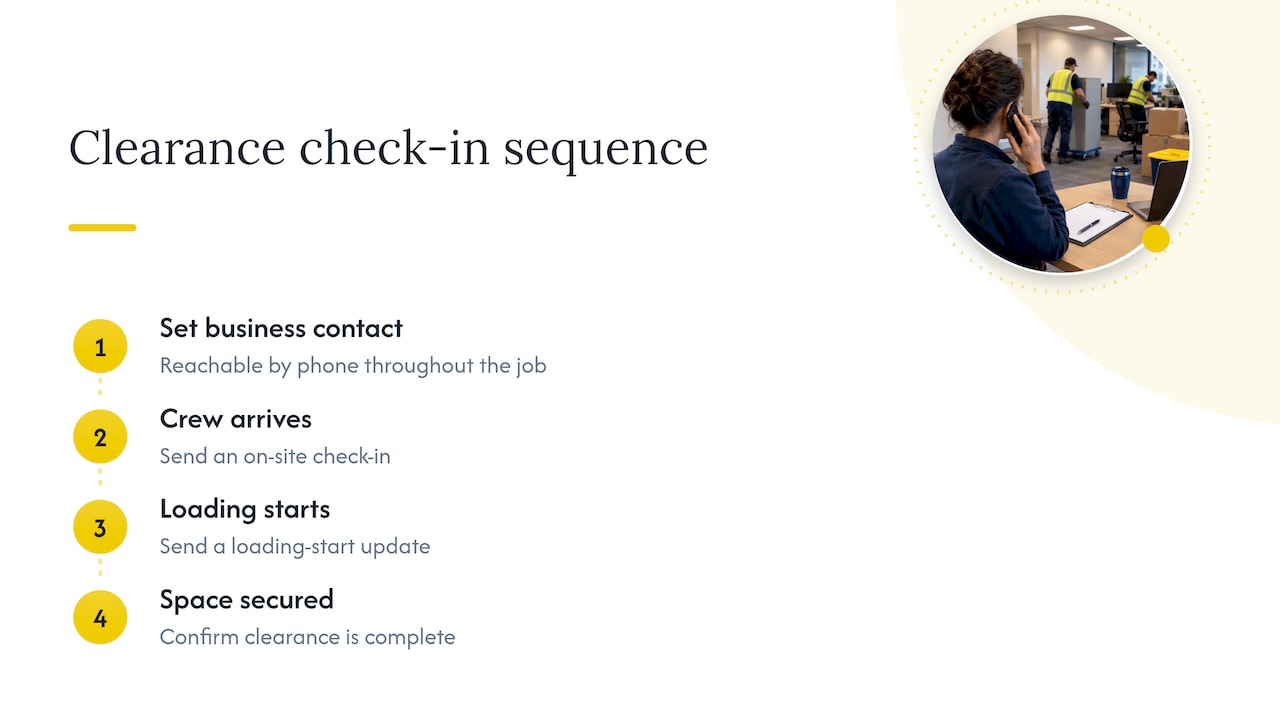
If something unexpected turns up on site, such as an item that wasn’t part of the original quote or a locked area that needs access, having a contact who can make a quick decision by phone keeps the job moving instead of stalling until the next business day.
What you’re responsible for during an after hours clearance
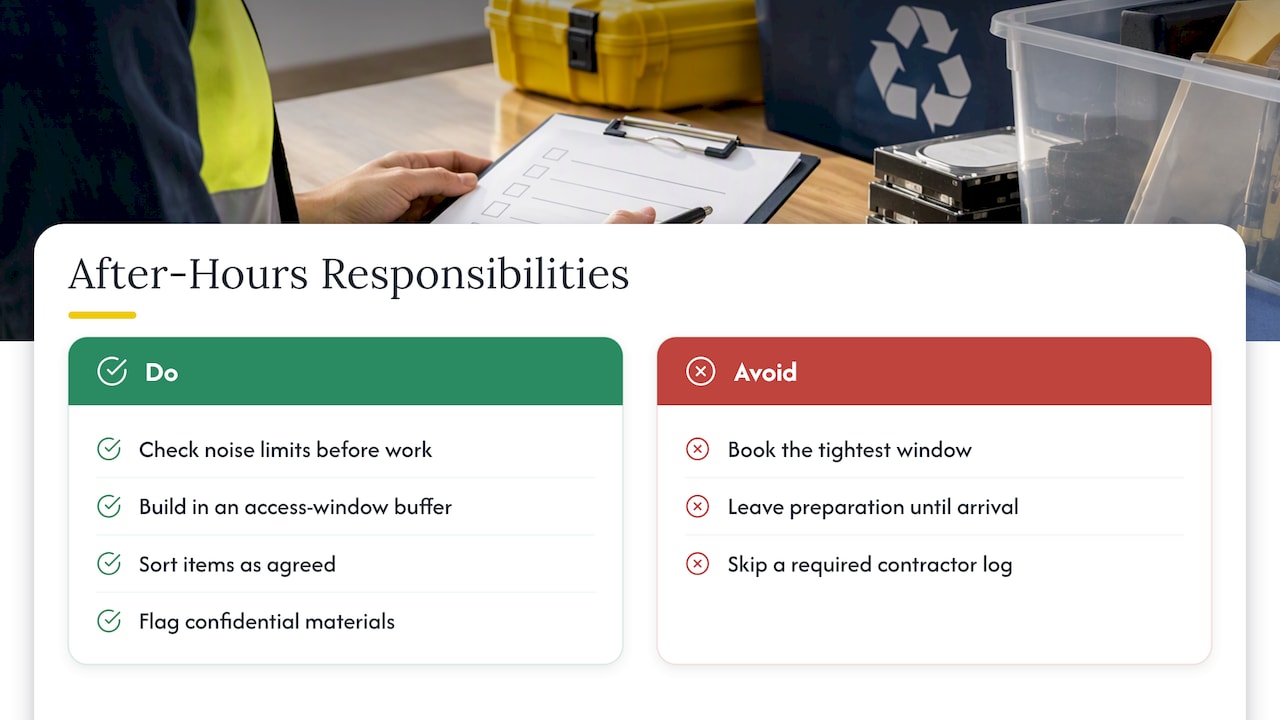
Booking the clearance doesn’t remove every obligation from your side. Most buildings set noise limits for after hours work, particularly in mixed-use buildings with residential tenants nearby, so check what’s allowed before the crew starts moving furniture or breaking down partitions.
Access windows are usually fixed and enforced strictly. If your booking has a fixed access window, arriving late or needing extra time can mean the job gets cut short or incurs additional charges, so build in a buffer rather than booking the tightest possible window.
You’re also responsible for making sure the site is ready when the crew arrives: items sorted as agreed in the quote, confidential materials flagged, and any areas needing restricted access clearly marked. Leaving this until the crew is on site adds time to the job and can push you past your approved access window.
Finally, check whether your building requires you to log the after hours visit separately from the clearance booking itself. Some buildings keep their own register of contractors on site overnight, and missing that step can cause issues even when the clearance itself is fully approved.
Melbourne City Rubbish: booking an after hours office clearance
We handle office junk removal and full office cleanouts, which means an evening start or a weekend window is a normal booking for us, not a special request. We prioritise punctuality, so you’re not left waiting on a tight access window.
When you get in touch, you can expect:
- A written quote, with an offer to beat competing written quotes
- Carbon neutral disposal options if that matters to your sustainability reporting
- Clear communication on WHS documentation and insurance so building management has what they need in advance
- No mess left behind, whether it’s a single floor clearance or a staged strip out
If your lease or building requires diversion reporting for a make good, raise it when you request your quote so it’s confirmed before the job starts. For anything involving partitions or joinery, our workstation and desk removal service and broader strip out work cover both the furniture and the fit out waste in the same visit.
Once the space is cleared, businesses refitting or re-leasing it sometimes bring in a commercial plantscaping partner to freshen up the fit out before new tenants or staff move in.
Ready to lock in a date? Request a quick quote and we’ll confirm an after hours slot that works around your building’s access rules.
FAQ
Can an office clearance be booked for overnight or weekend hours?
Yes, after hours and weekend clearances are a standard booking option for commercial office jobs, not an exception. You’ll generally need to confirm building access approval and any required paperwork before the date is locked in.
Does building management need to approve an after hours clearance?
In most commercial buildings, yes. A tenancy fit out guide notes that after hours access normally requires prior approval, contractor insurance certificates and a formal work request submitted ahead of time.
What happens to e-waste during an office clearance?
E-waste is handled separately from general office rubbish and taken to an authorised drop off point or collected by an authorised provider, as outlined by Sustainability Victoria. It’s worth asking your provider directly whether e-waste collection is included in the clearance.
How much does an after hours office clearance cost?
Cost depends on waste volume, crew hours, any specialist disposal fees and after hours levies set by building management. Current prices are on our website.
What causes delays or refused access on the night of a clearance?
The most common issues are an unbooked goods lift, unverified lift dimensions, or missing insurance and WHS paperwork, which a tenancy fit out guide lists as frequent causes of refused entry. Confirming these details with building management before the booking date avoids most delays.
Sources
- Waste and recycling for businesses | City of Melbourne
- (https://www.sustainability.vic.gov.au/recycling-and-reducing-waste-at-home/recycling-at-home/e-waste?token=4EFmFmmjsVm-ArzxurBHRt_cQjDszsw5)
- The green way to clean out your office | Business Victoria
- Tenancy fit out guide