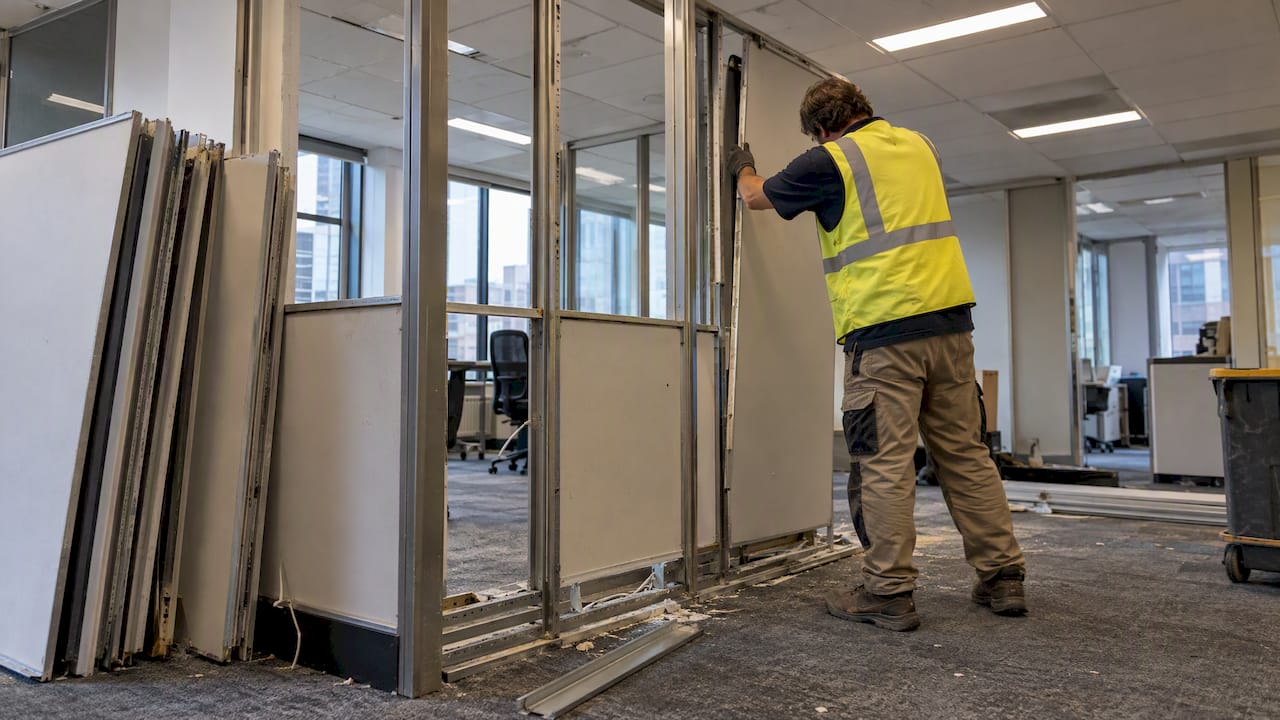
Most non structural office partitions can be dismantled and removed without major drama, as long as you check for asbestos and isolate any services first. Where either of those applies, pause and bring in licensed specialists before anyone touches a panel. For everything else, the fastest safe route is a scoped removal or strip out service. Start by requesting a written quote that lists dismantling, service isolations, waste sorting, resource recovery targets and lawful disposal.
TL;DR:
- Ask for a written quote that itemizes dismantling, service isolation, sorting, transport, and disposal, and specifies access protections, recovery targets, and documentary proof.
- Check the asbestos register before work; friable asbestos always requires Class A licensed removal, while unlicensed work on nonfriable material is allowed only under strict conditions.
- Set a 60% resource recovery target in the contract and require tracking for reportable priority waste whenever it changes hands in Victoria.
- Freestanding screens may take hours to remove, but a floor of track mounted walls with services can take several days; compare quotes accordingly.
Table of Contents
- What a professional partition removal job should include
- How to dismantle different partition types
- Compliance checks before any partition work starts
- Waste handling, reuse and recycling options
- How to get quotes and choose a removal service
- How Melbourne City Rubbish handles partition disposal and strip outs
- FAQ
- Sources
What a professional partition removal job should include
A proper scope of works protects you from surprise costs and compliance gaps later. Before you sign anything, the quote should walk through the job from first site visit to final sweep, not just “removal of partitions” as a single line item.
Look for these inclusions in any tender document or quote:
- A site survey and access plan, including protections for floors, lifts and neighbouring tenancies.
- A dismantling sequence covering safe service isolations, removal of fixings and trim, and a final clean and handover.
- Waste sorting, transport and recycling or reuse channels, with documentary proof such as weighbridge tickets or reuse receipts.
- Health and safety provisions, including PPE, dust suppression and asbestos checks before work starts.
A contractor who can answer each of these without hesitation is usually the one who has done this work enough times to price it properly. If a quote skips straight from “we’ll remove the partitions” to a dollar figure, ask what happens to the waste and who checks for asbestos first.
How to dismantle different partition types
Partition systems vary enormously, and the removal method changes the labour, risk and timeline involved. Knowing the basics helps you judge whether a quote is realistic.
- Panelised or demountable systems: these come apart in a set sequence, panel by panel, with track anchors checked as you go. Label components if you plan to reuse or resell them, since matching finishes later is hard.
- Glass and glazed screens: large panes need two person lifts and edge protection to avoid chips or cracks, and a glazier may be needed for fixed glazed walls.
- Stud and plaster or drywall partitions: expect dust, hidden cabling or data points, and a need for patching or reinstatement once the wall comes down.
- Track mounted operable walls and ceiling hung systems: these need a specialist removal sequence and sometimes lifting equipment, since the weight hangs from the ceiling grid rather than the floor.
- Freestanding cubicles and screens: usually the quickest to remove, and often in good enough condition for donation or reuse rather than disposal.
Timeframes stretch from a few hours for a handful of freestanding screens to several days for a full floor of track mounted walls with services to isolate. Use that range to sanity check any quote that seems unusually fast or suspiciously cheap.
Pro Tip: Ask the contractor which partition type takes longest on your floor plan. A specific answer, rather than a flat day rate, usually signals real experience with that system.
Compliance checks before any partition work starts
Before a single panel moves, the site’s asbestos register needs to be checked. Older buildings, particularly those fitted out before the 1990s, can have asbestos containing materials in wall linings, floor tiles or ceiling panels tucked behind partitions. WorkSafe guidance sets out when licensed removal is required: friable asbestos always needs a Class A licence, and even small, non-friable removals are only permitted without a licence under tightly restricted conditions.
Waste classification matters just as much as the physical removal, and businesses that plan on large-scale cardboard recycling should consider a cardboard compactor to streamline onsite waste handling. Mixed demolition and fitout waste needs to be sorted and classified correctly, and in Victoria, reportable priority wastes must be tracked through EPA Victoria’s Waste Tracker every time they change hands.
A load that is misclassified or poorly documented can be rejected at the disposal facility, which means fines and project delays on top of the original cost.
Before work starts, confirm:
- The asbestos register has been reviewed for the specific area being stripped out.
- Licensed removalists are booked if any disturbance of suspected ACM is likely.
- Waste streams are classified correctly and tracked where required.
- Paperwork obligations are written into the contract, not left as a verbal promise.
Waste handling, reuse and recycling options
Landfill should be the last stop for partition materials, not the first. Reuse and donation come before recycling, and recycling comes before disposal of whatever is left over. Partitions in reasonable condition can go to furniture disposal and recycling channels or reuse marketplaces rather than straight into a skip, which guidance on office reuse points to as both cheaper and lower carbon than processing mixed materials for recycling.
Build a measurable target into the contract rather than leaving diversion to chance. The Better Buildings Partnership’s stripout guidelines recommend a minimum resource recovery target of 60% for strip out work, because without that figure in writing, contractors tend to default to landfill for anything that is not straightforward to sort.
To check the target is actually being met, ask for:
- Weighbridge tickets showing where waste was taken and how it was classified.
- Receipts from recyclers for materials like metal framing and glass.
- Donation records for furniture or partitions passed on for reuse.
Mixed materials and contaminated loads are the main obstacle to high diversion rates, and some components genuinely need specialist processing rather than a standard skip bin.
How to get quotes and choose a removal service
Comparing quotes properly means asking the same questions of every contractor, not just comparing the bottom line.
- Request a site survey and a detailed written scope with itemised pricing for dismantling, service isolations, sorting, transport and disposal.
- Ask for copies of relevant licences, proof of insurance, and examples of previous strip outs with evidence of waste diversion.
- Insist on specific contract clauses covering the asbestos protocol, a resource recovery target, and a requirement to produce disposal or tracking evidence.
- Watch for red flags: a vague scope, no mention of disposal evidence, or reluctance to provide weighbridge tickets or refuse destination details.
Good site design also affects pricing. Better practice guidelines for commercial waste handling note that accessible collection points and clear transport routes reduce contractor charges and handling risk, so flag any awkward loading dock or lift access upfront rather than letting it surface as a surcharge later.
How Melbourne City Rubbish handles partition disposal and strip outs
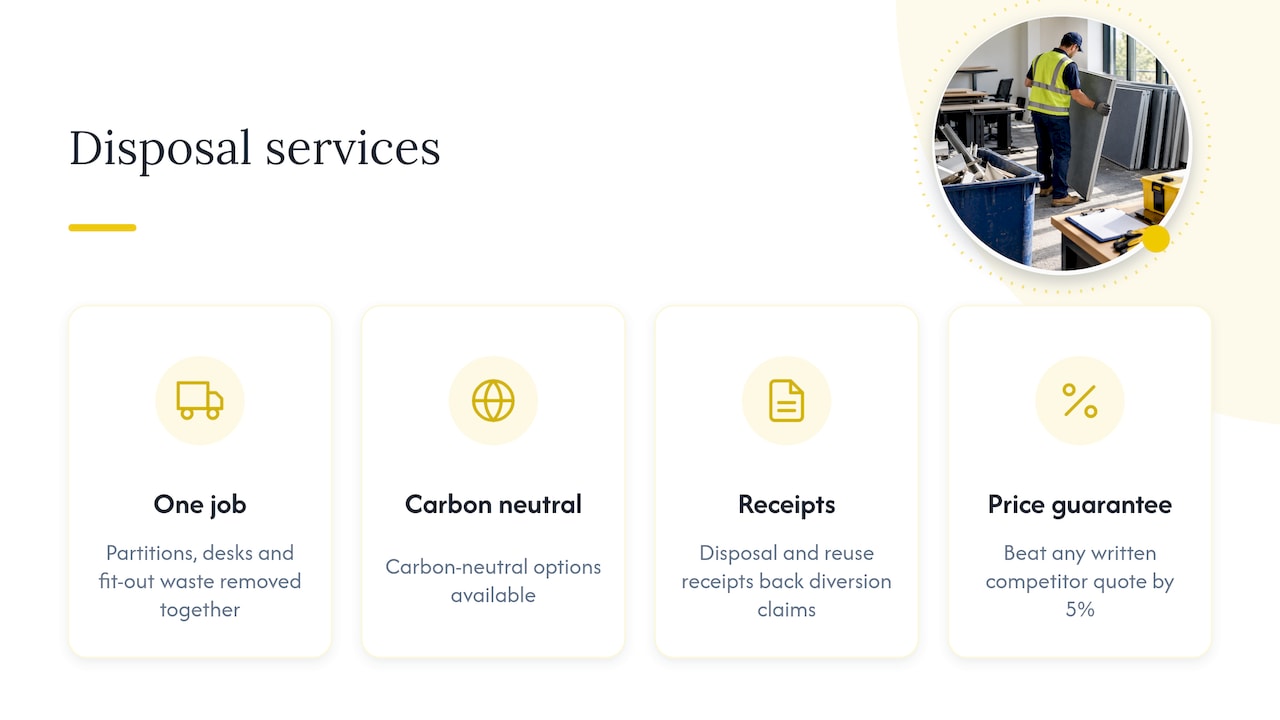
We run full strip outs, commercial office rubbish removal, furniture disposal and recycling, and workstation removal as part of make good support, so partitions, desks and fit out waste come out in one coordinated job rather than several separate bookings. We offer carbon neutral options for clients who want eco-friendly disposal built into the scope, and we back diversion claims with disposal and reuse receipts rather than a verbal assurance.
We price every job per site rather than off a generic rate card, and we guarantee to beat any written competitor quote by 5%. If you are planning a layout change, refurbishment or end of lease clearance, request a free site survey and scoped quote through our commercial office rubbish removal page, or get a fast estimate via our quick quote form.
FAQ
How do I dismantle an office partition?
Dismantling starts with checking the asbestos register and isolating any power or data cabling, then removing fixings and trim before taking down panels in sequence. For panelised systems, work from one end of the run to the other and check track anchors as each section comes free.
How do I remove office cubicle walls?
Freestanding cubicle walls are usually the simplest type to remove, since they are not fixed to the ceiling or structural framing. Unclip or unbolt connecting panels, disconnect any shared power poles, and lift sections clear, checking first whether they are in good enough condition for donation or resale.
What are office dividers called?
Office dividers go by several names depending on the system: demountable or modular partitions, operable or track mounted walls, glazed screens, and freestanding cubicle panels. The right removal method depends on which type is installed, since fixed glazed walls need different handling to a simple screen.
How do I disassemble a partition wall?
Disassembly generally follows isolate services, remove trim and fixings, then take down panels or studwork in the reverse order they were installed. Stud and plaster or drywall partitions typically generate more dust and may reveal hidden cabling, so budget extra time for patching once the wall is down.
Sources
- BBP stripout waste guidelines and workbook
- Removing asbestos in workplaces — compliance code
- What is Waste Tracker | EPA Victoria
- Better practice guidelines for waste management and recycling in commercial and industrial facilities