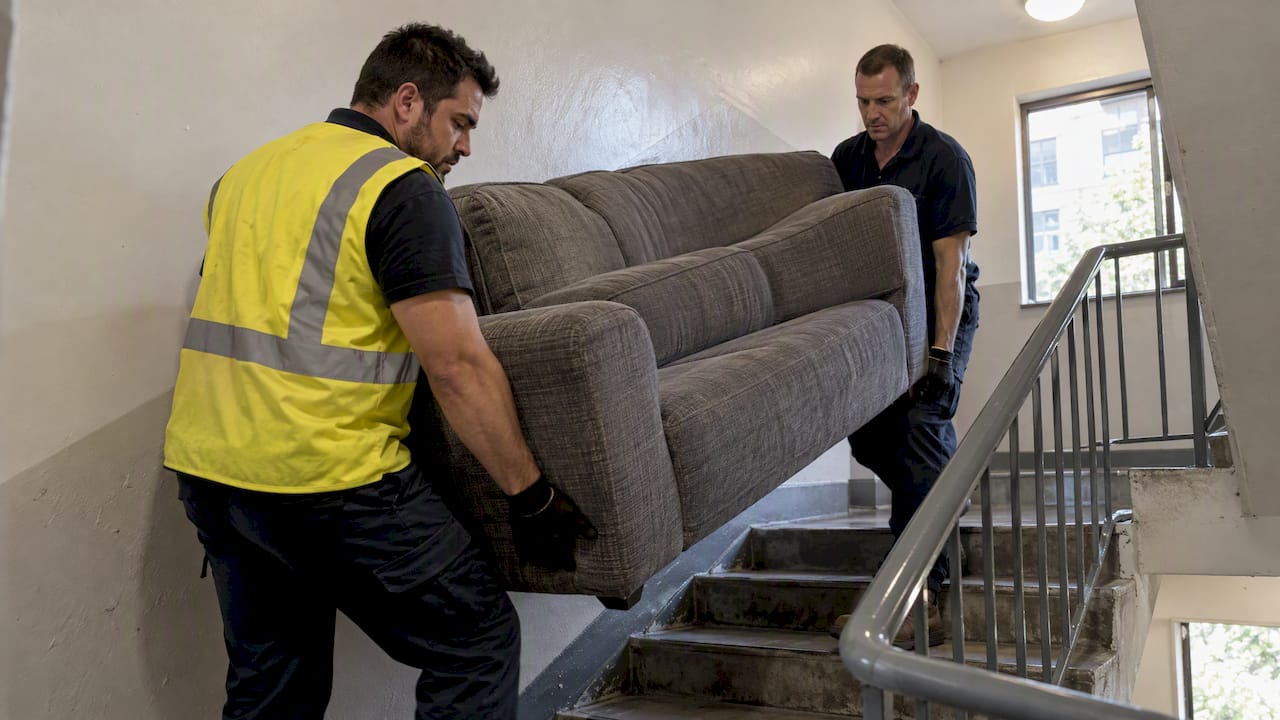
Yes, professional rubbish removal teams will carry bulky items down stairs, and most will also manage lifts, loading docks and tight apartment access as part of the job. To get an accurate quote, tell the team your floor number and stair count, whether a lift is available and bookable, and your parking or loading access. Access and labour drive the price far more than volume alone.
TL;DR:
- Quotes can include labor, disposal fees, restricted parking charges, and a minimum charge; heavy or awkward stair carries may require extra crew or equipment.
- Send photos of the item, stairwell, and route to the truck; they help crews estimate labor and quote closer to the final price.
- Give the crew your floor, stair count, tight turns, parking limits, and lift booking status; an unconfirmed service lift can delay or reschedule collection.
- Council pickup is kerbside only: Melbourne offers one free one cubic meter collection per financial year, while Yarra allows two bookings per calendar year.
- Flag mattresses, large glass panels, gas appliances, asbestos, and chemicals before booking, since these items may need special handling or disposal at licensed facilities.
Table of Contents
- What a stair-carry rubbish removal service includes
- What affects the price (access, labour, disposal and minimum charges)
- Checklist to give when you request a quote or booking
- Why safety and manual-handling controls matter
- When council hard-waste applies and when you need a private stair-carry removal
- How a stair-carry job typically runs from arrival to completion
- Melbourne City Rubbish: how we help with stair-carry jobs
- FAQ
- Sources
What a stair-carry rubbish removal service includes
A standard stair-carry job covers carrying items from your unit or storage area down to the truck, loading, and disposal or recycling sorting at the other end. Most crews separate items that can be donated or recycled from genuine waste, which cuts landfill volume and can reduce your bill.
Service details vary by provider and by job size:
- Same-day or next-available pickup where the job is straightforward and access is confirmed.
- A free on-site quote for larger or awkward jobs, especially where stairs or narrow doorways are involved.
- Crew size adjusted to the job, often two to four people for multi-flight carries.
- Truck type matched to volume, from a single trailer to a full tipper for bulky furniture or construction waste.
Most crews accept furniture, appliances, general household junk, green waste and office furniture. Items needing special handling include mattresses, large glass panels, gas appliances and anything containing asbestos or chemicals, which usually need separate arrangement or disposal through a licensed facility.
What affects the price (access, labour, disposal and minimum charges)
Stairs add time, and time is what you pay for. A load that takes ten minutes to wheel out of a ground-floor garage can take forty minutes to hand-carry down three flights with a tight turn on the landing, and that difference shows up directly in the quote.
Most quotes are built from a few components:
- Labour, based on crew size and estimated time on site.
- Disposal or tip fees, which depend on volume and item type.
- Access or parking charges, where loading zones are restricted or a permit is needed.
- A minimum charge that applies regardless of load size, to cover travel and set-up time.
Pro Tip: Send photos of the stairwell, the item and the path to the truck before the job, not just a description. This lets the team quote closer to the final price before they arrive.
Safe Work Australia classifies carrying heavy or awkward loads up or down stairs as a hazardous manual task, and jobs that trigger extra control measures, such as a larger crew or mechanical aids, generally cost more than a simple ground-floor collection.
Checklist to give when you request a quote or booking
The more precise your access details, the closer your quote will match the final invoice. Before you call or submit an online form, have this ready:
- Full address, floor number, and the number of stairs or flights between the item and the truck.
- Whether any stairwell has tight turns, low ceilings or narrow landings.
- Lift availability, and whether a service lift booking is confirmed or still needed.
- Any storage cages, balconies or basement areas the crew needs to access.
- Parking or loading bay details, including truck size limits, gate codes or concierge instructions.
- A preferred time window, especially in buildings with restricted move hours.
- A list of items with photos and approximate dimensions or weights, flagging anything hazardous.
- Confirmation of any building insurance or compliance requirements, such as proof of public liability cover.
Pro Tip: Confirm your lift booking reference with building management before the crew arrives. Arriving without a confirmed booking is one of the most common reasons a stair-carry job gets delayed or rescheduled on the day.
Why safety and manual-handling controls matter
Carrying heavy or bulky items down stairs is physically demanding and genuinely risky, which is why it is treated as a distinct category of work rather than routine lifting.
Hazardous manual tasks, including carrying loads up or down stairs, call for control measures such as mechanical aids, team lifts and task redesign to reduce the risk of musculoskeletal injury.
Safe Work Australia
In practice, that means crews use trolleys and straps where stairs allow, add an extra team member for awkward or heavy pieces, and plan the route before lifting anything. Accurate access details let a team plan these controls ahead of time instead of improvising on arrival, which is also what keeps a quote stable and avoids a job being cancelled on safety grounds.
When council hard-waste applies and when you need a private stair-carry removal
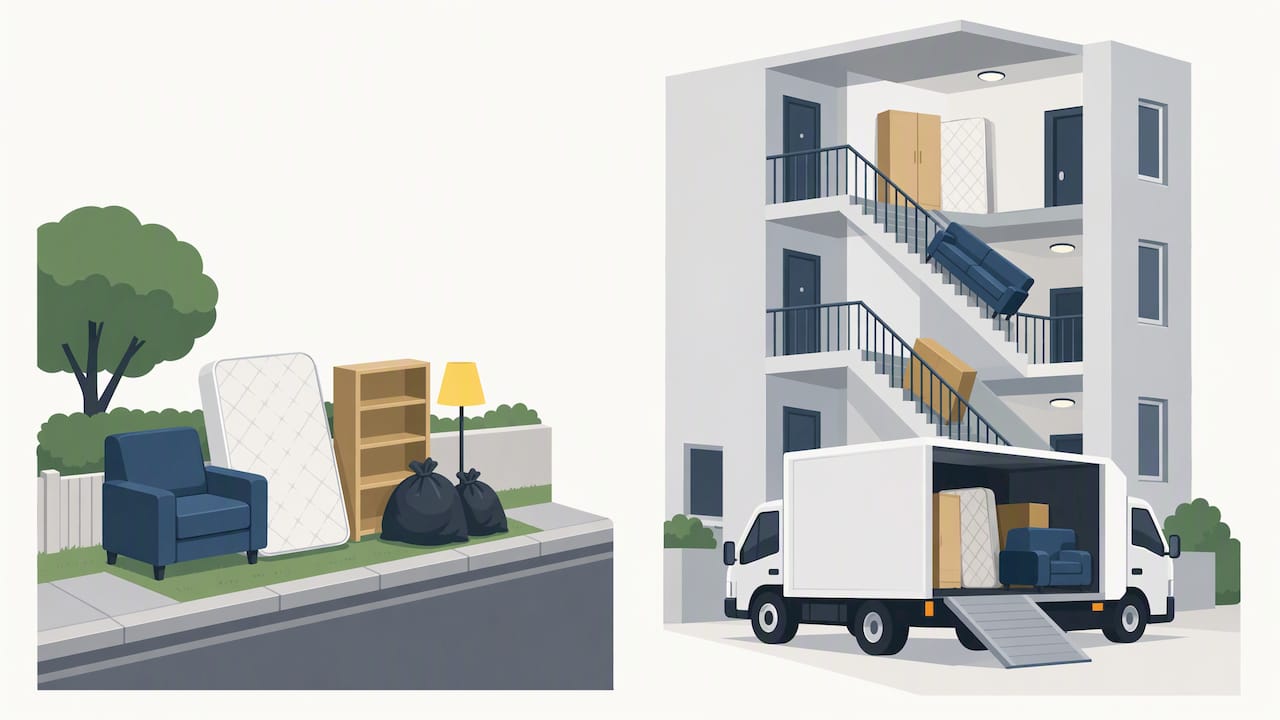
Council hard-waste collections are a useful free option, but they come with real limits. City of Melbourne offers one free collection of one cubic metre per financial year, and crews will not enter private property to collect it. Yarra City Council caps eligible properties to two collections per calendar year, with volume and weight limits per booking, and collection is kerbside only.
This creates a gap for apartment living:
- Items inside a unit, storage cage or basement are not collected unless you carry them to the kerb yourself.
- Shared or common-property waste in multi-unit buildings often falls outside standard council bookings, as outlined in council apartment building toolkits.
- Where council collection does not cover your situation, booking a private stair-carry service or asking your building manager to arrange commercial collection is the practical next step.
How a stair-carry job typically runs from arrival to completion
A typical job follows a predictable sequence, which is part of what makes stair-carry removal straightforward once access is confirmed.
- The crew arrives within an agreed window and does a quick walk-through of the route from your unit to the truck.
- Where a free on-site quote applies, the crew confirms the price before loading begins.
- Protective materials go down on floors, door frames and lift walls to prevent scuffs or damage during multiple trips.
- Items are carried down in stages, with larger crews splitting roles between carrying, loading and managing the lift or stairwell.
- Recyclable and donatable items are sorted separately from general waste where possible.
- The crew sweeps the collection area and common hallway before leaving, so you are not left tidying up after them.
If your clear-out includes construction debris or leaves dust on floors and skirting, a guide to removing debris from indoor surfaces covers practical steps for the final clean once the waste is gone.
Melbourne City Rubbish: how we help with stair-carry jobs
We handle apartment and strata jobs where stairs, lifts and loading access shape how the job runs, not just how much goes in the truck. Our crews plan the route, crew size and timing around the access details you provide, so the quote you receive on-site reflects what actually happens on the day.
- We offer apartment building rubbish removal built around stairwells, lifts and restricted loading zones.
- We provide strata rubbish removal with direct coordination with building managers where insurance or move-in rules apply.
- We cover hard-waste collection solutions for items that fall outside council limits.
- We offer a disposal option focused on reducing environmental impact.
We state on our site that we prioritise punctuality, back it with real-time notifications and a lateness credit, and promise to beat any written competitor quote by 5%. If you have a stair-carry job coming up, get a quick quote and tell us your floor, stairs and lift details so we can price it accurately before we arrive.
FAQ
What is the minimum price for junk removal?
Minimum charges vary by provider and typically cover a base amount of labour and travel time regardless of load size. The exact figure depends on your location, access and the volume of waste, so an on-site or photo-based quote gives the most accurate answer.
How much does hard rubbish removal cost?
Cost depends on volume, access and whether items need to be carried from inside a building rather than collected kerbside. Stair carries, tight turns and restricted parking generally raise the price compared with a straightforward ground-floor or kerbside collection.
Is it illegal to put your rubbish in someone else’s bin in Australia?
Putting rubbish in a bin that is not yours, including a neighbour’s or a shared building bin without authorisation, is generally not permitted and can lead to fines under local council rules. Check with your specific council or building manager, since bin rules and enforcement vary by area.
How do I get rid of a lot of rubbish?
For small volumes, a council hard-waste booking may work if your items are eligible and can be placed at the kerb, as outlined by City of Melbourne and Yarra City Council. For larger volumes, items inside a building, or anything needing to be carried down stairs, a private removal service is generally the more practical option.
Sources
- Book hard rubbish collection — Yarra City Council
- Hard waste — City of Melbourne
- Lifting, pushing and pulling — Safe Work Australia