A typical office clearance in Melbourne runs from a few hundred dollars for a single room to several thousand for a full-floor strip-out, with weight, access and regulated waste streams like e-waste driving most of the swing. The fastest way to pin down your own number is a written quote that lists exclusions and confirms where your waste ends up. Get that in hand before you compare any two prices.
TL;DR:
- Quotes can use volume, truckload, item, or fixed scope pricing, so send every provider the same inventory, photos, and access details before comparing totals.
- Convert each quote to a full job total, including GST, access charges, heavy item fees, electronic waste handling, shredding, and permit or parking costs.
- A skip or bin on a public road or footpath generally needs a council permit; confirm who pays and whether building loading dock access avoids it.
- Victoria bans electronic waste from landfill, while certain batteries need special handling; verify authorized transporters and facilities, request disposal records, and use Waste Tracker when required.
Table of Contents
- What affects the price of an office clearance in Melbourne
- Typical price bands and example job scenarios for Melbourne offices
- How to scope the job and get comparable written quotes
- Council, CBD and permit costs that can add to a Melbourne office clearance
- Sustainability, e-waste and compliance obligations in Victoria
- Why choose Melbourne City Rubbish for office clearances
- FAQ
- Sources
What affects the price of an office clearance in Melbourne
Office clearance quotes rarely fail because a provider is dishonest. They fail because two quotes are pricing different jobs. Providers charge by cubic metre, by truck load, by item, or as a fixed price for a defined scope, and those models don’t convert cleanly into each other unless you ask for the underlying detail.
A few things consistently push a quote up:
- Heavy or awkward items such as safes, server racks or boardroom tables often carry a line-item surcharge.
- Stair carries or lift bookings add labour time, especially in older CBD buildings without a dedicated goods lift.
- Suspected asbestos in ceiling tiles or old flooring stops a standard clearance until it’s assessed separately.
- Confidential document shredding is usually priced apart from general rubbish.
- E-waste such as monitors, printers and cabling is billed differently again because it can’t go to landfill.
Disposal route matters just as much as collection. Landfill levies, e-waste processor fees and recycler gate charges all sit behind the number you’re quoted, even when the provider doesn’t break them out. Add GST, and factor in that some buildings require a parking permit or loading dock booking that shows up as a separate charge rather than part of the removal fee.
Pro Tip: Ask every provider to quote using the same unit, whether that’s per cubic metre or a single fixed price, so you’re genuinely comparing like with like.
Typical price bands and example job scenarios for Melbourne offices
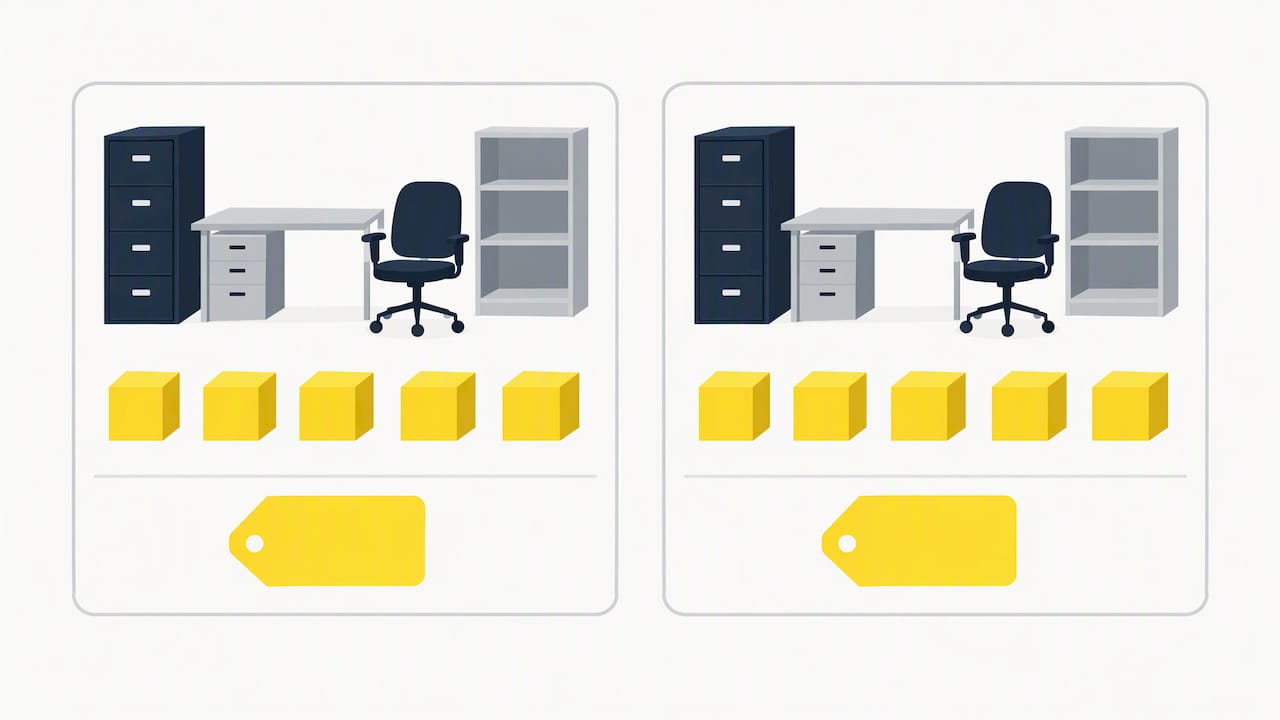
Scope drives price more than anything else, so it helps to know roughly where your job sits before quotes start arriving.
| Job size | What’s typically included | Likely add-ons |
|---|---|---|
| Small (single room, a few desks) | General waste removal, basic furniture, loading and transport | E-waste handling, confidential shredding |
| Medium (several rooms, mixed furniture) | Desks, chairs, partitions, kitchen fit-out items | CBD permit fees, heavy item surcharge, after-hours labour |
| Large (full floor strip-out or de-fit) | Segregated waste streams, joinery removal, floor coverings | Skip placement, daily parking-bay charges, hazardous material assessment |
Add-on line items worth asking about specifically include e-waste handling fees, a heavy item surcharge for things like safes or filing cabinets, any CBD permit cost passed through from the council, and skip placement with its associated daily parking-bay charge.
Before you accept a quote, request these in writing:
- An itemised exclusion list, so you know what isn’t covered.
- Confirmation of disposal destination for regulated waste streams.
- Whether any permit or parking fee is included or billed separately.
How to scope the job and get comparable written quotes
Getting three wildly different numbers for the “same” job almost always means three providers quoted three different scopes. A short, structured brief fixes that.
- Write an itemised scope document covering furniture, IT equipment, confidential paper and anything that might be hazardous.
- Supply access details and photos, including floor level, lift availability and loading dock access, so every provider prices the same labour and vehicle size.
- Ask for disposal destinations and recycling rates in writing, along with confirmation that any permit fee is built into the quoted figure.
- Request one fixed price for that exact scope, with written exclusions and proof of disposal supplied after the job is done.
When you compare quotes, convert everything to the same basis. A per-lift price and a per-cubic-metre price don’t tell you much side by side unless you work out what a full job would cost under each model, inclusive of GST. Commercial waste cost guidance recommends modelling the total project cost this way rather than comparing headline per-lift figures, since a cheaper-looking unit price can still produce a higher total once frequency, weight and access charges are added in.
Pro Tip: Send the same scope document and photos to every provider you ask. It’s the single easiest way to stop quotes drifting apart for reasons that have nothing to do with price.
Council, CBD and permit costs that can add to a Melbourne office clearance
Some of the cost in a CBD clearance has nothing to do with the removalist and everything to do with council rules. If a skip or bin sits on a public road or footpath, it generally needs a permit, and the City of Melbourne publishes the fee schedule for these. Under its waste bin permit fees, a green annual permit for a 240 litre garbage bin costs a moderate fee, and a daily parking-bay permit application carries a separate application fee, figures that apply from 1 April 2026.
Separate to bin permits, commercial waste-collector trucks operating in the CBD face their own annual permit fee, and some zones restrict collection hours, which can push jobs into after-hours slots that cost more in labour. Worth confirming before you sign anything:
- Who is responsible for arranging and paying for any council permit.
- Whether the quoted price already includes permit and parking-bay fees.
- Whether your building’s loading dock avoids the need for a public-space permit altogether.
Sustainability, e-waste and compliance obligations in Victoria
E-waste, including old monitors, printers and cabling, is banned from landfill in Victoria, and certain batteries are classified as priority waste requiring special handling. As the generator of that waste, EPA Victoria’s permissions scheme guidance sets out that you’re expected to check your transporter and receiving facility are authorised, retain evidence of disposal, and use the Waste Tracker system where the waste stream requires it.
Separating furniture, IT equipment and packaging before collection isn’t just tidier. It improves recovery rates and gives you a clearer paper trail for each stream. Before you book, ask your provider for:
- Waste transaction records for the job.
- The name of the destination facility for each waste stream.
- Recycling or recovery percentages where available.
Our e-waste collection and disposal service is built around exactly this kind of record-keeping, so clients have documentation on hand if they’re ever asked to show where their decommissioned IT equipment ended up.
Why choose Melbourne City Rubbish for office clearances
We quote office clearances as a fixed price for the scope you give us, not a vague per-load estimate that moves once the truck arrives. Every quote comes with written exclusions, disposal records after the job, and the option to go carbon-neutral through our partnership with carbonneutral.com.au.
- Some providers work after-hours and around lift bookings to minimize business disruption.
- Team members may carry insurance and undergo background checks for work in occupied commercial floors.
- Disposal records for e-waste and general waste may be provided to clients for compliance purposes.
| What you get | Detail |
|---|---|
| Pricing | Fixed quotes for specified scopes |
| Disposal proof | Destination and recycling records may be supplied after collection |
| Sustainability option | Option for eco-friendly disposal may be available |
Booking starts with a site detail form covering your scope, access and preferred timing, and we confirm the job in writing before anything is collected. If you’re ready to compare a real number against whatever you’ve already been quoted, use our quick quote tool and we’ll come back with a fixed price for your specific job.
FAQ
What is the typical cost of rubbish removal in Melbourne?
Cost depends heavily on volume, weight and access, with small single-room jobs sitting at the lower end and full-floor strip-outs at the higher end. The only reliable way to know your own figure is a written quote scoped against an itemised list of what needs removing.
How much can you charge for rubbish removal?
Pricing structures vary by provider and are usually based on cubic metres, truck loads, individual items or a fixed price for a defined scope. Comparing providers only works when you convert their pricing models to the same basis, including GST and any permit fees.
How can I get junk removed in Melbourne?
The simplest path is booking a provider that handles collection, transport and disposal as one service, rather than arranging a skip and labour separately. Our office junk removal service covers exactly this, from scoping through to disposal records.
How much does it cost to hire a skip bin in Melbourne?
Skip bin costs depend on size and placement location, and if the skip sits on a public road or footpath you’ll generally need a permit as well. The City of Melbourne’s bin permit fee schedule lists specific charges by bin size and permit type, separate from whatever the skip hire company itself charges.
Do I need a permit to place a skip bin in the Melbourne CBD?
Yes, placing a skip or bin on public space in the CBD typically requires a council permit, and restricted collection hours can apply in some zones. Confirm with your provider whether this fee is already included in your quote or billed separately.
Sources
- Waste bin permits | City of Melbourne
- Permissions scheme policy and guidance (EPA Victoria)
- Commercial waste costs (BundleWaste)