Run a short waste audit this week, then prioritise whichever stream is bulkiest in your bins, usually cardboard for offices and retail, or organics for hospitality. That single move drives the fastest cost savings and diversion gains. From there, right-size your bins and bring in a compliant local contractor such as Melbourne City Rubbish to secure collections that meet City of Melbourne and EPA Victoria rules.
TL;DR:
- Most Melbourne businesses should prioritize targeting their largest waste stream, with cardboard for offices and retail, and organics for hospitality, to maximize cost savings.
- A three-day waste audit focused on sampling and simple sorting can identify the dominant material, guide bin right-sizing, and improve recycling efficiency within one month.
- Separating high-levy materials like cardboard, organics, and e-waste reduces costs and contamination risks, but staff training and clear signage are essential to prevent rejected loads.
- Choosing a compliant waste contractor requires verifying proper disposal sites, permission for priority waste, and transparent, itemized invoicing to avoid hidden surcharges.
- Melbourne businesses benefit from the landfill levy as an incentive to recycle, with localized government programs and deposit schemes providing additional on-site support and revenue recovery options.
Table of Contents
- Which recycling streams to start with in Melbourne
- How do you run a fast waste audit for your business?
- What does the Victoria landfill levy mean for your costs?
- What causes contamination surcharges and how do you avoid them?
- How do you choose a compliant waste contractor in Melbourne?
- Are there government incentives for business recycling in Melbourne?
- How do you set up a business recycling program in Melbourne, step by step?
- How do you get staff on board with recycling at work?
- Getting your recycling program running with local support
- Key Melbourne and Victorian waste resources
- Sources
- FAQ
Which recycling streams to start with in Melbourne
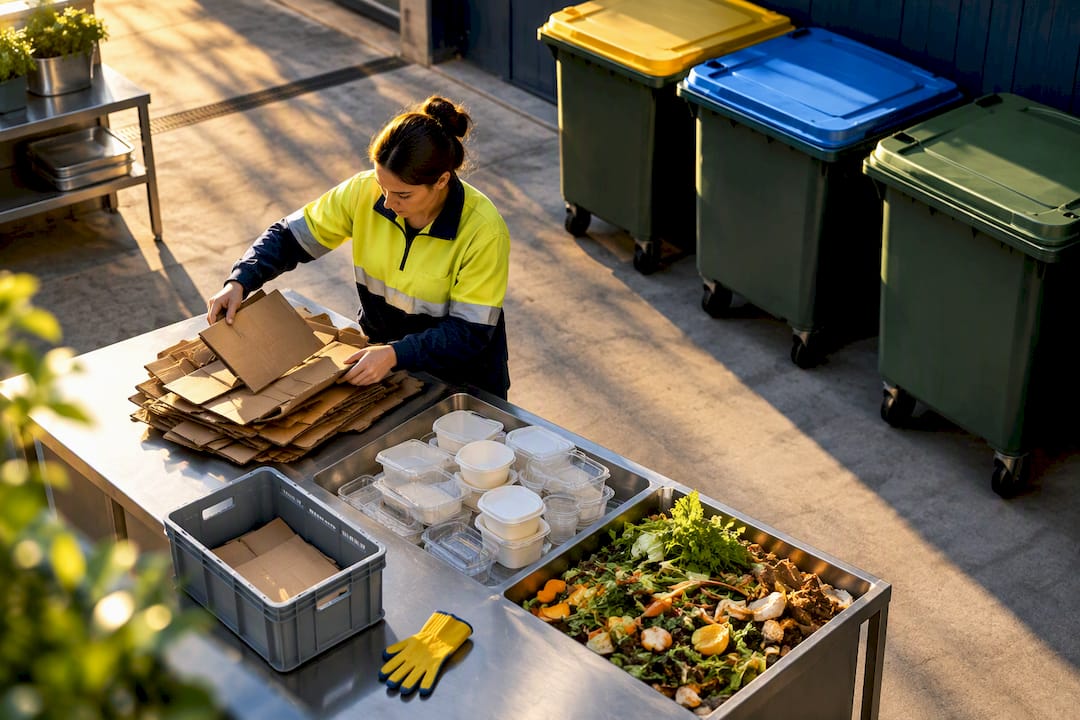
Cardboard is the highest-impact starting stream for most Melbourne offices, retail outlets and warehouses, because it’s usually the single biggest thing filling your general waste bin, and it’s cheap to bale or separate. A Bundle Waste guide for Melbourne businesses makes the same point: auditing general waste first and isolating one high-volume stream avoids contamination problems and shows savings almost immediately.
Commingled recycling covers glass, plastic bottles and containers, paper, and cans, all loose in one bin, no bagging. The usual exclusions trip people up: no soft plastics, no polystyrene, no shredded paper (it jams sorting equipment), and no takeaway coffee cups, which are lined and not accepted in most commercial commingled streams.
Organics matters most for hospitality. Food scraps sent to landfill break down without oxygen and generate methane, a potent greenhouse gas, while a dedicated organics bin usually costs less per lift than general waste once volumes are separated properly. Cafés, restaurants and catering kitchens typically see the fastest payback here.
E-waste needs separate handling entirely. Old monitors, keyboards, phones and batteries are banned from landfill in Victoria and must go through a licensed collector, not your general recycling stream. If your office is doing a refresh or a clean-out, a dedicated e-waste collection service keeps you on the right side of that ban rather than risking a mixed load.
Priority order for most businesses:
- Offices and retail: cardboard first, commingled second.
- Hospitality and food service: organics first, cardboard second.
- Warehouses and logistics: cardboard and pallet timber first.
- Any business with old electronics: e-waste as a standalone, licensed stream.
How do you run a fast waste audit for your business?
You don’t need a consultant or a spreadsheet marathon to know what’s in your bins. A basic three-day audit tells you almost everything you need to prioritise correctly.
- Sample for three days. Before collection, open the general waste bin and record what’s dominant by volume, not weight. Cardboard looks huge but weighs little; food waste is the opposite.
- Tally the top two materials. Most sites find one or two streams make up more than half the bin. That’s your starting point.
- Right-size the bins. If general waste is half empty on collection day, drop to a smaller bin or fewer lifts per week. If recycling overflows, go bigger before you go more frequent.
- Place recycling bins beside every general waste bin, not in a separate corner, and update signage so staff aren’t guessing. Bundle Waste’s research found bin placement is one of the biggest levers on contamination rates.
- Pilot one or two streams only. Don’t roll out cardboard, commingled and organics in the same week. Get one working, then add the next.
Pro Tip: Run the audit the same week you’d normally get a rubbish collection quote. You’ll walk into that conversation with real numbers instead of guessing your bin sizes, which usually gets you a tighter, more accurate quote.
Give the pilot one to three months before expanding. A structured plan following this kind of phased approach can cut landfill volumes by 20 to 40% within a year, largely through right-sizing and getting one stream genuinely clean before adding the next.
What does the Victoria landfill levy mean for your costs?
Every tonne your business sends to landfill in Victoria carries a levy on top of the base disposal fee, and that levy has climbed steadily over the past decade. It’s the single biggest reason recycling is usually cheaper than landfill for the same volume of waste. Recyclable material either avoids the levy altogether or attracts a much lower processing charge, so shifting cardboard, organics or commingled material out of your general waste bin doesn’t just reduce clutter, it reduces the line item your contractor bills you for.
The gap shows up fastest in businesses with high-volume, low-complexity waste, cafés with food scraps, retailers with cardboard, offices with paper and packaging. Separate that material properly and your general waste bin can often shrink a full size, sometimes eliminating a weekly lift altogether.
Recycling Victoria’s policy work frames this as deliberate: the levy exists partly to make landfill diversion the cheaper long-term option, and infrastructure investment is following that incentive. For a business owner, the practical takeaway is simpler than the policy language. Right-sizing your general waste bin after an audit, and switching to fewer, larger lifts instead of frequent small ones, is one of the quickest ways to cut monthly spend without disrupting how staff work day to day.
What causes contamination surcharges and how do you avoid them?
Contamination happens when the wrong material ends up in a recycling bin, and it’s the fastest way to turn a cost-saving stream into an expensive one. Most commercial contracts set a contamination threshold, commonly around 10 to 15% of load volume, and going over it can mean the whole load gets rejected and billed as general waste, levy included, or you cop a separate surcharge on the invoice.
The usual culprits are predictable: food scraps or liquid in commingled bins, soft plastics and shredded paper mixed into recycling, and general rubbish dumped into a cardboard skip because it was closer. None of that is malicious, it’s almost always a signage and placement problem rather than a staff attitude problem.
Two fixes handle most of it. First, put a recycling bin next to every single general waste bin in high-traffic areas, kitchens, print rooms, loading docks, not tucked away where it’s inconvenient. Second, keep signage specific to your actual waste, not a generic poster. “No liquids” means more in a café than in an accounting office.
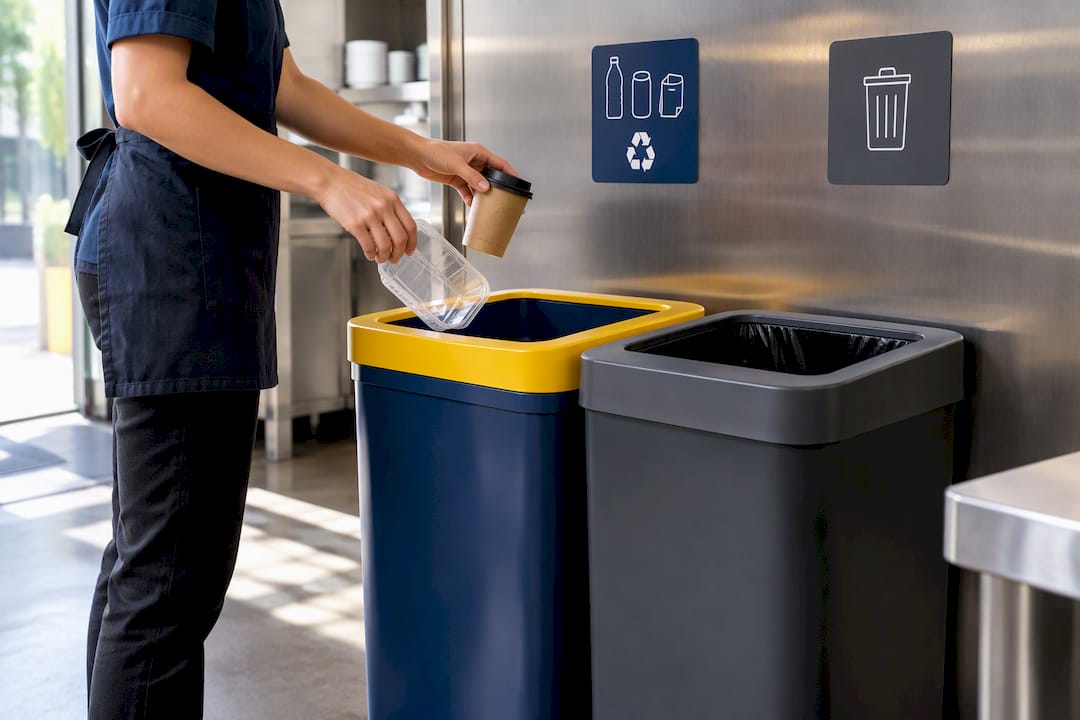
If your load gets rejected once, treat it as a signal, not a one-off. Check what went in, retrain the team on that specific item, and consider whether you’ve piloted too many streams at once. Businesses that stick to one or two well-managed streams before expanding see far fewer rejected loads than those trying to separate five categories from day one.
How do you choose a compliant waste contractor in Melbourne?
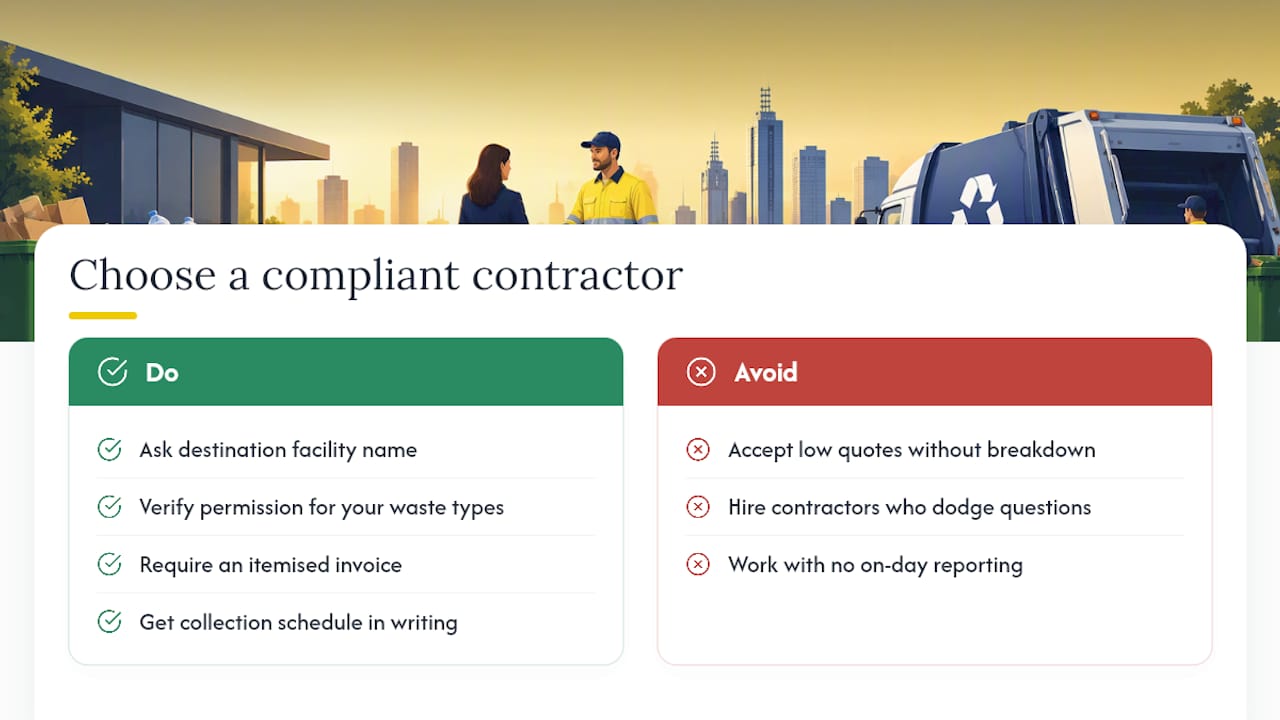
Ask three questions before signing anything. First, where does the material actually go, and can they name the facility? A contractor who can’t tell you the destination site can’t prove lawful disposal, and EPA Victoria’s general environmental duty puts that obligation on the business generating the waste, not just the transporter. Second, are they permissioned to carry the waste types you generate, particularly if you produce any priority waste like e-waste or certain construction materials? Third, what does the invoice actually itemise?
That third question matters more than most businesses realise. City of Melbourne’s guidance for businesses points to itemised invoices, showing the levy, transport and processing fees separately, as a basic check. A quote that’s dramatically lower than everyone else’s, with no breakdown, is a red flag for non-compliant disposal, not a bargain.
Watch for contractors who won’t commit to a collection schedule in writing, who can’t explain contamination thresholds for your contract, or who dodge questions about where your recyclables end up. A legitimate operator answers all three without hesitation. It’s also worth checking how they communicate on the day, reliable collection services that confirm timing and provide real reporting save you the follow-up calls that eat into a facility manager’s week.
Are there government incentives for business recycling in Melbourne?
Direct cash subsidies for individual businesses are limited, but the policy settings around you are actively pushing costs in favour of recycling. The Victoria landfill levy is the biggest indirect incentive: it makes landfill progressively more expensive, so any diversion you achieve pays for itself through lower levy exposure rather than a grant cheque.
Recycling Victoria’s market reporting also tracks infrastructure investment tied to the state’s circular economy priorities, meaning more processing capacity and, over time, potentially more competitive pricing for businesses that separate their waste properly. That’s a slower-moving benefit, but it’s a real one for businesses planning multi-year contracts.
Where local government adds value is mostly in access and guidance rather than subsidy. City of Melbourne runs waste and recycling hubs for central city businesses and provides permit pathways for bin placement, which matters if you’re on a busy CBD footpath. For beverage containers specifically, the Container Deposit Scheme gives businesses a way to recover value directly. A CDS Vic depot in South Melbourne accepts eligible containers for a refund, which can add up for hospitality venues generating high bottle and can volumes.
How do you set up a business recycling program in Melbourne, step by step?
Start with the audit covered earlier, then build outward from there rather than designing a full program on paper first.
Step one: confirm your waste classification. Know whether anything you generate counts as priority or industrial waste under EPA Victoria’s framework, because that changes who can legally collect it.
Step two: check permit requirements if you’re in the CBD. Businesses in the central city often need a bin placement permit through City of Melbourne, and ignoring this can mean fines or bins being removed from footpaths.
Step three: select your priority stream from the audit results and choose a contractor who can service it specifically, rather than a generic package that doesn’t match your actual waste profile.
Step four: set collection frequency to match volume, not habit. Most businesses default to whatever the previous tenant had, which is rarely right for a new occupant.
Step five: brief staff before the first collection, not after. A program that starts with confusion generates contamination in week one, which then takes months to unwind.
Step six: review after one full billing cycle. Check the invoice against what was promised, confirm contamination rates, and decide whether to add a second stream.
How do you get staff on board with recycling at work?
Staff behaviour drives contamination rates more than bin quality or signage design, so the engagement side of this deserves as much attention as the logistics. The businesses that get this right treat it as a five-minute conversation, not a policy document nobody reads.
Show people, don’t just tell them. A two-minute walkthrough of the actual bins on their actual floor, pointing at what goes where, beats an email with a PDF attachment every time. Put someone specific in charge of checking bins in the first fortnight, not because you don’t trust staff, but because early habits set the pattern for months.
Make the bin next to the wrong one obvious. If a coffee cup keeps ending up in the paper recycling, that’s a signage problem in the exact spot it’s happening, not a general reminder in a staff meeting three weeks later. For hospitality venues specifically, a 2026 operator guide on sustainability in food services covers kitchen-specific waste habits that translate well to the front-of-house recycling conversation too.
Celebrate the win once you have a number. Telling staff “we cut our general waste bin by one size this quarter” lands better than a vague sustainability statement, because it’s specific and it’s theirs.
Getting your recycling program running with local support
Auditing your bins and picking a priority stream is the strategy. Getting someone reliable to actually collect it is the part that determines whether the program survives past month two. Melbourne City Rubbish handles commercial office rubbish removal, construction waste removal, e-waste collection, and furniture disposal and recycling, across CBD & South Melbourne, Melbourne Airport, Port Melbourne and West Melbourne.
The business runs carbon-neutral operations with eco-friendly disposal options for clients who want their waste stream to match their sustainability commitments, not just their bin count. Punctuality is supported by notifications to keep clients informed about collection times. Melbourne City Rubbish also promises to beat any written quote by 5%, which is useful leverage once you’ve done the contractor vetting covered above and have a few quotes to compare.
If you’ve just finished your three-day audit and know which stream is dominant, the next step is straightforward: get an on-site quote through what we do and have a collection schedule matched to your actual volumes, not the previous tenant’s habits.
Key Melbourne and Victorian waste resources
For permit rules and hub locations, check City of Melbourne’s business waste guidance. For drop-off options, the Port Phillip Resource Recovery Centre and the CDS Vic depot in South Melbourne both serve local businesses directly.
Sources
- Business Recycling Melbourne: What You Can & Can’t Recycle | Bundle Waste
- Waste and recycling for businesses | City of Melbourne
- Circular Economy Market Report 2026 | EPA Victoria (Recycling Victoria)
- Port Phillip Resource Recovery Centre
FAQ
What is the fastest way to start business recycling in Melbourne?
Run a three-day waste audit to find your dominant material, then set up one dedicated bin for that stream before adding others. Most Melbourne offices find cardboard dominates, while hospitality venues usually find organics does, according to Bundle Waste’s guide for Melbourne businesses.
Do I need a permit to place recycling bins outside my business in Melbourne?
Businesses in the central city often need a permit for bin placement on footpaths or in public areas, managed through City of Melbourne. Waste hubs are also available for some CBD businesses as an alternative to individual bin permits.
How much does business recycling cost compared to general waste in Melbourne?
Recycling is usually cheaper per tonne than general waste because landfill disposal carries Victoria’s landfill levy on top of the base fee, while recyclable material avoids or reduces that charge. The exact saving depends on your volumes, contamination rate and bin sizing, which is why an audit before signing a contract matters.
What happens if my recycling bin is contaminated?
Loads over the contamination threshold, commonly around 10 to 15%, risk rejection and can be billed as general waste including the landfill levy. Preventing this comes down to bin placement next to general waste bins and clear, specific signage rather than generic posters.
Does Melbourne City Rubbish handle business recycling collections?
Yes. Melbourne City Rubbish offers commercial office rubbish removal, e-waste collection, and eco-friendly disposal options across CBD & South Melbourne, Melbourne Airport, Port Melbourne and West Melbourne. Pricing is quoted per job, and current details are available through what we do.
Is e-waste allowed in general recycling bins in Melbourne?
No. E-waste is banned from landfill in Victoria and must go through a licensed collector rather than a standard commingled or general waste bin. Mixing it into general recycling exposes a business to regulatory risk under EPA Victoria’s rules.