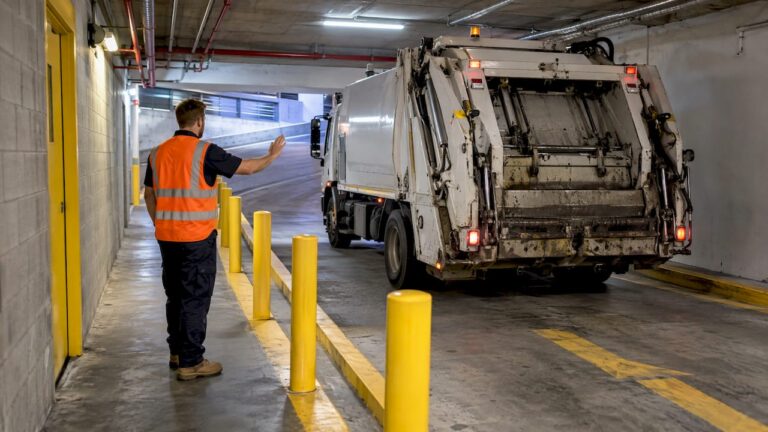
For most Melbourne businesses, property managers, builders and tenants, the better choice is the business that actually does the removal. A broker takes your booking and passes it to someone else, which adds a layer between you and the truck. When something goes wrong on the day, or an auditor asks where your waste ended up, you want one party who can answer for the whole job. That is how we work at Melbourne City Rubbish: you get a written quote that we promise to beat by 5%, and you deal with us about timing, the job itself and the paperwork.
This article explains the difference, how the two models affect price, service and accountability, and what to check before you commit to either.
TL;DR
- A broker sells and arranges the job, then subcontracts it. A direct hauler is the business that turns up, loads the waste and takes it away.
- Price differences come less from the model than from the contract: volume-based pricing rewards more waste collected, and long terms and auto-renewals lock you in.
- Whoever you hire, you still need proof that your waste went to a lawful, licensed facility. Ask for disposal or weighbridge dockets.
- Fewer parties means fewer handovers for timing, damage and disposal records to fall through.
- Ask any provider for a written, itemised quote. We will beat any written quote by 5%.
Table of Contents
- What a waste broker and a direct hauler actually are
- How pricing really differs
- Accountability: one party or two
- Proof of responsible disposal
- Contract terms that matter more than the label
- Which model suits which reader
- A short checklist before you book
- Book the job with one accountable team
- FAQ
- Sources
What a waste broker and a direct hauler actually are
A direct hauler is the business that performs the work. Its crew arrives, clears the waste, transports it and delivers it to a disposal or recycling facility. You pay it, and you can call it when something needs fixing.
A waste broker is an intermediary. It markets the service, takes your order and your payment, and then hands the job to a local operator. Brokers often look like the provider: a polished website, a call centre, a quote form. The crew that turns up may carry another company’s name or none at all.
Brokers are not illegal and some are well run. The question for you is simpler: who is accountable, in writing, for the job and for where the waste goes?
Two terms are worth knowing because they come up in quotes:
- Weighbridge docket: a receipt printed when a loaded truck is weighed at a tip or recycling facility. It shows the weight and the facility.
- Disposal docket: any record from the receiving facility that confirms what was dropped, when and where.
How pricing really differs
There is no set price for waste collection in Australia. The NSW EPA’s guidelines say quotes are negotiable and competitive, and contractors tend to quote lower where the service is easy and efficient over a long period. That applies to brokers and haulers alike, so comparing like with like matters more than comparing labels.
When a job passes through a broker, there are two businesses to pay for one piece of work: the one that sells it and the one that does it. Whether the broker’s margin is worth it depends on what the broker adds. When the quote does not say, you cannot tell.
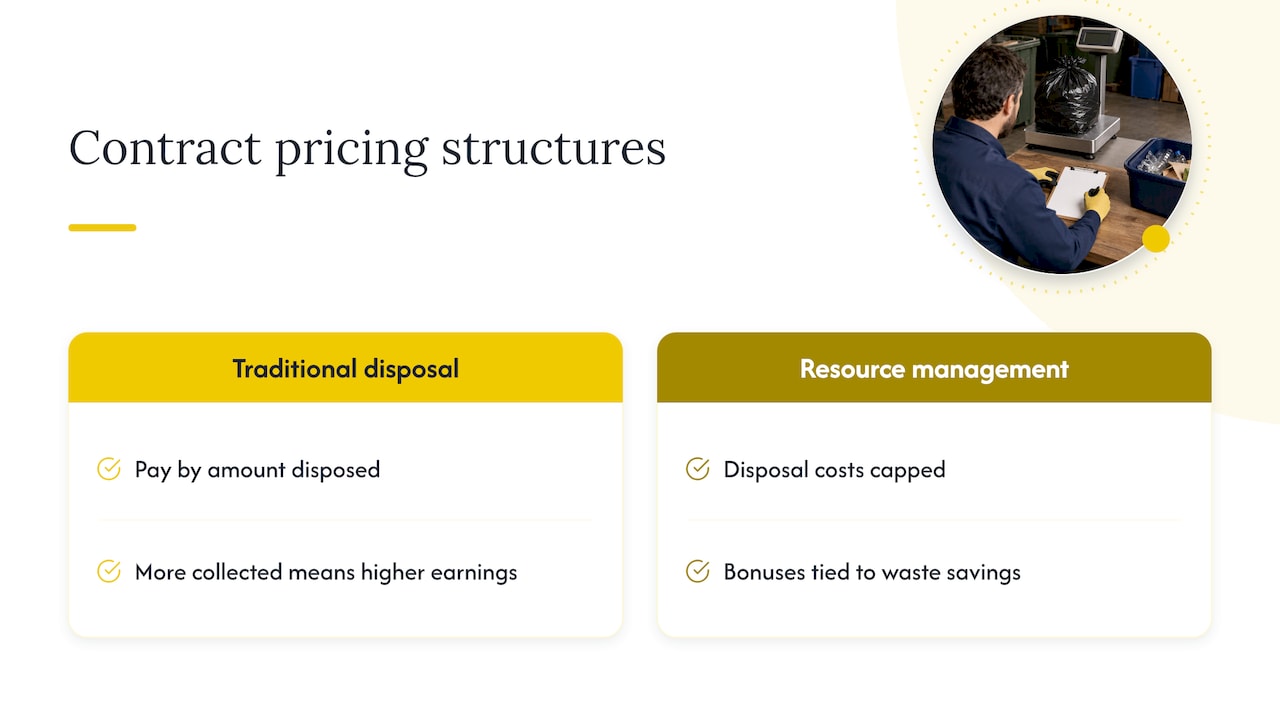
The same EPA guidance draws a more useful distinction than broker versus hauler. In a traditional disposal contract you pay by the amount of waste disposed, and the contractor earns more the more it collects. In a resource management contract, disposal costs are capped and performance bonuses are tied to savings from reducing and recycling waste. The second structure points everyone at less waste. Whoever you choose, ask which structure your quote follows.
What to ask for in a quote
- A written, itemised price. Labour, truck time, tip fees and any bin or equipment hire shown separately. The Queensland guidance recommends asking for itemised invoices showing weight or bin lifts.
- What is excluded. Restricted waste types, weight limits, access constraints and after-hours loading.
- Who does the work. The business that signs the quote, or a subcontractor.
- What you receive afterwards. Disposal dockets, recycling evidence, or both.
If you already hold a written quote from another provider, we promise to beat any written quote by 5%. You can request a quick quote with the details of your job.
Accountability: one party or two
Accountability is where the model matters most. Picture a Collins Street tenant finishing a lease with a make-good deadline, or a builder with a skip-sized pile blocking the next trade. The job needs three things at once: the crew arrives when promised, the building is left undamaged, and the waste goes where the paperwork says.
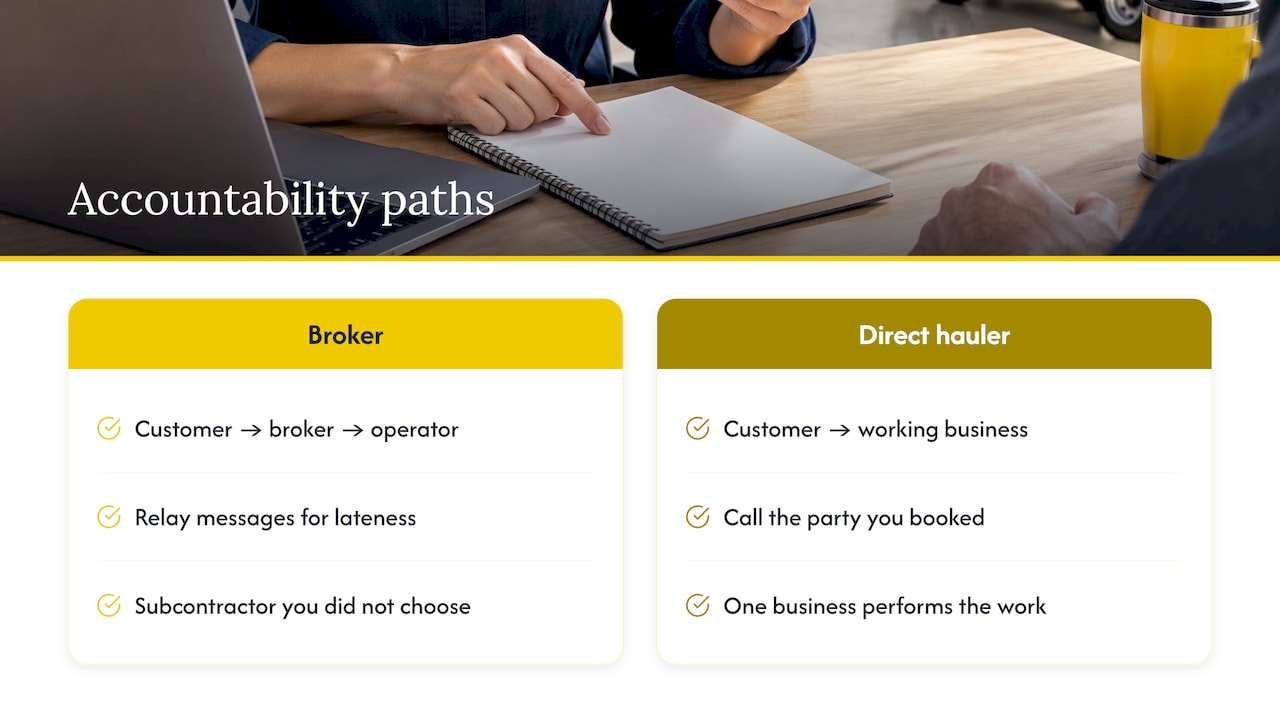
With a broker, each of those depends on a subcontractor you did not choose, did not meet and cannot instruct directly. A late crew becomes a message from you to the broker, then from the broker to the operator, then back again. Damage to a loading dock or lift raises the same question: whose insurance, whose crew?
With one business doing the work, the chain is short. Our positioning is built on this: punctuality backed by real-time notifications and a lateness credit, plus experience in all types of Melbourne commercial buildings, with no mess and no damage to property. When you book with us, the party you phone about any of that is the party you booked.
That matters for the waste itself too. The reader who is legally and commercially exposed is you, the waste generator, not the broker. The NSW EPA guidance says it is the responsibility of the cleaner or the building manager or owner to check that waste and recyclables are deposited at a lawful, licensed facility, including asking contractors for disposal and weighbridge dockets. That is a New South Wales document, but the logic of keeping evidence applies to any business. In Victoria, EPA Victoria is the regulator for waste transport and disposal, so ask any provider for the paperwork your own compliance obligations require.
Proof of responsible disposal
A good provider makes verification easy. Here is what the official guidance suggests, and what it looks like in practice.
| What you want to know | What to ask for | Source of the advice |
|---|---|---|
| Waste went to a lawful, licensed facility | Disposal and weighbridge dockets, then check the facility | NSW EPA guidelines |
| Recyclables were actually recycled | An assurance clause requiring evidence that separated recyclables go to an appropriate recycling facility | Victorian contract guide |
| You can see what you paid for | Itemised invoices that identify disposal or recycling destinations | Victorian contract guide |
| Reporting over time | KPIs and reports covering waste streams, collection dates, volumes and costs | Victorian contract guide |
The reason this matters nationally: Australia generated 79.0 million tonnes of waste in 2024–25, and about 33% of core waste went to landfill, according to the federal environment department’s national report. Roughly a fifth of mixed recyclables sorted at material recovery facilities was unsuitable and was landfilled. Which stream your waste goes into, and how well it is separated, changes the outcome.
If sustainability is part of your brief, for example a property manager reporting on building performance, our carbon-neutral operations let you opt in to eco-friendly disposal. Our guide to eco-friendly rubbish removal for Melbourne businesses sets out what that covers.
Contract terms that matter more than the label
The contract can cost you more than the model. The Victorian guide says business waste and recycling contracts commonly run three to five years, with longer terms generally meaning lower costs. It also tells businesses to watch for:
- Automatic renewal or rollover clauses, which extend the contract unless you act inside a narrow window.
- Exclusivity clauses, which stop you using anyone else for the same waste.
- Contamination penalties, with the acceptable rate usually under 10% and loads sent to landfill above it.
The Waste Contractors and Recyclers Association’s fact sheet on what waste contracts typically contain adds fee-increase notice terms, restrictions on waste type and weight, who owns and maintains bins, liability and indemnity limits, and termination often possible only in writing close to expiry.
These terms matter doubly with a broker, because the contract you sign may be with the broker while the bins, trucks and tip fees belong to someone else. Ask who owns the bin, who can change the price, and who you give notice to.
For one-off work, such as an office clean-out, a strip-out or a lease-end clearance, you rarely need a long contract at all. A per-job quote with a clear scope avoids rollover clauses entirely. We bill on-demand work per job or by the volume of waste collected, with a quote for each project, and offer regular or one-off collections.
Which model suits which reader
Tenants finishing a lease
Your deadline is fixed, and a landlord’s make-good inspection does not move. You want a crew that arrives on time, knows building access rules and leaves the premises clean. A single point of contact is worth more than a marginally lower headline price. Our Makegood and De-fit and office clean-out services are built around this kind of job.
Property managers and strata
You answer to owners and committees who ask where the waste went. Itemised records and a provider who knows Melbourne commercial buildings make reporting simpler. Our page for building managers’ waste management covers the recurring side, and our guide to business recycling describes an audit aimed at cutting landfill.
Construction firms
Construction and demolition waste is large and heavy. In New South Wales it averaged 56% of all waste generated in the five years to 2023–24, which shows why disposal records and recycling rates get attention on sites. Delays here cost trades and programs, so the provider who answers for the schedule is the one you want. We handle construction waste removal, commercial demolition and truck and driver hire, and our demolition waste cost guide explains how those jobs are priced.
Organisations clearing furniture and general junk
Your priority is cost and a clean finish. Ask for a written quote and compare it line by line. For furniture, we offer furniture disposal and recycling so reusable pieces do not simply go to landfill.
A short checklist before you book
- Is the business on the quote the one doing the work?
- Is the price written, itemised and clear about exclusions?
- Will you receive disposal or weighbridge dockets, and recycling evidence where relevant?
- What happens if the crew is late or damages property?
- If a contract is involved, what is the term, and does it renew automatically?
- Does the provider offer a lower-carbon option if your reporting needs one?
Our answers: we beat any written quote by 5%, back punctuality with real-time notifications and a lateness credit, and aim to leave no mess and no damage to property.
Book the job with one accountable team
We provide rubbish removal across Melbourne, including the CBD, South Melbourne, Port Melbourne, West Melbourne and Melbourne Airport, for commercial and residential clients. That covers office junk, construction debris, green waste, e-waste, strip-outs, demolition debris and make-good clearances, one-off or regular. Browse everything we do or send your quote request through our quick quote page.
FAQ
What is the main difference between a waste broker and a direct hauler?
A broker sells and arranges the job and passes it to another operator. A direct hauler is the business that does the collection and disposal itself. The difference shows up in who you can hold to the timing, the condition of the site and the disposal records.
Are brokers always more expensive?
Not always, but a job that passes through two businesses has to pay both. There is no set price for waste collection in Australia, so quotes are negotiable. The safest comparison is an itemised written quote from each provider.
How do I know my waste was disposed of lawfully?
Ask for disposal or weighbridge dockets and check the facility named on them. The NSW EPA guidelines recommend exactly this, and Victoria’s guide suggests an assurance clause for recyclables. For regulated or trackable waste, check the rules in your state.
Should I sign a multi-year waste contract?
For regular collection, longer terms can lower the price, but watch automatic renewal, exclusivity and contamination clauses. For one-off clearances like a lease-end or strip-out, a per-job quote is simpler and avoids the lock-in.
Can Melbourne City Rubbish beat a quote I already have?
Yes. We promise to beat any written quote by 5%. Send the written quote with your job details through our quick quote page.
Sources
- NSW EPA, Better Practice Guidelines for Waste Management and Recycling in Commercial and Industrial Buildings
- NSW EPA Better Practice Guidelines (due diligence and docket checks)
- Smarter Resources Smarter Business: best practice waste and recycling contracts
- reThink Business Waste: a guide to reviewing waste and recycling contracts
- WCRA fact sheet: Talking to your waste provider
- DCCEEW, National waste and resource recovery report 2026
- NSW State of the Environment: Waste and recycling