Australia has no single national “waste disposal certificate”. What you hold as proof depends on the state, the type of waste and who handles it: a tracking record or transport certificate for regulated waste, and a facility docket or receipt for ordinary commercial waste. For a Melbourne office, strip-out or make-good, the practical goal is the same everywhere: a paper trail showing your waste went to a place that can lawfully take it. At Melbourne City Rubbish we remove commercial and residential waste across Melbourne, and this guide sets out the records worth asking for and keeping.
TL;DR
- There is no national certificate. Each state and territory runs its own tracking system, and proof is usually a tracking record, transport certificate or landfill docket.
- Most everyday office, construction and tenant waste needs a written record of where it went, not a government-issued certificate. Regulated or hazardous waste is tracked formally.
- In Victoria, reportable priority waste is recorded in EPA’s online Waste Tracker, and the business stays responsible for where its waste ends up even when a contractor handles it.
- Keep dockets and receipts for years, not months: retention periods range from 12 months to six years depending on the jurisdiction and the record.
- Get a written quote and written scope before the job, so the paperwork you expect is agreed up front.
Table of Contents
- What people mean by a waste disposal certificate
- Who needs formal tracking, and when
- What a good disposal record contains
- Your responsibility does not end when the truck leaves
- How long to keep the records
- Rules are changing, so check the live pages
- A practical routine for each type of reader
- Choosing a removal partner who makes the paper trail easy
- FAQ
- Sources
What people mean by a waste disposal certificate
Searchers use the phrase for three different documents, and mixing them up is the most common source of confusion.
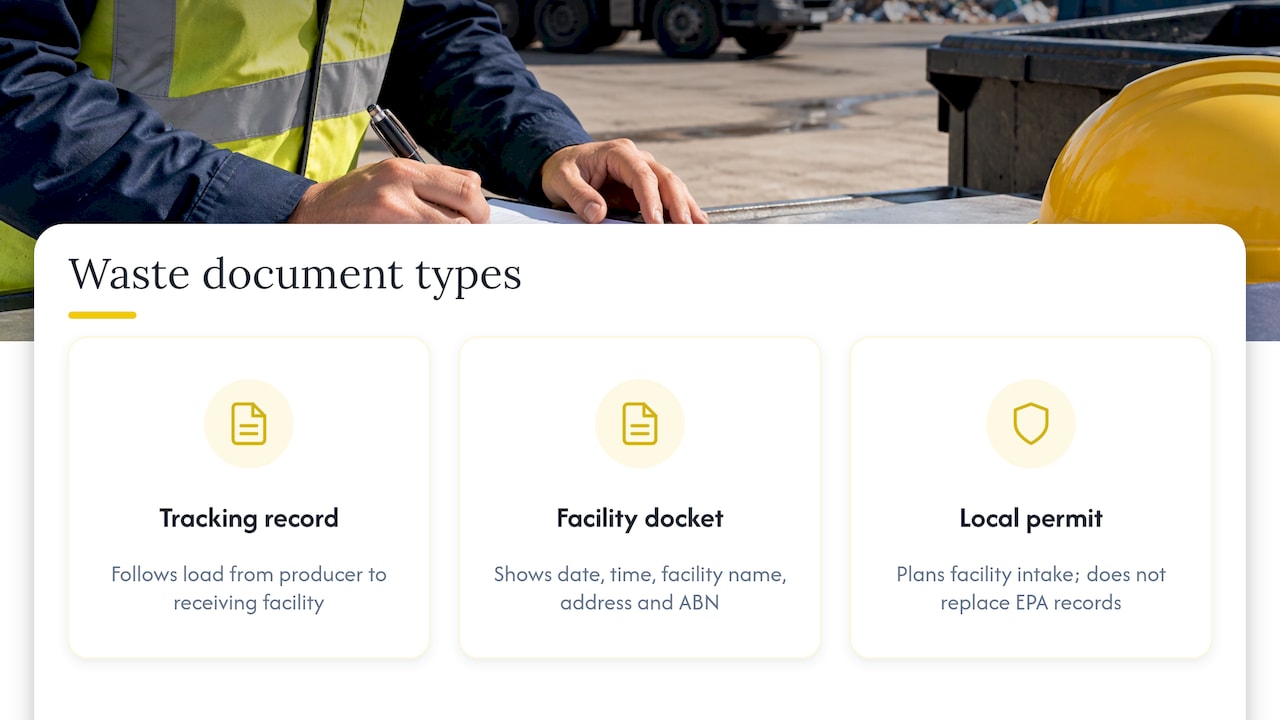
A tracking record or transport certificate. This is the formal record for regulated waste (often called controlled, trackable or prescribed waste, depending on the state). It follows the load from the producer to the transporter to the receiving facility. NSW EPA explains that tracking exists to reduce harm to the environment and human health, to help stop illegal dumping, to keep waste from going to the wrong facility and to prevent unfair competition.
A facility docket or receipt. When a load is accepted at a landfill, transfer station or recycler, the facility issues a docket. NSW EPA advises keeping waste dockets or receipts showing the date, time, facility name, address and ABN.
A local permit. Some councils and facilities require permission before certain waste arrives. Tamworth Regional Council, for example, requires commercial generators or transporters of asbestos or soil waste products to hold an approved Waste Disposal Permit, which exists so the facility can plan for the waste, not to track it for regulators. It is a facility document and does not replace EPA records.
For most Melbourne businesses, the second document is the one that matters day to day, and the first applies when your waste falls into a regulated category.
Who needs formal tracking, and when
The rules sit with each state, so the right answer depends on where the waste is generated and where it travels.
| Jurisdiction | System and what it covers |
|---|---|
| Victoria | Reportable priority waste is recorded in EPA’s Waste Tracker, and every change of hands must be notified |
| NSW | Schedule 1 hazardous waste must be tracked when moved into, within or out of the state. Waste from the Metropolitan Levy Area moving out of NSW is tracked too |
| Queensland | Generators, transporters and receivers of regulated waste submit tracking information online, in bulk or on paper certificates, and fees apply |
| South Australia | Waste types listed in Schedule 1 of the Environment Protection Act 1993 are tracked. A consignment authorisation can cover multiple loads for up to a year |
| Interstate controlled waste | A consignment authorisation from the destination jurisdiction is needed. The ACT, for instance, asks producers to allow five working days for it |
The national rules sit under the Movement of Controlled Waste NEPM, which says tracking information must accompany each load and that jurisdictions should keep records for at least 12 months. Because each jurisdiction runs its own system, the National Environment Protection Council notes that consistency and scope vary and that work is under way to harmonise controlled waste tracking nationally.
In practice, ordinary office furniture, fit-out debris, cardboard and general bulk waste are not usually in the formal tracking categories. Asbestos, certain contaminated soils, chemicals and similar materials are. If a strip-out might disturb asbestos, ask the building owner for the hazardous materials register before work starts, and treat the waste as regulated until it is classified.
What a good disposal record contains
Regulators spell out what a formal record holds, and it is a useful benchmark for any paperwork you receive.
Queensland’s waste tracking guideline splits the certificate into three parts. Part 1 covers the waste description, packaging, amount, physical nature, waste code, and generator, receiver and transporter details. Part 2 records the driver’s name, signature, date and phone number. Part 3 is completed by the receiving facility, covering the disposal or treatment code, the amount received, any discrepancies and the receiver’s environmental authority number.
NSW transport certificates record the pick-up date, intended delivery date, the facility’s acceptance or rejection date and the date the waste was disposed of, treated or stored, plus any discrepancies.
For non-regulated commercial waste, a sound record answers five questions:
- What was removed (type and approximate volume or weight)?
- From which address, and on what date?
- Who transported it?
- Which facility received it, with its name, address and ABN?
- How was it handled: landfill, recycling or reuse?
If your paperwork answers those five, you can show a landlord, a strata committee, an auditor or a regulator what happened to the waste.
Your responsibility does not end when the truck leaves
This is the point that surprises most business owners. EPA Victoria’s guidance on sending waste to a lawful place says the business remains responsible for taking reasonable steps to make sure its waste goes to a place that can lawfully receive it, even when a contractor manages the waste. It advises asking in writing where the transporter plans to take the waste.
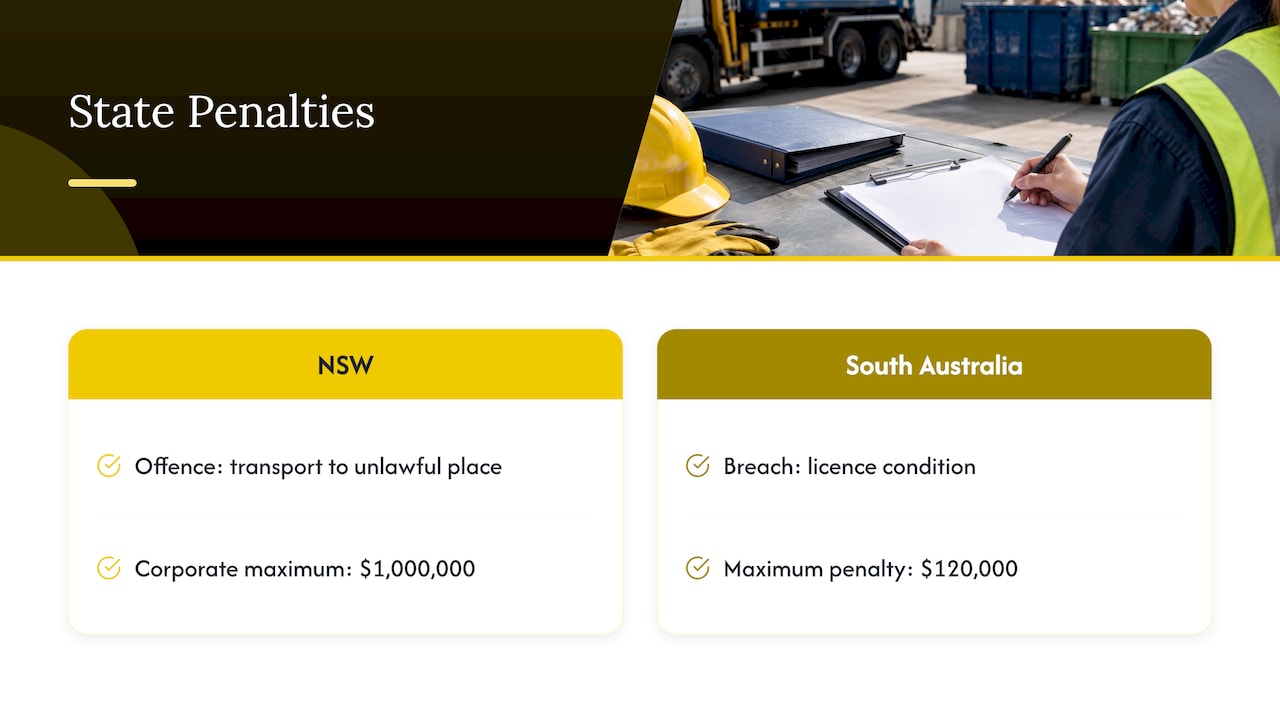
The stakes are real. In NSW, section 143 of the Protection of the Environment Operations Act 1997 makes it an offence to transport waste to a place that cannot lawfully accept it, with a maximum penalty of $1,000,000 for a corporation. In South Australia, breaching a licence condition under the Environment Protection Act 1993 carries a maximum penalty of $120,000. Victoria’s rules differ in detail, so check the EPA Victoria pages above for your own obligations.
For property managers this connects directly to payment. Our checklist on holding final payment until proof of disposal arrives walks through the point in a job when that evidence should be in your hands. Our overview of Melbourne waste regulations and your business obligations covers the local duties in more detail.
How long to keep the records
Retention periods vary, and the longest one that applies to you is the safe one to follow.
- 12 months: the national NEPM minimum for controlled waste records, and the South Australian and ACT periods for consignment documents and certificates.
- Five years: Queensland generators keep prescribed tracking information for at least five years.
- Six years: Transport for NSW’s waste management guideline requires written waste records, including transport certificates, landfill dockets and Section 143 Notices, to be kept for at least six years.
A simple rule for a Melbourne business: file every docket and tracking confirmation with the job record, and keep it for at least six years, which also fits ordinary tax record-keeping. Our guide on whether rubbish removal is tax deductible explains why the invoice and the disposal evidence belong together.
Rules are changing, so check the live pages
Tracking rules have moved recently. NSW’s Integrated Waste Tracking Solution replaced the older online system in 2024, and Queensland amended its Environmental Protection Regulation 2019 through the Environmental Legislation Amendment Regulation 2025, so older notes on waste classification may be out of date. Western Australia has proposed an amendment bringing the Controlled Waste NEPM into its regulations, with publication anticipated in mid-2027; until then, the 2004 Regulations remain in force. Always confirm the current requirement on the relevant EPA page before moving regulated waste, especially across a state border.
A practical routine for each type of reader
Office managers and tenants finishing a lease
At make-good or end of lease, the landlord often wants evidence that fit-out, furniture and rubbish were cleared properly. Get the scope in writing: what is being removed, from which floors, and what the landlord expects at handover. Keep the quote, the invoice and any facility dockets together. Our office cleanout and furniture disposal and recycling services cover this kind of job.
Property managers and strata
You answer to owners and committees, so a file that shows what left each building and where it went is your protection. Our guide for office building managers sets out a routine for regular collections, and the business waste audit page shows how to measure what your building produces.
Construction and demolition firms
Demolition and strip-out debris is where regulated material is most likely to appear. Classify before you load, and keep the classification report with the tracking records. Our page on demolition debris disposal explains recycling and waste management plans, and the strip out vs demolition guide covers the asbestos questions that change what paperwork a job needs.
Businesses with electronics
E-waste has its own handling rules. Our e-waste regulations guide explains what businesses must do, and the local service is covered in disposing of e-waste in Melbourne.
Choosing a removal partner who makes the paper trail easy
The paperwork you can produce later depends on the job you set up first. Before booking, agree in writing on the scope, the waste types, the price and how the waste will be handled. Melbourne City Rubbish removes office junk, construction debris, green waste, electronic waste, strip-outs, demolition debris and make-good clearances for commercial and residential clients across Melbourne, and we offer a carbon-neutral option for clients who want it. We work in all types of Melbourne commercial buildings, aiming for no mess and no damage to property.
Timing and price are part of the same picture. Our punctuality is backed by real-time notifications and a lateness credit, and we promise to beat any written quote by 5%. Send us your written quote and your scope through the quick quote page, or look at the full range on our services page. Quotes are provided per project, so the price reflects your actual job.
FAQ
Is there one official waste disposal certificate in Australia?
No. Each state and territory runs its own tracking system for regulated waste, and ordinary commercial waste is usually evidenced by dockets and receipts from the receiving facility. The national controlled waste rules mean interstate movements need a consignment authorisation from the destination jurisdiction.
Does my office clean-out need a tracking certificate?
General office furniture and rubbish are not usually in the formal tracking categories, so a written record of what was removed and where it went is the standard you should aim for. If the waste includes asbestos, chemicals or contaminated material, regulated tracking applies and you should check your state EPA’s rules first.
How long should I keep disposal records?
The periods range from 12 months under the national controlled waste rules to six years under Transport for NSW’s guideline. Keeping dockets and tracking records for at least six years covers the longest of these.
Am I still responsible if a contractor takes my waste?
Yes. EPA Victoria says a business must take reasonable steps to ensure its waste goes to a lawful place even when a contractor manages it. Ask in writing where the waste will go and keep the reply with your job file.
Sources
- Tracking and transporting hazardous waste, NSW EPA
- Transporting waste, NSW EPA
- Waste Disposal Permits, Tamworth Regional Council
- Waste Tracker, EPA Victoria
- Sending waste to a lawful place, EPA Victoria
- Submitting waste tracking information, Business Queensland
- Completing waste tracking certificates, Queensland guideline
- Waste tracking for waste producers, EPA South Australia
- Information sheet 3, Access Canberra
- National Environment Protection (Movement of Controlled Waste) Measure
- NEPC Annual Report 2023-24
- Waste management guideline, Transport for NSW
- Controlled waste amendment regulations FAQ, Government of Western Australia
- Waste tracking in Australia, RegAffairs AI