Yes, you can remove an above ground pool, and for most homeowners it is a far simpler job than pulling out an in-ground one. Small, simple kits with easy access can cost a few hundred dollars to dismantle, while jobs involving decking, buried retaining walls, or difficult site access usually cost more, reaching into the low thousands once disposal and compaction are factored in.
The number that actually matters isn’t the sticker price. It’s whether your removal meets local council decommissioning rules. Every state expects the structure to be incapable of holding more than 300mm of water once you’re done, and most councils want proof of lawful waste disposal and, in some cases, compaction certification.
Before you book anyone, check what your local council requires under its building or development rules, and if the job involves a permit application, QBCC guidance is a good starting reference for building obligations tied to pool work.
Your next move: get a written quote that spells out permit handling, disposal receipts, and whether compaction verification is included. A provider like Melbourne City Rubbish can manage the whole scope, from dismantling through to legal waste disposal.
- Small portable/kit pools: low cost
- Standard above ground removals with moderate dismantling: moderately priced
- Complex jobs (decking, partial burial, machinery access): higher priced, depending on site conditions
Key Takeaways
Above ground pool removal is routine, legally straightforward when decommissioned to the 300mm standard, and priced mainly by access, materials, and disposal complexity rather than pool size alone.
| Point | Details |
|---|---|
| Cost varies by complexity | Simple kit pools cost a few hundred dollars; decking or buried elements push jobs into the low thousands. |
| The 300mm rule is universal | Councils require the structure to be incapable of holding water deeper than 300mm after decommissioning. |
| Permits depend on location | Demolition permits are commonly triggered within 2 metres of a boundary or building, or above council area thresholds. |
| Keep every receipt | Disposal dockets and clean fill delivery records are what councils ask for during inspections or property sales. |
| Get a full-service quote | Melbourne City Rubbish handles dismantling, legal disposal, receipts, and clean-up in one booking. |
Table of Contents
- What type of above ground pool removal are you dealing with?
- What does above ground pool removal cost?
- How does the removal process actually work?
- Do you need council approval to remove a pool?
- How long does above ground pool removal take?
- Should you DIY it or hire a professional?
- How do you choose a pool removal contractor?
- How Melbourne City Rubbish handles above ground pool removal
- Frequently asked questions
- Sources
What type of above ground pool removal are you dealing with?
Not all above ground pools come apart the same way, and the category yours falls into decides how much extra work is involved.
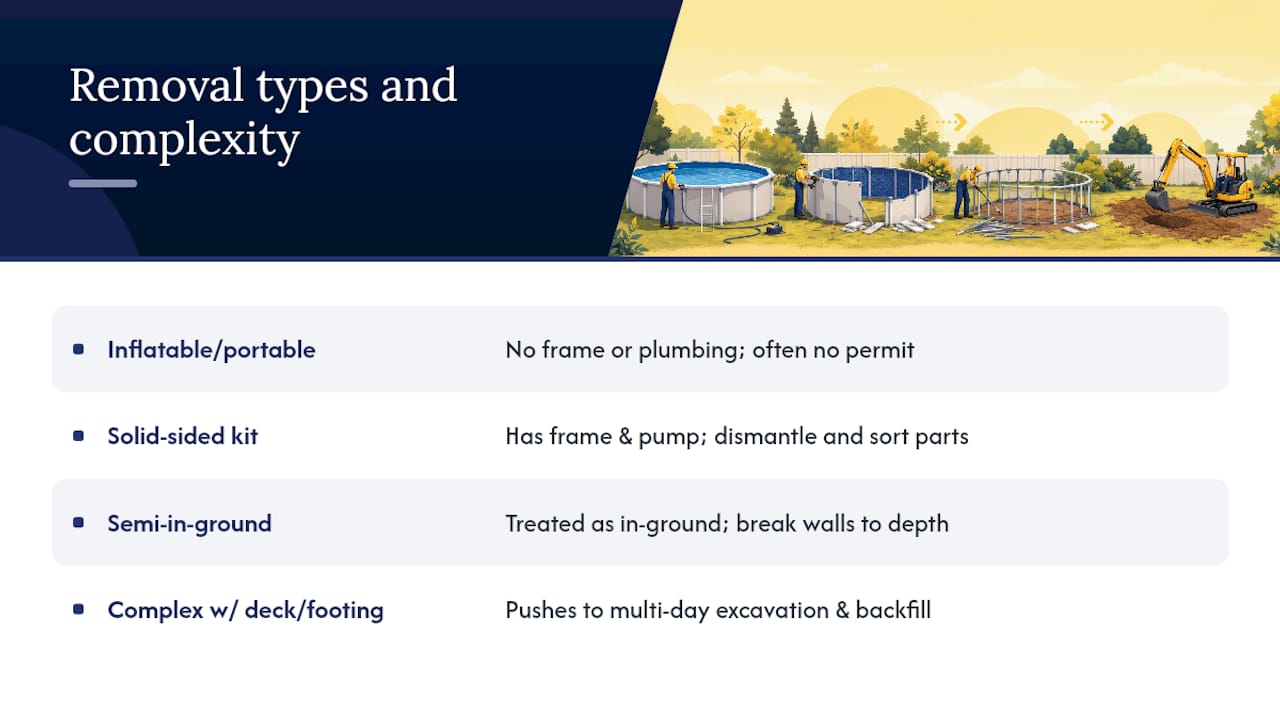
Inflatable and portable pools are the easy end. No frame to cut, no plumbing, often no permit trigger at all.
Solid-sided kit pools have a metal or resin frame, a liner, and usually a small pump and filter setup. These need dismantling in sequence and the components sorted for disposal.
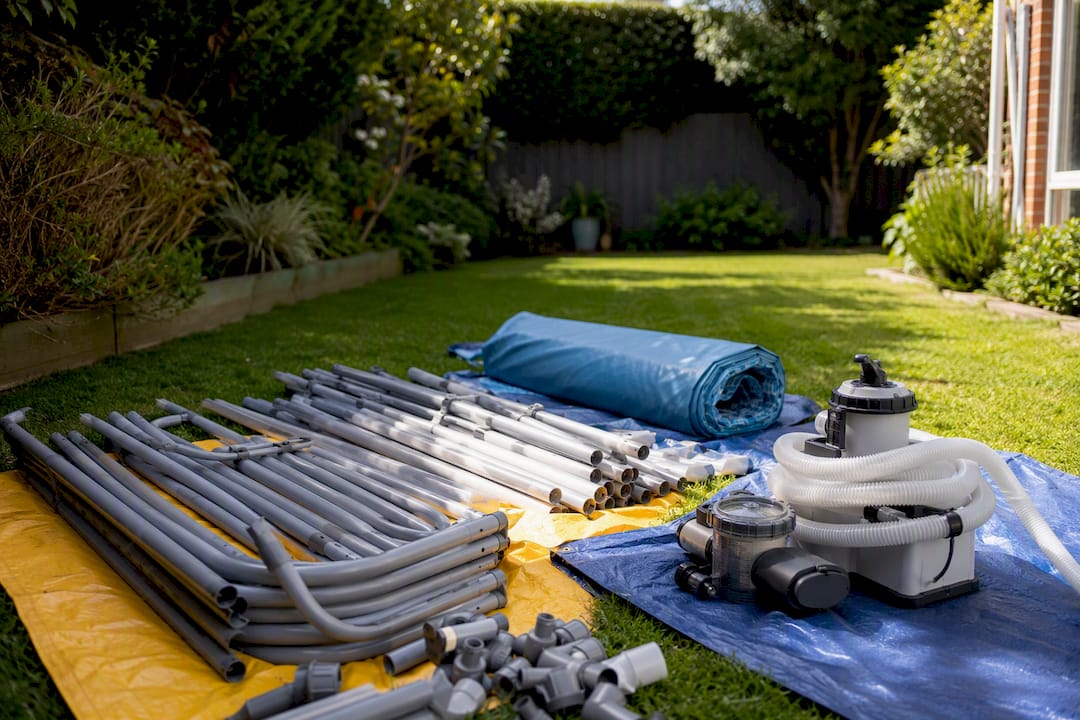
Semi-in-ground pools, where part of the structure sits below natural ground level, get treated as in-ground removals for regulatory purposes. That can mean breaking down retaining walls to a set depth before backfilling.
Pro Tip: Walk your yard and check for fixed decking, concrete footings, or plumbing run to the house before you call anyone. These details push a job from a same-day dismantle into a multi-day project with excavation and engineered backfill.
What does above ground pool removal cost?
Price bands vary widely because the job varies widely. A basic kit pool removal with clear access can sit at the low end. Add a timber deck, a retaining wall, or a tricky driveway approach for machinery, and the job moves into the low thousands. Large or heavily built-up above ground pools with partial burial push higher still, largely because they’re treated much like in-ground demolitions.
Local providers commonly advertise starting prices for straightforward jobs, which is a useful benchmark, but it’s not the number to budget against once your site has any complexity. Treat published low prices as a floor, not an estimate for your yard.
| Cost driver | Why it moves the price |
|---|---|
| Site access | Tight side gates or no vehicle access mean more manual labour and time |
| Pool size and materials | Larger frames and thicker liners take longer to cut down and cart away |
| Decking or concrete aprons | Extra demolition and disposal volume beyond the pool shell itself |
| Disposal fees | Licensed facilities charge by weight and waste type; contaminated liners cost more |
| Council permits | Lodgement fees and inspection requirements add administrative cost |
| Backfill and compaction | Clean fill delivery and compacting in layers takes machinery time |
Before you sign anything, check the quote covers these points:
- Itemised scope, not a single lump-sum figure with no breakdown
- Confirmation that demolition waste goes to a licensed facility, with receipts provided
- Whether permit lodgement is included in the price or billed separately
- Whether compaction certification or engineer sign-off is part of the job
Industry commentary on pool removal costs backs this up. Quotes that skip disposal and compaction detail tend to be the ones that come back with surprise add-ons once work starts.
How does the removal process actually work?
A proper above ground pool removal follows a set sequence, whether the crew is working on a $600 kit pool or a semi-buried structure with a deck.
- Site inspection and quote. The contractor checks access, pool type, buried elements, and whether council permits apply.
- Permit checks and lodgement. If the pool sits within the trigger distance of a boundary or building, a demolition permit may be needed before work starts.
- Isolation. Any electrical connections to pumps and filtration, and plumbing tied into the house, get disconnected safely.
- Dismantling. Liner, ladder, frame, and filtration equipment come apart in stages.
- Waste removal. Demolition debris is transported to a licensed disposal facility, never left on site or buried.
- Backfill and compaction. The void gets filled with clean fill or excavated natural material, compacted in layers, exactly what Maroondah City Council requires for a compliant decommission.
- Site clean and council notification. The yard is cleared of debris and the council is notified the pool has been removed, ready for inspection if required.
When you’re comparing quotes, check they explicitly cover:
- Full scope of works in writing, not a verbal summary
- Disposal receipts for demolition waste
- Compaction method, and certification if your council asks for it
- Insurance cover and a guarantee the site is left clean
On the day, expect a work vehicle in your driveway or on the verge, some noise from cutting metal framing, and dust control if there’s any concrete breaking involved. A straightforward kit pool might be gone by lunchtime. Anything with a deck or buried section takes longer, and you’ll want clear access confirmed in advance.
Do you need council approval to remove a pool?
Permit requirements depend on where you live and how your pool is positioned. Many councils require a demolition permit when a pool sits within 2 metres of a boundary or building, and some apply area thresholds, often around 40 square metres, that trigger the same requirement. Greater Shepparton City Council sets out these triggers clearly, and it’s worth checking your own council’s equivalent page before you assume your job is permit-free.
Decommissioning itself follows a consistent standard across most jurisdictions. The structure must be incapable of holding water deeper than 300mm, a rule Yarra Ranges Council spells out for relocatable pools specifically. That means:
- Complete removal of the liner, ladder, and filtration system
- No shell remnants left in the ground or used as backfill
- Backfilling only with clean fill or excavated natural material, compacted in layers
- Keeping receipts for both waste disposal and clean fill delivery, since councils may ask for them
Some councils, including Logan City Council, recommend a structural engineer certify the compaction work and expect a notification of removal once the job’s done, sometimes followed by a site inspection.
Pro Tip: Ask your contractor upfront to include permit lodgement and final council notification in their scope. Skipping this step is exactly what causes failed inspections later, or awkward conversations when you go to sell the property.
How long does above ground pool removal take?
Duration depends on job complexity rather than just pool size.
- Portable or kit pools with easy access can often be removed within a day
- Standard above ground removals with moderate dismantling typically take one to two days
- Complex jobs involving deck removal, partial burial, heavy machinery, or engineered backfill can take several days
Council inspections may extend the overall timeline, especially if compaction certification is required.
Should you DIY it or hire a professional?
DIY removal can be reasonable for small portable or inflatable pools with no fixed decking, no plumbing connections, and easy yard access. Even then, the job still has to meet the same 300mm decommissioning standard as a professional removal, and that’s where DIY attempts most often fall short.
The risks aren’t trivial. Getting compaction wrong leads to ground subsidence months or years later, long after the contractor (or you) has moved on. Dumping demolition waste incorrectly, including old liners that may contain harmful residues, can breach local waste rules. Missing a permit obligation because you didn’t know your pool was within 2 metres of a boundary is a common and avoidable mistake. Industry sources on DIY versus professional pool removal point to exactly these long-term issues as the reason professional decommissioning tends to hold up better over time.
DIY suits you if: small inflatable/portable pool, no decking, easy access, no plumbing.
Hire a pro if: any fixed structure, decking, partial burial, difficult access, or you’re unsure about permit triggers.
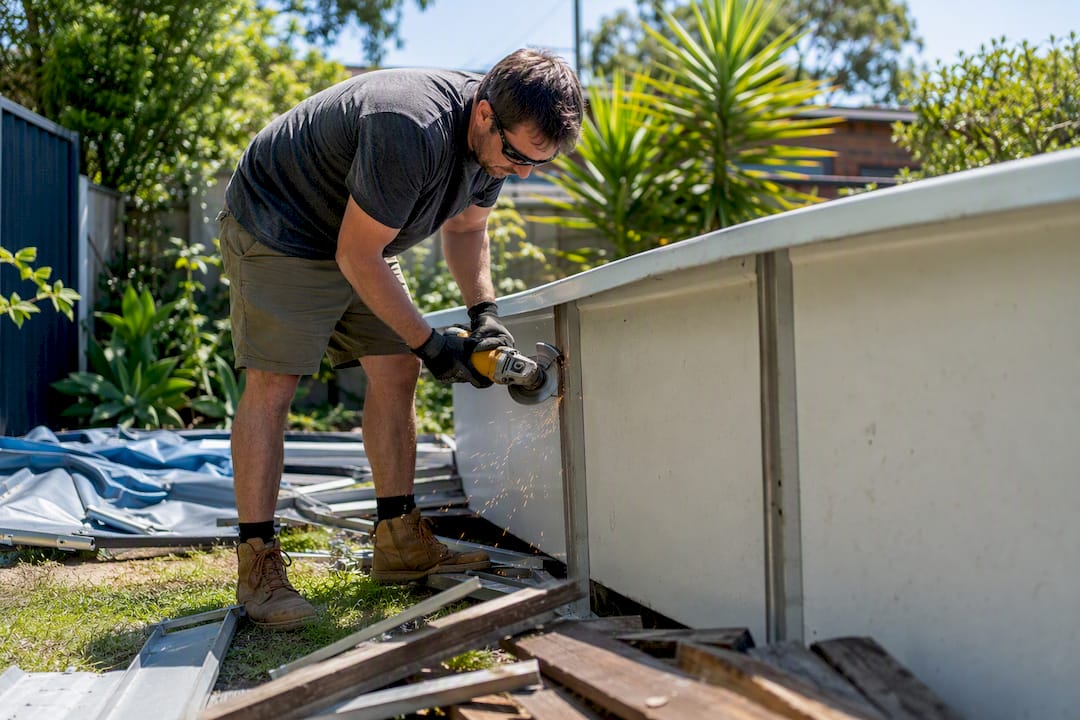
Pro Tip: Cutting metal pool frames and handling residual pool chemicals is genuinely hazardous work. If you’re not confident with an angle grinder or unsure how to safely dispose of chlorine products, that’s reason enough to call someone qualified.
How do you choose a pool removal contractor?
Vetting a contractor properly saves you from the two most common problems: blown-out costs and non-compliant removal that comes back to bite you at sale time.
Look for proof of insurance, a valid ABN registered with the Australian Business Register, and a written quote with an itemised scope rather than a single number. A contractor who documents their disposal plan and can point to where waste is going is one worth trusting.
On the quote call, ask directly:
- Who handles the permit lodgement, if one’s required?
- Which licensed facility will the demolition waste go to?
- Is compaction certified, and by whom?
- What warranty applies to the backfill and site restoration?
- What’s the realistic timeline, including any council inspection wait?
Red flags are easy to spot once you know what to look for: vague verbal quotes with no breakdown, reluctance to provide disposal receipts, any suggestion that waste can be buried on site, or a business with no public contact details or local references. If a contractor dodges the disposal question, that’s your answer.
- ☐ Written, itemised quote
- ☐ Insurance and ABN confirmed
- ☐ Permit handling clarified
- ☐ Disposal facility named
- ☐ Compaction certification discussed
- ☐ Local references available
A checklist for choosing a rubbish removal service covers these vetting steps in more depth if you want a fuller reference before requesting quotes.
How Melbourne City Rubbish handles above ground pool removal
Melbourne City Rubbish is the option for homeowners who want the compliance headache taken off their plate entirely. The crew handles full dismantling of the pool structure, lawful transport of frames, liners and filtration units to licensed disposal facilities, and site clean-up so you’re not left staring at a pile of debris. Disposal receipts come as standard, which matters the moment your council asks for evidence during an inspection or a future property sale.
For homeowners managing broader clean-outs alongside the pool, from old decking to renovation waste, the same crew can take it all in one visit rather than juggling multiple bookings. Jobs are insured, crews run on-site safety controls, and pricing is fixed or volume-based so there are no surprise add-ons. Clients who want a lighter environmental footprint can opt into carbon-neutral disposal at no extra hassle.
Request a written, itemised quote that names the disposal facility, confirms whether compaction certification is included, and sets out the full scope before work begins. Get a quote from Melbourne City Rubbish to start the conversation.
Frequently asked questions
Do I need council approval to remove an above ground pool?
It depends on your location and how close the pool sits to a boundary or building. Many councils require a demolition permit within 2 metres of these, and some apply area-based thresholds too, so check your local council’s building rules before starting work.
Can I just leave the pool shell buried in the ground?
No. Councils don’t allow shell remnants to be used as fill or left buried. The full structure needs to come out, and backfilling must use clean fill or excavated natural material only.
How much does above ground pool removal typically cost?
Small, simple removals often run a few hundred dollars. Jobs involving decking, partial burial, or difficult access typically cost more, landing in the low thousands once disposal and compaction are included.
Do I need proof the pool was disposed of correctly?
Yes, in most cases. Councils commonly ask for disposal receipts and clean fill delivery dockets, and some request a compaction certificate from an engineer before signing off on the removal.
Is DIY removal ever a good idea?
It can suit very small portable or inflatable pools with no decking or plumbing. Even then, you still need to meet the 300mm decommissioning standard, and getting compaction or disposal wrong can cause problems well after the job’s done.
Sources
For location-specific rules, check your own council’s pool decommissioning page, such as Maroondah, Yarra Ranges, Greater Shepparton, Fairfield City, and Logan City. For cost context, hipages offers a useful trade perspective on pricing and DIY risk.
- Decommissioning or removal of swimming pools and spas – Maroondah City Council
- Decommissioning of pools and spas fact sheet and notification of removal form – Logan City Council
- hipages – pool removal costs