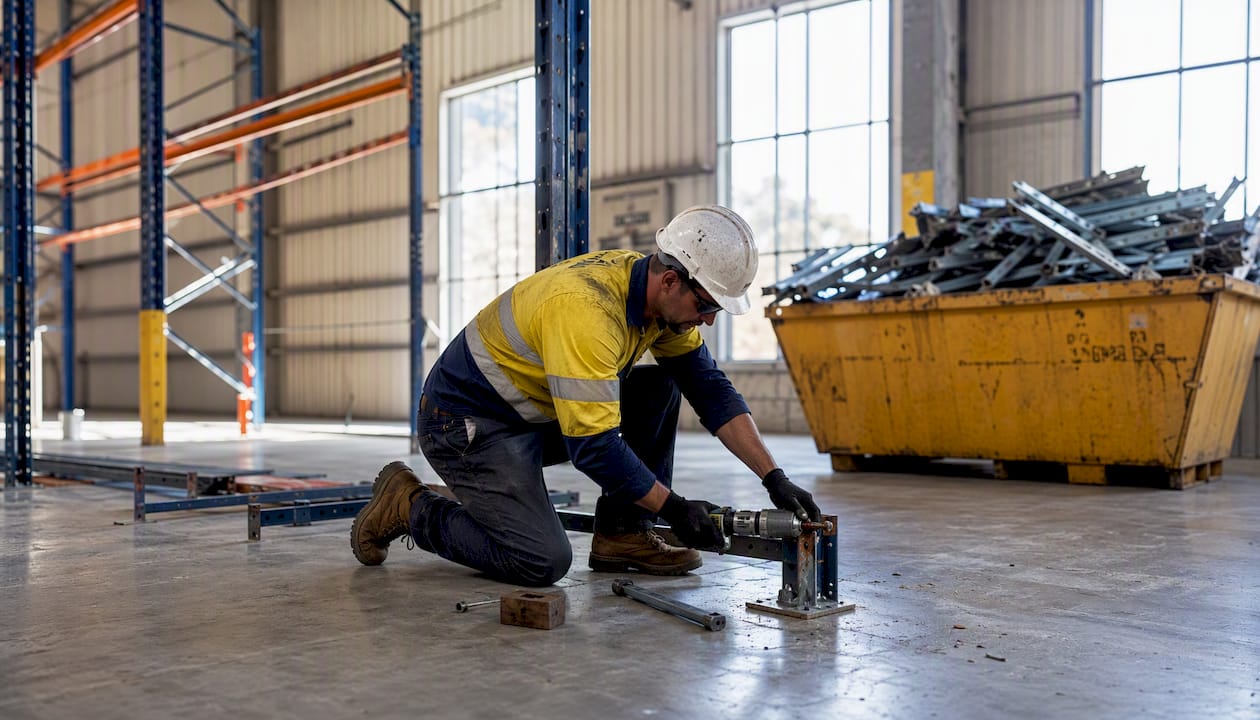
Hire a professional pallet racking removal service that includes a site inspection, a written quote, safe dismantling, recycling and disposal, and floor make-good. That combination is what actually gets a warehouse handed back to a landlord without a bond fight. Anything less, a crew that just unbolts the uprights and drives off, tends to leave you with stripped anchors, gouged concrete and a make-good bill that costs more than the removal itself.
The steel storage racking standard AS 4084 governs how racking should be inspected and dismantled safely, and SafeWork NSW’s guidance sets out when incidents need reporting. Most commercial and industrial leases require the space returned to its original, “back-to-building” condition, which almost always means racking gone and the slab repaired. Melbourne City Rubbish handles this as one job rather than three separate trades, and a typical site clears in one to three days depending on scale and anchor condition.
Your next move is simple:
- Book a site inspection and get a written, itemised quote before anything is touched.
- Confirm the quote explicitly names core drilling or anchor extraction, not just “removal”.
- Check that epoxy floor repair and grinding are included, priced, and scheduled.
- Ask for proof of insurance, waste transport permits and disposal receipts up front.
- Get a completion certificate or photo record you can hand straight to your landlord.
Key Takeaways
A successful pallet racking removal hinges on hiring a contractor who bundles anchor extraction, recycling and epoxy floor repair into one accountable job, not three disconnected tasks.
| Point | Details |
|---|---|
| Hire full-service, not haul-away | Confirm the contractor extracts anchors and repairs the slab, not just removes visible steel. |
| Get an itemised written quote | Demand separate line items for labour, anchor removal, disposal fees and epoxy repair. |
| Require disposal proof | Ask for transport certificates, disposal receipts and waste facility licence details before work starts. |
| Prepare the site in advance | Clear access, remove stock and confirm handover requirements to keep the job to its typical one to three days. |
| Melbourne City Rubbish handles it end to end | Site inspection, fixed quote, controlled dismantling, segregated recycling and floor make-good in one engagement. |
Table of Contents
- What does a professional pallet racking removal service include?
- How long does removal take and what drives the cost?
- What legal and safety obligations apply?
- How do you prepare your site before the crew arrives?
- What should you ask suppliers, and what are the red flags?
- Why is professional removal usually cheaper than DIY?
- How Melbourne City Rubbish handles pallet racking removal
- Sources
What does a professional pallet racking removal service include?
A competent contractor walks the site first. That inspection produces a written quote covering labour, plant, disposal fees and floor repair, all itemised so you can see exactly what you’re paying for and where. If a quote arrives as a single lump sum with no breakdown, that’s your first warning sign, not a convenience.
From there, the job runs in a fairly consistent sequence:
- Site inspection and scoping — measuring the racking system, checking anchor type, and noting floor condition before quoting.
- Controlled dismantling — uprights, beams, braces and fasteners come down in sequence, labelled and sorted rather than dropped in a pile.
- Anchor and bolt extraction — this is where jobs diverge sharply. Proper make-good uses core drilling or chemical anchor removal to pull fixings clean out of the slab, rather than grinding bolts flush and leaving stubs behind.
- Material segregation — steel, timber and other components get sorted for recycling versus disposal, with paperwork tracking where everything goes.
- Concrete repair — holes get filled with high-strength epoxy, then levelled and ground back so the floor reads as continuous, not patched.
- Final clean and handover evidence — a swept site plus photos or a completion report you can pass straight to the landlord or facilities team.
Pro Tip: Ask the contractor to photograph the floor before dismantling starts and again after epoxy repair. That before-and-after pair is often the single piece of evidence that settles a bond dispute in your favour.
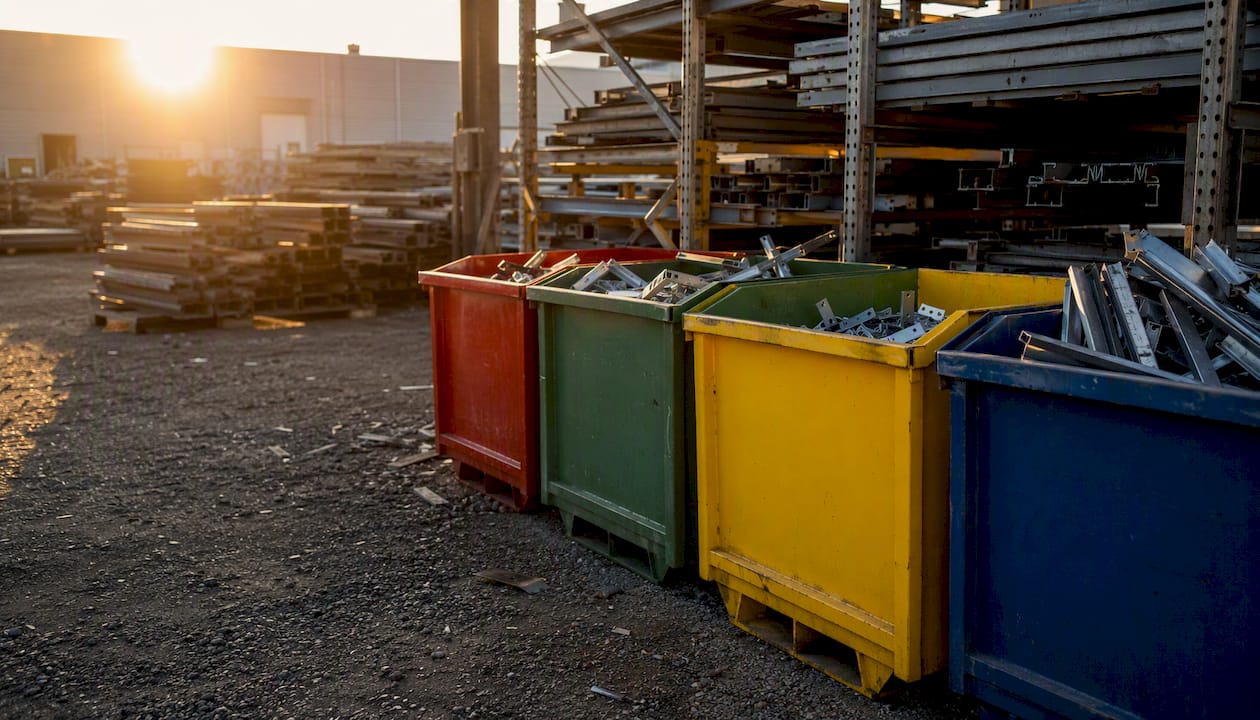
Comprehensive operators separate recyclable metals from waste destined for landfill and handle floor restoration as part of the same engagement. This is what actually gets a site to handover standard rather than just “cleared”.
How long does removal take and what drives the cost?
Most single-site jobs typically finish within a few days. A small mezzanine store with a few bays of racking might be gone by lunchtime; a full-height, multi-aisle warehouse system with hundreds of anchor points can run closer to a week once you add floor repair and curing time for epoxy.
Several variables move the price more than anything else:
- System size and complexity — more bays, more anchors, more labour hours.
- Anchor removal difficulty — chemical anchors set decades ago can be harder to extract cleanly than newer mechanical fixings.
- Floor repair scope — a handful of holes is cheap; a slab riddled with cracked concrete around old footings is not.
- Site access — loading dock access speeds things up; a tight CBD basement with no forklift access slows everything down.
- Contaminated or hazardous items — old batteries, chemical residue or asbestos-era fixtures add handling steps and cost.
- Recycling value recovered — scrap steel has resale value, and assessing resale or repurpose options before scrapping indiscriminately can meaningfully offset your invoice.
Insist on a fixed, itemised quote rather than open-ended time-and-materials billing wherever the scope is knowable in advance. That quote should separately list anchor removal, disposal and recycling fees, and confirm you’ll receive disposal receipts once the job’s done. If a contractor won’t commit to a number until the day of the job, get a second quote.
What legal and safety obligations apply?
This is where DIY attempts and dodgy contractors both come unstuck. Lease agreements commonly require tenants to return the warehouse to its original condition, and that clause is doing a lot of work: it typically covers racking removal, fixing removal and concrete repair, and failing to meet it can trigger bond deductions that dwarf the cost of doing the job properly the first time.
On the safety side, work health and safety duties require racking and similar structures to be inspected by a competent person, generally at intervals not exceeding 12 months, with AS 4084 providing the reference standard for what that inspection should cover. Where a racking collapse or serious incident puts people at risk, SafeWork must be notified, and SafeWork NSW publishes both the reporting threshold and contact details for exactly this scenario.
Waste transport adds another compliance layer. Prescribed industrial waste rules require permits and detailed transport certificates for certain consignments, recording who produced the waste, who transported it and who received it. WorkSafe Victoria’s guidance on safe handling of industrial waste covers container standards and the cooperation expected between the business generating the waste and the business treating it.
Before you sign anything, ask for:
- Evidence of public liability and workers’ compensation cover.
- Waste transporter permits and disposal facility licences.
- Signed transport certificates and delivery receipts for every load.
Statistic Callout: Racking inspections should occur at intervals not exceeding 12 months under SafeWork NSW guidance referencing AS 4084. If your racking hasn’t been formally inspected in over a year, factor that into your removal timeline. Damage found mid-dismantling can add scope and cost.
How do you prepare your site before the crew arrives?
A tidy handover starts with a tidy site. Clear truck access and parking first, since a crew that spends an hour finding somewhere to park a skip bin is a crew billing you for that hour. Mark restricted zones if other parts of the warehouse stay operational during the job.
Strip stock, pallet loads and loose inventory off any racking scheduled for removal, and tag anything you’re keeping so it doesn’t end up on the truck by mistake. Give the contractor a site contact, confirm access times or lock-out procedures, and flag anything overhead, sprinklers, lighting rigs, mechanical services bolted to the racking, before dismantling starts. Finally, confirm what your landlord actually wants for handover: some want a signed completion certificate, others just want photos. Settle that before the job starts, not after.
What should you ask suppliers, and what are the red flags?
Ask every quoting contractor these questions directly:
- Do you core-drill and remove anchors, or do you cut and leave stubs?
- Is epoxy floor repair included, and what’s the itemised cost?
- Can you supply waste transport permits and disposal receipts for this job?
- What insurances do you hold, and what are the liability limits?
- Can you provide references from a similar warehouse make-good?
Treat vague or purely verbal quotes as a red flag on their own. So is any contractor offering to “cut off and leave stubs” as a cost-saving shortcut, or one who can’t name where the scrap steel is going. If nobody can produce a waste receiver’s name or licence number, assume the disposal chain doesn’t exist. Be sceptical of blanket guarantees too. A contractor who says “we’ll make it handover-ready” without listing the actual repair method and materials is making a promise, not a plan.
Why is professional removal usually cheaper than DIY?
DIY racking removal looks like a saving right up until someone strips a bolt, cracks a slab, or a rack section comes down wrong. Floor damage and failed handovers routinely cost more to fix afterwards than a professional removal would have cost upfront, and that’s before you count the lost time chasing a second contractor to patch what the first attempt broke.
A single supplier handling dismantling, transport and floor repair also removes the coordination headache of managing three separate trades on three separate schedules. That matters more than it sounds: every handoff between trades is a chance for something to fall through the gap between “not my job” and “already left site”.
Pro Tip: Before awarding any removal job, ask the contractor for photos of a previous warehouse make-good, ideally the floor before and after. If they can’t produce one, that’s telling you something about their actual experience with this exact scope of work.
Professionals also manage the recycling and disposal chain end to end, which maximises scrap recovery and hands you the compliance paperwork you’ll need if a landlord or regulator ever asks questions later.
How Melbourne City Rubbish handles pallet racking removal
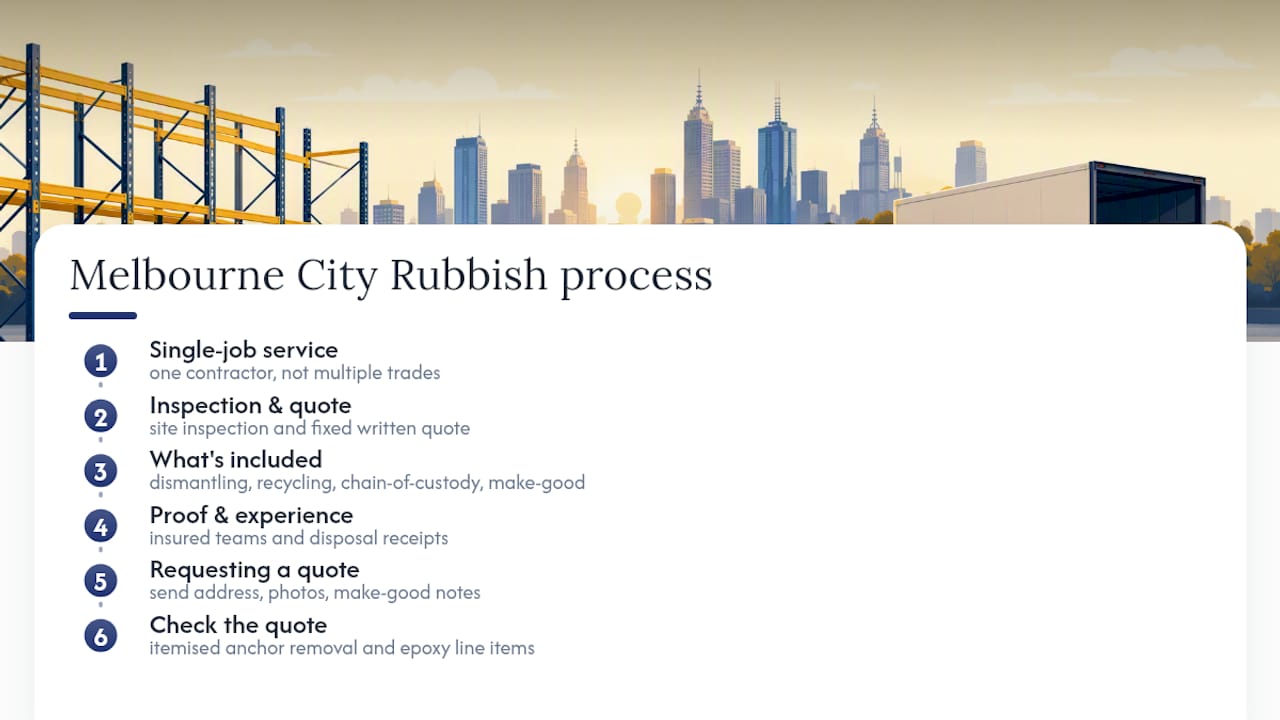
Melbourne City Rubbish runs pallet racking removal as one job, not a relay between three tradespeople. A site inspection and fixed, written quote come first, covering controlled dismantling, segregated recycling, documented chain-of-custody for scrap steel, and floor make-good options including anchor removal and epoxy repair where the slab needs it. Insured teams, disposal receipts and prior experience with end-of-lease warehouse handovers back that up, so you’re not the one chasing paperwork after the trucks leave.
Requesting a quote is straightforward: send through the property address, a few photos of the racking, and any specific make-good notes from your lease. Ask for an itemised breakdown that lists anchor removal and epoxy repair as separate line items, not buried in a general “removal” fee, and check it against the advice on vetting rubbish removal contractors before you sign. Strata and commercial clients organising a coordinated end-of-lease clearance can also see how strata rubbish removal works for multi-tenancy sites. If you’re ready to move, contact Melbourne City Rubbish for a same-day inspection or a competitive written quote that includes make-good from the start.
Sources
Before signing off on any removal job, cross-check your contractor’s claims against the primary references governing lease obligations, safety and waste transport. Ask suppliers to hand over the documents these bodies require, not just tell you they hold them.
- AustLII — Environment Protection Act / make-good obligations (Victorian consolidation)
- SafeWork NSW — Pallet racking guide
- Environment Protection (Industrial Waste Resource) Regulations 2009 — Schedule and transport certificate requirements (Victoria)
- WorkSafe Victoria — Safe handling of industrial waste guide (PDF)
Ask suppliers directly for transport certificates, signed disposal receipts, a current waste facility licence number, and a certificate of currency for public liability insurance. If a contractor hesitates to produce any of these before the job starts, treat that hesitation as your answer.