Choose deconstruction when salvage value, embodied carbon, or heritage character matters to your project. Choose demolition when the site is unsafe, the timeline is fixed, or no viable reuse market exists nearby. That’s the decision rule, and everything else is detail.
The EPA NSW house deconstruction guidance documents this trade-off clearly: deconstruction typically takes 55–60% longer than demolition, but it recovers materials that would otherwise become landfill. The World Economic Forum frames it as a circular-economy imperative, noting that careful dismantling retains embodied carbon locked into building materials for decades. Australia’s National Waste Report confirms that construction and demolition waste is one of the largest waste streams nationally, making the recovery choice a system-level decision, not just a project-level one.
Key Takeaways
| Point | Details |
|---|---|
| Decision rule | Choose deconstruction for salvage value or heritage; choose demolition for speed, safety, or no reuse market. |
| Timeline trade-off | Deconstruction takes roughly 55–60% longer than demolition, per EPA NSW guidance. |
| Cost offset potential | Salvage resale and avoided landfill fees can bring net costs closer to parity when reuse markets are active. |
| Survey first | A pre-work salvage survey is the single most important step before accepting any quote for either method. |
| Demolition is sometimes necessary | Unsafe structures, contaminated sites, and fixed short timelines make demolition the only viable option. |
Table of Contents
- What is deconstruction and how does it actually work?
- What demolition is and its common variants
- How do deconstruction and demolition compare head-to-head?
- When should you choose deconstruction over demolition?
- What does the process look like, step by step?
- How do costs compare, and can salvage offset the difference?
- Why deconstruction matters beyond waste diversion
- How to hire the right contractor and document what you recover
- An editorial perspective on the real decision
- Sources
What is deconstruction and how does it actually work?
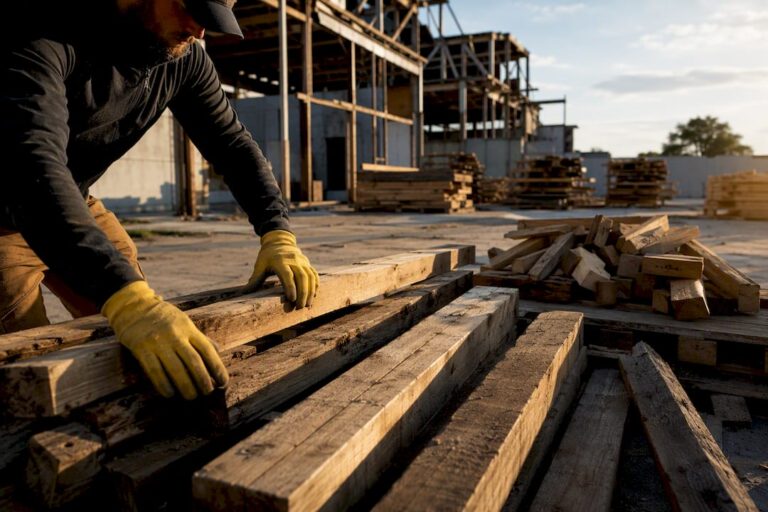
Deconstruction is the careful, systematic dismantling of a building to maximize the reuse and resale value of its components. Think of it as construction in reverse: instead of knocking a structure down, workers take it apart piece by piece, preserving materials in a condition that lets them be sold, donated, or reused directly on-site.
The process follows a logical sequence:
- Salvage survey: A pre-work assessment identifies which materials have reuse or resale value and estimates quantities.
- Selective dismantling: Workers remove high-value items first — fixtures, cabinetry, doors, windows — before any structural work begins.
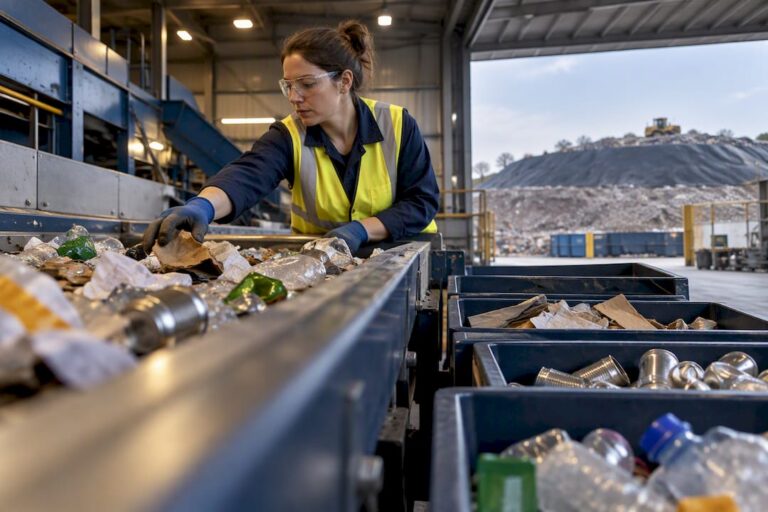
- On-site sorting: Materials are separated by type and condition as they come off the building.
- Storage, marketing, or reuse: Salvaged goods go to a reuse organization, are sold directly, or are staged for use in the replacement structure.
Commonly salvageable materials include old-growth timber, hardwood flooring, structural beams, brick and masonry, doors and door frames, windows, kitchen and bathroom cabinetry, appliances, architectural metalwork, and decorative elements like cornices or balustrades. The Cornell local-government guide recommends salvage surveys and materials management plans as the foundation of any deconstruction project, noting that diversion rates improve substantially when these steps are completed before work begins.
One non-negotiable before any dismantling starts: permits and a hazardous-material inspection. Asbestos and lead paint are common in pre-1990 buildings and must be identified and remediated by licensed contractors before the salvage team enters.
What demolition is and its common variants
Demolition is controlled destruction for site clearance. Where deconstruction preserves, demolition reduces. The goal is to bring a structure down efficiently, separate the resulting rubble into recyclable and non-recyclable fractions, and clear the site for whatever comes next.
Three main variants cover most projects:
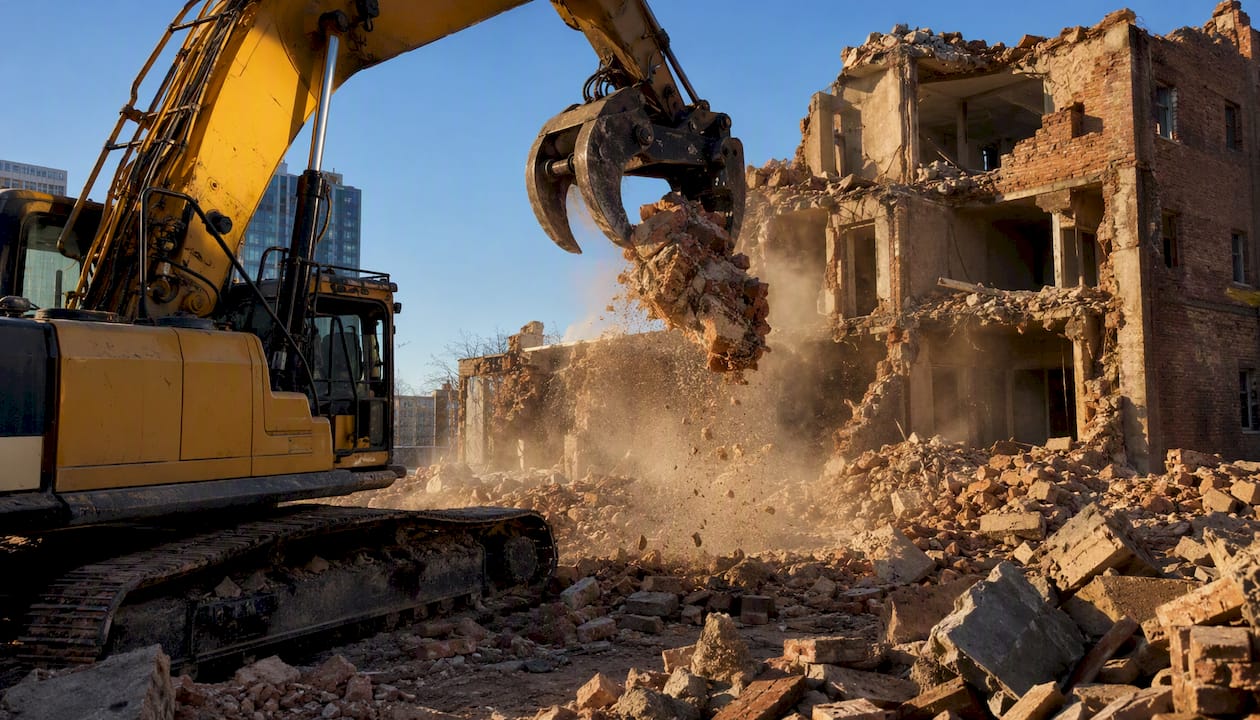
Mechanical demolition uses heavy equipment — excavators fitted with hydraulic shears or crushers, cranes, and wrecking balls — to tear down structures quickly. It’s the default for most residential and commercial clearances.
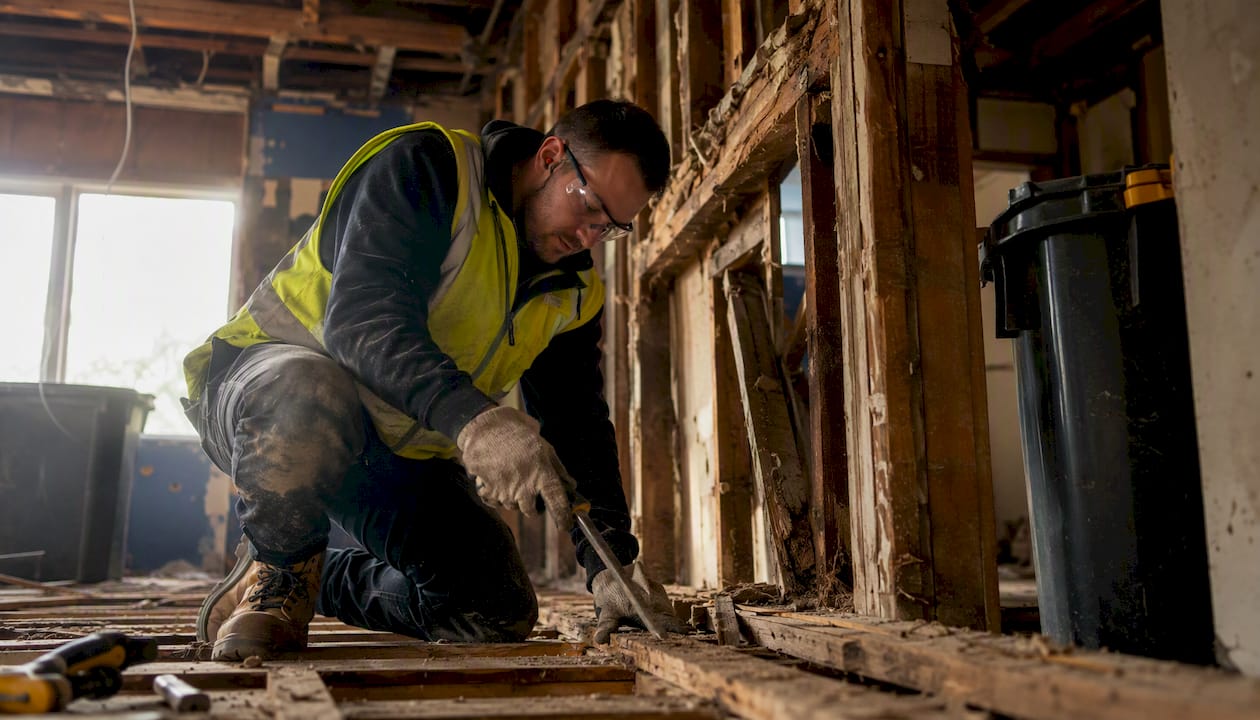
Selective (soft-strip) demolition removes specific internal elements before mechanical work begins. This is a hybrid approach: strip out the finishes, fixtures, and services first, then bring in the machines. It captures some salvage value without the full labor intensity of deconstruction.
Implosion or detonation applies to large structures where controlled explosive charges bring the building down in seconds. It requires extensive pre-planning, exclusion zones, and specialist contractors, and it’s rarely used outside major commercial or infrastructure projects.
Typical equipment and outputs include:
- Excavators with hydraulic attachments, cranes, and wrecking balls
- Mixed concrete rubble (often crushed and recycled as aggregate)
- Separated steel and metal (high recycling rate due to commodity value)
- Timber waste (often chipped or landfilled unless pre-sorted)
- General mixed demolition debris
Regulatory requirements apply to every demolition project: permits, site exclusion zones, dust and noise controls, asbestos clearance certificates, and approved waste transport plans are standard. Skipping any of these creates legal exposure and safety risk.
How do deconstruction and demolition compare head-to-head?
| Dimension | Deconstruction | Demolition |
|---|---|---|
| Speed / timeline | 55–60% longer than demolition | Fast; days to weeks depending on size |
| Direct cost | Higher upfront labor cost | Lower upfront cost |
| Indirect cost | Lower landfill fees; potential resale income | Higher landfill / tipping fees; no salvage income |
| Waste diversion rate | High; most materials recovered for reuse or recycling | Lower; mixed rubble often partially landfilled |
| Labor & skill required | Skilled trades; manual disassembly | Fewer workers; machine-operated |
| Salvage value / resale | Significant for old-growth timber, fixtures, masonry | Minimal; scrap metal only |
| Best for | Heritage, renovation, high-value materials | Fast clearance, unsafe structures, tight schedules |
| Safety & regulatory | Hazmat checks critical; lower dust/vibration risk | Exclusion zones, dust control, vibration management |
But the indirect cost column is where the comparison shifts. Landfill tipping fees have risen steadily, and a project that diverts significant tonnage avoids fees that can run into thousands of dollars on a full house clearance.
Best for deconstruction: heritage properties, whole-house rebuilds where salvaged materials will be reused, projects with strong local reuse markets.
Best for demolition: structurally unsafe buildings, contaminated sites, projects with fixed short timelines, locations with no viable reuse infrastructure.
When should you choose deconstruction over demolition?
The decision comes down to two variables: how much time you have, and how much the materials are worth. When both favor recovery, deconstruction wins clearly. When one or both favor speed, demolition is the practical answer.
Scenarios where deconstruction makes sense:
- Heritage renovation: A pre-1960s home with old-growth timber floors, original brick, and period joinery. Those materials are scarce, and buyers pay well for them. Deconstruction recovers them intact.
- Whole-house rebuild with on-site reuse: You’re knocking down to rebuild on the same lot. Salvaged timber, windows, and doors go straight into the new structure, cutting material costs.
- Resale of architectural components: Ornate staircases, leadlight windows, cast-iron fireplaces, and Victorian-era fittings have active resale markets through architectural salvage dealers.
- Regulatory triggers: Some municipalities now require diversion plans or impose landfill levies that make deconstruction economically attractive. The EPA NSW resource recovery framework outlines how orders and exemptions can shift the economics at the local level.
Scenarios where demolition is the right call:
- Structurally unsafe or contaminated buildings: If entry is dangerous, systematic hand-dismantling is not feasible. Mechanical demolition with appropriate safety controls is the only option.
- Subdivision or fast-cash clearance: A developer buying to subdivide needs the site cleared quickly. The holding cost of a longer deconstruction schedule often outweighs any salvage return.
- Post-fire or flood damage: Severely compromised structures with contaminated materials are poor candidates for salvage and may require demolition under safety orders.
- No local reuse market: Salvaged materials need somewhere to go. If there’s no reuse organization, architectural salvage dealer, or active buyer within a reasonable distance, the economics of deconstruction collapse.
Understanding Melbourne’s waste regulations is worth doing early, since local landfill levies and diversion requirements can shift the break-even point before you’ve priced a single quote.
What does the process look like, step by step?
Deconstruction sequence
- Pre-work salvage survey and material inventory
- Permit applications (demolition permit, hazardous-material assessment)
- Asbestos and lead remediation by licensed contractors
- Soft strip: remove fixtures, fittings, cabinetry, flooring, windows, and doors
- Structural dismantling: roof, walls, foundations in sequence
- On-site sorting into material streams
- Transport to reuse organizations, salvage dealers, or recyclers
Timeline note: EPA NSW guidance documents that deconstruction typically takes 55–60% longer than conventional demolition. A house demolition that takes one week could take 1.5–2 weeks as a deconstruction project.
Demolition sequence
- Permit applications and site safety plan
- Utility disconnections (gas, water, electricity)
- Asbestos clearance (required before mechanical work)
- Soft strip if selective demolition is specified
- Mechanical demolition: structure brought down by excavator or crane
- Rubble sorting: concrete separated for crushing, metals for recycling
- Site clearance and transport to recycling facility or landfill
Logistical realities matter here. Deconstruction requires staging areas for sorted materials, more truck movements for different material streams, and time for marketing salvaged goods before the site can be fully cleared. Local reuse infrastructure — whether a nearby architectural salvage yard or an active online market — directly affects how quickly salvaged materials move and whether the schedule stays on track. For practical guidance on managing the debris side of a renovation or strip-out, managing renovation waste in Melbourne covers sorting, transport, and disposal planning in detail.
How do costs compare, and can salvage offset the difference?
Deconstruction costs more upfront. That’s the honest starting point. The labor is manual, skilled, and slow. But the full cost picture includes several offsets that demolition doesn’t offer.
Cost items for both approaches:
- Labor (manual for deconstruction, machine-operated for demolition)
- Equipment hire (excavators, cranes, hand tools, scaffolding)
- Transport and truck movements
- Landfill or tipping fees (significantly higher for demolition)
- Hazardous-material remediation (required for both)
- Permit fees
- For deconstruction: storage, marketing, and logistics for salvaged goods
How salvage offsets costs:
Resale of high-value items — old-growth timber, period joinery, cast-iron elements, quality cabinetry — can generate direct income. Avoided landfill fees reduce the disposal bill. In some jurisdictions, donating materials to a registered reuse organization may create a tax deduction. Practitioners report that as reuse markets mature, projects with strong salvage channels can approach cost parity with demolition when all costs and offsets are counted together.
A simple way to think about the break-even: if your demolition quote includes $3,000–$5,000 in landfill fees and your salvage survey identifies $4,000–$8,000 in resaleable materials, the gap between methods narrows considerably. The math shifts further when landfill levies are high or rising.
Budgeting tips:
- Build a 15–20% contingency into deconstruction budgets; hazmat finds and slow salvage markets are the most common cost blowouts.
- Allow time for marketing salvaged items before the project starts, not after. Buyers for architectural elements often need lead time.
- Estimate disposal volumes conservatively. Assume more material goes to landfill than the optimistic salvage survey suggests.
- Get smart about construction waste disposal costs before signing any contract, since tipping fees vary significantly by material type and facility.
Why deconstruction matters beyond waste diversion
The environmental case for deconstruction goes deeper than keeping rubble out of landfill. Every kilogram of old-growth timber or fired brick that gets reused is a kilogram that doesn’t need to be manufactured, transported, and installed as a new product. The World Economic Forum describes this as retaining embodied carbon — the carbon already spent making the material — rather than wasting it and spending more carbon to replace it.
Material passports are an emerging tool that formalizes this logic. A material passport is a documented record of a building’s components: what they’re made of, their condition, and their specifications. When a building is deconstructed, the passport travels with the salvaged materials, making them easier to specify and sell into new projects. The World Economic Forum identifies material passports as a key enabler of the circular economy in construction.
Social benefits are real too. The Cornell local-government guide documents that deconstruction programs create specialized green jobs and help preserve trade skills — joinery, masonry, careful carpentry — that mechanical demolition has no use for. Cities that have adopted deconstruction ordinances, including some in the United States, have reported significant tonnages diverted from landfill after ordinance adoption, with local reuse businesses growing alongside the programs.
Pro Tip: List salvaged materials on architectural salvage platforms and local reuse networks before the project starts. Buyers for period joinery, timber, and masonry often need 4–6 weeks of lead time, and pre-sold materials move off-site faster, keeping your schedule tighter.
How to hire the right contractor and document what you recover
The contractor you hire determines whether a deconstruction project delivers on its promise or just costs more than demolition with nothing to show for it.
Questions to ask every contractor:
- How many deconstruction projects have you completed in the last two years?
- Can you provide references from projects where salvage was documented and sold?
- Are you licensed for hazardous-material removal, including asbestos?
- What is your target diversion rate, and how do you measure it?
- Do you provide a written materials management plan before work begins?
- Who holds the demolition permit, and what does it cover?
- What is your insurance coverage for property damage and worker injury?
- How do you handle materials that can’t be sold or donated?
Red flags to walk away from:
- No written diversion plan or vague promises about “recycling most of it”
- Pricing with no line-item breakdown for labor, disposal, and salvage
- Reluctance to allow a pre-work salvage survey by an independent appraiser
- No proof of hazardous-material handling certification
- No public liability insurance documentation
Documenting your material recovery:
A basic salvage and deconstruction (S&D) survey should record: material type, estimated quantity, condition rating, location in the building, and estimated resale or donation value. The minimum fields for a usable material inventory are item description, dimensions or quantity, condition (good/fair/poor), and intended disposition (sell, donate, reuse on-site, recycle, landfill). An independent appraiser, a reuse organization representative, or a specialist deconstruction contractor should sign off on the inventory before work begins.
Pro Tip: Photograph every salvageable item in place before removal. Buyers of architectural salvage pay more for items with provenance photos, and the documentation protects you if a contractor later disputes what was recovered.
For multi-unit or strata projects, strata rubbish removal services can handle the ongoing debris stream while deconstruction or strip-out work is underway, keeping the site clear without disrupting the salvage process.
An editorial perspective on the real decision
The framing that deconstruction is always the sustainable choice and demolition is always the lazy one misses something important. Deconstruction done badly — with no salvage survey, no reuse market, and materials that end up in a skip anyway — is just slow demolition at a higher price. The method only delivers on its promise when the full chain works: survey, skilled labor, sorted materials, and a buyer or reuse channel waiting at the other end.
What practitioners rarely say loudly enough is that the reuse market is the constraint, not the technique. In areas with active architectural salvage networks, strong landfill levies, and contractors who know what they’re doing, deconstruction can genuinely approach cost parity with demolition. In areas where none of that infrastructure exists, the economics are harder to justify unless heritage or regulatory requirements force the issue.
The practical advice I’d give anyone standing in front of a building they need to take down: get the salvage survey done before you accept any quote. It costs relatively little and tells you whether the materials are worth recovering. If the survey comes back with high-value items and a viable market, deconstruction deserves serious consideration. If it comes back with low-grade materials and no buyers, demolition is the honest answer.
Melbournecityrubbish handles the debris side of both scenarios across Melbourne — construction waste, strip-out material, and post-demolition rubble cleared efficiently, with carbon-neutral disposal options for projects where the environmental accounting matters. If you’re planning a clearance and want a quote that actually reflects the full disposal picture, get in touch.

Sources
- Deconstruction is an eco-friendly alternative to building demolition | World Economic Forum
- A Local Government Policy Guide to Alternatives to Demolition through Deconstruction and Building Material Reuse
- Environment
- Practitioner observations on deconstruction economics (IOPscience conference paper)