
A NABERS Waste Rating is an independent star rating that measures a building’s waste and resource recovery performance against industry benchmarks, and it currently applies to office buildings. If you manage an office, the fastest next step is to register on the NABERS Waste Platform or contact a NABERS Accredited Assessor to start the process.
TL;DR:
- Buildings aiming to improve their NABERS Waste Rating should prioritize collecting weight-based data from certified contractor tickets and track multiple waste streams regularly.
- A higher rating beyond three stars usually involves expanding waste streams to e-waste, furniture, and organics, and managing contamination at the source.
- Choosing between base-building and whole-building scope early prevents delays, as data collection responsibilities vary significantly.
- Accurate data collection requires recording material destinations and flagging contractor or volume changes during the 12-month reporting period.
- Engaging a waste partner experienced in multi-stream collection and certified weight tickets simplifies validation and boosts chances of achieving a higher star rating.
Table of Contents
- What the NABERS Waste rating measures and why it matters
- Eligibility and rating types: base building vs whole building
- How the rating is calculated and what data you must collect
- Using the NABERS Waste Platform and pricing you should budget for
- How to get a NABERS Waste rating: step-by-step
- Practical measures to raise your NABERS Waste performance
- NABERS Waste Rules, documentation and recent changes
- How to find and use current NABERS Waste ratings
- How Melbourne City Rubbish supports your NABERS Waste preparation
- Sources
- FAQ
What the NABERS Waste rating measures and why it matters
A NABERS Waste Rating scores how well a building diverts waste from landfill and how effectively it recovers materials for reuse or recycling, expressed on the familiar NABERS star scale. The rating differs from a NABERS Waste Verification, which measures the same performance without benchmarking it against comparable buildings for a star result.
The scale rewards genuine improvement over time rather than a single snapshot, which is why building owners often track their rating year-on-year.
- A higher star rating signals stronger diversion and recovery practice, not just lower volumes of waste.
- Ratings feed into broader sustainability programmes, including Green Star pathways for commercial buildings.
- Continuous improvement, not a one-off audit, is the intent behind the annual rating cycle.
A 3-star result is generally treated as market standard, with higher stars reflecting better recycling and recovery outcomes, according to NABERS case study material. Buildings that push past that benchmark tend to run more waste streams and closer tracking of what leaves the site.
Eligibility and rating types: base building vs whole building
NABERS Waste Ratings are currently available for office buildings, and the NABERS Waste Platform can still be used by other building types to track and benchmark waste data even where a formal star rating is not yet offered for that sector.
Within offices, the rating can apply at two levels, and the choice affects who is responsible for collecting data.
- A base-building rating covers common areas and base-building operations managed by the landlord or building manager.
- A whole-building rating extends to tenancy waste, requiring cooperation from tenants and their contractors.
- The eligible scope determines whether the property manager alone can supply data or whether tenant engagement is required.
Choosing the wrong scope early is a common cause of delay, since assessors need to know from the outset whose waste streams are being measured.
How the rating is calculated and what data you must collect
Ratings are built on 12 months of operational data, validated by a NABERS Accredited Assessor before a certificate is issued, according to NABERS-focused guidance. Preferred data sources are weighbridge tickets or certified contractor reports rather than estimates or bag counts.
- Collect a full 12 months of waste and recycling data from every contractor servicing the site.
- Use weight-based figures from weighbridges or certified contractor tickets wherever possible.
- Record the destination or pathway for each material stream, not just the tonnage collected.
- Flag any gaps or contractor changes during the reporting period so the assessor can account for them.
Scoring rewards the quality of recovery, meaning where material actually ends up, not simply how much is diverted from a general waste bin. A skip sent to a mixed-recycling facility scores differently to the same material separated into clean streams. Assessors treat missing or inconsistent data conservatively, which usually drags the result down rather than leaving it unscored.
Pro Tip: Ask every contractor for certified weight tickets from day one of the reporting period, rather than trying to reconstruct volumes from invoices later.
Using the NABERS Waste Platform and pricing you should budget for
The NABERS Waste Platform is where data is uploaded, validated and turned into a calculated result, and it also generates the reporting used in a final submission. Budgeting needs to cover more than the software itself.
- Platform access carries a tracking fee, published at $450 per year for the waste tracking option.
- Assessor fees and administration or lodgement fees apply separately and are set by the assessor engaged for the job.
- Templates and user guides for data upload and contractor reporting are available through the NABERS website ahead of submission.
There is no mandatory government requirement forcing every building into a NABERS Waste Rating; it is chosen to benchmark performance or to support a Green Star submission.
How to get a NABERS Waste rating: step-by-step
Getting a rating follows a fairly consistent sequence, whether it is a building’s first rating or a renewal.
- Register the building on the NABERS Waste Platform and confirm whether a base-building or whole-building scope applies.
- Engage a NABERS Accredited Assessor and start compiling 12 months of contractor data, weight tickets and material pathway records.
- Support the assessor’s site visit, where waste storage, signage and contractor practices are checked against the submitted data.
- Have the assessor validate the data set and lodge the submission through the platform.
- Receive the star rating and certificate, then repeat the cycle annually to track improvement or maintain the result.
Timelines vary depending on how complete the 12 months of records are when the assessor is engaged, so starting the data collection early is worth more than rushing the final submission.
Practical measures to raise your NABERS Waste performance
The buildings that move from a market-standard 3-star result to higher stars tend to do a few things consistently: add more waste streams, get objective data, and manage contamination at the source.
- Split general waste into more targeted streams, such as e-waste, furniture, paper and organics, rather than relying on one mixed skip.
- Move from estimated volumes to weight-based data from a weighbridge or certified contractor tickets, reported on a regular digital schedule.
- Run tenant campaigns on contamination, since a single mislabelled bin can undermine an otherwise clean recovery stream.
- Schedule dedicated e-waste and furniture collections rather than folding them into general waste runs.
NABERS case study material notes that higher-rated buildings typically operate more waste streams and closer real-time tracking than buildings sitting at market standard, drawing on examples from buildings that lifted their rating through multi-stream systems.
A rubbish removal partner that can supply certified weight tickets and keep separate streams properly sorted at collection reduces the manual reconciliation an assessor otherwise has to do, which matters when 12 months of records need to line up cleanly. Our guide on eco-friendly rubbish removal for Melbourne businesses and our piece on waste management for office building managers go into more detail on setting this up.
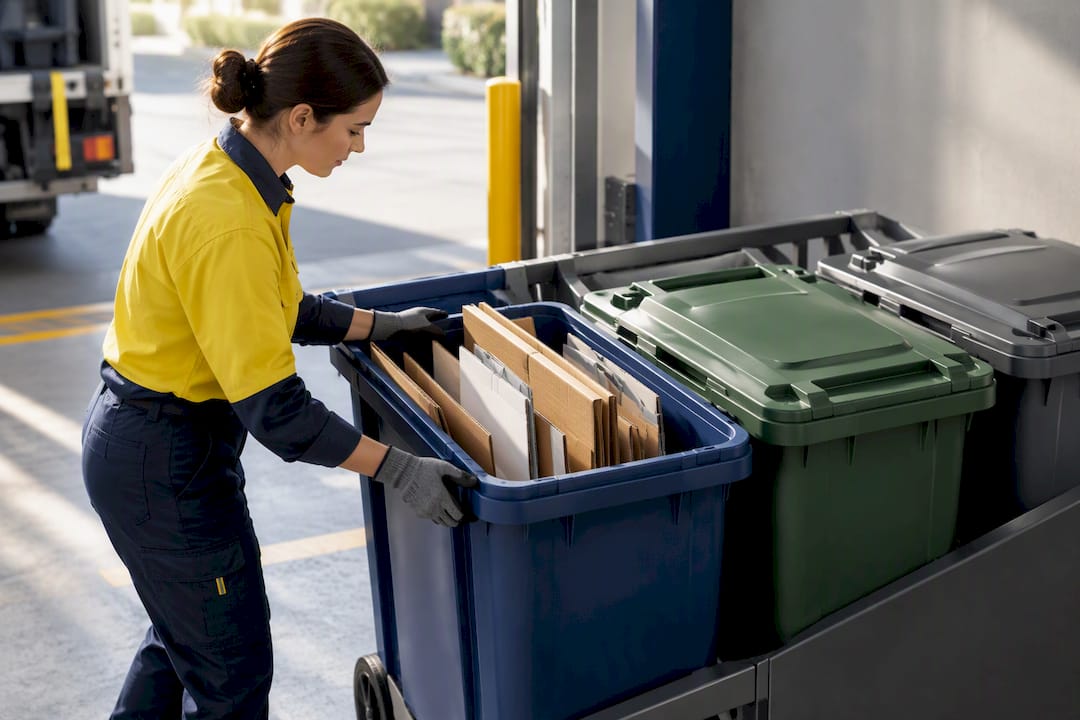
Pro Tip: Set up a shared spreadsheet or platform folder where every contractor uploads their weight tickets monthly, so nothing is missing when the assessor asks for the full year.
NABERS Waste Rules, documentation and recent changes
The current NABERS Waste Rules and support documentation set out the exact requirements for both ratings and verifications, and they are the version assessors work from when validating a submission.
- Always cite the current published version of the Waste Rules when preparing documentation, since procedural detail can change between updates.
- Recent updates have leaned further into recovery quality, meaning where material ends up, rather than headline diversion percentages alone.
- Support templates for contractor reporting and data upload sit alongside the Rules on the NABERS website and should be checked before each new reporting cycle.
Facility teams and assessors both benefit from working off the same version of the Rules, particularly when a building is being rated for the first time.
How to find and use current NABERS Waste ratings
Current ratings, star levels and expiry dates are published on the NABERS Rating Register, which supports CSV download and an API for portfolio-level reporting. Leasing teams, procurement managers and sustainability staff use the register to check a building’s standing before a transaction or a Green Star submission, since the GBCA recognises NABERS Waste as a valid pathway for demonstrating waste-to-landfill reduction.
How Melbourne City Rubbish supports your NABERS Waste preparation
Getting clean, weight-based data for a full 12 months is the part of a NABERS Waste Rating that eats the most time, and it is exactly where a good rubbish removal partner earns its place. A good rubbish removal partner runs multi-stream collections across commercial offices, provides certified weights on jobs, and handles office cleanouts, e-waste and furniture recycling as separate, trackable streams rather than one mixed load.
- Commercial Office Rubbish Removal covers structured, multi-stream collections suited to base-building or whole-building data needs.
- Office Cleanout Melbourne and Office Junk Removal Melbourne handle larger clearouts without disrupting tenants.
- Furniture Disposal & Recycling keeps furniture out of general waste and gives it its own recovery pathway.
- Construction Waste Removal in Melbourne supports fit-out and strip-out projects that also feed into a building’s waste data.
If separating streams and getting certified weights sounds like the missing piece in your rating preparation, get a quick quote and we will set up a collection schedule around your building’s reporting year.
Sources
For the primary rules, platform access, current ratings and training, consult the NABERS Waste Rules, the NABERS Waste Platform, the Rating Register and free NABERS Waste training modules, alongside GBCA’s Green Star guidance.
FAQ
What is a good NABERS rating?
A 3-star result is generally treated as market standard for NABERS Waste, with higher stars reflecting stronger diversion and recovery practice. Buildings aiming higher typically run more waste streams and track data more closely throughout the year.
How do I find a NABERS rating for a building?
Current ratings, including star levels and expiry dates, are published on the NABERS Rating Register. The register supports search, CSV download and an API for anyone managing a portfolio of buildings.
Is a NABERS Waste rating mandatory?
No, a NABERS Waste Rating is not a mandatory government requirement for buildings in Australia. Organisations choose to obtain one to benchmark performance or to support a Green Star submission, and costs include a platform access fee alongside separate assessor fees.
What are the main waste management companies in Australia?
Waste management in Australia includes a mix of national contractors, regional operators and specialist collection services, and the right fit depends on building type, location and the waste streams involved. Property managers preparing for a NABERS Waste Rating should prioritise contractors that can supply certified weight data over general price alone, and should also check obligations under guidance such as this waste manifest compliance guide for Victoria.