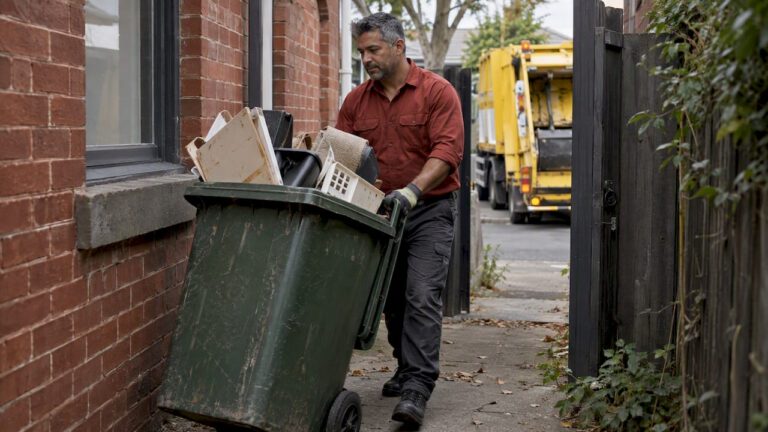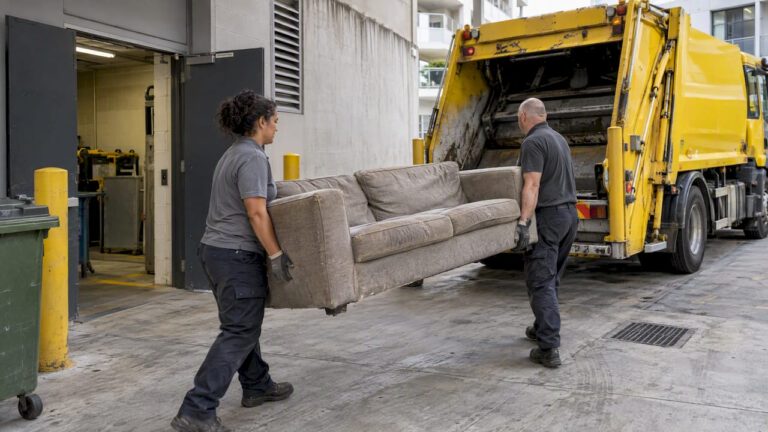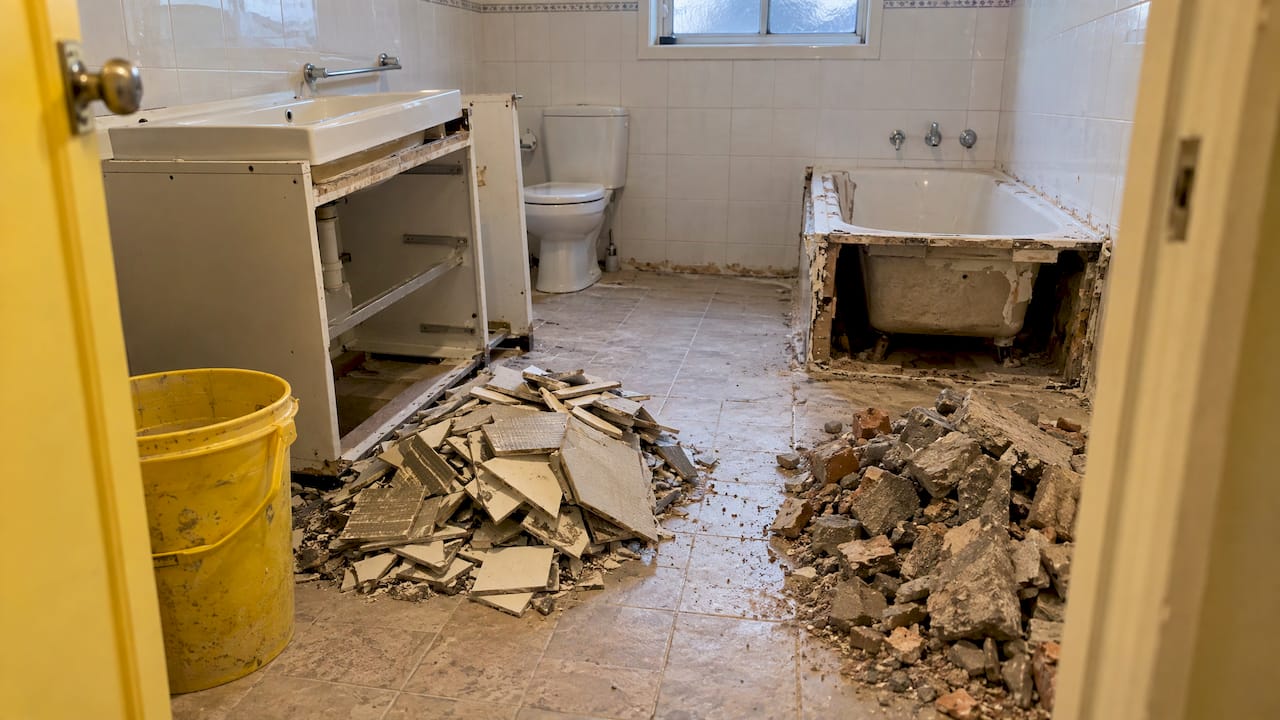
A bathroom strip-out produces a heavy, mixed pile: tiles, cement sheet, plasterboard, a bath or shower base, a vanity and a toilet. In Melbourne you have three choices. Sort and reuse what you can, get everything else to a place authorised to take it, or book a removal crew to do both. The one step you must never skip is checking for asbestos before anything is cut, drilled or smashed.
This guide covers what comes out of a bathroom, which materials need special care, how to cut the volume going to landfill, and how to organise removal so the job doesn’t stall.
TL;DR
- A bathroom reno creates dense, mixed waste (tiles, sheeting, fixtures, framing), and it is heavier than it looks.
- Check for asbestos first. Cement sheeting and old pipes in older bathrooms can contain it, and it needs licensed handling and disposal.
- Sort as you go: metal, timber, masonry and reusable fixtures separately, so more of it is recycled or donated.
- In Victoria, industrial waste must go to a place authorised to receive it, so ask any remover where your load ends up.
- Plan removal before demolition day so waste isn’t piling up in the driveway or on the street.
Table of Contents
- What a bathroom renovation actually throws out
- Check for asbestos before you touch anything
- Cut the volume: sort, salvage and reuse
- Where bathroom waste is allowed to go in Victoria
- Plan the waste before demolition day
- How we handle bathroom renovation waste
- Questions to ask before you book any removal
- FAQ
- Sources
What a bathroom renovation actually throws out
Most people underestimate the volume. A bathroom is small, but every surface is built to be waterproof and durable, which means it is also dense and hard to break down. A typical strip-out includes:
- Wall and floor tiles, with the adhesive and screed attached to the back of them
- Cement sheet or plasterboard lining the walls and ceiling
- Timber framing or battens, if walls are being reconfigured
- Fixtures: bath or shower base, toilet, basin, vanity, tapware and shower screens
- Old plumbing and electrical fittings, such as pipework, exhaust fans and light fittings
- Packaging and offcuts from the new fit-out, which arrive once demolition is done
Tiles are the real weight problem. A few square metres of floor and wall tile, plus the bed they were laid on, adds up to a load that easily overwhelms a car boot or a couple of trips. If tiles are a big part of your job, our tile disposal and removal service handles them as a dedicated waste stream.
Check for asbestos before you touch anything
This is the part of bathroom renovation waste that carries real legal and health weight, so it comes before the tips on saving money.
Older bathrooms can have asbestos-containing materials in wall and ceiling sheeting, floor underlay, and pipes. You can’t identify it by looking. If you suspect it, stop work and have the material tested by a qualified person before you cut, drill or demolish.
What the Victorian rules say
WorkSafe Victoria’s compliance code says an employer doing work in domestic premises must determine, so far as is reasonably practicable, whether asbestos is present in areas such as bathroom walls, ceilings and floors before cutting or drilling. The same guidance says the ultimate goal is to have workplaces free of asbestos-containing material, and it recommends removal before renovation over sealing or enclosing it.
If you are a homeowner hiring tradies, ask them directly whether they have checked for asbestos. If you are a property manager or a business owner fitting out amenities, this duty sits squarely with you and your contractors.
How asbestos is handled
The Victorian code for removal work sets out safer methods. They include hand tools instead of power tools, wet methods to suppress dust, and Class H vacuuming and damp rags rather than sweeping or brushing. The same guidance stresses that planning matters, because misunderstandings about the process can lead to unsafe methods that endanger workers, neighbours and residents.
For disposal, EPA Victoria’s guidance says asbestos waste must go to an EPA-licensed site, and that asbestos cement sheeting and pipes should be thoroughly wetted and kept wet until they are packaged for transport. The landfill must also handle the material so that no dust is generated.
Waste tracking applies too. In Victoria, reportable priority waste such as asbestos has to be tracked each time it changes hands, so a paper trail exists from your bathroom to the tip.
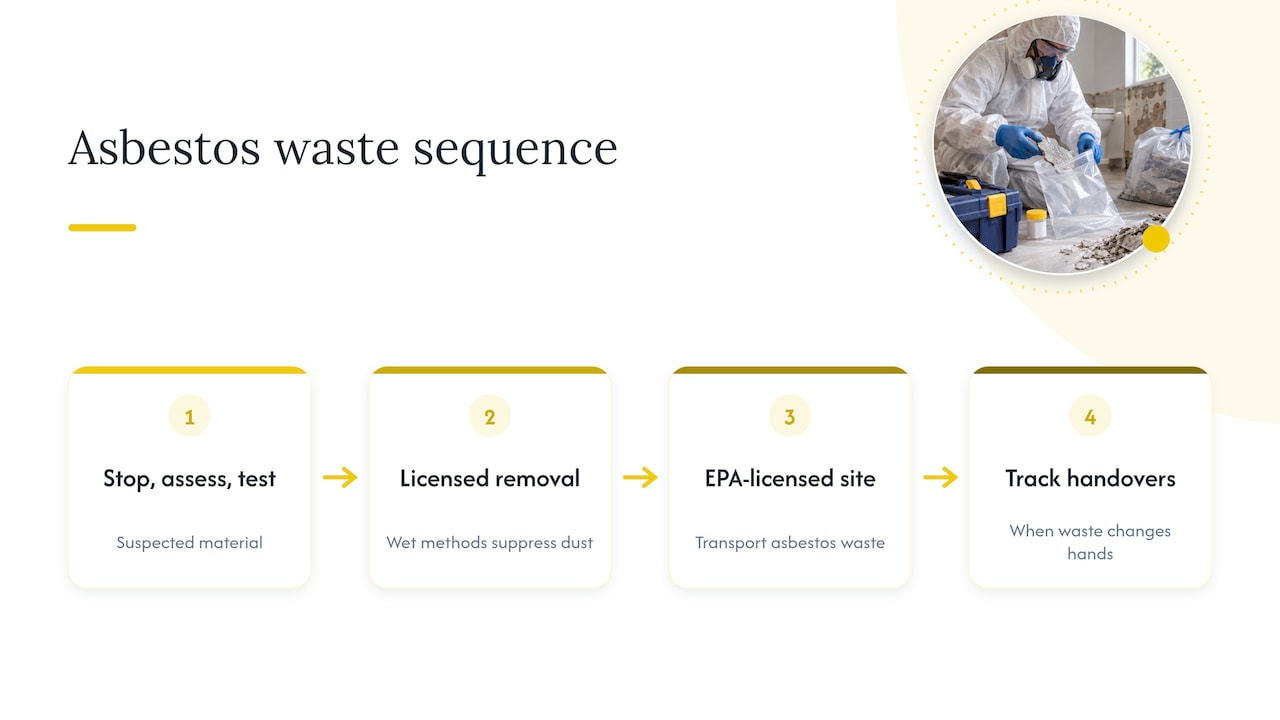
If you uncover suspect material mid-job, this explainer on what to do first after finding asbestos during a renovation covers the stop, assess and test sequence in plain terms. Local rules differ by jurisdiction, so follow the Victorian requirements above for work in Melbourne.
A practical rule: never put suspected asbestos in a general rubbish pile, a mixed load or a bin with other materials, and never break it up to make it fit. Keep it separate and leave it to people licensed to deal with it.
Cut the volume: sort, salvage and reuse
Once asbestos is ruled out, the cheapest waste is the waste you never produce. Even a tight bathroom job can divert a good share of material if you plan for it.
Deconstruct, don’t smash
US EPA guidance on renovation waste points out that careful, intact deconstruction opens the door to reuse or donation, and that crews can source-separate materials as debris is produced rather than sorting a mixed heap later. The principle holds in Melbourne even though the document is American.
In a bathroom that means:
- Vanities, mirrors and cabinets in good condition can be listed for sale or donated if they are lifted out undamaged.
- Tapware, towel rails and basins in decent shape have resale or reuse value.
- Timber framing that is clean and untreated can often be reused for the new build or sent for recycling.
- Metal such as copper pipe, steel and aluminium fittings goes in its own pile.
- Bulky furniture and fittings that can’t be reused can be recycled; see our guide to donating or recycling old furniture before booking removal.
Keep waste streams apart
The same US EPA document notes that renovation and demolition debris is often mixed material that needs sorting on or off site, and that labelled bins for metal, timber and masonry make recycling easier. When there is no room on site, contractors can send material to off-site processing facilities to keep it out of landfill.
For a bathroom, a simple three-way split works well:
- Masonry and heavy hard waste: tiles, screed, broken ceramics
- Timber and sheeting: framing, offcuts, plasterboard (kept dry)
- Metal and fixtures: pipes, tapware, reusable items
The same guidance also says that whether recovery pays off depends on things like hauling and disposal fees, labour costs and the market for salvaged materials. Planning ahead lets you recover more even when the schedule is tight.
EPA Victoria makes the same point from the local side: segregating industrial waste protects the environment and prevents contamination, and it can also save money and time by reducing the need for new raw materials.
Where bathroom waste is allowed to go in Victoria
The rule that matters most: in Victoria, industrial waste must be deposited at a place authorised to receive it. Tipping a load on a nature strip, in a vacant lot or in someone else’s bin is not an option, and the responsibility doesn’t disappear because someone else drove the truck.
In practice, you have four main routes.
| Option | Best for | What to watch |
|---|---|---|
| Hard waste sorted and driven to a facility yourself | Small, asbestos-free jobs with a ute or trailer | Weight, repeated trips, facility rules on what and how much they accept |
| Skip bin hire | Larger jobs with space for a bin on your property | Permits if the bin sits on a road, fill limits, banned materials |
| Rubbish removal crew | Jobs where you want the lifting, loading and disposal handled | Ask where the load is taken and how it is sorted |
| Licensed asbestos removalist | Any confirmed asbestos-containing material | Must be handled and disposed of under the EPA and WorkSafe rules above |
Council rules on kerbside hard waste and tip access vary across Melbourne, so check your own council’s website for what it accepts, how much, and whether it takes building materials at all. Many councils exclude renovation debris from kerbside collections.
The cheapest route on paper isn’t always cheapest overall. As the US EPA notes, hauling and disposal fees, labour and market demand all move the numbers, so count your own time, fuel, trips and any fees at the facility, not just the headline price of a bin.
Plan the waste before demolition day
EPA Victoria’s advice for construction sites translates neatly to a bathroom job. It recommends identifying all the likely types of industrial waste, assessing the impact on neighbours, and placing stockpiles away from drains and waterways.
Here is how that looks in a typical Melbourne home or small commercial amenity upgrade:
- Confirm asbestos status before the first cut, with testing if there is any doubt.
- List what is coming out: tiles, sheeting, fixtures, framing, old plumbing.
- Decide what is going to be reused or donated, and tell your builder before they start demolishing.
- Set up a waste spot on a hard surface away from stormwater drains, and keep fine dust and slurry from washing into the street.
- Book removal for the right day, ideally timed to the end of demolition, so material isn’t sitting around for weeks.
- Keep paperwork for anything that had to be tracked, such as asbestos.
Timing is where most renovations get messy. Demolition produces its heaviest pile on day one or two, and builders can’t continue if the access path or work area is blocked. If you are managing several bathrooms at once, for example in a rental portfolio, an office building or a strata complex, sequencing removals floor by floor stops waste piling up in corridors and loading areas.
Avoiding damage on the way out
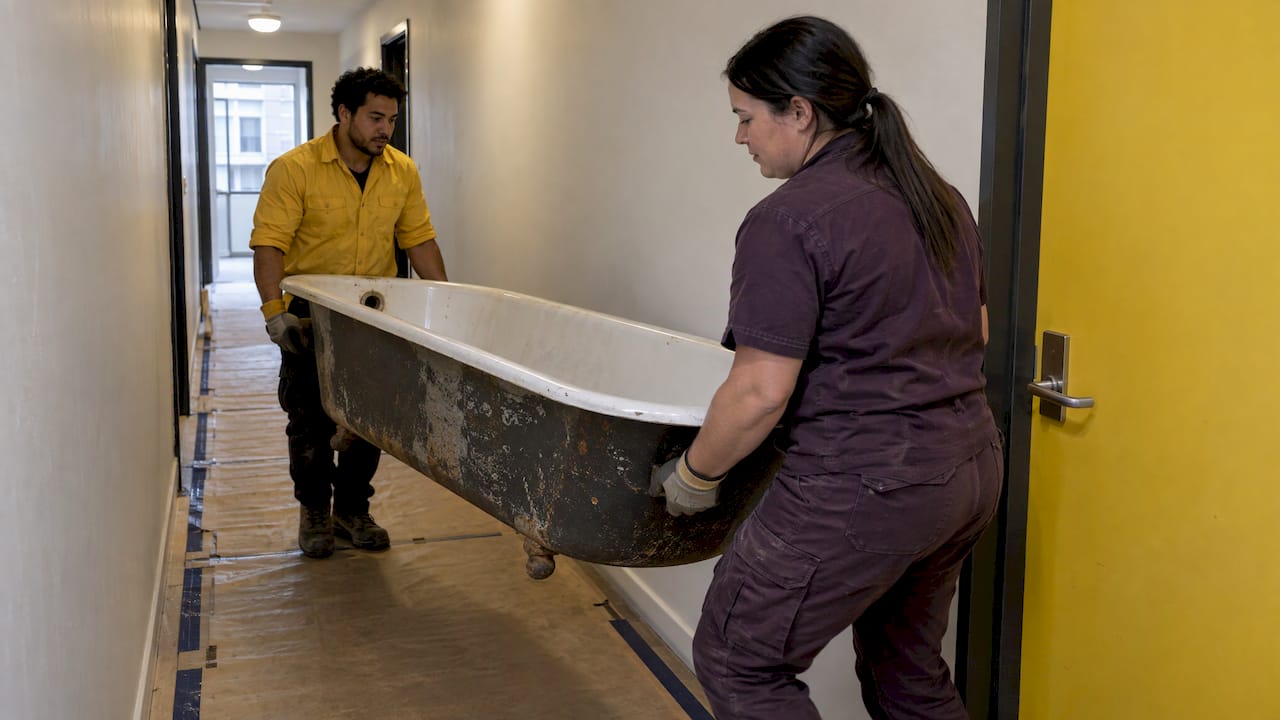
Bathroom waste is heavy and awkward. Cast iron baths, stone-topped vanities and boxes of loose tile can mark floors, scrape walls and damage lift interiors. Lay protection on the route out, break large items down where it is safe to do so (never asbestos-containing material), and use a crew that carries the load rather than dragging it.
How we handle bathroom renovation waste
At Melbourne City Rubbish, we clear renovation and construction waste from homes, offices, strata buildings and building sites across Melbourne. For a bathroom job, that means we come to your site, load the mixed waste, and take it away so your builder can keep working. Our construction waste removal service covers building debris, and you can read more in our guides to managing renovation waste in Melbourne and how to dispose of building waste.
Our approach is built around a few commitments:
- Punctuality: real-time notifications, and a lateness credit if we are behind.
- No mess, no damage: we aim to leave the property as we found it.
- Carbon-neutral option: you can opt in to carbon-neutral disposal.
- Price match plus: we promise to beat any written quote by 5%.
Prices are quoted per project, based on the volume and type of waste, so the quickest way to know the cost is to request a quick quote. If your bathroom job is part of a bigger project, such as a strip-out or make-good, take a look at everything we offer on our services page.
If you suspect asbestos, get it tested and removed by licensed professionals first. We can then clear the remaining non-asbestos waste once the area is safe.
Questions to ask before you book any removal
Whoever you hire, a few questions separate a proper operator from a risky one:
- Where does the waste go? You want the name or type of facility, not “the tip”.
- Is the quote written? A written quote with the scope, access assumptions and any extra charges protects you.
- How do you handle mixed loads? Tiles, plasterboard and metal should be sorted, not simply dumped together.
- What happens if asbestos turns up? A responsible crew stops and tells you.
- Can you work around the builder’s schedule? Timing matters as much as price.
- Will you protect the floors, walls and lift? Ask before they arrive.
FAQ
What counts as bathroom renovation waste?
It covers everything a strip-out and fit-out generates: tiles and adhesive, wall sheeting, timber framing, baths, showers, toilets, vanities, tapware, screens, and old plumbing or electrical fittings. New-build offcuts and packaging count too. Most of it is heavy and mixed, so it needs sorting.
Can I put bathroom renovation waste in my household bin?
No. Building debris is industrial waste in Victoria, and it must go to a place authorised to receive it. Check your council’s rules on what its kerbside and tip services accept, and use a skip or removal crew for the rest.
How do I know if my bathroom has asbestos?
You can’t tell by looking. If your bathroom is older, have a qualified person test suspect wall sheeting, flooring or pipes before any cutting or drilling. Victorian guidance expects asbestos to be checked for before work begins in bathroom walls, ceilings and floors.
Can old tiles and fixtures be recycled or reused?
Often, yes. Fixtures and vanities in good condition can be sold or donated if they come out intact, and metal and clean timber can be recycled when kept separate. Tiles and masonry are harder to reuse but should still be kept apart from other waste so they can be processed properly.
When should I book rubbish removal for a bathroom renovation?
Book before demolition starts and time the pick-up for when the heaviest waste is out, usually in the first days of the job. That way the work area stays clear and your builder isn’t waiting on a pile to be shifted.
Sources
- EPA Victoria: Construction (industrial waste guidance)
- EPA Victoria: The transport and disposal of waste asbestos
- WorkSafe Victoria: Managing asbestos in workplaces
- WorkSafe Victoria: Removing asbestos in workplaces
- US EPA: Building savings strategies for waste reduction of renovation and demolition debris
- Found asbestos during your renovation? What to do first