Yes, you can get junk removed over a weekend in Melbourne, but the council service will not do it for you. Council hard waste runs to booked dates, while private removalists set their own weekend availability and quote by the job. Before you book, confirm three things: the day and arrival window, what the crew will and will not take, and how the price is worked out. This guide covers each, plus how to prepare and how to keep the cost down.
TL;DR
- Council hard waste in the City of Melbourne is free once per financial year, up to one cubic metre, but you must book it in advance and cannot choose a weekend slot to suit you. A private removalist is the option when you need a set day.
- Always ask a removalist to confirm the weekend day, the arrival window and what is excluded (asbestos, paint, chemicals and tyres are commonly refused).
- Quotes depend on volume, access, item type and disposal fees, so send photos and ask for a written quote.
- Sort, donate and separate recyclables before the crew arrives. It usually lowers the load and the bill.
- Businesses carry extra duties for where their waste ends up, so ask where it goes.
Table of Contents
- Council collection or a private weekend pickup?
- What to confirm before you book a weekend slot
- What can be collected, and what gets refused
- How weekend junk removal is priced
- Preparing for the pickup day
- How to cut the cost of a clear-out
- Business and building-site waste on weekends
- Book your weekend removal with us
- FAQ
- Sources
Council collection or a private weekend pickup?
The City of Melbourne offers residents one free hard waste collection of one cubic metre per financial year. Bookings are essential, and the council makes dates available two months ahead. That suits a slow clear-out. It does not suit a lease handover on Sunday, a Saturday renovation or a Monday-morning deadline.
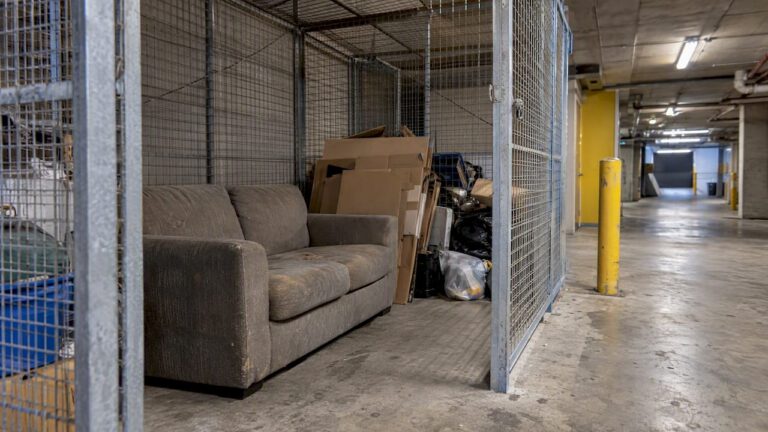
The council service also has firm limits. Items must be on the kerbside or in an accessible location by the day before collection, and the council says it will not enter your private property boundary. If your rubbish sits in a basement, a garage behind a locked gate or an apartment lift, that is a problem. In a high-rise building, the council says you can ask your building manager to book on your behalf.
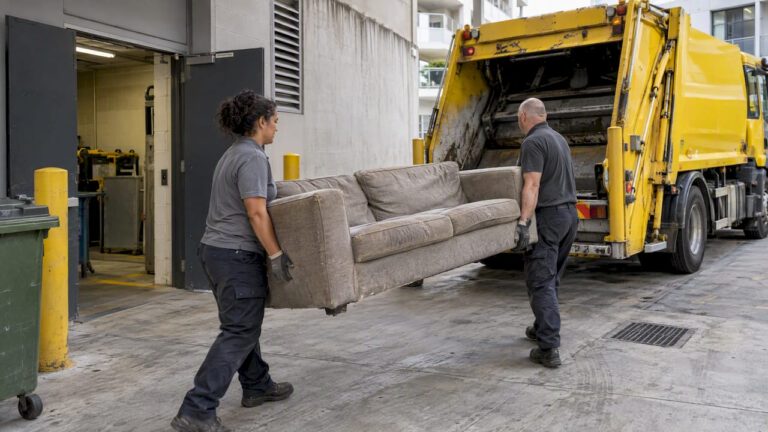
A private removalist works the other way round. You choose the date, they bring the truck and the labour, and they carry items out of the building. You pay for that convenience, which is why it pays to understand what drives the quote (covered below).
| Council hard waste | Private weekend removal | |
|---|---|---|
| Choice of day | Set by the council schedule | Agreed with the provider |
| Booking | Essential, dates released two months ahead | Often a quote then a booking, so ask about lead time |
| Carry-out from inside | No, items must be kerbside or accessible | Ask what is included |
| Cost | Free once a financial year, up to one cubic metre | Quoted per job or volume |
| Building or demolition waste | Refused | Depends on the provider, so ask |
What to confirm before you book a weekend slot
Weekend availability is not the same everywhere, and we do not assume it. Whoever you call, get these answers in writing, by message or email, before the day.
- The exact day and arrival window. “Saturday” is not a booking. Ask for a window and how you will be told if the crew is running behind. We offer real-time notifications and a lateness credit, and you should ask any provider what they offer if the truck is late.
- Whether the price is fixed or an estimate. A fixed written quote protects you if the load turns out bigger than you described.
- What is included. Carry-out from inside the property, lift access, sweeping up afterwards and disposal fees should all be named.
- What is excluded. Ask for the refused-items list up front rather than finding out at the kerb.
- Building access on a weekend. Many apartment and commercial buildings need a lift booking, loading dock access or a manager’s approval. Sort that earlier in the week, not on the morning.
- Where the waste goes. A reputable provider can tell you whether items are reused, recycled or sent to a licensed facility.
If you live in an apartment tower, our page on apartment building rubbish removal in the Melbourne CBD explains how these jobs work around lifts and building rules.
What can be collected, and what gets refused
Most household and office clear-outs are straightforward. The City of Melbourne lists furniture, appliances with doors removed, e-waste, scrap metal, mattresses and pottery as accepted hard waste, and private removalists generally take a similar range, often more, including bulky items you cannot lift yourself.
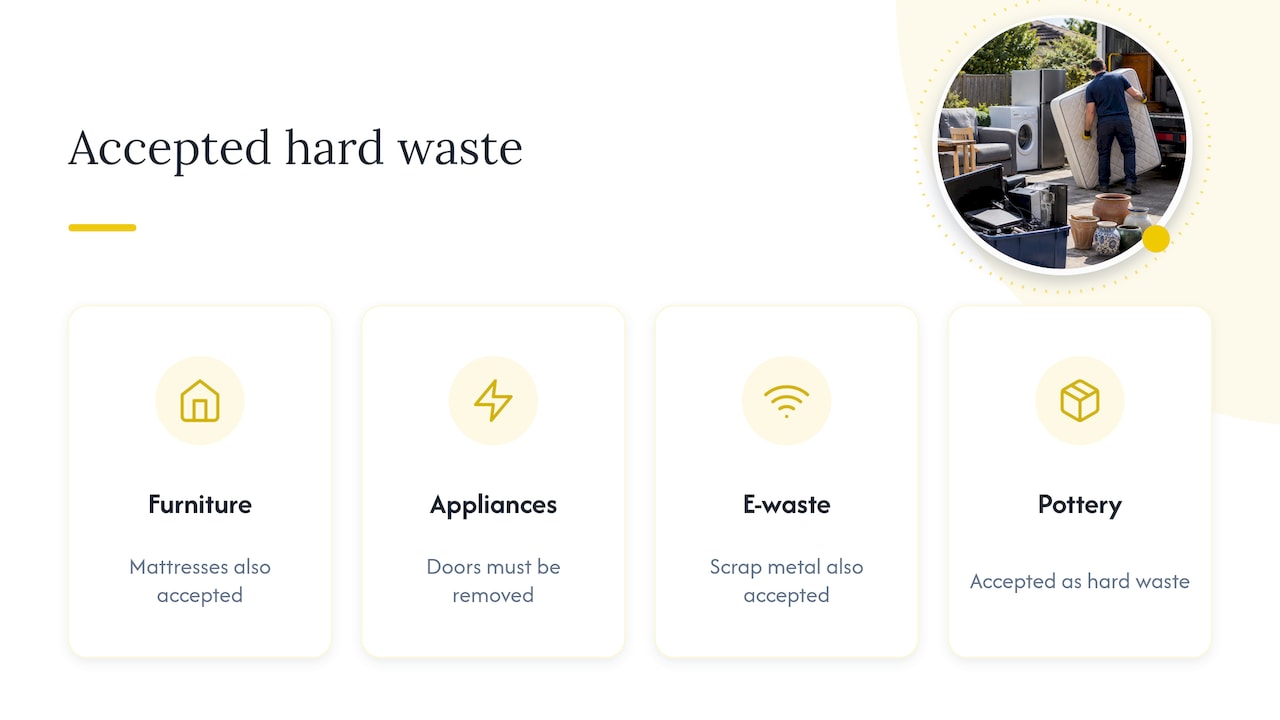
The refused list matters more, because a rejected item is the most common reason a pickup goes wrong. The council does not collect asbestos, chemicals, paint, motor oil, building or demolition waste, car bodies, or car and truck tyres. Private providers have their own lists, so check ours at prohibited items in junk removal and ask any other provider for theirs.
Items that need special handling
- Batteries. EPA Victoria states that all used batteries are e-waste, most are priority waste, and they cannot go to landfill. Do not toss them into a bag of general rubbish. See our page on battery disposal for how to handle them safely.
- Electronics. Old TVs, monitors, computers and printers count as e-waste and should be kept separate. Our guide to disposing of e-waste in Melbourne covers what to expect, and the e-waste collection page explains the service.
- Garden waste. Branches, clippings and soil are usually handled as green waste rather than mixed in with furniture. See garden waste removal.
- Building waste. Tiles, plasterboard, timber offcuts and concrete from a renovation are construction waste, not household junk. Council hard waste will not take them, and they are priced differently by private providers. Our construction waste removal page explains how these jobs are handled.
- Anything that might contain asbestos. Do not break it, drill it or bag it yourself. Leave it alone and get it assessed by a qualified professional before anyone moves it.
How weekend junk removal is priced
Private removal is quoted per job, usually on the volume of waste, the type of material, how hard it is to reach and what the disposal costs. That last part is not something a removalist controls. Tip fees in Victoria include the state’s waste levy. At the Wyndham City tip, for example, a single-axle trailer load (water level) costs $154.00 and a heaped tandem trailer costs $390.00 on the 2025-26 fees. The same page notes the compulsory state levy was set to rise to $169.76 per tonne on 1 July 2025. Fees vary by facility and change each year, so treat these as an illustration of what sits inside a quote, not a price list.
Those figures show something useful. Even if you hired a trailer and drove to a tip yourself, you would pay the gate fee plus hire, fuel and your own time, and you would do all the lifting. A removalist rolls labour, truck and disposal into one figure.
Factors that move your quote:
- Volume. A few items and a full truck are priced differently. Photos help.
- Weight. Concrete, tiles and soil are heavy and cost more to dispose of than the same volume of cushions or cardboard.
- Access. Stairs, long carries and lift bookings add time.
- Material type. Mixed rubbish, e-waste and green waste follow different disposal pathways.
- Timing. Weekend slots can be in demand, so ask whether the quote changes by day.
We do not publish set prices, because every job differs. We quote per project, and we promise to beat any written quote by 5%. Send us the competing quote with your photos and we will work from there. Our quick quote page is the fastest way to start.
Preparing for the pickup day
Good preparation is the difference between a 40-minute job and a three-hour one. Our rubbish removal preparation checklist covers six checks that help avoid rejected items. In short:
- Walk through and list everything. Include items in the garage, balcony, storage cage and under the stairs. Surprises at the door change the price.
- Photograph the load. Take wide shots and close-ups of large items. Add notes about stairs and lifts.
- Separate the refused items. Put paint, chemicals, batteries, gas bottles and tyres to one side and arrange them separately.
- Empty and prepare appliances. Defrost and drain fridges and washing machines. Remove doors if the provider asks, as the council does for appliances.
- Clear a path. Move parked cars, open gates, prop doors and keep pets inside.
- Book the building. Reserve the lift or loading dock and tell the building manager about the weekend pickup.
- Be reachable. Keep your phone on for arrival updates and any access issues.
If you are using the council service instead, remember the day-before rule: everything must be out at the kerbside or an accessible spot by then.
How to cut the cost of a clear-out
The volume and weight of what the crew loads is the biggest lever you control. A few habits make a real difference.
- Donate what still works. Furniture in good condition, working appliances and household goods can often be passed to charities or given away locally. Every item that leaves before the truck arrives is one less item in the quote.
- Sell the valuable pieces. Solid timber furniture and good appliances often find a buyer on online marketplaces. Do this early in the week, so the sale is complete before the weekend.
- Separate recyclables. Cardboard, scrap metal and e-waste follow different pathways to general rubbish. Keep them in their own piles.
- Flatten and break down. Disassemble bed frames, shelving and wardrobes so they take less truck space.
- Consolidate into one job. Combine the garage, the spare room and the garden into a single booking instead of paying for several short visits.
- Ask about furniture recycling. If you have a lot of desks, chairs or joinery, our furniture disposal and recycling service is built for it.
One caution: do not cut the cost by hiding refused items in the pile. If a crew finds asbestos sheeting, paint tins or chemicals mixed in, they may have to stop, re-quote or leave them behind.
Business and building-site waste on weekends
Weekends are popular for commercial work because offices are empty, and trades can strip out without disrupting staff. Office relocations, fit-outs and make-goods often have a Monday handover that leaves no room to slip.
The rules differ for businesses. EPA Victoria defines industrial waste as any waste produced by a business, whereas kerbside waste collected by or for a council is not treated as industrial waste until it reaches a recovery facility. The same publication says anyone depositing industrial waste must ensure it goes to a place authorised to receive it. In practice, a business should ask its removalist where the waste will be taken and keep the paperwork. For a wider view of how companies plan their waste streams, see this overview of packaging waste management for businesses.
We work in all types of Melbourne commercial buildings and aim to leave no mess and no damage to property. Depending on your project, one of these pages will fit:
- Commercial office rubbish removal for regular or one-off office waste.
- Office cleanout for relocations and downsizing.
- Office furniture removal for desks, workstations and chairs.
- Construction waste removal for site debris.
Book your weekend removal with us
We handle rubbish removal across Melbourne for homes, offices, strata buildings and building sites, including general bulk rubbish, office junk, e-waste, green waste, strip-outs and make-good clearances. We offer a carbon-neutral option, and you can opt in when you book. Start with the quick quote form, tell us your preferred day and send photos, or browse everything we do. If you want to compare options for your suburb first, our page on hard waste collection in the City of Melbourne explains how council and private services fit together.
FAQ
Can I get junk removed on a Saturday or Sunday in Melbourne?
Yes, through a private removalist who offers weekend slots. Council hard waste follows its own booked schedule and does not let you choose a weekend. Ask the provider to confirm the day, the arrival window and what is excluded in writing.
Is council hard waste collection free?
In the City of Melbourne, residents get one free collection of up to one cubic metre each financial year. You have to book ahead, and items must be kerbside or accessible the day before. Anything beyond that, or anything the council refuses, needs a private service.
What will a junk removal service refuse to take?
Commonly refused items include asbestos, paint, chemicals, motor oil and tyres. Batteries and electronics need separate handling because they are e-waste. Check the provider’s excluded list before booking, or see our page on prohibited items.
How do I get an accurate quote?
Send clear photos of everything, describe stairs, lifts and distance to the truck, and say whether you want carry-out included. A written quote based on that information is far more reliable than a phone estimate. We also promise to beat any written quote by 5%.
Do I need to be home during the pickup?
Not always, but someone should be reachable for access and to confirm what is going. For apartments and offices, arrange building access in advance so the crew can get to the lift or dock.
Sources
- Hard waste, City of Melbourne
- Municipal Tip/RDF fees, Wyndham City
- Waste batteries management guideline, EPA Victoria
- Industrial waste resource guidelines (1825.1), EPA Victoria
- Packaging Waste Management for Businesses: 2026 Guide