Hire a truck if you have a modest load, a free weekend and a strong back, and you are happy to queue at the tip. Book a junk removal service if the load is heavy, bulky or mixed, your time is worth more than the saving, or the rubbish comes from a workplace, a strip-out or a lease handback. This guide sets the two side by side for Melbourne jobs: what each really costs once tip fees are counted, who does the work, what the rules say, and where each option fails.
TL;DR
- Truck rental looks cheaper on the booking page, but the real cost adds fuel, tip fees, your labour, your time and the second trip you did not plan for.
- Junk removal is priced on the volume of rubbish, with loading, transport and disposal included in one quote.
- Heavy, awkward or mixed loads (old couches, appliances, joinery, office fit-outs) suit a crew. Small, light, clean loads suit a DIY run.
- Under Victorian EPA guidance, hiring someone does not hand off your responsibility: you should still take reasonable steps to make sure the waste ends up somewhere lawful.
- Some items, such as commercial asbestos, are a job for licensed contractors under either option.
Table of Contents
- What each option actually is
- The real cost of hiring a truck and doing it yourself
- What junk removal costs and what the quote should cover
- Side-by-side comparison
- Which jobs suit a truck rental
- Which jobs suit junk removal
- Time, effort and convenience
- Environmental impact
- The rules: responsibility does not transfer with the invoice
- How to decide in five minutes
- Book the removal, skip the lifting
- FAQ
- Sources
What each option actually is
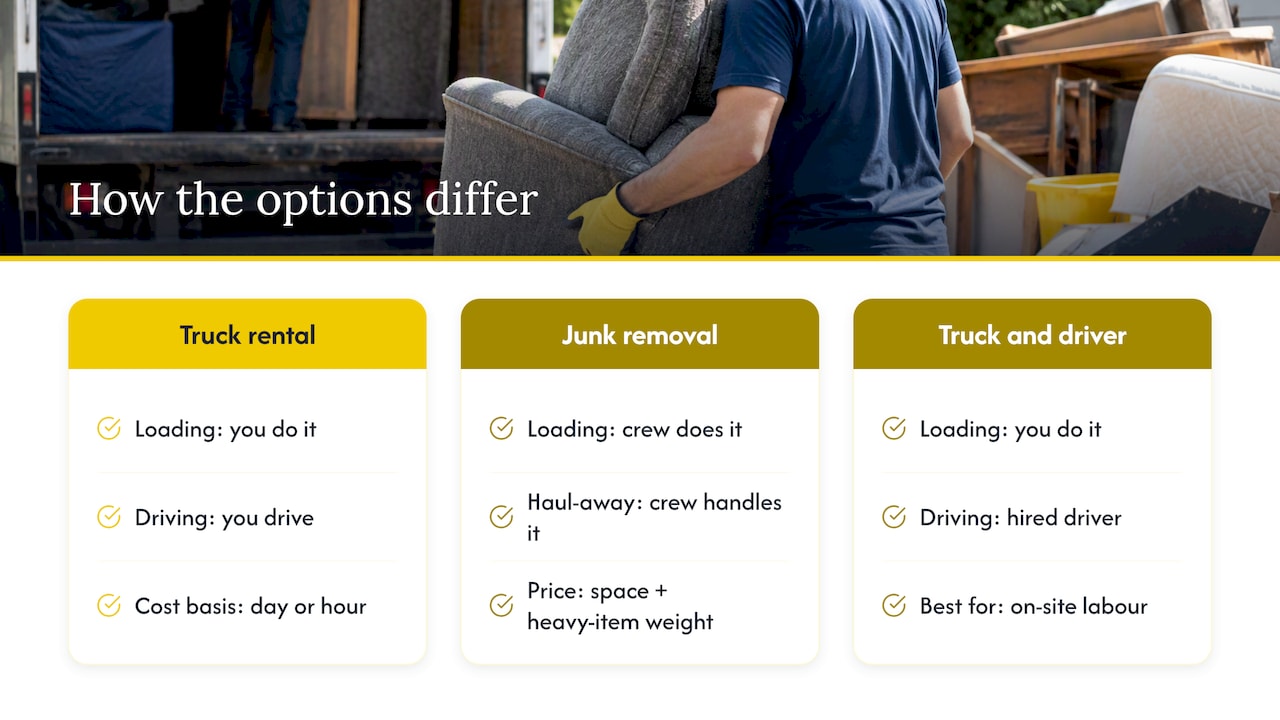
Truck rental means you hire a ute, van or truck by the day or hour, load it yourself, drive it to a tip or transfer station and unload it. You carry the work, the fuel, the risk of damage and the paperwork. A fair number of people also need a friend or two to help lift.
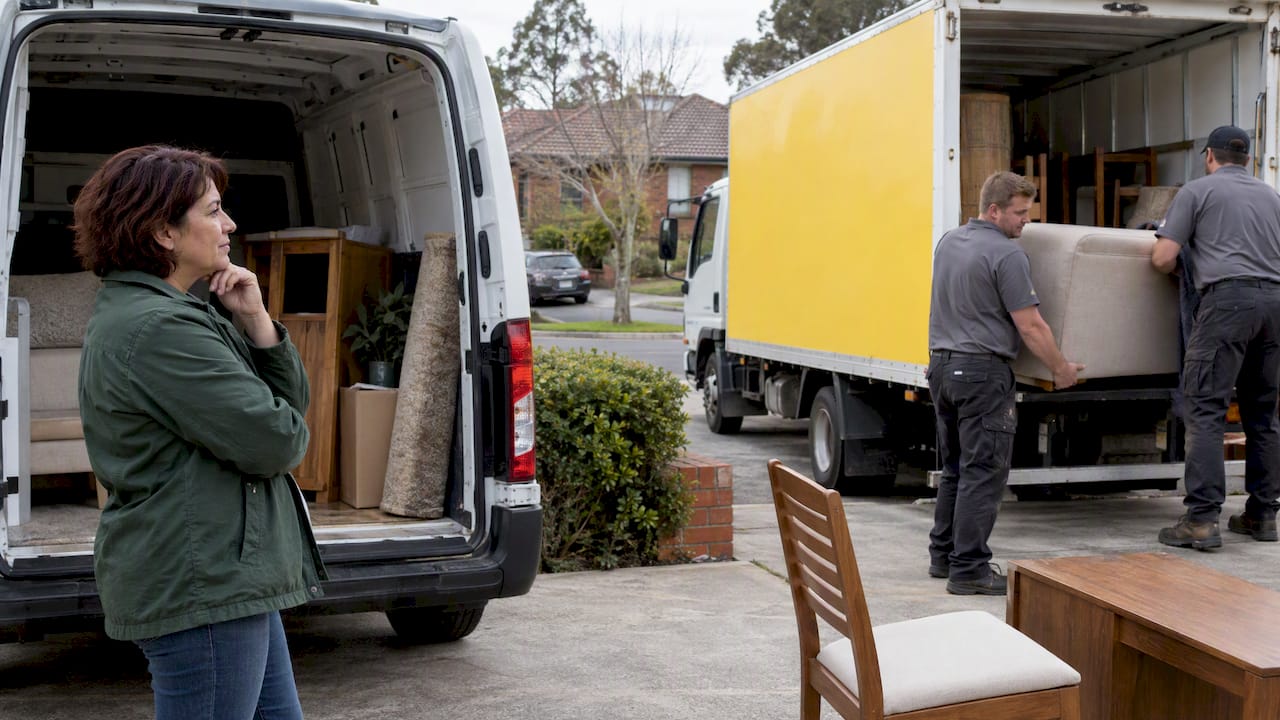
Junk removal, also called rubbish removal or hauling, means a crew arrives with a truck, loads everything for you, takes it away and sorts it for recycling or disposal. You point, they lift. The price is built around how much space the load takes up, plus any heavy material charged by weight.
There is a third path, truck and driver hire, which sits between the two. You still decide what goes on the truck, but someone else drives and handles the route. Our truck and driver hire suits jobs where you have your own labour on site, such as a renovation crew, but need a licensed driver and a vehicle that is the right size.
The real cost of hiring a truck and doing it yourself
The daily hire rate is only the first line. A DIY rubbish run has several costs that rarely appear in the headline price:
- Vehicle hire: a day rate, often with a kilometre allowance, plus insurance and a bond.
- Fuel: a loaded truck or van uses more than you expect, especially in stop-start traffic.
- Tip fees: charged per load, per item or by weight at the tip.
- Extras: tarps, straps, gloves, trolleys and sometimes a second person’s time.
- Your time: loading, driving, queueing, unloading and returning the vehicle.
What the tip charges you
Tip fees are where DIY budgets blow out. Wyndham City Council’s schedule is a useful example of how they are structured. For residential mixed waste, its listed charges include $30 for a car boot, $60 for a car or SUV, $154 for a water-level ute or single-axle trailer and $195 for a van. A mattress costs $43 and each passenger tyre $10.
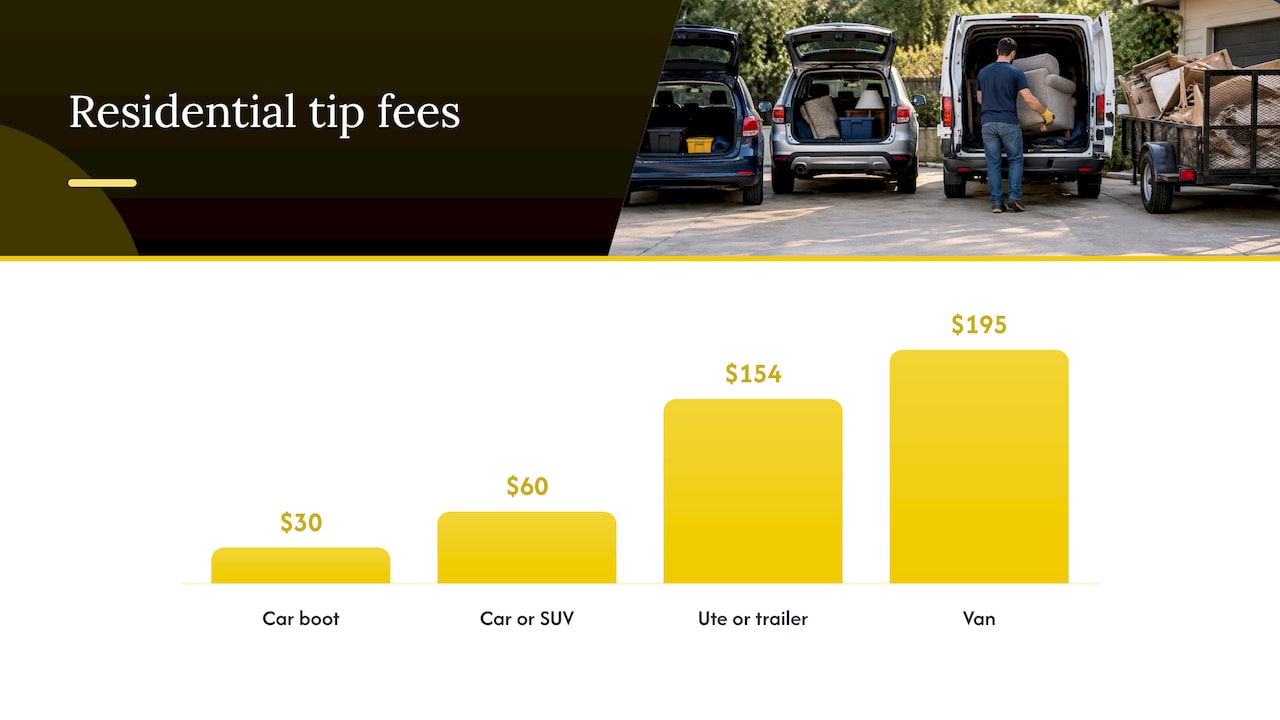
Those are charges per entry, and they are separate from whatever you paid to hire the vehicle. Councils differ, and the schedule is updated each financial year, so check your own council or tip before you budget.
The same council explains that its fees are made up of council operating charges, the Victorian government waste levy and GST. The levy is a per-tonne charge set by the state and, on Wyndham’s published figures, it rose from $132.76 to $169.76 per tonne on 1 July 2025. That matters because heavy loads such as soil, bricks, concrete or wet timber cost far more to dump than light ones, and the levy is built into every tip price you see.
A worked example
Take a typical garage clear-out: an old sofa, two chairs, a mattress, a broken bookcase and about 15 boxes of mixed junk. Using the Wyndham figures above:
- Hire a van for the day. Add fuel and any insurance extras.
- Tip fee for a van load: $195.
- Mattress: $43 on top.
- Two people for three to four hours, plus the trip to collect and return the van.
The tip fees alone come to $238 before the van costs anything. If the load is bigger than one van, or the tip rejects an item, you are doing a second trip. For many households that puts a DIY run in the same range as a professional quote for the same load, with a lot more effort. A removal crew’s price already includes the truck, the labour, the tip fee and the sorting.
What junk removal costs and what the quote should cover
Junk removal is almost always priced by volume: how much of the truck your rubbish fills. Heavy material such as concrete, soil or brick is usually charged by weight, because that is how the tip charges for it. We quote each job individually and do not publish a fixed price list, because a single item, a half-day office clear-out and a full strip-out are very different jobs. If you want a number, request a quote with photos or a description of the load.
Whatever company you choose, a good written quote should state:
- That labour, loading and the truck are included.
- That tip or disposal fees are included, and how heavy material is charged.
- Any minimum charge and any access surcharge (stairs, long carries, no parking).
- Whether items will be recycled or donated where possible.
- What happens if the load turns out larger than described.
We also beat any written quote by 5%, so it is worth getting a second quote to compare like with like.
Side-by-side comparison
| Factor | Truck rental (DIY) | Junk removal |
|---|---|---|
| Who loads | You and your helpers | The crew |
| Who drives and tips | You | The crew |
| Upfront price | Lower on paper | Quoted per job |
| Hidden costs | Fuel, tip fees, extras, second trips | Usually none if the quote is all-inclusive |
| Time needed | Half a day to a full day or more | A short booking window and a short visit |
| Physical effort | High | Minimal |
| Best for | Small, light, clean loads | Heavy, bulky, mixed or large loads |
| Risk of damage | Yours, including to the vehicle and your property | The crew’s, under their insurance |
| Disposal paperwork | Your responsibility | The provider’s, though you still need to choose a lawful operator |
Which jobs suit a truck rental
Hiring a vehicle yourself makes sense when:
- The load is small enough for one trip in a ute or van.
- The items are light and easy to carry, such as flat-packed cardboard, garden pots or a few boxes.
- You are already moving things anyway, for example donating furniture to a charity shop on the way.
- You have helpers and a free day.
- The tip is close to you and you know its opening hours and what it accepts.
It is often the cheapest route for a lone item such as a single old bike or a bag of building offcuts, particularly if you already own a ute or trailer.
Which jobs suit junk removal
A crew is the better call when:
- The items are heavy or awkward: couches, wardrobes, fridges, treadmills, spas, pianos.
- The job is large: a whole-house clear-out, a deceased estate, a hoarded garage or an end-of-lease clean-up with a deadline.
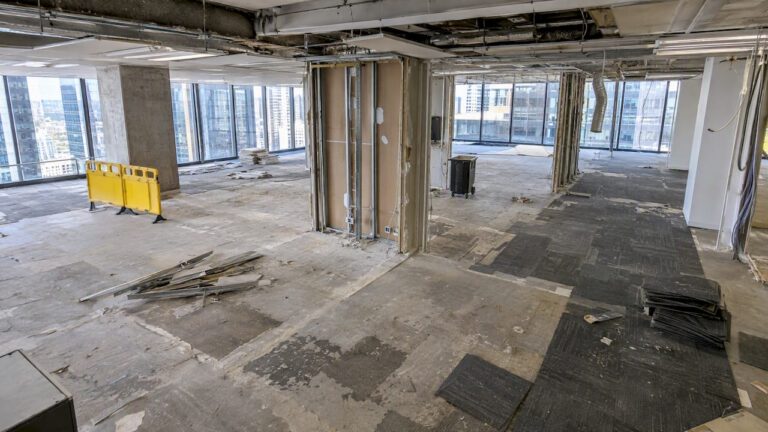
- It is commercial: an office cleanout, a fit-out, a make-good or a strip-out. Landlords often set a handback date, and delay can cost you. See our commercial office rubbish removal and make-good and de-fit services.
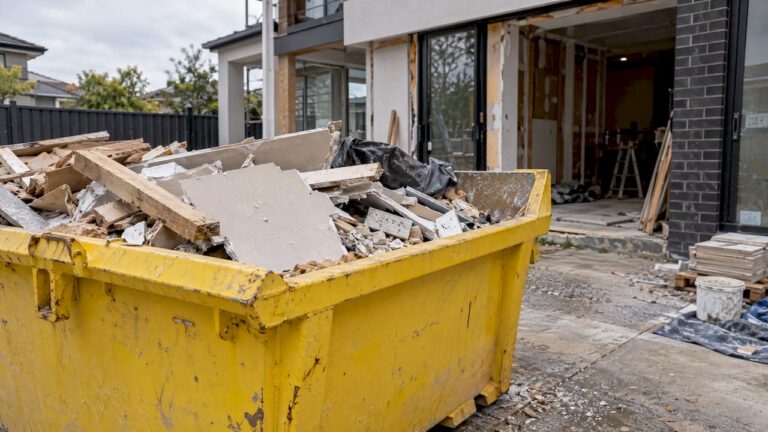
- Construction waste is involved: plasterboard, timber offcuts, tiles and concrete are bulky, heavy and tip-expensive. Construction waste removal lets trades keep working while the waste leaves.
- You cannot lift or do not have the time: or you are managing a property from a distance.
- The access is hard: upper floors, tight laneways, basements and CBD buildings with loading dock bookings and lift rules.
City buildings in particular carry rules that a rented truck does not solve: dock times, lift protection, building manager sign-off and insurance certificates. Crews that work in commercial buildings every week know those rules and plan around them.
Time, effort and convenience
A DIY run means collecting the vehicle, loading, driving, queueing, unloading and returning it. For a small van load that can fill half a day. For a larger clear-out it becomes a full day or two trips. The tip also has opening hours, and the weekend queue can be long.
Junk removal is built around your schedule. You book a window, the crew arrives, loads and leaves the space swept. We offer same-day rubbish removal when you need the job done quickly, and our real-time notifications and lateness credit are there so you are not waiting around wondering when the truck will turn up.
Flexibility cuts both ways. A rented truck can be used at 6 am on your own timetable, and it can carry anything you decide to load. A service, on the other hand, has rules about what it can take, which is the reason to read the checks before booking. Our guide to preparing for rubbish removal covers the common reasons items get rejected, and the list of prohibited items shows what we cannot take.
Environmental impact
What matters most for the environment is where the rubbish ends up, not what carried it. A tip run delivers mixed waste to a landfill or transfer station, and what gets recovered depends on how well you sorted it and what that site separates. A good removal service sorts as it loads, sending timber, metal, e-waste, furniture and green waste to recyclers where it can.
Our operations are carbon neutral, and clients can opt in to eco-friendly disposal. Read more about eco-friendly rubbish removal for Melbourne businesses. For garden waste specifically, see our guide to sorting green waste in Melbourne, since it often has its own cheaper stream.
One trip with a full, well-sized truck is also usually better than three half-loaded runs in a rented van.
The rules: responsibility does not transfer with the invoice
In Victoria the person who produces waste cannot simply wave it away. The EPA’s guidance on waste transport explains that generators, transporters and receivers share responsibility for making sure waste reaches a place authorised to receive it. Lawful destinations include licensed landfills, resource recovery facilities and transfer stations. The same publication takes the position that engaging a contractor does not remove the producer’s responsibility: you should take reasonable steps to check the waste is transported and received lawfully.
In practice:
- If you do it yourself, take the load to a legitimate tip and keep the receipt. Dumping on roadsides, in bushland or in someone else’s bin is illegal.
- If you hire someone, ask where the load goes and whether they use licensed facilities. Be wary of a very low cash quote with no business details.
Asbestos
Asbestos is the clearest case where the two options differ. The EPA’s guidance says that householders may transport their own domestic-sourced asbestos to a licensed landfill without transport certificates or a permitted vehicle, provided they follow the handling and packaging guidelines. Commercial contractors removing it do need transport certificates and a permitted vehicle. A general junk crew should not be loading suspected asbestos sheeting, so get it tested and use a licensed asbestos contractor. If you suspect asbestos in a commercial building, treat it as a specialist job before any strip-out begins.
Fences and other regulated work
Whether you dispose of waste yourself or hire help, other rules may apply to the work that creates it. For example, our guide to fence removal and disposal explains the 10 m² rule homeowners should understand before pulling a fence down.
Bulk fill is a different category
If your job is moving soil, gravel or fill rather than clearing rubbish, dump truck hauling services are built for that bulk material rather than for household clear-outs. Rubbish loads that are mostly heavy inert material should be flagged when you ask for a quote, because they are priced by weight.
How to decide in five minutes
- Estimate the volume. If it will fit in one ute or van load with room to spare, a DIY run is realistic. If you are unsure, assume it will not.
- List the heavy or awkward items. Two or more big pieces tip the decision toward a crew.
- Price your time. Add up the half-day or more you would spend on the trip, and the cost of any helpers.
- Check the tip. Look up your council’s fees for your vehicle size, and note any item charges such as mattresses and tyres.
- Get a written quote for the same load and compare it with your true DIY total, not just the day rate.
- Check the deadline. An end-of-lease or make-good deadline makes reliability more valuable than saving a small amount.
Book the removal, skip the lifting
If the numbers point toward a crew, we handle everything from a single-item pickup to commercial strip-outs across Melbourne, including the CBD, South Melbourne, Port Melbourne and West Melbourne. We work in all types of commercial buildings, leave no mess and no damage, and we beat any written quote by 5%. See what we do or get a quick quote.
If you are weighing up keeping things in storage instead, our comparison of storage versus junk removal shows how that cost builds over time.
FAQ
Is it cheaper to hire a truck or use a junk removal service?
For a small, light load, hiring a ute or van and tipping it yourself can be cheaper. Once you add fuel, tip fees, helpers and a day of your time, the gap narrows quickly, and for heavy or large loads a crew is often comparable or better value. Compare a written quote with your full DIY total.
What does junk removal and hauling mean?
It means a company comes to your property, loads your unwanted items onto its truck, transports them and disposes of or recycles them. You do not lift, drive or pay tip fees separately. Pricing is normally based on the volume of the load, with heavy materials charged by weight.
Do I have to pay tip fees if I hire a truck?
Yes. The truck hire is separate from disposal charges. Councils charge by vehicle size, by weight or per item, and Victoria’s waste levy is built into those fees. As an example, Wyndham’s listed residential charge for a van load is $195, with mattresses charged extra.
Can I take asbestos to the tip myself?
In Victoria, householders may transport their own domestic-sourced asbestos to a licensed landfill if they follow the EPA’s handling and packaging guidelines. Commercial contractors must hold transport certificates and use a permitted vehicle. Get suspected material tested and speak to a licensed asbestos professional first.
Am I still responsible if a company takes my rubbish?
The EPA’s position is that producers should take reasonable steps to make sure waste is transported and received lawfully, even when a contractor is engaged. Ask where your load will go and choose an operator that uses licensed facilities.
Sources
- Municipal Tip/RDF (Refuse Disposal Facility), Wyndham City
- EPA Victoria publication 1825.1
- The transport and disposal of waste asbestos, EPA Victoria