If you will use it again, store it. If you won’t, remove it. That is the short answer, and most of the money people waste on this decision comes from ignoring it. A storage unit is a monthly bill for keeping things. Junk removal is a one-off bill for ending them. Pay for the wrong one and you either throw away something you needed or rent a box for years to hold things you would never buy again.
This guide helps you decide item by item. It covers what each option really costs over time, the Victorian rules that apply when you clear a business site or a unit, and a few situations where the answer is neither.
TL;DR
- Store items you will genuinely use again within a defined period and that would cost more to replace than to keep.
- Remove items that are broken, outdated, low value or that you have not touched in a year. Storage fees quickly pass what most of them are worth.
- Storage is a rolling cost. Removal is a one-off cost. Compare 12 months of rent against the removal quote, not the first month.
- In Victoria, waste left on a site stays your responsibility until it reaches a lawful place, so ask for written proof of where it went.
- Many people do both: keep a small core in storage and clear the rest in one booking.
Table of Contents
- The real difference: renting time versus ending a problem
- What storage costs in Melbourne
- What junk removal costs, and why quotes differ
- A simple test for each item
- Worked examples
- The legal side: waste is a duty, not just a nuisance
- Why council hard waste rarely covers a business
- Sustainability: removal does not have to mean landfill
- Side-by-side comparison
- The hybrid approach most people end up with
- Booking removal with us
- FAQ
- Sources
The real difference: renting time versus ending a problem
Storage does not solve clutter. It moves it somewhere else and charges you rent. That can be exactly right when you are between leases, renovating, holding stock or waiting on a decision. It is the wrong tool when the decision has already been made and you are just avoiding it.
Junk removal does the opposite. You pay once, the items leave, and the space and the recurring cost go with them. For a business, that also closes a liability, which matters more than most people expect (more on that below).
A useful way to frame it: storage is a deferral, removal is a decision. Deferral is worth paying for only when there is a date or a trigger attached to it.
What storage costs in Melbourne
Self storage pricing varies widely by size, location and promotions. A storage price comparison covering more than 90 Melbourne facilities lists advertised rates starting from about $20 a month, and it notes that promotional rates may revert to higher prices after the introductory period. Small units close to the city and larger units cost considerably more than that entry figure.
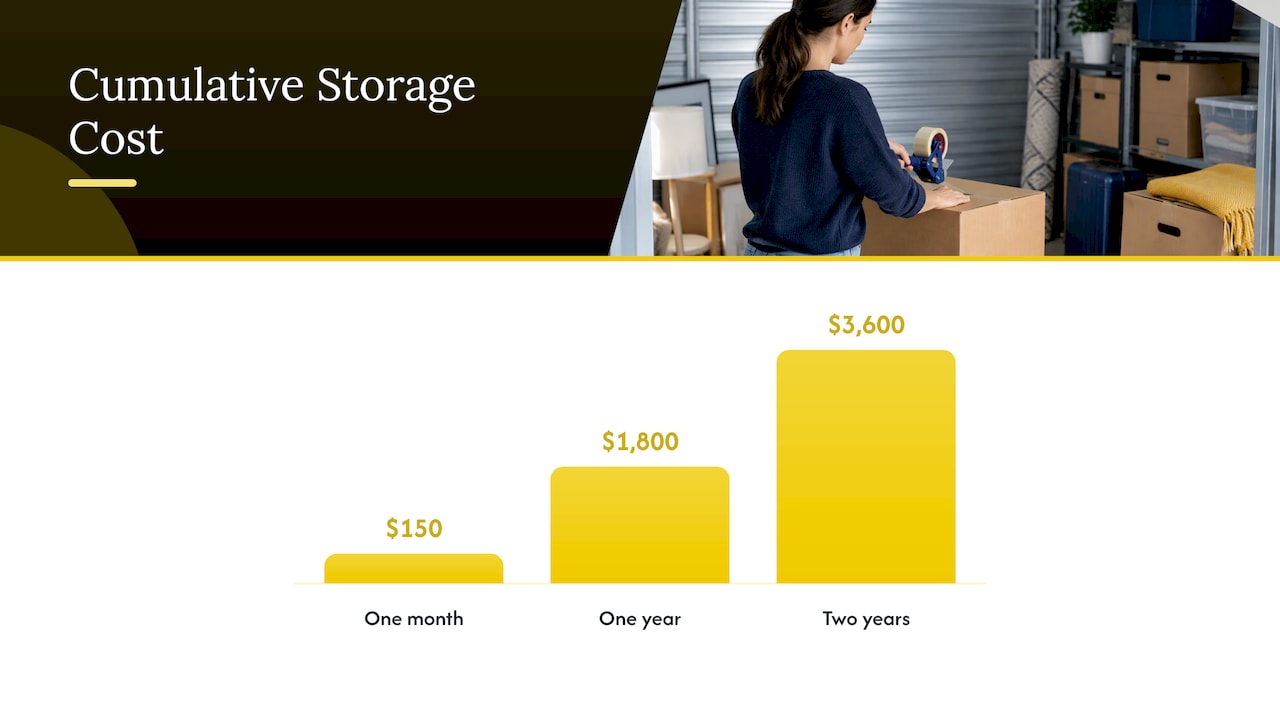
The number to focus on is not the monthly rate but the cumulative one. A $150 a month unit costs $1,800 over a year and $3,600 over two. If the contents are an old couch, a damaged filing cabinet and boxes of outdated paperwork, you have paid more than the items would cost new.
Storage also tends to carry extras: insurance, access limits, a deposit, and sometimes a minimum term. Read the contract for what happens when you stop paying. Facilities usually have a clause allowing them to sell or dispose of goods after prolonged non-payment, and Consumer Affairs Victoria explains how uncollected goods and the relevant charge work if a business holds your property.
What junk removal costs, and why quotes differ
Removal is priced on the job, not on time. The main drivers are:
- Volume: how much space the load takes up on the truck.
- Weight and material: concrete, tiles and plasterboard cost more to dispose of than bagged office waste.
- Access: stairs, lifts, loading docks, building induction requirements and parking restrictions in the CBD.
- Sorting needs: electronics, green waste and construction debris go to different facilities.
- Timing: after-hours work, or a hard deadline such as an end-of-lease inspection.
Because of these variables, honest providers quote per project rather than publish a flat rate. We do the same: our pricing is quoted per job, and we promise to beat any written quote by 5%. Get two or three written quotes with the same scope, so you are comparing like with like.
If part of the clear-out involves taking down a structure, such as a shed or partition, a breakdown of shed demolition costs shows how a bill splits between labour and disposal, which is a handy way to read any removal quote.
A simple test for each item
Go through the pile and put every item through four questions.
- Will I use it again, and when? If you cannot name a month, it is not a storage item.
- Would replacing it cost more than storing it? Work out the rent for the likely holding period. A $300 desk stored for 18 months at $100 a month is a $1,800 desk.
- Is it in usable condition? Broken, water-damaged or unsafe items have no resale or reuse value.
- Does it have legal or sentimental weight? Records you must keep, heirlooms and items of real value belong in storage or at home, not in a skip.
Anything that fails the first three goes. Anything that passes all four gets stored or kept. The middle category, usable but not needed, is where donation, resale and recycling beat both options.
Store it if
- You are between homes or offices and have a confirmed return date.
- You hold business stock, display fixtures or records you are legally required to keep.
- Furniture is in good condition and you will furnish a new space within months.
- You are renovating and need the room cleared temporarily.
Remove it if
- It is broken, damaged, outdated or incomplete.
- You have already paid more in rent than it is worth.
- You are handing back a leased premises and the lease requires it to be empty.
- It is waste from a fit-out, strip-out or demolition.
- You inherited it from a previous tenant and have no use for it.
Worked examples
The office that downsized
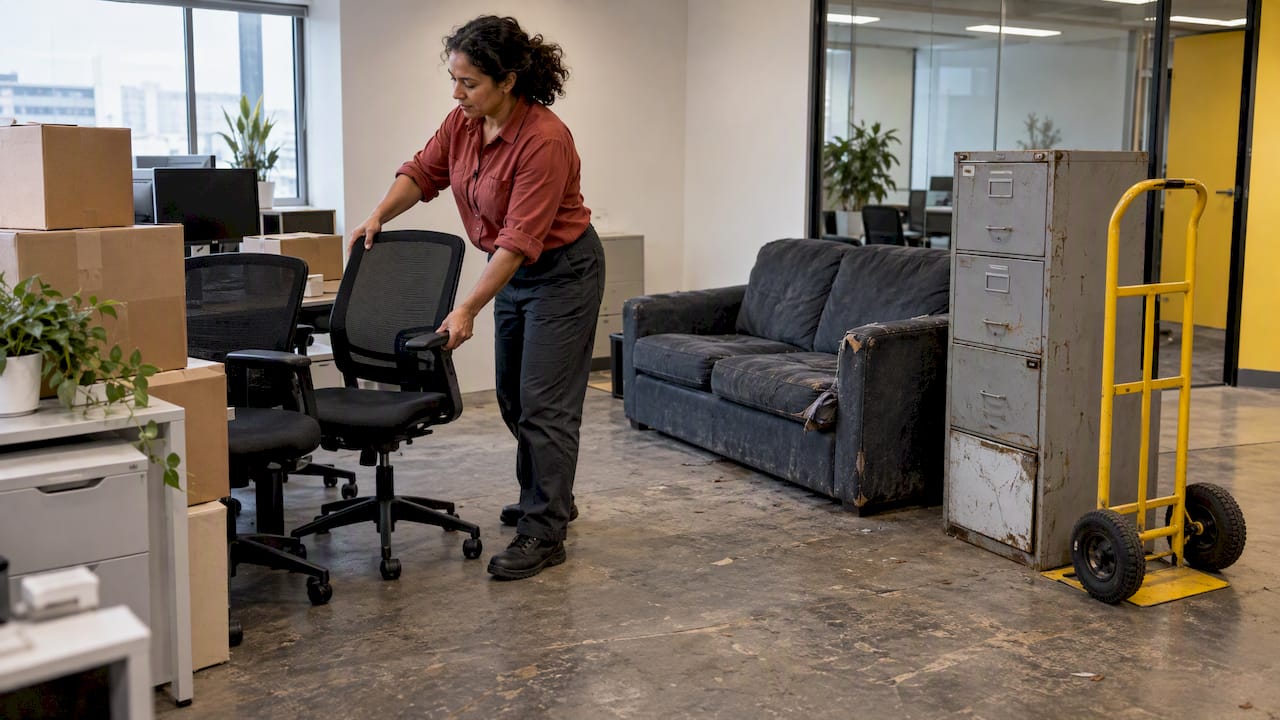
A 40-person firm moves to a smaller floor and keeps 15 workstations, 20 filing cabinets and a pile of old monitors in storage “just in case”. The unit costs a few hundred dollars a month. After a year the firm has spent several thousand dollars on furniture it never reinstalls. The better path was to keep a handful of pieces for growth and clear the rest through office junk removal, with reusable items rehomed.
The tenant at end of lease
A commercial tenant must return the premises to base condition. Storing the leftover fit-out only delays the problem, and the landlord will not accept it. This is a removal job, usually a makegood or office cleanout, done to the lease deadline.
The family mid-renovation
A household clearing a house for builders keeps good furniture for six months and sends the old carpet, broken cabinetry and green waste away. Storage for the furniture, removal for everything else. That split is the most common correct answer.
The legal side: waste is a duty, not just a nuisance
This is where storage and removal differ most for businesses and property managers.
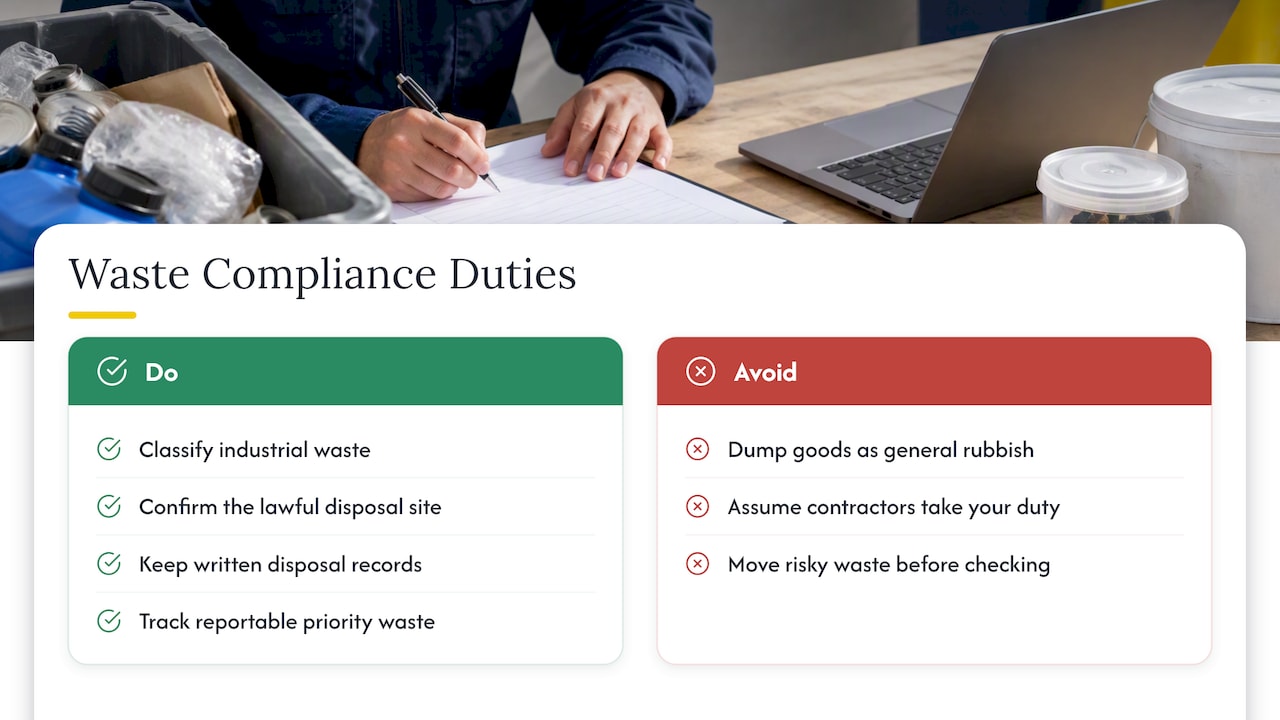
Under the Environment Protection Act 2017 (Vic), businesses must classify industrial waste and make sure it goes to a lawful place. Both the transporter and the person who permits the transport have duties. That applies to debris from clean-outs as well as from construction.
Two practical consequences follow.
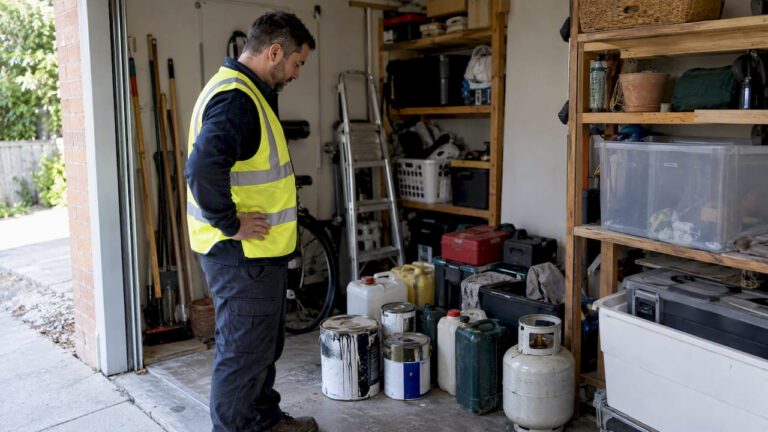
Abandoned items are your problem. Goods left behind by a previous tenant, including in a storage area or a commercial tenancy, remain the responsibility of whoever controls the site until they are classified and disposed of at a lawful facility. You cannot tip them as general rubbish and move on.
Hiring a contractor does not hand off the duty. You still need to be sure the waste ends up at a lawful place. The EPA’s guidance on managing risk and keeping a compliance trail supports asking for written confirmation of the final disposal site, so you hold a record if the EPA ever asks.
For higher-risk materials, the EPA runs a digital tracking system. Reportable priority waste must be tracked with Waste Tracker when it moves from one site to another. If a clear-out turns up chemicals, asbestos-related material or similar, stop and check the category before anything leaves the site.
The cost of getting this wrong is real. The City of Greater Geelong, for example, says illegal dumping costs ratepayers about $800,000 a year, a reminder that unmanaged waste ends up on someone’s bill.
Why council hard waste rarely covers a business
Households sometimes lean on council services. Some councils offer one free hard waste collection per year for eligible households, such as the Nillumbik Shire Council hard waste service. Rules differ by council, and these services are for household items, not commercial or industrial waste.
A business, strata manager or construction firm therefore needs a private operator, and the paperwork that comes with one. If you are a household with a small load, check your own council’s booking rules first. If you have more than the allowance, a commercial-grade clearance is usually quicker.
Sustainability: removal does not have to mean landfill
The waste hierarchy ranks landfill as the least preferred outcome. Avoidance and resource recovery come first, and the NSW EPA estimates that recycling 10,000 tonnes of waste creates about 9.2 full-time equivalent jobs, against 2.8 for landfill. The principle applies in Victoria too.
That changes how you think about removal. A good operator sorts on collection, diverting metal, timber, electronics and furniture before anything is tipped. Sorting at the kerb or on a loading dock with a mixed bin is hard to do well. Sorting at a facility built for it is far easier.
Before you pay for removal, business.gov.au recommends measuring your waste first, so you know what you produce and where you can cut it. A short audit often shows that half the pile never needed to exist.
We offer an opt-in carbon-neutral service for clients who want it. If sustainability is a purchasing criterion for your organisation, our page on eco-friendly rubbish removal for Melbourne businesses explains how it works. For furniture in decent condition, donating or recycling before booking removal usually costs less and keeps it out of landfill.
Side-by-side comparison
| Factor | Storage | Junk removal |
|---|---|---|
| Cost pattern | Ongoing monthly rent | One-off, per job |
| Best for | Items you will reuse on a known date | Items you will not use again |
| Solves the clutter | No, it relocates it | Yes |
| Legal exposure | Contents stay yours, and unpaid fees can lead to goods being sold | Closed once waste reaches a lawful place, with proof |
| Flexibility | Easy to add or remove items | Hard to reverse once collected |
| Break-even | Falls the longer you hold items | Falls as volume rises |
The last row matters. Storage looks cheap at month one and expensive at month eighteen. Removal looks expensive on the day and is finished the same afternoon.
The hybrid approach most people end up with
The most efficient plan is rarely all or nothing.
- Sort into three piles: keep, store, remove.
- Set a review date for anything stored, say six or twelve months out, and write it on the contract.
- Book removal for the rest in one visit so you pay for one call-out, not three.
- Rehome what has value through donation, resale or furniture recycling first.
- Keep the paperwork showing where the waste went.
If you are already paying for a unit you rarely open, treat that as the signal to clear it. Emptying a unit is a standard removal job: the team loads the contents, takes them to the right facilities and leaves the space swept. Compare one removal quote against the next 12 months of rent and the answer is usually clear.
Booking removal with us
We remove rubbish across Melbourne for businesses, property managers, construction firms and tenants. That includes office junk, construction debris, green waste, electronic waste, strip-outs, demolition debris and make-good clearances, as one-off or regular collections. We give real-time notifications on the day, a credit if we are late, and we take care to leave no mess and no damage to property.
For a clear-out of an office, tenancy or site, start with commercial office rubbish removal or ask for a price through our quick quote form. Quotes are per project, and we will beat any written quote by 5%.
FAQ
Is it cheaper to keep things in storage or throw them away?
For items you will not use again, removal is almost always cheaper. Storage fees are charged every month, so a year or two of rent can pass the replacement cost of ordinary furniture and equipment. For items you will reuse soon and that are costly to replace, storage can be the cheaper choice.
What happens if I stop paying for a storage unit?
The facility’s contract will set out what follows, and it often allows the operator to sell or dispose of contents after a period of non-payment. Check your agreement and contact the operator early. Consumer Affairs Victoria’s guidance on uncollected goods explains how long stores must keep goods in some situations.
Can I put business waste in a council hard waste collection?
Generally no. Council hard waste services are designed for eligible households, and commercial or industrial waste needs a private operator. Check with your council for its exact rules.
How do I empty a storage unit quickly?
Sort what you are keeping before the day, then book removal for the remainder in a single visit. Ask the operator how items will be sorted, and request written confirmation of where the waste went. For a business, keep that record on file.
Do I stay responsible for waste after a contractor takes it?
In Victoria, you keep a duty to make sure the waste reaches a lawful place. That is why you should choose an operator who can document disposal, and keep their confirmation.
Sources
- Understand your waste obligations and duties, EPA Victoria
- Managing risks and duties, EPA Victoria publication 1825.1
- What is Waste Tracker, EPA Victoria
- Book a hard waste collection, Nillumbik Shire Council
- The waste hierarchy, NSW EPA
- Manage business waste, business.gov.au
- Self storage Melbourne price comparison, StoragePrices.au
- Relevant charge for uncollected goods, Consumer Affairs Victoria
- Uncollected goods explained, Consumer Affairs Victoria