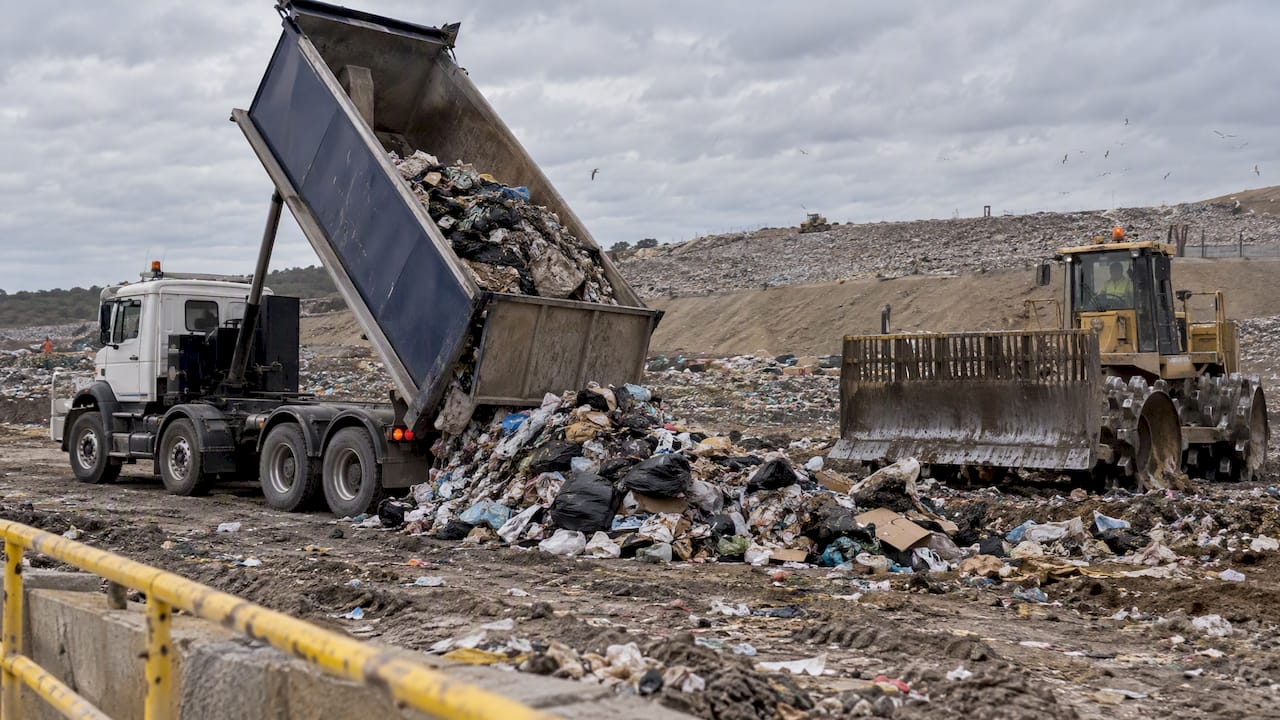
The carbon footprint of waste is the greenhouse gas released when your rubbish is made, moved, buried, burned or recycled. In Australia, the biggest part is methane from organic material rotting in landfill. That is why a tonne of office paper or food scraps can carry a far larger footprint than a tonne of concrete, and why what you throw away matters more than how far the truck drives.
This guide explains the numbers in plain terms, shows how to estimate your own footprint with official Australian factors, and sets out what you can change this quarter.
TL;DR
- Landfill emissions are mostly methane from decomposing organics. Food, paper, cardboard and green waste are the high-impact materials, while concrete, metal and glass are close to negligible.
- Official Australian factors put commercial and industrial waste at 1.3 t CO2-e per tonne, municipal waste at 1.6 and construction and demolition waste at 0.2.
- Transport is usually a small part of the footprint compared with what happens at the disposal site.
- The biggest levers, in order: avoid the waste, reuse it, recycle it, divert organics, and only then dispose.
- You stay legally responsible for your waste after a contractor collects it, so ask where it goes.
Table of Contents
- What “carbon footprint of waste” actually measures
- How big is the problem in Australia and Victoria?
- Why a tonne of paper and a tonne of concrete are not the same
- A worked example: a CBD office clean-out
- Is transport the problem? Usually not
- The waste hierarchy: where to act first
- Organics: the single most useful diversion
- Recycling in a CBD building: the practical constraints
- Your legal duty does not end at the kerb
- How to estimate your own waste footprint
- What we do about it at Melbourne City Rubbish
- Five changes that cut the footprint fastest
- FAQ
- Sources
What “carbon footprint of waste” actually measures
A carbon footprint is shorthand for the greenhouse gas an activity or organisation emits, usually reported in tonnes of carbon dioxide equivalent (CO2-e). The “equivalent” matters because methane and other gases are converted to the same scale as carbon dioxide so they can be added together.
For waste, there are four places emissions come from:
- Making the material in the first place. This is embedded carbon, and it sits in your supply chain rather than your bin.
- Collection and transport. Fuel burned by trucks and loaders.
- Processing. Sorting, shredding, composting, energy recovery or baling.
- Final fate. Landfill gas, incineration emissions, or the avoided emissions when a material is recycled and replaces virgin supply.
When Australian guidance talks about the footprint of waste sent to landfill, it counts the lifetime emissions as the material breaks down, not just the day it is tipped. That is a useful way to think about it: the truck leaves in an hour, but the emissions from what it carries can continue for years.
How big is the problem in Australia and Victoria?
Waste is a modest slice of national emissions, but a stubborn one.
- Nationally, solid waste management produced 10.5 Mt of CO2-e in 2021-22, about 2.5% of Australia’s total, with landfill methane making up around 97% of waste-sector emissions.
- In Victoria, the waste sector accounted for about 3.3 Mt CO2-e in 2023, roughly 4% of the state’s emissions. Solid waste disposal is responsible for around 72% of that.
- The same EPA Victoria report says the state cut waste-sector emissions by 21% between 2005 and 2023, helped by more organics diverted from landfill and better landfill gas capture.
- Queensland offers a useful comparison: its waste sector contributed 2.9 Mt CO2-e in 2022, or 2.3% of that state’s emissions.
Two takeaways. First, Victoria has made real progress, which shows the footprint responds to better handling. Second, national data suggests the long decline in landfill emissions from gas capture has flattened, and may be starting to rise in some areas. Gas capture alone will not keep doing the work.
Why a tonne of paper and a tonne of concrete are not the same
The Australian Government publishes lifetime Scope 3 emission factors for waste sent to landfill. The National Greenhouse Accounts Factors 2024 give these figures:
| Material sent to landfill | Emission factor (t CO2-e per tonne) |
|---|---|
| Paper and cardboard | 3.3 |
| Food | 2.1 |
| Textiles | 2.0 |
| Garden and green waste | 1.6 |
| Wood | 0.7 |
| Inert waste (concrete, metal, glass) | Negligible by comparison |
The pattern is clear. Anything that was once alive or made from plant fibre rots anaerobically under landfill and produces methane. Inert material just sits there.
That has a practical consequence for a Melbourne office. A tonne of old paper files and cardboard boxes has a larger landfill footprint than a tonne of timber, and a much larger one than a tonne of broken concrete. If you are choosing which stream to tackle first, paper, cardboard and food come ahead of almost everything else.
Weighted averages by waste stream
If you have not done a detailed waste audit, the same publication offers weighted average factors by stream:
- Municipal solid waste: 1.6 t CO2-e per tonne
- Commercial and industrial waste: 1.3 t CO2-e per tonne
- Construction and demolition waste: 0.2 t CO2-e per tonne
Construction and demolition waste scores low because so much of it is heavy, inert material such as concrete and bricks. It is still worth managing properly, because it is large in tonnage, contains timber, plasterboard and plastics, and carries legal duties. But in carbon terms, a fit-out or demolition job usually has a far lower landfill footprint per tonne than an office full of paper and a staff kitchen.
A worked example: a CBD office clean-out
Here is how the arithmetic works for a hypothetical tenant clearing a floor. These are illustrative tonnages, not a real client job, and the factors are the official ones above.
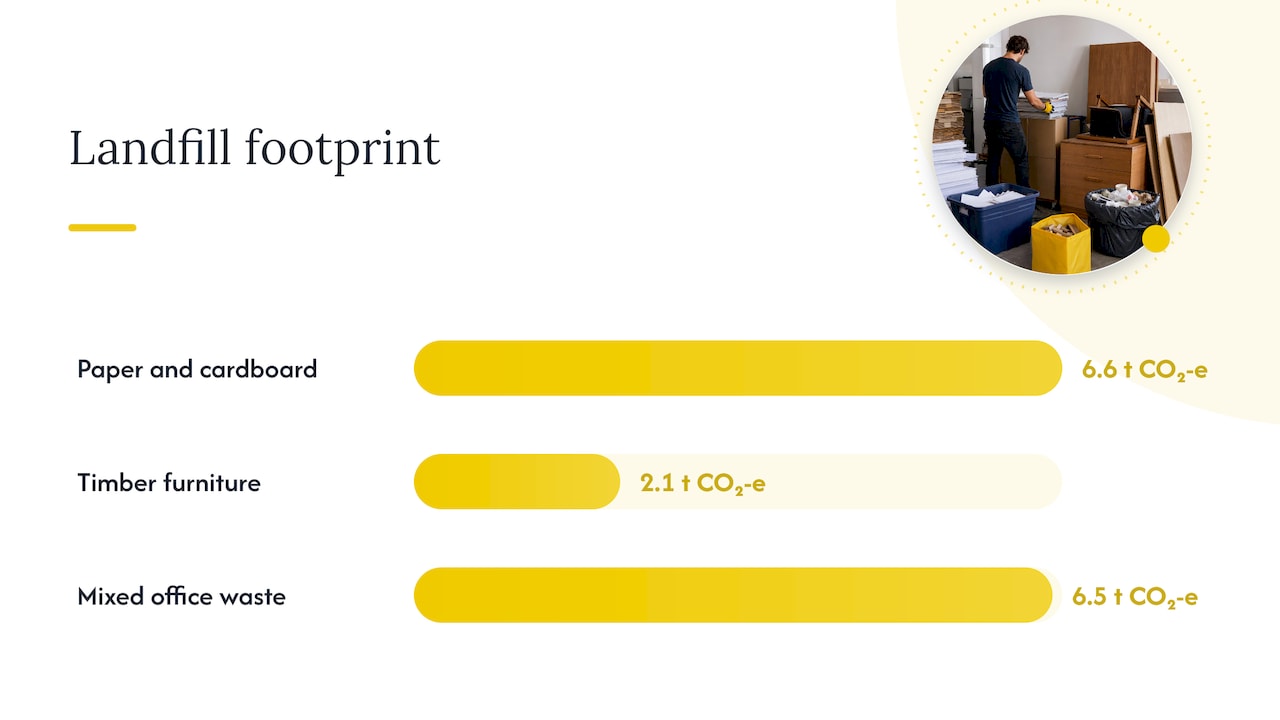
| Item | Tonnes | Factor | Landfill footprint |
|---|---|---|---|
| Archived paper and cardboard | 2 | 3.3 | 6.6 t CO2-e |
| Timber furniture and shelving | 3 | 0.7 | 2.1 t CO2-e |
| Mixed general office waste (use C&I average) | 5 | 1.3 | 6.5 t CO2-e |
If the paper and cardboard were recycled instead of buried, the 6.6 t CO2-e landfill figure for that stream would largely drop out of the calculation. That one decision removes more than the entire timber load contributes. The mixed general waste line is a rough average, so a proper audit would split it into paper, food and everything else, and would probably show room to improve.
Treat any figure like this as an estimate. The factors are averages across Australia and the real result depends on the landfill, its gas capture and what the load actually contains.
Is transport the problem? Usually not
Many business owners assume the truck is the main source. Fuel does matter, and a well-planned route and a right-sized vehicle reduce it. But national accounting shows the larger share sits with the material itself. The Australian Government’s energy recovery reporting illustrates this: tipping a 20-tonne load of municipal waste can produce more emissions than driving that load 14,000 km across the continent, when methane from organics is not captured.
The implication is not that distance is irrelevant. It is that sending a load to the right facility, even if it is a bit further, can beat sending it to the nearest tip. A load of sorted paper that reaches a recycler does more for your footprint than a short trip to landfill.
The waste hierarchy: where to act first
EPA Victoria and industry regulators rank waste options in a hierarchy, from best to worst: avoidance, reuse, recycling, energy recovery, treatment, containment and disposal. The EPA Victoria landfill guidance describes this as the starting point for managing waste.
For a business, that translates into a simple order of operations:
- Avoid. Stop the waste being created. Digitise records, cut packaging in your purchasing, refuse unneeded deliveries. Every tonne you never produce has no collection, no processing and no landfill emissions.
- Reuse. Redeploy furniture within your organisation, pass on usable fit-out items or donate working equipment.
- Recycle. Separate paper, cardboard, metals, e-waste and timber so they go to processors.
- Divert organics. Keep food and garden waste out of landfill.
- Dispose. Landfill is what is left, and it should be the smallest stream.
If you sell, lease or hand back a building, avoidance and reuse happen well before the skip arrives. Walk the floor with a checklist before booking anyone.
Organics: the single most useful diversion
EPA Victoria treats organic waste as a high-priority climate action, because it generates methane, a potent but short-lived climate pollutant. Its Circular Economy Market Report points to diverting food and garden waste into composting or anaerobic digestion as a way to cut emissions per tonne compared with landfill.
For most Melbourne businesses that means three practical moves:
- Staff kitchens and cafes. Separate food scraps if you have access to an organics collection.
- Grounds and landscaping. Garden waste has a landfill factor of 1.6 t CO2-e per tonne, so it should go to a green waste processor. See our guide to green waste disposal in Melbourne and our garden waste removal service.
- Hygiene. Organics bins need regular cleaning to keep odour and pests down. A guide to bin cleaning services from a Canadian provider shows what a regular wash routine involves, and a similar schedule applies on site wherever you are.
One point of clarity: Victoria’s four-bin household reform covers council kerbside collection, not businesses. Commercial operators arrange their own collection and choose their own streams, so there is no rule forcing the change. There is just a good reason to make it.
Recycling in a CBD building: the practical constraints
Recycling in a high-rise has real limits: loading docks with booking windows, lifts shared by tenants, strata rules and limited space for separate bins. Good results come from a plan that fits the building rather than from a generic poster in the kitchen.
Three things help most:
- Know your streams. Paper and cardboard, commingled recycling, e-waste, batteries, furniture and general waste each need a different path. Our guide to recycling in the Melbourne CBD covers the local detail.
- Handle hazardous items separately. E-waste and batteries should not go in general bins. See our pages on e-waste disposal in Melbourne and battery disposal.
- Measure first. A short audit tells you what is in your bins. Our 3-day business recycling audit plan is built for that, and it is aimed at cutting landfill volumes by 20 to 40 per cent.
Your legal duty does not end at the kerb
This part is easy to miss. Under EPA Victoria’s guidance on your duties as a waste producer, the business or property manager that produces the waste is responsible for making sure it reaches a lawful place. Hiring a contractor does not hand that duty over.
Best practice, as set out in that guidance, is to ask the transporter for written confirmation of the facility the waste is going to, and to check that the facility is licensed by EPA to accept that class of waste. Do this before the job, and keep the paperwork. It protects you legally, and it also tells you whether your load is going to recycling, energy recovery or landfill, which is the question that drives your footprint.
If you are a property manager handling a make-good or strip-out, or a construction firm with mixed demolition loads, this is the step to build into your contractor checklist. Our construction waste removal team works across Melbourne commercial buildings, and you can ask us where each stream is going.
How to estimate your own waste footprint
You do not need specialist software to get a first number. Use this method.
- List your waste streams for a year: general waste, paper and cardboard, organics, timber, e-waste, construction material.
- Get tonnages. Ask your collector for weights, or estimate from bin sizes and collection frequency. Weighbridge dockets are the most reliable.
- Apply the factor. Multiply each tonnage by the matching figure in the National Greenhouse Accounts Factors. Use the weighted average (1.3 for commercial and industrial waste) only when you cannot split by material.
- Record what was diverted. Recycled or composted tonnes should be tracked separately from landfilled tonnes.
- Repeat quarterly. The trend matters more than the first figure.
These factors cover the lifetime emissions from landfill degradation. They are suited to organisational reporting at a high level, not to a formal carbon claim. If you need audited reporting, speak to a qualified emissions consultant or your sustainability adviser.
What we do about it at Melbourne City Rubbish
We run carbon-neutral operations, and clients can opt in to eco-friendly disposal on their jobs. We handle commercial and residential clearances across Melbourne, including office junk, construction debris, green waste, e-waste, strip-outs and make-good work.
What that means in practice:
- You tell us what the job is, and we help you separate streams so recyclable and reusable material is not buried with the rest.
- We track arrival with real-time notifications and offer a credit if we are late, so a dock booking in a CBD building is not wasted.
- We aim to leave no mess and no damage to property.
- If you have a written quote from another provider, we promise to beat it by 5%.
Start with our eco-friendly rubbish removal for Melbourne businesses page, or go straight to a quick quote. For furniture, our furniture disposal and recycling service is a good first step, and our office cleanout service covers whole floors.
Five changes that cut the footprint fastest
If you do nothing else this quarter:
- Take paper and cardboard out of general waste. At 3.3 t CO2-e per tonne in landfill, it is the highest-impact material in the table.
- Separate food scraps where you can access organics collection.
- Reuse or resell furniture before a clean-out or make-good, rather than skipping it.
- Ask every contractor for destination facility details in writing.
- Put weights on your invoices. What you can measure, you can reduce.
Events and one-off jobs follow the same logic. If you run a launch or a trade show, see our guide to event rubbish removal in Melbourne. For wider planning, our business waste guide for Melbourne is a good companion to this one.
FAQ
How much CO2 does 1 kg of waste produce?
It depends on the material. Using the official lifetime landfill factors, 1 kg of paper or cardboard equates to about 3.3 kg CO2-e, food about 2.1 kg, garden waste about 1.6 kg and wood about 0.7 kg. Inert waste such as concrete is negligible by comparison. These are averages for Australia, not exact figures for a particular tip.
Does transport or disposal matter more for the carbon footprint?
For organic and mixed waste, disposal usually matters more. National accounting shows that landfill methane can outweigh the emissions of long-distance trucking. Efficient routing is still worthwhile, but the destination and the material in the load drive most of the result.
Is construction waste worse for the climate than office waste?
Per tonne, usually not. The weighted average factor for construction and demolition waste is 0.2 t CO2-e per tonne, against 1.3 for commercial and industrial waste. Construction loads are often large and carry other legal and environmental duties, so they still need proper handling.
Am I still responsible if a contractor takes my waste?
Yes. EPA Victoria’s guidance says waste producers must make sure waste goes to a lawful place, and hiring a contractor does not remove that duty. Ask for written confirmation of the destination facility and check that it is licensed to accept your waste type.
What is the quickest way for a small business to reduce its waste footprint?
Pull paper, cardboard and food out of the general bin, and track the weights. Those materials carry the highest landfill factors, so small changes show up quickly in your numbers.
Sources
- Australian National Greenhouse Accounts Factors 2024, DCCEEW
- Circular Economy Market Report 2026, EPA Victoria
- DCCEEW, Australian Government
- Waste sector greenhouse gas emissions, Queensland State of the Environment Report 2024
- Energy recovery, DCCEEW
- Landfill guidance, EPA Victoria
- Managing industrial waste: your duties as a waste producer, EPA Victoria