Construction waste removal in Melbourne is priced by volume for light, bulky material and by weight for heavy material such as concrete, brick and soil. Heavy loads cost more because of weight limits on trucks and the landfill levy charged per tonne. Published skip prices for heavy fill sit well above general waste prices, and a fixed figure for your job is only possible once someone knows what the waste is, how much there is and how easily a truck can reach it. This guide shows what sits behind a quote so you can judge one properly.
We are Melbourne City Rubbish, and we quote construction jobs per project. We do not publish a price list, so this guide uses public figures from councils, the EPA and transfer stations to explain the cost structure. It does not put a price on your job.
TL;DR
- Cost depends on four things: waste type, load size, access to the site and disposal fees. Weight matters as much as volume.
- Heavy inert waste (concrete, brick, soil) is the most expensive to move. Mixing it into a general waste bin invites overweight surcharges, reported at $100 to $300.
- Victoria’s landfill levy for industrial waste in metropolitan Melbourne is $177.19 per tonne from 1 July 2026, and it is built into what you pay.
- Sorting on site, declaring heavy waste upfront and planning before demolition are the most reliable ways to lower the bill.
- A written quote based on photos or a site visit is the only way to get a firm number.
Table of Contents
- How construction waste removal is priced in Melbourne
- What drives the cost
- Typical costs by material and service type
- Skip bin or a service that loads for you?
- Which jobs produce which waste
- Is it free to get rid of concrete in Melbourne?
- How to cut your construction waste cost
- What a good quote should show
- Get a price for your job
- FAQ
- Sources
How construction waste removal is priced in Melbourne
Most providers build a quote from the same few parts:
- Labour and loading. Someone has to pick the material up, carry it out and load it. A job where the crew loads is priced differently from one where you fill a bin yourself.
- Truck time and distance. Truck size, trips needed and travel to the tip all count.
- Disposal. Tip fees, charged by weight or volume depending on the facility, plus the state landfill levy when waste goes to landfill.
- Extras. Permits, stairs and long carries, dismantling, hazardous items and after-hours work.
Light material is usually priced by the cubic metre. Heavy material is usually priced by weight, or by a flat rate for a load of a single material, because a few cubic metres of concrete can reach a truck’s weight limit long before the tray is full.
The sections below take each factor in turn.
What drives the cost
Waste type
Type is the biggest lever. Roughly in order of cost per load:
- Light, mixed renovation waste (plasterboard offcuts, packaging, timber offcuts, carpet): cheapest per tonne to handle, though bulky.
- Timber and green waste: often recyclable or processable, which can reduce disposal cost if kept clean.
- Heavy inert waste (concrete, bricks, tiles, soil): dense, so loads are weight-limited, and disposal is charged by the tonne.
- Mixed loads: the most expensive to dispose of, because the facility treats the whole load at the rate of its worst component.
- Hazardous material such as asbestos: needs licensed handling and is a separate job entirely. Never put it in a general load.
For a sense of the gap, one Melbourne price guide reports that heavy waste in a 2m³ skip typically costs $350 to $550, against $250 to $380 for general waste in a bin of the same size. The same guide reports that mixing heavy material into a general bin usually leads to overweight surcharges of $100 to $300.
Load size
Load size is measured in cubic metres, and a cubic metre is a box one metre long, wide and high. A standard 6m³ truck load fills a lot of space, and a small ute load is closer to one or two. Underestimating is the most common reason a final price differs from a first estimate.
Two habits help:
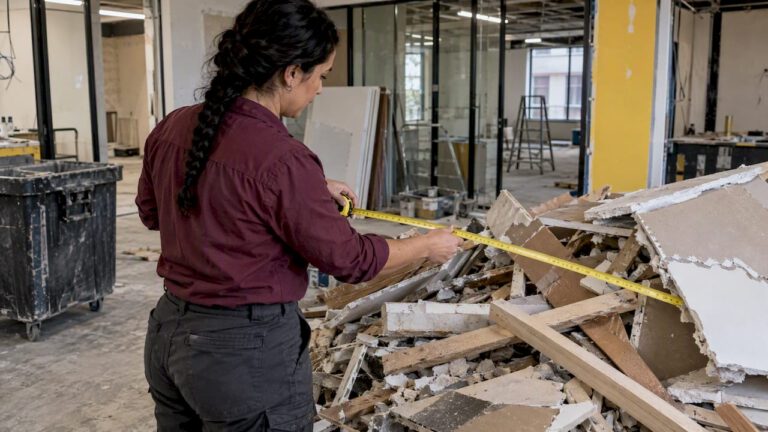
- Estimate the pile in cubic metres (length × width × height), then add a margin for loose, uneven material.
- Send photos with something for scale, such as a wheelie bin or a person standing next to the pile.
Because weight matters for heavy material, a photo of a pile of broken concrete tells a provider more than a volume figure does.
Access
Access is where tradies and project managers often get caught. A site with a clear driveway and a truck that can park at the pile is cheap to service. Costs rise with:
- stairs, lifts with booking windows, and long carries from a basement or upper floor
- narrow laneways, which are common around the CBD, Southbank, South Melbourne and Port Melbourne
- loading docks with time restrictions
- no legal parking for a truck or bin
If a skip has to sit on the street, the council gets involved. The City of Melbourne requires a permit to place skips, bins or containers on the road, with an application fee of $102.50 plus a daily fee of $102.50 per occupied parking bay. Other councils have their own permit rules and fees, so check with the council where the work is happening. A service where a crew loads a truck and leaves within hours often avoids the permit entirely, which can change the comparison.
Disposal fees and the landfill levy
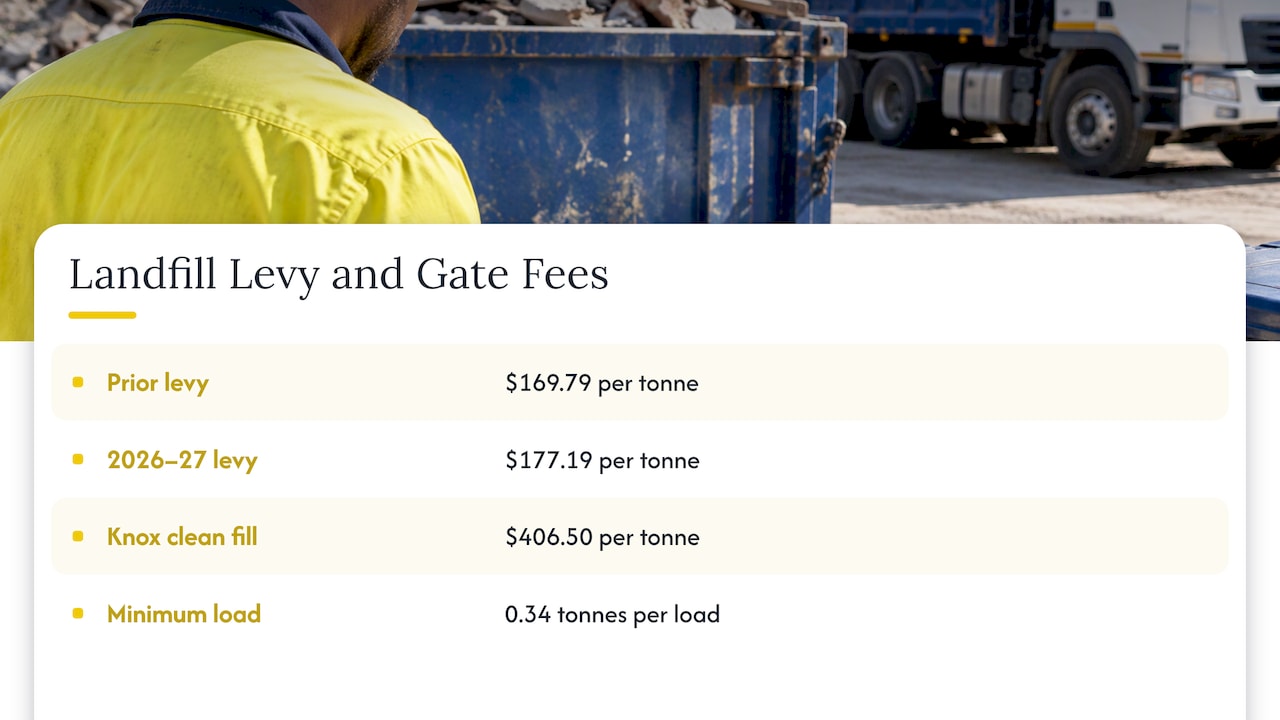
Every tonne of waste that goes to landfill in Victoria attracts the state waste levy. The EPA’s published rates show that from 1 July 2026 to 30 June 2027 the levy for industrial waste at metropolitan premises is $177.19 per tonne, up from $169.79 in the previous financial year. Construction and demolition waste sent to landfill is classed as industrial waste, so this rate applies to it.
The levy is only part of the tip fee. Transfer stations set their own gate prices. As an example, Knox Transfer Station’s gate list from 1 July 2026 charges $406.50 per tonne for clean fill including concrete, tiles, bricks and other heavy inert materials, and applies minimum weights for larger loads, such as 0.34 tonnes per load. Gate prices differ between facilities, so the same pile of rubble can cost different amounts depending on where it is taken. This is one reason two quotes for the same job can differ.
Typical costs by material and service type
No honest source can give one price for “construction waste”, because the range is wide. The table shows how the main options compare and what each depends on. Figures are published ranges for Melbourne from the sources linked above and are indicative only.
| Option | Published Melbourne range | What moves the price |
|---|---|---|
| Skip bin, general waste, 2m³ | $250 to $380 | Hire period, suburb, permit |
| Skip bin, general waste, 10m³ | $620 to $950 (7 days) | Hire period, weight limit |
| Skip bin, heavy waste (soil, concrete, brick), 2m³ | $350 to $550 | Weight, tip rate for clean fill |
| Overweight or mixed-load surcharge | $100 to $300 | Declaring heavy waste upfront |
| Tip drop-off, clean fill | $406.50 per tonne (Knox, 2026) | Facility, minimum load weight |
Skip figures are from Home Upkeep’s June 2026 Melbourne guide. Treat them as a starting reference, then compare against written quotes for your job.
A load-and-remove service sits outside this table because it is priced per job. We quote construction waste removal that way, based on the waste type, the volume and the site, and the crew does the loading.
Skip bin or a service that loads for you?
A skip can be the right choice. It suits a long project with steady waste, a site with room for a bin and a crew that has time to fill it. A load-and-remove service tends to win when:
- the site is tight, upstairs or in the CBD, where a bin needs a permit or has nowhere to go
- the job is a one-off clear-out, strip-out or make-good with a deadline
- the labour to load the bin would cost more than the price difference
- the waste is mixed and needs sorting for correct disposal
When comparing, put both on the same footing. A skip price usually excludes the labour to fill it, any permit and any overweight charge. A loaded-for-you price usually includes labour and the trip to the tip. Ask each provider what is and is not included, and compare totals.
Which jobs produce which waste
Renovations. Kitchens, bathrooms and extensions produce mixed waste: plasterboard, timber, tiles, old fittings and some concrete or brick. Separating the heavy part from the rest often pays off. Our guide to managing renovation waste in Melbourne goes through how to stage it.
Demolition. Structural and commercial demolition produces large volumes of concrete, brick, steel and timber, and the costs are shaped by what can be recycled. We have a separate breakdown in our demolition waste removal cost guide.
Commercial strip-outs and make-good. Ceilings, partitions, carpet tiles, joinery and cabling come out within a lease deadline. Time and access matter more than tonnage here. We handle strip-outs, make-good and de-fit work as well as the waste they produce, which means one party carries the job from demolition to removal.
Building sites. Ongoing builds need regular pick-ups of offcuts, packaging and soil. The cheapest approach is a plan made before work starts.
Is it free to get rid of concrete in Melbourne?
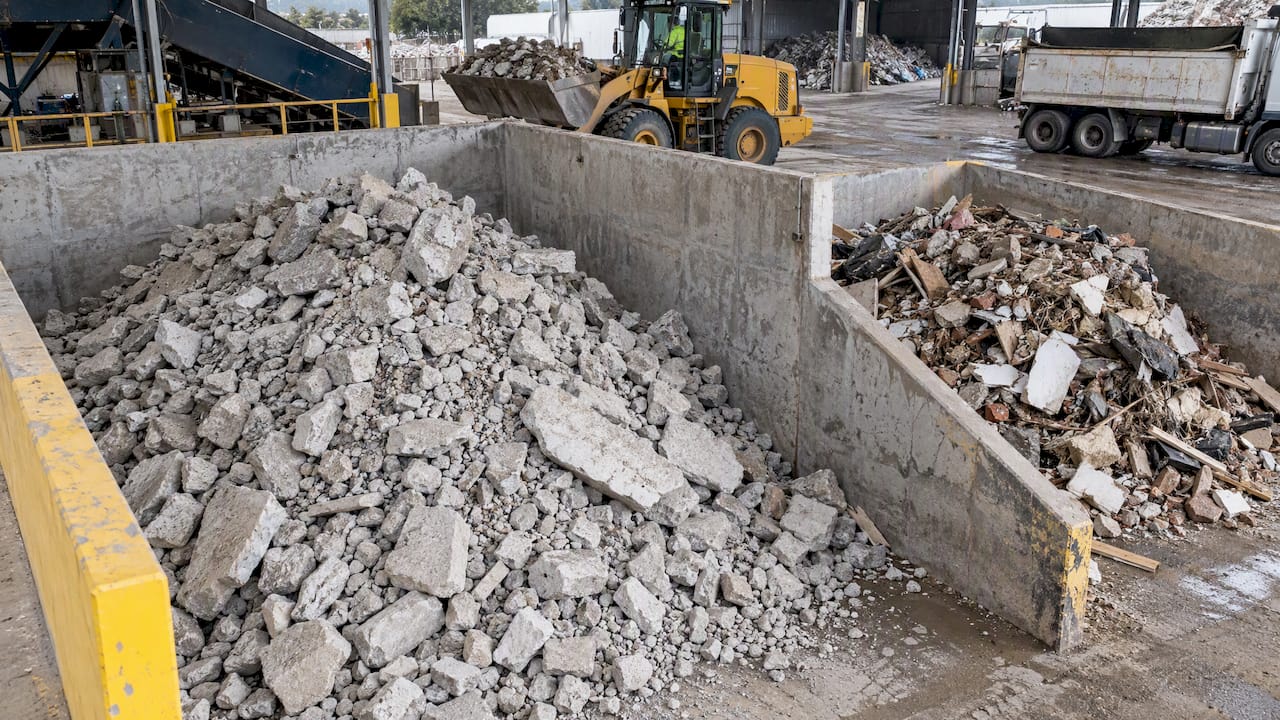
Rarely. Concrete, brick and tile are accepted at transfer stations and recycling facilities, but they are generally charged by weight, as the Knox gate price shows. Clean, separated concrete is cheaper to dispose of than concrete mixed with other waste, and in some cases it is processed into recycled aggregate rather than buried.
Council hard waste collections are not the answer for building work. The City of Melbourne says it does not collect building, renovation or demolition waste at its residential hard waste collections. If you are unsure what counts as hard waste in the city, our page on hard waste collection in the City of Melbourne explains the boundaries.
How to cut your construction waste cost
The most dependable savings come from decisions made before the first truck arrives.
Plan waste before work begins
EPA Victoria encourages civil construction and demolition projects to plan waste management upfront, with on-site storage and sorting described as foundational to responsible and cost-effective disposal. In practice, decide where each material goes before the skip or truck turns up.
Separate heavy and light waste
Keep concrete, brick and soil away from timber, plasterboard and packaging. A separated load is charged at its own rate, whereas a mixed load is treated as the most expensive component. Practical steps, such as breaking down bulky materials and separating heavy waste, also make better use of space on each load.
Declare what is in the load
Tell the provider if there is concrete, soil or brick. Surcharges and rejected loads cost far more than the honest price. If you are unsure whether something is accepted, our rubbish removal preparation checklist lists what typically causes rejections.
Fill bins and loads sensibly
Break down timber frames and pallets, put heavy items at the base and avoid leaving gaps. The result is fewer loads.
Get comparable written quotes
Give each provider the same information: waste types, estimated volume, photos, floor level, parking and timing. Ask what is included, then compare totals. We will beat any written quote by 5%, so if you already have one, send it with your photos. Our article on smart construction waste disposal covers more detail.
What a good quote should show
Before you accept a price, check that it states:
- the waste types it covers and any it excludes
- the volume or weight it assumes, and what happens if the load is larger
- whether labour, loading, travel and tip fees are included
- any permit, parking or access costs
- how hazardous items are handled
- the date and arrival window
A quote that is a single line with no assumptions is a warning sign. If the price is far below others, ask what it leaves out.
Get a price for your job
If you want a firm number rather than a range, we quote per project. Our crew loads and removes the waste, works in all types of Melbourne commercial buildings and leaves the site clean and undamaged. You get real-time arrival notifications and a credit if we are late, and you can opt in to carbon-neutral disposal. See our construction waste removal service or send photos through the quick quote page.
FAQ
How much does construction waste removal cost in Melbourne?
It depends on waste type, volume, access and tip fees, so there is no single price. Published skip prices for heavy waste in a 2m³ bin run from about $350 to $550, and heavy material is charged by weight at tips. For a firm price on your site, get a written quote based on photos or an inspection.
Why is construction waste more expensive than household rubbish?
It is heavier, so loads are limited by weight rather than space, and it is charged by the tonne at disposal, including the state landfill levy. It also often needs sorting and may need dismantling first. Mixed loads add further cost.
Can I put concrete or soil in a normal skip bin?
Not without telling the provider. Heavy material mixed into a general waste bin commonly leads to overweight surcharges, reported at $100 to $300, or a refused pick-up. Order a bin or service designed for heavy waste and declare the contents when booking.
Do I need a permit for a skip bin in Melbourne?
If the bin sits on a road or council land, yes. In the City of Melbourne the fee is $102.50 to apply plus $102.50 per day for each occupied parking bay. Bins kept on private property generally do not need one, but check with your local council.
Sources
- How Much Does Skip Bin Hire Cost in Melbourne? (Home Upkeep)
- Waste levy (EPA Victoria)
- Knox Gate Prices (Knox Transfer Station)
- Place skips, bins or containers on the road (City of Melbourne)
- Hard waste (City of Melbourne)
- Circular Economy Market Report 2026 (EPA Victoria)
- Construction debris removal for contractors