There is no single price for clearing a construction site in Melbourne, because the bill is built from crew time, truck capacity, tip fees and paperwork, and each moves with the job. As a rough trade benchmark, one 2026 Melbourne guide puts waste removal, including skip bins, a general tidy and construction-waste removal, at $1,500 to $4,000 per dwelling. That is indicative only. Below we explain what sits inside a quote, which numbers are real benchmarks, and how to get a fixed price you can trust.
TL;DR
- Expect a quote per job, not a flat rate. Volume, waste type, access, labour and the disposal destination set the price.
- Council tip fees are only one line. The City of Melbourne’s Dynon Road lists $440 per tonne for commercial or general waste, and a contractor must add loading, trucks, travel and sorting.
- Separating concrete, brick, metal, timber and plasterboard on site is the most reliable way to cut disposal cost.
- The cheapest quote can be the riskiest: under EPA Victoria guidance, the waste producer stays responsible for where the waste ends up.
- Suspected asbestos is a separate job for a licensed removalist, never part of a general cleanup price.
Table of Contents
- What “construction site cleanup” actually covers
- What drives the price of a site cleanup
- Council tip fees versus a full-service quote
- Rough ranges to sanity-check a quote
- A worked example
- The cost most quotes forget: compliance
- How to keep the cost down
- Who to call for which job
- How Melbourne City Rubbish prices a site
- Questions to ask before you accept any quote
- FAQ
- Sources
What “construction site cleanup” actually covers
People use the phrase for three different jobs, and they are priced very differently.
- Builders clean. Dust, glass, floors and fixtures at handover. This is a cleaning job, priced by area or by the hour.
- Rubbish and debris removal. Offcuts, packaging, pallets, plasterboard, timber, metal and concrete loaded onto trucks and taken to a lawful facility. This is what we do.
- Strip-out, make-good or demolition clearance. Removing fit-outs, ceilings, floor finishes, partitions or structures, then carting the debris away.
Most searches for this keyword land on builders-clean pricing, so it helps to separate the two. For the cleaning component, one Melbourne provider reports ongoing commercial cleaning around $35 to $70 per hour including GST, and builders or heavy cleaning from $120 per hour plus GST. Those are labour benchmarks, not rubbish-removal tariffs. The same source notes builders cleans are usually quoted by project, so compare scope rather than hourly rate alone.
If your site has a pile of debris, a bin full of offcuts or a fit-out to clear, you need rubbish removal first. The cleaner comes after the waste has gone.
What drives the price of a site cleanup
A specialist quoting a site will look at the same handful of variables every time.
Volume and weight
Light, bulky waste such as packaging and offcuts fills a truck quickly but weighs little. Concrete, brick, tiles and soil fill little space but weigh a lot, and tips charge by the tonne. A job that looks small can be expensive if it is heavy.
Waste type and how clean the load is
This is where the biggest swings happen. Tips price mixed loads far above clean, single-material loads. Surf Coast Shire’s 2025–26 schedule, a Victorian council outside Melbourne, lists mixed construction and demolition waste at $297.50 per tonne with a 0.5-tonne minimum, against $80 per tonne for clean concrete and bricks, $55 for clean plaster and $30 for clean fill. It is not a Melbourne quote, but it shows the pattern: a load of clean brick can cost a fraction of the same weight of mixed rubble.
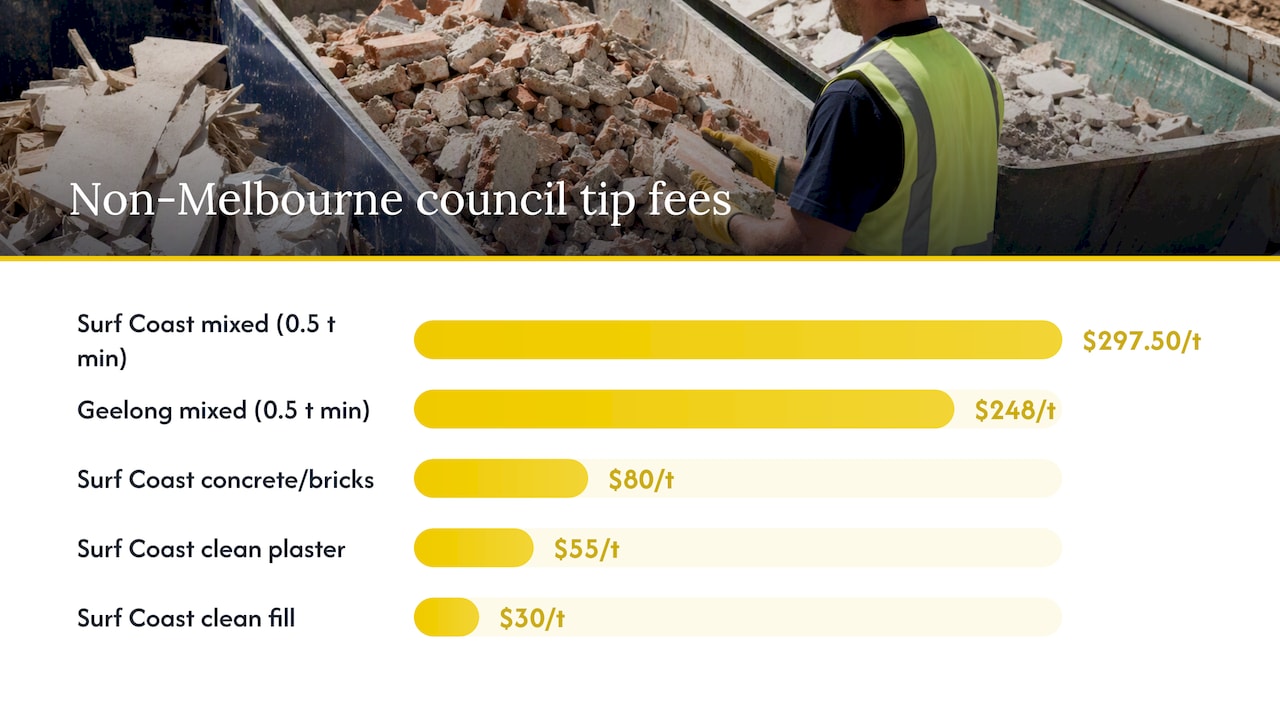
Greater Geelong shows the same structure from 1 July 2026, with mixed building rubble at $248 per tonne and a 0.5-tonne minimum charge unless a per-item price applies. Minimum loads matter on small jobs, so ask your contractor whether one applies.
Access and loading
A ground-floor site with a truck at the door costs less than a CBD fit-out on level 14 with a goods lift booked in two-hour windows. Stairs, hoarding, loading-dock limits, after-hours work and long carries all add labour time. Our crews work in all kinds of Melbourne commercial buildings, so lift bookings, building rules and keeping common areas clean are part of how we plan a job.
Labour and crew size
Hand-loading, sorting and sweeping take hours that no tip fee captures. Where debris must be broken up or removed from the structure first, such as floor finishes, concrete or joinery, the job moves from simple clearance into strip-out work.
Frequency
A one-off clearance at the end of a project costs differently from regular pickups during the build. Weekly collections keep the site safe and stop debris being handled twice, and they usually make quoting simpler because volumes become predictable.
Council tip fees versus a full-service quote
It is tempting to take a tip fee, multiply by your estimated tonnes and call it the price. That produces a number far below what a contractor can deliver.
The City of Melbourne lists Dynon Road general disposal at $440 per tonne including GST as of 5 May 2026, with example vehicle charges of $215 for a level utility, $285 for a heaped or caged utility, $280 for a level 6×4 trailer and $185 for a van. Prices are subject to variation and the facility does not accept building materials such as bricks, concrete, asphalt and soil.
The council also says Dynon Road is a service for residents rather than commercial quantities, and that business operators are responsible for disposing of their own waste, usually through a private collection company. So gate fees are a reference point only. A full-service quote also has to cover:
- crew time on site, including loading and sorting
- truck capacity and the number of trips
- travel and tolls
- site access constraints
- the cost of receiving the waste at an authorised facility
- documentation and responsibility for the final destination
Rough ranges to sanity-check a quote
Because every site differs, treat these as orientation only. None are our prices.
| Item | Benchmark | Source and caveat |
|---|---|---|
| Waste removal for a dwelling build (skip bin, tidy, construction waste) | $1,500 to $4,000 per dwelling | Trade-rate guide, indicative only |
| General commercial disposal at Dynon Road | $440 per tonne incl. GST | City of Melbourne, 5 May 2026, gate fee only |
| Mixed building rubble, Greater Geelong | $248 per tonne, 0.5 t minimum | Council fee page, effective 1 July 2026 |
| Mixed C&D waste vs clean concrete and brick, Surf Coast | $297.50 vs $80 per tonne | Council schedule, 2025–26 |
The lesson from the last row is the practical one. Sorting your waste can shift the disposal bill more than haggling over the labour rate.
A worked example
Take a small commercial fit-out removal: partitions, ceiling tiles, carpet, some timber and a few metres of joinery. Here is how a sensible quote breaks down, using no invented prices, just the structure.
- Scope. What is being removed, on which floors, and what is staying.
- Access. Lift booking, loading dock, hours of work, protection of common areas.
- Crew and trucks. Number of people, hours, truck size and trips.
- Disposal. Which materials go where, with recycling streams for metal, timber and carpet where possible.
- Exclusions. Asbestos, hazardous goods, anything the quote assumes the client has removed.
- Documentation. What proof of lawful disposal you will receive.
If two quotes differ by a large margin, the difference is almost always in lines 4 to 6. One contractor has priced in sorting and a lawful destination, while the other has not.
The cost most quotes forget: compliance
In Victoria, outsourcing the carting does not outsource the responsibility. EPA Victoria’s guidance says waste must be classified, safely contained and sent to a lawful place, and the business that produces it remains accountable even when a contractor manages it. The guidance recommends getting written evidence of the destination and checking that it is authorised to receive the material.
A compliant quote should identify:
- the waste types and how they will be loaded
- transport arrangements
- the authorised receiving facility
- recycling and disposal assumptions
- asbestos exclusions
- any documentation you will receive
This matters most for treated timber, e-waste, paints, chemicals and asbestos. A very low price can mean mixed loads going somewhere they should not. That becomes your problem, not the contractor’s.
Asbestos: keep it out of the general price
If you suspect asbestos in an older building, stop and do not let it go into ordinary debris. EPA Victoria says that industrial asbestos is reportable priority waste. Businesses should use a licensed asbestos removalist, an authorised transporter and an approved landfill, with Waste Tracker records. Ask for those records before work starts, not after the load has left the site. Your licensed removalist or occupational hygienist is the person to call first, and we only quote general clearance once the asbestos question has been settled in writing.
How to keep the cost down
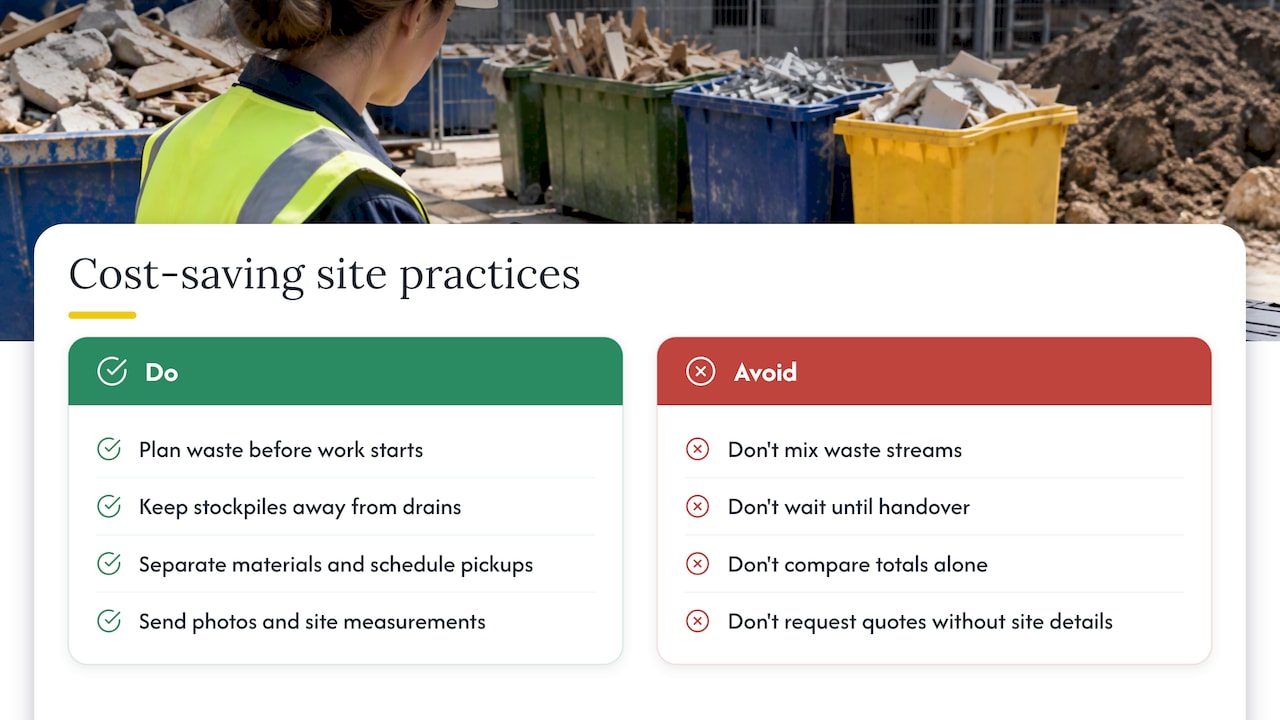
Plan waste before the first day. EPA guidance treats waste planning as part of site management: designate stockpile areas, keep them away from drains and inspect them at the start and end of each day. Designated and separated stockpiles mean less rehandling, less litter and fewer complaints from neighbours. A staged renovation cleanup checklist is a good way to sequence the clean-up so one trade’s mess is not another trade’s rework.
Separate materials. Keep concrete, brick, metals, timber, plasterboard, e-waste and green waste apart. EPA guidance prioritises reuse and recycling and notes some waste types are banned from landfill, so clean streams are cheaper and safer.
Clear as you go. Regular pickups beat one giant clearance at handover. Debris stays out of the way of trades, and the final job is smaller.
Give the quoter real information. Photos, measurements, floor levels, lift details and a list of materials let a contractor fix a price rather than pad it for unknowns. For a larger job, an onsite look is better still. The City of Melbourne notes that location, waste type and quantity determine which services are available, which is why generic advertised rates rarely survive contact with a real site.
Compare scope, not totals. Put quotes side by side and tick off the six lines in the worked example. Ask each contractor where the waste goes.
Our own guide on smart construction waste disposal in Melbourne goes deeper on separation and scheduling.
Who to call for which job
Different kinds of provider suit different stages, and it saves money to call the right one.
| Job | Right provider type |
|---|---|
| Dust, glass and floors at handover | Builders-clean cleaner |
| Offcuts, debris, bulk waste during or after the build | Rubbish removal contractor |
| Fit-out removal, make-good, de-fit | Strip-out and rubbish removal contractor |
| Structure removal | Demolition contractor |
| Suspected asbestos | Licensed asbestos removalist |
| A few bags of household waste | Council or household services |
Many sites need two or three of these in sequence. Doing the rubbish removal before the final clean avoids paying a cleaner to work around debris.
How Melbourne City Rubbish prices a site
We quote per project, based on the volume and type of waste, access and the work involved, so there is no published rate card to misquote you. Our services cover construction waste removal, building strip-out, make-good and de-fit, commercial and structural demolition, furniture and joinery removal, floor finish removal and grinding, and truck and driver hire, for regular or one-off jobs.
What you can expect from us:
- We beat any written quote by 5%. Send us a written quote from another contractor and we will go below it.
- Punctuality you can check. Real-time notifications, and a credit if we are late.
- No mess, no damage. We work in all types of Melbourne commercial buildings and leave the site clean.
- Carbon-neutral option. You can opt in to eco-friendly, carbon-neutral disposal.
Send photos and rough measurements through our quick quote form and tell us what is staying and what is going. If the job is a larger clearance, see our full list of services.
Questions to ask before you accept any quote
- Is the price fixed, or per tonne or per load? What triggers extra charges?
- Which authorised facility will receive each material?
- Will I get written proof of lawful disposal?
- Does the price include loading, sorting and travel?
- What is excluded, in particular asbestos and hazardous goods?
- What happens if the crew is late or the site is damaged?
A contractor who answers these clearly and in writing is usually the one worth hiring, whatever the headline price.
FAQ
How much does construction site cleanup cost in Melbourne?
It depends on volume, waste type, access and labour, so contractors quote by project. One 2026 trade guide gives $1,500 to $4,000 per dwelling for waste removal as an indicative figure. For a firm number, send photos and measurements for a written quote.
Is a builders clean the same as rubbish removal?
No. A builders clean is a handover clean of dust, glass and floors. Rubbish removal clears the debris, offcuts and bulky waste first. Most sites need the removal done before the clean.
Can I just take site waste to the council tip?
Usually not for commercial quantities. The City of Melbourne says its Dynon Road centre is for residents and that businesses must arrange compliant waste services, generally through private providers. Dynon Road also does not accept bricks, concrete, asphalt or soil.
What if I find asbestos during cleanup?
Stop work in that area and call a licensed asbestos removalist. EPA Victoria says industrial asbestos is reportable priority waste that needs an authorised transporter and Waste Tracker records. It must not be mixed with general debris.
Does separating waste really save money?
Yes, because tips charge less for clean, single-material loads. Surf Coast Shire’s schedule lists clean concrete and bricks at $80 per tonne against $297.50 for mixed construction waste, as shown above.
Sources
- City of Melbourne, Dynon Road Waste and Recycling Centre
- City of Melbourne, Waste and recycling for businesses
- City of Greater Geelong, Drysdale Landfill fees
- Surf Coast Shire, What’s accepted at disposal sites
- EPA Victoria, Construction
- EPA Victoria, Manage asbestos waste
- EPA Victoria
- Clean My Biz, Builders clean cost Melbourne
- Pekaj Group, Trade rates in Melbourne for 2026