Demolition waste removal in Melbourne is priced by what the debris is, how heavy it is and how easily a truck can reach it, not by a flat rate. For a whole house, published guides put demolition at roughly $15,000 to $40,000, with waste removal and disposal one line inside that total. This guide shows what drives that line, what the state and councils charge, and where owners usually overspend.
We are Melbourne City Rubbish. We quote demolition and construction waste jobs per project, so we do not print a rate card here. We explain how the number gets built so you can read any quote, ours included.
TL;DR
- Demolition waste is charged mainly by weight and material type. Concrete, brick and tiles cost more to dispose of than bulky household rubbish.
- The Victorian landfill levy for Category C industrial waste is $177.19 per tonne from 1 July 2026 to 30 June 2027, and it is passed on in tip fees.
- Asbestos, council permits for skips on the road and difficult access are the extras that blow out budgets.
- Sorting clean concrete, brick and metal on site is the most reliable way to lower the disposal bill.
- Get itemised written quotes that name disposal. Online calculators tend to run low.
Table of Contents
- What you are actually paying for
- Why demolition waste costs more than household rubbish
- Typical costs around the waste line
- The extras that push the bill up
- How to lower your demolition waste costs
- Residential, commercial and strip-out jobs compared
- A worked example of reading a quote
- Questions to ask before you book
- How we price and what we offer
- FAQ
- Sources
What you are actually paying for
A demolition waste line on a quote is rarely one cost. It bundles at least five things:
- Loading. Labour and machinery to get debris out of the building or off the slab and onto a truck or into a bin.
- Transport. Truck and driver time, travel to the facility and waiting time at the gate.
- Disposal or processing. The gate fee at a landfill or recycling facility, which includes the state levy for landfill.
- Access and permits. Skip permits on public roads, traffic control and any protection of neighbouring property.
- Hazardous material handling. Asbestos, treated timber and contaminated soil follow separate rules and cost more.
When a quote shows only one figure for all of this, you cannot compare it to another. Ask for it split out, or at least for a statement of what is included.
Why demolition waste costs more than household rubbish
Weight is the main reason. A cubic metre of old furniture and a cubic metre of broken concrete take up the same space but not the same load capacity. Trucks reach their weight limit long before they are full, so you pay for more trips or for a larger vehicle. Disposal facilities also charge per tonne, not per cubic metre.
Research we reviewed puts construction rubbish removal at typically 50% to 200% more than household rubbish removal because of dense materials such as concrete, brick and tiles. Treat that as a range for planning, not a quote. Your job could sit anywhere in it depending on the mix.
The landfill levy
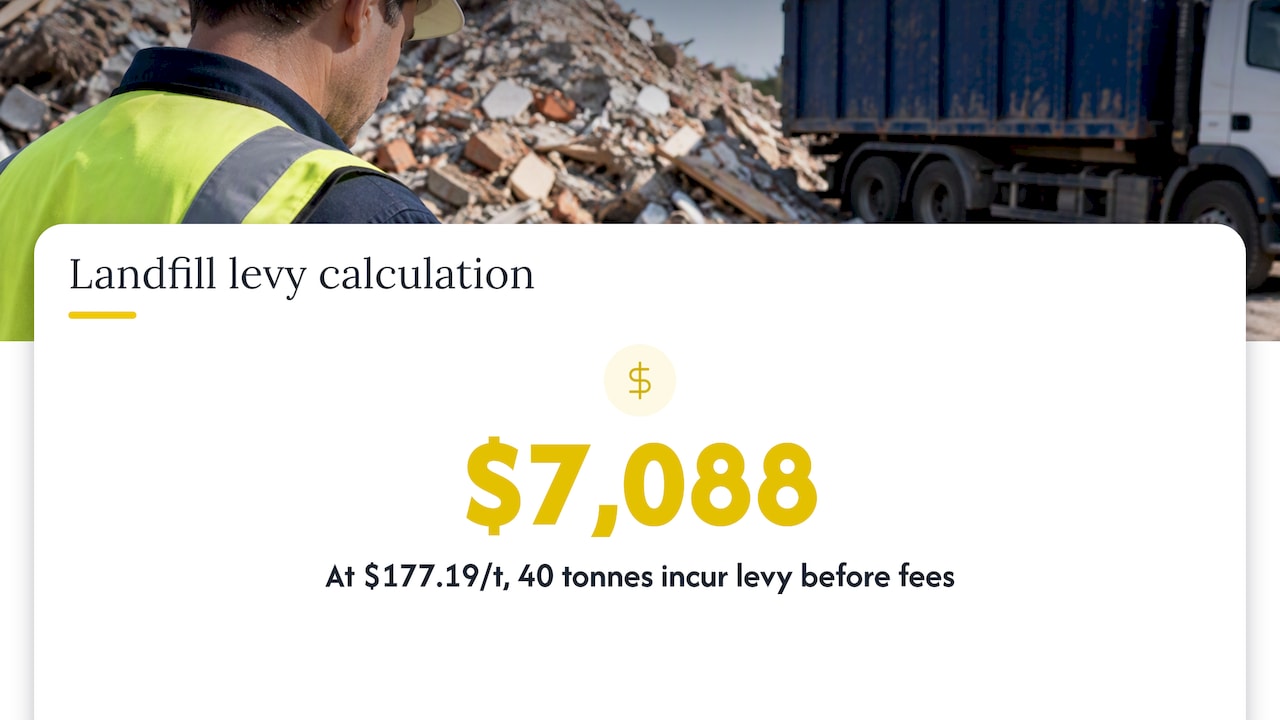
Every tonne of waste received at a Victorian landfill attracts a levy, and the EPA Victoria waste levy page lists the current rates. For Category C industrial waste, the rate is $177.19 per tonne between 1 July 2026 and 30 June 2027. EPA Victoria describes the rising levy as a deliberate tool to push investment into recycling and resource recovery.
So the levy alone adds $177.19 for each tonne that goes to landfill, before the facility adds its own gate fee, and before the truck is paid. A house that generates 40 tonnes of mixed debris would carry roughly $7,088 in levy if it all went to landfill. That is simple arithmetic on the published rate, not a quote, and it shows why diverting material matters.
Typical costs around the waste line
Sources vary a lot, so use these as context for reading a quote, not as prices.
| Cost item | Published range or rate | Notes |
|---|---|---|
| Whole house demolition (Melbourne) | $15,000 to $40,000 | Depends on size, materials and asbestos presence |
| Asbestos remediation on older homes | $5,000 to $15,000 | Extra, for properties with asbestos-containing material |
| Skip on a City of Melbourne road | $102.50 per bay, per day | Council permit required before placing the skip |
| Landfill levy, Category C | $177.19 per tonne | 1 July 2026 to 30 June 2027 |
The house figure is an all-in demolition range. Waste disposal is only part of it, and the share grows as the building gets heavier, with brick veneer, concrete slabs and tiled roofs.
The extras that push the bill up
Asbestos
If a building has asbestos, the job changes. Removal and disposal follow separate rules, and WorkSafe Victoria sets out what the person managing or controlling a property must do once they know about it, as described on its asbestos notification and plans page. Have a licensed assessor test before demolition starts. Finding asbestos halfway through a job stops work and costs more than finding it at the start. For specific advice on your property, speak to a licensed asbestos assessor or WorkSafe Victoria.
Permits and road space
Demolition often needs a building permit. In some cases you may first need Section 29A consent (Report and Consent) from the council, for example when a large part of a building is being removed. The City of Melbourne explains when Section 29A consent applies, and the City of Port Phillip has its own guidance. Check your own council, since processes differ between municipalities.
If the skip cannot sit on your property, you need a council skip permit before putting it on the road. City of Melbourne publishes its fees and permitted hours on its skip and container permits page. In a tight CBD, South Melbourne or Port Melbourne street, those daily bay fees add up fast on a multi-day job.
Access and site constraints
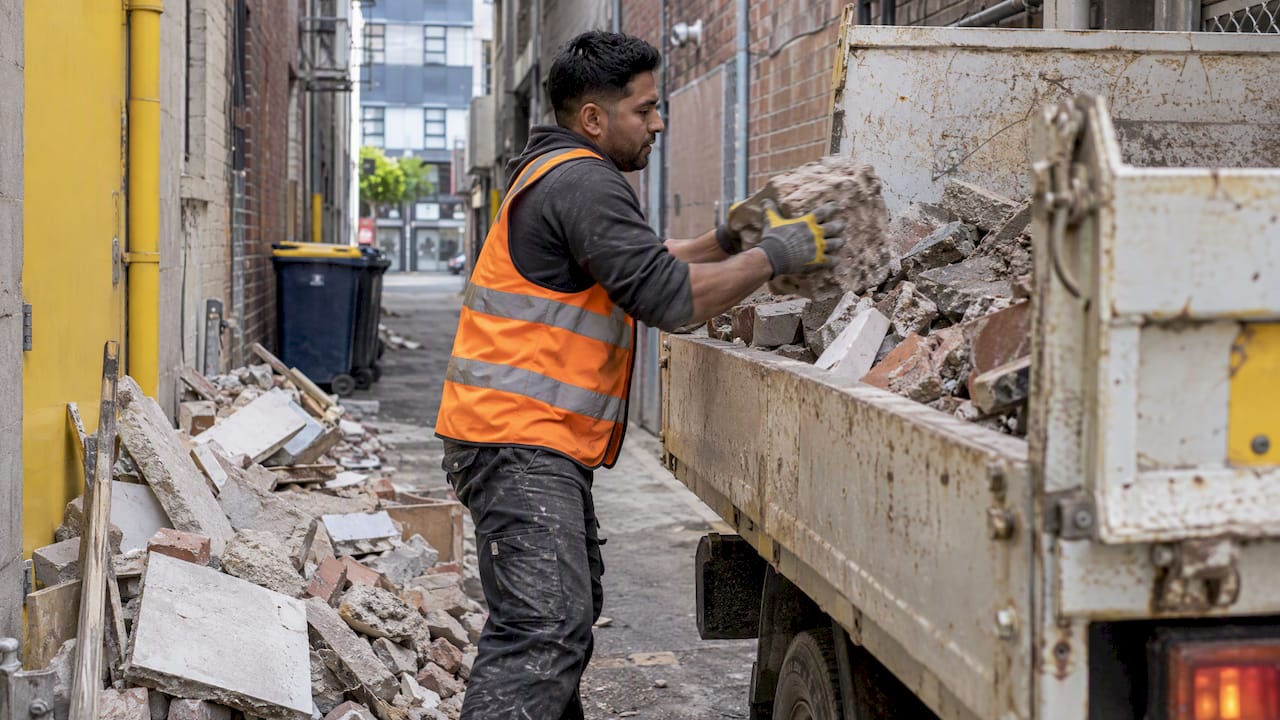
A narrow laneway, a steep driveway, no lift in a commercial building or a ground floor shop with limited loading hours all mean more labour and smaller trucks. Hand-loading instead of machine-loading is the usual cause of a quote that looks high on paper but is fair for the site.
Mixed loads
One bin of clean concrete is cheaper to process than the same weight of mixed demolition waste. Once timber, plasterboard, plastics and soil are mixed, a facility may treat the whole load as the most expensive category. Keeping materials apart keeps the rate down.
How to lower your demolition waste costs
Separate what has value or a cheaper pathway
Concrete, brick, steel and some timber can go to recovery rather than landfill. EPA Victoria’s guidance encourages looking for contractors who specialise in material recovery, because recycling concrete, brick and steel can offset landfill fees. Ask any contractor which materials they sort and where each goes.
We handle concrete removal and disposal and tile waste removal as separate waste streams, which is the same principle: one material per load, priced for what it is. If you are weighing options for slabs and footings, our short guide on choosing a concrete disposal option lists the questions to ask.
Strip out reusable fit-out before demolition
For commercial jobs, furniture, joinery and fittings leave the building first. Handling them properly keeps them out of a general waste load, and facility managers who need to document this can look at furniture decommissioning and diversion as a way to prove what was diverted. We cover this on our own furniture disposal and recycling page.
Book removal into the demolition schedule
A demolition crew that finishes and then waits for a bin, or a bin that arrives full of the wrong material, costs money in idle time. Plan the sequence: soft strip, hazardous material, structure, then slab and footings, with trucks booked for each stage.
Keep the access clear
Move cars, cut back vegetation and mark where trucks can park. A clear site saves labour time, and labour is often the biggest part of a waste removal line.
Do not rely on a calculator alone
Online calculators are handy for a rough number. But analysis from Forge Property notes that these tools often underestimate project costs, typically by 10% to 30%, because they miss professional fees, compliance costs and site constraints such as slope or narrow access. Use a calculator to set expectations, then get a site-specific written quote.
Residential, commercial and strip-out jobs compared
| Job type | What drives waste cost | What to ask for |
|---|---|---|
| House or garage demolition | Brick, roof tiles, slab, asbestos in older stock | Asbestos test result, tonnage estimate, itemised disposal |
| Commercial demolition and strip-out | Access, lifts, loading hours, mixed fit-out | Out-of-hours work, protection of common areas, recycling statement |
| Make-good and de-fit | Lease obligations, partitions, ceilings, floor finishes | Lease make-good schedule matched to the quote |
| Renovation waste | Plasterboard, tiles, timber, small volumes | Per-load or per-volume pricing, material sorting |
Our team works on all of these: residential demolition, commercial demolition and structural demolition. For renovation jobs, see our notes on managing renovation waste in Melbourne, and on saving money with smart construction waste disposal.
A worked example of reading a quote
Take a small commercial strip-out in a CBD building. This is an illustration of how to read a quote, with no real prices.
A good quote would list: soft strip of ceilings and partitions, removal of carpet and floor finish, furniture and joinery removal, disposal by material type, any asbestos clearance certificate required, and the access constraints it has assumed, such as hours and lift use. It states who pays for permits and whether disposal is included or charged at cost.
A weak quote says one line: demolition and rubbish removal, one total. You cannot tell whether disposal is covered, so you cannot compare it, and you cannot hold anyone to it if the job changes.
The cheapest quote is not always the safest one. Demolition carries liability and insurance risks, and a contractor that dumps waste improperly can leave the property owner exposed. A transparent, detailed quote that includes all waste removal and disposal up front protects you from that. Ask for proof of insurance and for disposal receipts or dockets when the job is done.
Questions to ask before you book
- Is disposal included in the price, and is it itemised by material?
- Which materials are recycled, and where do they go?
- Who arranges council skip permits, and who pays?
- Has the site been tested for asbestos?
- What happens if the load is heavier than estimated?
- What is the arrival window, and what happens if the crew is late?
How we price and what we offer
We quote demolition and construction waste per project, based on volume and material, so there is no published price to quote here. What we do publish is how we work:
- We aim to beat any written quote by 5%. Send us a written quote from another provider and we will compare it line by line.
- Punctuality is backed by real-time notifications and a lateness credit.
- Carbon-neutral disposal is an opt-in if sustainability reporting matters to your business or strata.
- No mess, no damage. We have worked in all types of Melbourne commercial buildings and leave the site clean.
For a site that needs both demolition and waste cleared, start with our construction waste removal service or ask for a quick quote with photos and an address.
FAQ
How much does demolition waste removal cost in Melbourne?
There is no single rate. Cost depends on material, weight, access, permits and any asbestos. Whole-house demolition is commonly published at $15,000 to $40,000, with waste disposal one part of that. A written, itemised quote for your site is the only reliable figure.
Is demolition waste charged by weight or by volume?
Facilities charge by weight, and the state levy is set per tonne. Some removal providers quote by volume or by truck load for convenience, but heavy materials such as concrete and brick push the price up. Ask how a quote handles a load that weighs more than expected.
Do I need a permit for a skip bin on the road?
Yes. In the City of Melbourne you must not place a skip on the road until you hold a skip permit, and the council charges $102.50 per bay, per day. Other councils have their own fees and rules, so check yours before booking.
Do I need a permit to demolish a house in Victoria?
Demolition generally needs a building permit, and some sites need Section 29A Report and Consent from the council first. Read the City of Melbourne’s Section 29A page or ask your local council or a registered building surveyor for your specific property.
How can I reduce the cost?
Separate concrete, brick, metal and clean timber, clear access for trucks, test for asbestos early and book removal into the demolition schedule. Landfill carries a levy of $177.19 per tonne for Category C waste in 2026-27, so every tonne diverted to recovery avoids that charge.
Sources
- EPA Victoria: Waste levy
- City of Melbourne: Place skips, bins or containers on the road
- City of Melbourne: Section 29A consent for proposed demolition
- City of Port Phillip: Demolition
- WorkSafe Victoria: Properties containing asbestos
- Alpha Real Property: Knockdown-rebuild vs renovate calculator
- Forge Property: Rebuild costs and sum insured
- Furniture decommissioning for facility managers