Strata rubbish removal in Melbourne is priced per job, and the price comes down to four things: how much waste there is (by volume or weight), what type it is, how hard it is to reach, and what the tip charges to take it. We don’t publish a fixed rate, because a bin room clean-out and a full building clear-out are different jobs. This guide explains how the cost is built, which council services cost little or nothing, and what to have ready so a written quote is accurate the first time.
TL;DR
- Private strata removal is quoted per job or per volume, so the number depends on load size, waste type, access and disposal fees.
- Council hard-waste services can be free or cheap for residents, but they exclude trade, building and garden waste, so many strata jobs need a private collector.
- Tip charges are a real part of the bill: Victoria’s landfill levy is $169.79 per tonne, and heavy loads cost more to dispose of.
- Clear access, sorted piles and a booked lift or loading dock are the easiest ways to bring the price down.
- Get a written quote with the inclusions listed. We beat any written quote by 5%.
Table of Contents
- Why there is no single price for strata rubbish removal
- What drives the cost of a strata clean-out
- Council charges are not the same as private clean-out prices
- The cheapest route for bulky waste: council hard waste
- When a private collector is the better choice
- Your legal responsibility does not end when the truck leaves
- How to lower the price of a strata job
- What to include when you ask for a quote
- How we price and what we promise
- FAQ
- Sources
Why there is no single price for strata rubbish removal
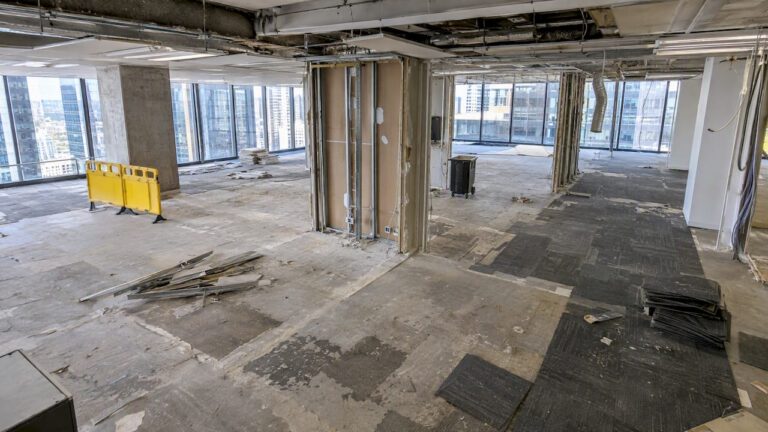
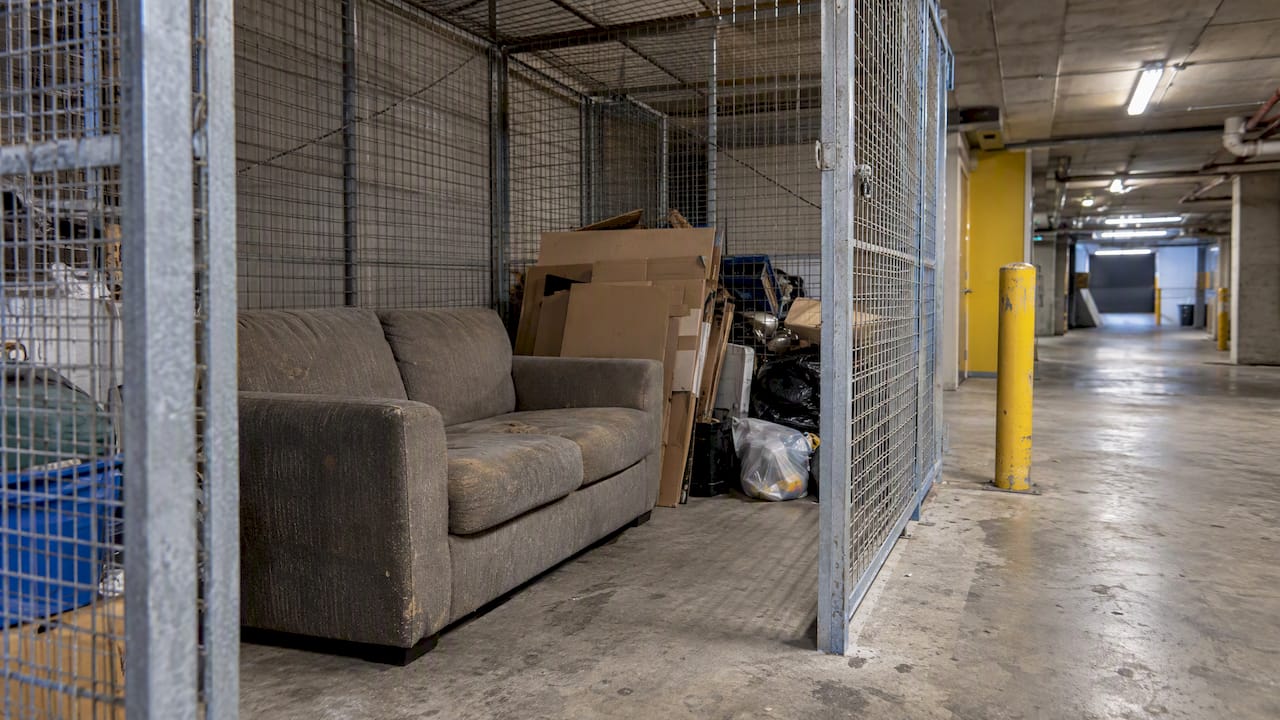
Search for the cost and you will see “from” prices and load-size tables. They are a starting point and rarely match a strata job. A load of old furniture from a basement storage cage is not the same as a bin room full of mixed waste, and neither looks like a refurbished common area with carpet, joinery and plasterboard.
Strata work also has constraints a house clear-out does not. The truck needs a loading dock or a safe stopping point. Lifts need booking. Owners corporation rules may limit working hours. Common property must be left clean and undamaged. All of that is labour and time, and time is what you pay for.
So instead of quoting a figure that would mislead you, here is how the price is built, so you can judge any quote you receive, including ours.
What drives the cost of a strata clean-out
Sustainability Victoria’s guide to waste in multi-unit developments says services should be planned around shared-bin capacity, storage, access and collection logistics. Those same factors set the price of a one-off removal. Costs generally rise with:
- more bins or more truck volume
- higher collection frequency
- heavy waste, or waste that attracts a landfill levy
- mattresses and other special items
- difficult access, stairs and long carry distances
- sorting or dismantling on site
- urgent or out-of-hours attendance
- contaminated or hazardous materials
Costs tend to fall when waste is separated for recycling, items are consolidated in one place, access is clear, and the building uses an appropriately sized service. The exact saving depends on the council, the waste stream and the contractor.
Volume and weight
Most private collectors price by the space your waste takes up on the truck, and some add a weight component for dense material. Bulky but light items such as sofas and cardboard are mostly a volume question. Tiles, bricks, timber offcuts and wet carpet are a weight question, and that is where disposal fees start to matter.
Disposal fees and the landfill levy
A share of every quote is what the tip charges. EPA Victoria’s 2026 Circular Economy Market Report states that the Victorian waste levy rose to $169.79 per tonne on 1 July 2025. EPA’s levy guideline explains that the levy applies to each tonne of relevant waste received at a permitted landfill, at a rate that depends on how the waste is classified. That is why weight and waste type both change the disposal part of your price.
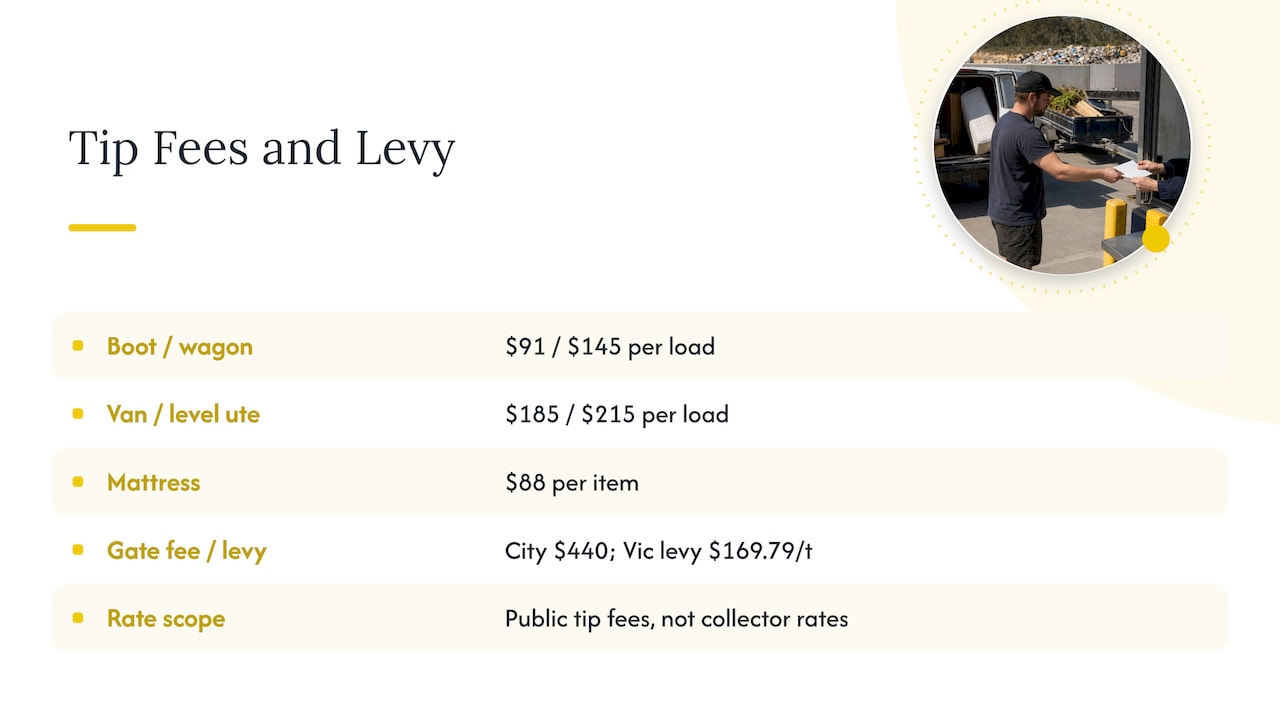
For a sense of public tip pricing, the City of Melbourne’s Dynon Road Waste and Recycling Centre listed these fees, correct on 5 May 2026: $91 for a car boot, $145 for a station wagon, $185 for a van, $215 for a level ute load, $88 per mattress and a $440 per tonne gate fee. Check the page for the current schedule. A private collector pays commercial rates rather than these gate fees, but the figures show how quickly a few vans of mixed waste add up before anyone has lifted a thing.
Access, stairs and carry distance
A ground-floor storage room beside a loading dock is quick. A fourth-floor storage cage with a shared lift booked for two hours is slow. Carry distance, stairs, lift availability, ramp gradients and truck parking all change how many people are needed and how long they are on site. Tell the collector about every one of these when you ask for a quote.
Waste type
General household-style waste is the cheapest to move. E-waste, mattresses, fridges and bulky metals need separate handling. Building waste such as plasterboard, concrete and tiles is heavy and often must go to specific facilities. Asbestos, chemicals and other hazardous materials are a different job altogether and should never be mixed into a general clear-out.
Timing
Urgent same-day attendance and out-of-hours work cost more than a booked weekday slot. If a lease handover, a council notice or an owners corporation deadline is driving the job, book early and the price usually reflects it.
Council charges are not the same as private clean-out prices
One source of confusion is council waste fees, which look like “strata rubbish costs” but cover regular bin collection. They are useful for budgeting ongoing services, not one-off clear-outs.
- The City of Stonnington’s bin fee table shows shared 240-litre garbage bins allocated at one per two apartments, with a $57 per-property request fee, and annual rubbish service charges of $362 for a 120-litre bin and $724 for a 240-litre bin.
- The City of Boroondara says residents in multi-unit developments with shared bins pay a waste charge based on the number of bins at the property. Its listed annual general-waste fees are $317 for 80 litres, $576 for 120 litres and $1,399 for 240 litres.
These charges differ council by council. If your building sits in a different municipality, check that council’s current fee schedule. Extra bin capacity is often the cheapest fix for ongoing overflow. A private collector is the better answer for bulky, one-off or non-household waste.
The cheapest route for bulky waste: council hard waste
For residential apartment buildings, the council service is the first thing to check, and it can cost nothing.
The City of Melbourne offers residents in high-rise buildings one free hard-waste collection of up to one cubic metre per financial year, and a building manager can book it. The City also recommends donating, selling or giving away usable items, and points residents to e-waste and chemical disposal services for those materials. Its apartment building guidance says the same about serviceable furniture and appliances.
Other councils have their own rules and prices:
- Nillumbik states that households with council waste services get one free hard-waste collection per financial year of up to two cubic metres. Extra collections cost $106.40, plus $25.60 per mattress or bed base and $30.40 per fridge (prices from 1 July 2025).
- Hobsons Bay gives eligible properties one free collection each financial year and a second for $89.61. The limit is 3 cubic metres, with items no longer than 1.5 metres and no heavier than 20 kg per item, container or bundle.
Council services are not free of cost to the public. Sustainability Victoria’s local government report recorded Victorian hard-waste service costs of almost $39.6 million in 2019–20, averaging $18 per property with access. Ratepayers fund it, which is why the free allowance is capped.
Where the council service stops
The City of Melbourne’s hard-waste service excludes commercial or trade waste, building and demolition waste, bricks, concrete, rubble, soil, chemicals, asbestos, tyres and garden waste. It accepts household furniture, appliances, mattresses, e-waste, metal, tools and similar household items.
That matters for strata. If the waste comes from a common area refurbishment, a contractor’s leftovers or an abandoned commercial tenancy in a mixed-use building, it is probably not eligible. A skip or bin may be an option for larger quantities, and a skip on the road or council land needs a permit. If a booking is knocked back, the alternative is a private collection.
When a private collector is the better choice
You are likely to want a private job when:
- The waste is not household (trade, building, garden or mixed).
- You have used up the council allowance for the financial year.
- The volume exceeds the council limit.
- You need a specific date, for example before a building inspection, a sale or a handover.
- Items need to be carried out from awkward locations and left clean behind.
We do this work across the Melbourne CBD, South Melbourne, Port Melbourne, West Melbourne and surrounding areas. Our strata rubbish removal service covers one-off clear-outs and regular or scheduled collections, and our apartment building rubbish removal page covers the particulars of CBD towers. For bulky items only, see our hard waste collection options.
Your legal responsibility does not end when the truck leaves
A lower quote is no bargain if the waste ends up dumped. EPA Victoria’s waste-sector guide says waste generators, transporters and receivers must make sure waste goes to a place authorised to receive it, and that hiring a contractor does not remove the generator’s responsibility to take reasonable steps to check lawful disposal. For a strata, the generator is typically the owners corporation or its manager.
The same guide says waste should be classified, safely contained in transport and sent to the right lawful facility, and lists e-waste among the waste banned from landfill. The practical checks are simple:
- Ask where the waste will go and how much is recycled.
- Ask for a receipt or confirmation of disposal on request.
- Confirm the collector is insured for work on common property.
- Keep the quote, invoice and any disposal paperwork with the building records.
EPA’s waste hierarchy puts avoidance, reuse, recycling and energy recovery ahead of treatment, containment and disposal, with landfill a last resort. Good news for your budget: reuse and recycling tend to be the cheaper end of the hierarchy as well.
How to lower the price of a strata job
Most savings come from preparation, not negotiation.
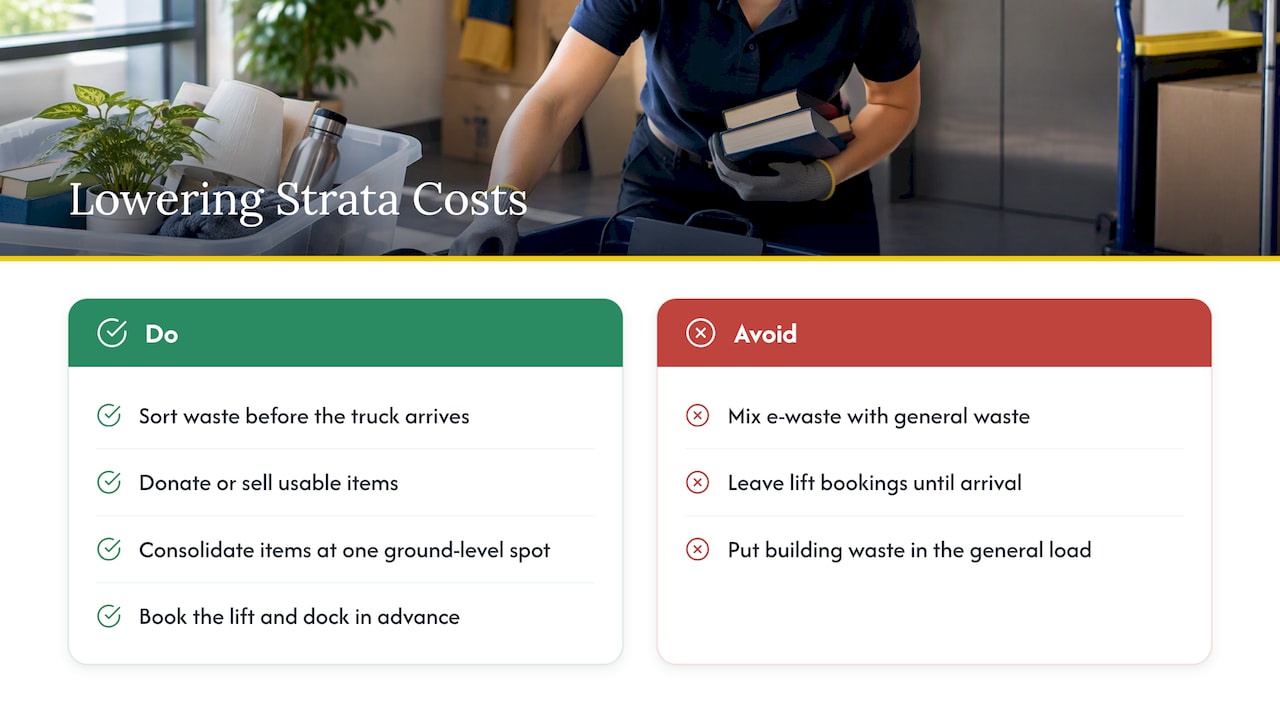
Sort before the truck arrives. Separate e-waste, mattresses, metal, timber and general waste. Mixed loads take longer to load and are more expensive to dispose of. Our pre-collection checklist lists the common reasons items get rejected.
Donate or sell what still works. Serviceable furniture and appliances can leave the building at no cost. If it can be reused, the furniture disposal and recycling route is worth a look first.
Consolidate. Move items to one ground-level spot or the loading dock. Shorter carry distances mean fewer labour hours.
Book the lift and the dock. Waiting for a lift is billable time. Arrange it with the building manager in advance.
Combine jobs. Bin room, storage cages, abandoned items and a common area refresh can be handled in one visit rather than three.
Keep e-waste separate. Computers, TVs and similar items need their own handling. See our guides to disposing of e-waste in Melbourne and our e-waste collection service.
Keep building waste out of the general load. If the job involves refurbishment leftovers, read how to dispose of building waste, or ask about our construction waste removal.
What to include when you ask for a quote
A quote is only as accurate as the information behind it. Send this:
| Detail | Why it matters |
|---|---|
| Building address and loading arrangements | Truck access and parking affect time and setup |
| Floor level, lift access and booking rules | Carry distance and labour hours |
| Types of waste (furniture, e-waste, building, green) | Disposal route and fees differ |
| Rough volume or photos | The easiest way to size the job |
| Any heavy items (tiles, concrete, appliances) | Weight drives tip charges |
| Preferred date and working-hour limits | Urgent or out-of-hours work costs more |
| Whether common areas need protecting | Time for protection and cleaning |
Photos and a short list are usually enough for a written quote. Ask that the quote states what is included (labour, truck, disposal, cleaning) and what is not, so you can compare like with like.
How we price and what we promise
We quote per project, based on volume and the factors above. We handle commercial and residential clients across Melbourne, including strata, office, construction, strip-out and make-good work. Our approach for strata:
- We beat any written quote by 5%.
- We send real-time notifications on the day, and a lateness credit applies if we are late.
- We work in all types of Melbourne commercial buildings, with no mess and no damage to property as the standard.
- A carbon-neutral disposal option is available if you want to opt in.
If you already have a written quote, send it with your enquiry. If you are starting from scratch, request a quick quote with photos and the details above. For larger building work, our full list of services includes strip-outs, make-goods and demolition.
FAQ
How much does strata rubbish removal cost in Melbourne?
It depends on volume, waste type, access and disposal fees, so private collectors quote per job. A few items from a storage room cost far less than a full bin room or refurbishment clear-out. Send photos and a description to get a written, itemised quote.
Is there a free way to get rid of bulky rubbish from an apartment building?
Often, yes. The City of Melbourne offers residents one free hard-waste collection of up to one cubic metre per financial year, which a building manager can book. It excludes building waste, garden waste, chemicals and trade waste, so check eligibility before the day.
Why do heavy loads cost more to remove?
Landfills charge by the tonne, and Victoria’s waste levy is $169.79 per tonne. Dense materials such as tiles, concrete and wet carpet therefore carry higher disposal costs than the same volume of light furniture.
Who is responsible if a contractor dumps the waste illegally?
Hiring a contractor does not remove the generator’s responsibility to take reasonable steps to check lawful disposal, according to EPA Victoria. Ask where the waste goes, keep your paperwork, and use an insured collector.
Sources
- City of Stonnington: request a new, extra or different bin
- City of Boroondara: order a bin
- Sustainability Victoria: Waste Management and Recycling in Multi-unit Developments
- EPA Victoria: Circular Economy Market Report 2026
- EPA Victoria: Calculating waste levy and allowable rebate
- City of Melbourne: hard waste
- City of Melbourne: waste and recycling in apartment buildings
- City of Melbourne: Dynon Road Waste and Recycling Centre
- Nillumbik Shire Council: book a hard waste collection
- Hobsons Bay City Council: hard waste
- Sustainability Victoria: Local government waste services report 2019–20
- EPA Victoria: waste sector guide 1825.1
- EPA Victoria: waste hierarchy 788.3