Most commercial carpet tiles don’t have to end up in landfill. Manufacturers’ take-back programmes, specialist recyclers and reuse channels can divert them, depending on condition and volume. Start by checking the tile manufacturer’s take-back scheme, then try local recyclers, council options or donation channels. If none of those fit your timeline or job size, book an eco-conscious removal service that documents where the material actually goes.
TL;DR:
- Reuse is the most energy-efficient end-of-life option, provided the tiles are in good condition without contamination or mixed backing types.
- The type of backing, contamination, and construction materials heavily influence whether tiles are reused, recycled, or sent to energy recovery.
- Most stewardship programs are project-based and require meeting volume, packaging, and turnaround time criteria, often involving offshore processing for Australian tiles.
- Local options include council recycling, specialist recyclers, or commercial collection services, but preparation and condition of tiles impact costs and success.
- Design for Disassembly and ECS certification improve the chances of onshore reuse and recycling, with ongoing innovations aiming to reduce contamination-related barriers.
Table of Contents
- How carpet tile recycling actually works
- Who runs take-back programmes and what to expect from them
- Where can you drop off or arrange collection locally?
- What should you check before booking a collection?
- What role does the ECS play in carpet stewardship?
- What if recycling isn’t available for your tiles?
- What’s changing in carpet tile recycling technology?
- Why is carpet tile recycling still so hard to scale?
- Recycling versus landfill: what’s the real difference?
- How can recycled carpet tile material be reused in new projects?
- Removal help when take-back doesn’t fit your timeline
- Sources
How carpet tile recycling actually works
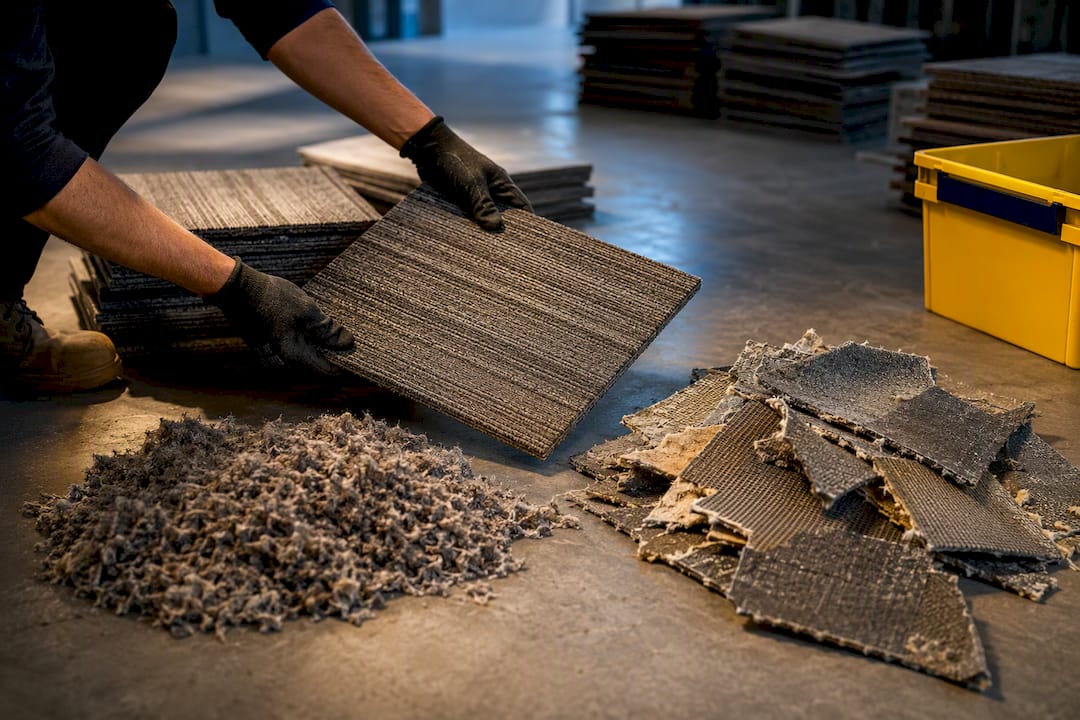
Carpet tiles have three realistic end-of-life routes, and they’re not equal. Reuse comes first: tiles in good condition get graded, cleaned and sent back into circulation for a new install, which is the least energy-intensive option by far. Mechanical recycling comes next. That’s where the yarn face gets separated from the backing, usually shredded and processed into regenerated nylon or backing pellets for new products. Energy recovery, sometimes called waste-to-energy, is the fallback when material can’t be separated cleanly. It’s better than a landfill hole, but it’s the last stop, not the goal.
What decides which route your tiles get? Backing type matters most. PVC-backed tiles separate more easily than tiles bonded with mixed adhesives or fibreglass reinforcement. Contamination, whether it’s underlay glue, mould, or paint overspray, kills reuse options fast and can push otherwise recyclable material toward recovery instead.
Recovered material shows up in surprising places: regenerated yarn goes into new carpet face fibre, backing pellets get moulded into other plastic products, and refuse-derived fuel from the last-resort stream can power industrial kilns.
Pro Tip: If you’re unsure what’s under your tiles, lift a corner and check the backing before you call anyone. A five-second look tells a recycler more than a phone description ever will.
Who runs take-back programmes and what to expect from them
Most large flooring manufacturers operate stewardship programmes rather than a single national collection service. Interface’s ReEntry program is a well-known example, grading collected tiles for reuse before anything gets mechanically processed. GH Commercial’s ReCover and Loop programmes work similarly, collecting eligible tiles project by project, grading them, and either reusing them in new installs or holding material for recycling.
These are project-based arrangements, not drop-off bins. Before you commit a job to one, check for:
- Minimum volume requirements (small domestic jobs often don’t qualify)
- Packaging and palletising rules the manufacturer expects you to follow
- Whether fees apply, and whether they’re cost-recovery or a genuine service charge
- Realistic turnaround time between collection and confirmed processing
Some Australian brands ship material offshore when local processing capacity is limited. Nolan Carpets’ stewardship programme collects TOLI tiles, palletises them, and containers the material to a Japanese recycler that separates PVC backing from nylon yarn for reuse in new products. It’s not glamorous, but it keeps material out of landfill and back into a supply chain.
Where can you drop off or arrange collection locally?
Three practical routes exist once you know what you’re dealing with.
- Check your council recycling page first. Many councils accept clean, reusable carpet and underlay through recyclopaedia-style listings, but acceptance criteria vary by local government area, so confirm before you load the ute.
- Contact a specialist recycler for anything beyond a small domestic job. Directory listings for carpet recyclers show that services and fees vary widely between operators, and site access or transport distance often decides who’s worth calling.
- Book a commercial collection service when volume, site access or timing rules out DIY transport. This is the route most offices, strata buildings and construction sites end up using, particularly during a strip-out where carpet can be one of several waste streams.
Cost depends less on the carpet itself and more on logistics: how far the material has to travel, whether it needs sorting on-site, and whether a recycler is grading tiles for resale (which can offset cost) or simply processing for recovery (which usually doesn’t). Lead times stretch when a job needs palletising and inspection before a truck turns up, so build that into your renovation schedule rather than assuming next-day pickup.
What should you check before booking a collection?
Getting an accurate quote comes down to two things: knowing what condition your tiles are actually in, and asking the right questions before anyone shows up.
Run a quick inspection first. Reusable tiles need a consistent colour and batch, an intact pile with no obvious wear patterns, and no adhesive residue bleeding through the backing. Mixed batches or sun-faded sections rarely make the reuse cut, even if they’re structurally fine.
Preparation matters as much as condition. Remove underlay separately, scrape off major adhesive residue where practical, and keep tiles dry during storage. Palletise and label stacks by batch if you can. It sounds fussy, but it’s exactly what separates a load a recycler will grade for reuse from one that goes straight to recovery.
Before you book anything, ask the provider:
- What’s the minimum volume they’ll collect?
- Are there fees, and are they flat or based on weight/volume?
- Where does the material actually go once it leaves your site?
- Do they grade for reuse, or is everything processed the same way regardless of condition?
Pro Tip: Ask for the destination facility by name, not just “a recycling partner.” Vague answers are usually a sign the material is heading to recovery, not reuse.
What role does the ECS play in carpet stewardship?
The Australian Carpet Classification Scheme, through its Environmental Certification Scheme (ECS), gives the industry a structured way to prove stewardship claims instead of just asserting them. The ACCS-ECS technical guidelines set out ECS levels covering lifecycle assessment, reporting, and a specific criterion called Design for Disassembly, which rewards products engineered to separate face fibre from backing cleanly.
Why does that matter to you? Cleaner separation means lower sorting costs and a better shot at onshore processing rather than export or energy recovery. Licence-holders under the scheme have to back their claims with declarations and, in many cases, independent assessor reports, which gives specifiers something concrete to check rather than a marketing line.
If you’re specifying flooring for a fit-out or build, this is where leverage sits:
- Ask suppliers for their ECS level and stewardship declaration up front
- Favour products rated for Design for Disassembly if end-of-life recycling matters to the project
- Write take-back or recycling obligations directly into the project specification rather than hoping it happens informally later
What if recycling isn’t available for your tiles?
Sometimes the maths doesn’t work: volume’s too small, the site’s too remote, or the deadline’s too tight for a graded take-back process. That doesn’t mean landfill is the only option left.
Short-term storage buys time to find a home for reusable sections, and splitting a load, salvaging what’s clean and sending the rest for recovery, still keeps a portion out of landfill even when a full diversion isn’t realistic. Energy recovery remains the genuine last resort, not the default.
This is usually when hiring a removal contractor makes sense: large volumes, tight deadlines, or a site with mixed materials that a manufacturer programme won’t touch. Before you book, ask for evidence of responsible disposal, ideally a diversion report or receipt showing where the load actually went. Some removal operators offer carbon-neutral or documented diversion options as standard. Ask for proof rather than taking the claim at face value.
What’s changing in carpet tile recycling technology?
The biggest shift isn’t a single new machine. It’s manufacturers designing tiles differently from the start so they’re easier to pull apart later. Design for Disassembly, baked into ECS guidance, is pushing suppliers toward backings that separate from face fibre with less contamination, which cuts sorting costs downstream before a tile ever reaches a recycler.
On the processing side, yarn regeneration partnerships are maturing. Rather than every manufacturer running its own facility, several brands now funnel collected material to specialist processors, sometimes overseas, that separate nylon yarn and PVC or bitumen backing at a scale local operators can’t match yet. That’s less a technological leap than a logistics one, but it’s what’s actually moving material through the system today.
Local rejuvenation is the other quiet innovation. Rather than shredding every returned tile, programmes like Signature Floors’ Circul8 initiative rejuvenate tiles that are structurally sound but cosmetically tired, restoring them for resale while reserving full regeneration for tiles that genuinely can’t be reused. Combining restoration with regeneration partnerships keeps more material circulating domestically instead of defaulting straight to export or recovery.
Chemical recycling of nylon face fibre, which breaks yarn down to a molecular level for remanufacture into new fibre, is progressing overseas but isn’t yet a mainstream Australian option. For now, mechanical separation and reuse do the heavy lifting.
Why is carpet tile recycling still so hard to scale?
Contamination is the biggest practical barrier. Adhesive residue, mixed underlay, mould, and paint overspray can turn an otherwise recyclable tile into recovery-only material overnight, and there’s no cheap fix once contamination’s set in.
Mixed construction is the second issue. Older tiles bonded with fibreglass reinforcement or multiple adhesive layers resist clean separation, which is exactly why Design for Disassembly has become such a focus for newer product lines.
Logistics add another layer of friction. Take-back programmes are project-based, which suits a 2,000-square-metre office strip-out far better than a small residential job with a handful of leftover tiles. Minimum volume thresholds exist because sorting and transporting small loads rarely covers its own cost.
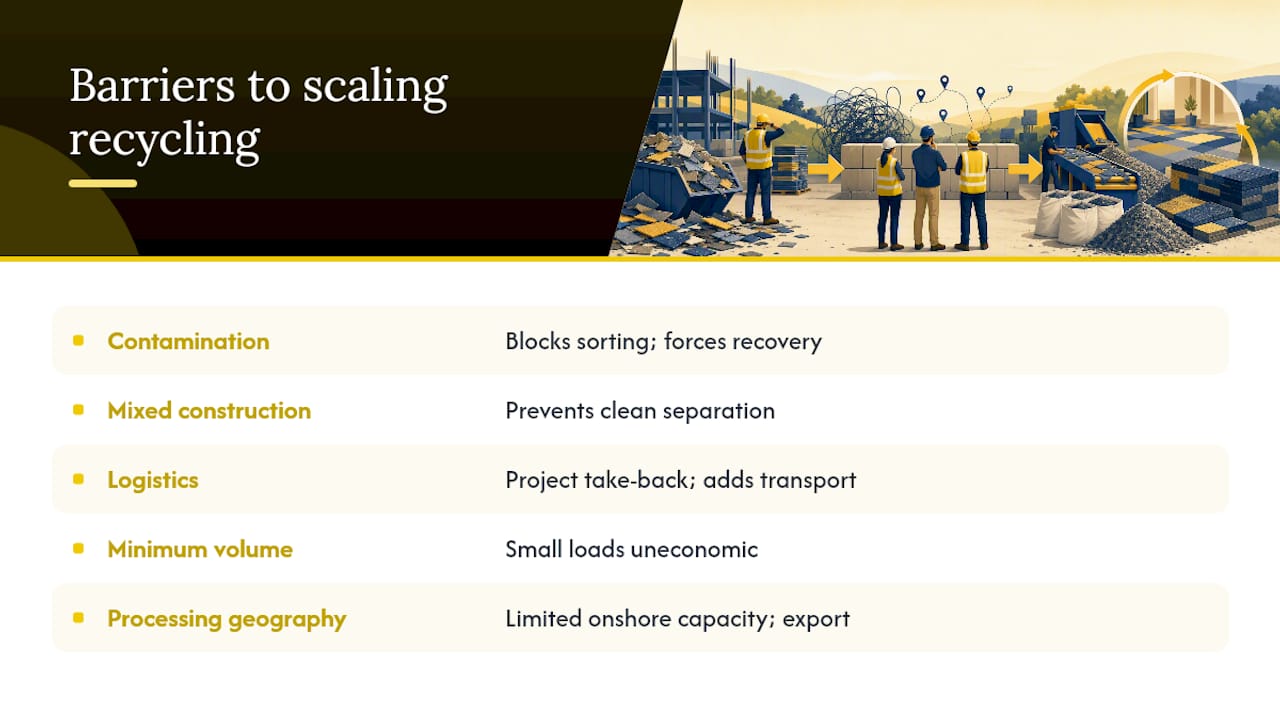
Then there’s geography. Onshore processing capacity for separated yarn and backing is limited in Australia, which is why several stewardship programmes ship material overseas for specialist regeneration. That adds transport emissions and cost, undercutting some of the environmental benefit the recycling was meant to deliver in the first place.
None of this makes carpet tile recycling pointless. It does mean the easy wins (clean, single-batch, well-designed tiles) get diverted reliably, while messy, mixed, small-volume jobs still lean heavily on recovery rather than true recycling. Closing that gap depends on better product design at the manufacturing stage more than any single processing breakthrough.
Recycling versus landfill: what’s the real difference?
Landfill is the default only because it’s the path of least resistance, not because it’s cheap or clean in the long run. Carpet tiles in landfill don’t break down quickly, and the space they occupy is space a growing city can’t easily replace. Incineration without energy recovery is rarer in Australia and offers none of the material recovery benefit that mechanical recycling or reuse provides.
Recycling and reuse, by contrast, keep material circulating. A tile graded for reuse under a programme like Interface’s ReEntry goes straight back into another installation with essentially no reprocessing energy cost. Mechanical recycling uses more energy than reuse but far less than manufacturing new nylon yarn from raw material. Energy recovery sits below both, but it still keeps carpet out of a landfill cell and generates usable energy in the process, which is a genuinely better outcome than a straight dump.
The trade-off readers actually weigh is cost and convenience against outcome. Landfill or general waste collection is almost always the cheapest and fastest option on paper. Recycling and take-back routes usually cost more in time and sometimes in fees, and they demand better preparation, cleaner sorting, sometimes palletising. For a business managing a large strip-out, that extra effort often pays off through documented diversion, which increasingly matters for tenants, landlords and sustainability reporting. For a small job, the calculus can genuinely tip toward hiring a removal service that handles sorting on your behalf.
How can recycled carpet tile material be reused in new projects?
Recovered carpet tile material doesn’t just disappear into an abstract “recycling” bin. It comes back as specific, usable inputs, and knowing that helps you specify smarter on your next project.
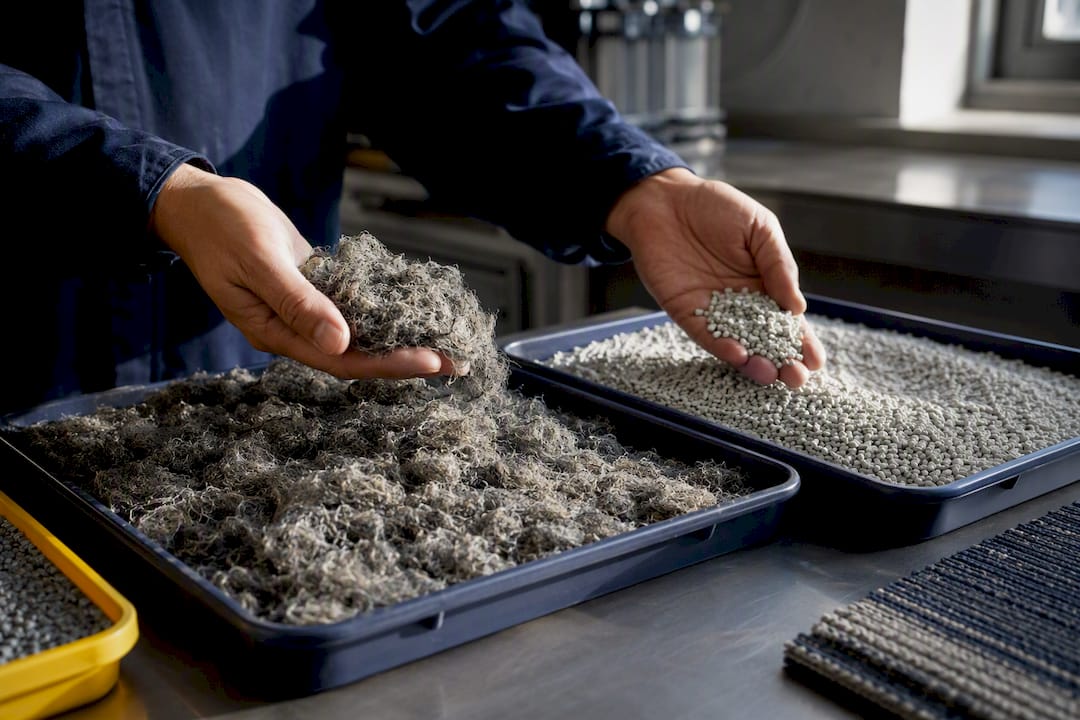
Regenerated nylon yarn from separated face fibre goes back into new carpet tile face fibre, sometimes blended with virgin material depending on the manufacturer’s process. Backing material, once separated and pelletised, gets moulded into other plastic products, from new backing to unrelated industrial components. If you’re renovating and want a genuinely closed loop, ask suppliers directly whether their product line contains regenerated content and at what percentage. It’s a fair question, and a supplier confident in their ECS declaration should answer it without hesitation.
At the specification stage, you have real leverage. Writing take-back obligations into a tender or project brief locks in a disposal pathway before the job even starts, rather than leaving it as an afterthought once the old carpet’s already ripped up. Favouring products rated for Design for Disassembly under the ECS framework means whatever you install today separates more cleanly when it’s replaced years from now.
For smaller renovation or fit-out projects that can’t access a manufacturer programme directly, rejuvenated tiles from local initiatives are worth considering as a supply source, giving structurally sound material a second life in a lower-budget fit-out rather than a full recycling process it doesn’t need.
Removal help when take-back doesn’t fit your timeline
Manufacturer programmes and specialist recyclers work well when you’ve got the volume, the lead time, and tiles in decent condition. Plenty of real jobs don’t tick all three boxes: a tenancy make-good with two weeks’ notice, a mixed-material strip-out with carpet, vinyl and old partitioning tangled together, or a small office fit-out that’s below any take-back programme’s minimum volume.
That’s where Melbourne City Rubbish’s office carpet and vinyl removal service fits in as a practical alternative to arranging take-back yourself. Rather than coordinating a manufacturer programme, a separate recycler and a transport booking across a tight deadline, one team handles collection, sorting and disposal, with eco-conscious options available for projects that want documented outcomes.
To get an accurate quote, have your carpet tile volume (square metres or an estimated number of tiles), site access details, and your preferred collection date ready. Get a quick quote and Melbourne City Rubbish will confirm what’s realistic for your site and timeline.
Sources
- Interface ReEntry carpet recycling program overview
- GH Commercial ReCover and Loop programmes
- Carpet Recyclers listing (RecyclingNearYou)