Hire a professional clearance service for ceiling grid removal, and confirm two things before anyone touches a tile: whether asbestos could be present, and where the waste is legally going. If the ceiling is old or undocumented, pause the job until a licensed asbestos removalist checks it. Ask every contractor for a written, itemised quote that names the disposal facility, not just a total price.
TL;DR:
- Obtain a detailed quote that explicitly lists disposal site information and includes sorting, handling, and transport costs to avoid unlawful waste disposal.
- Confirm access points, staging areas, and timing to minimize disruption, particularly in occupied buildings with shared lifts or restricted work hours.
- Keep thorough records of waste destination, weight, and disposal documentation to comply with legal requirements and for future audits.
- Use appropriate safety gear and only attempt DIY removal if the tiles show no signs of asbestos or other hazardous materials, and always escalate to licensed professionals if in doubt.
Table of Contents
- What a professional ceiling-grid removal service does
- Asbestos risk, required safe practice and who must be licenced
- Quote checklist: what to ask for and why it matters
- Planning site logistics and minimising disruption
- Lawful disposal, records and what to keep for audits
- Step-by-step process for safely removing a ceiling grid
- Tools and equipment commonly used for ceiling grid removal
- Precautions to prevent damage to existing structures during removal
- Handling and disposal of ceiling tiles that may contain hazardous materials other than asbestos
- Post-removal site cleaning and restoration procedures
- Potential safety hazards and protective gear recommendations for DIY removal
- Why choose Melbourne City Rubbish for ceiling-grid removal and how to request a quote
- Primary guidance and disposal resources
- Sources
- FAQ
What a professional ceiling-grid removal service does
A standard ceiling grid removal job runs as a commercial waste clearance, not a casual pull-down. The contractor assesses the site, removes the suspended grid and tiles, separates materials that can be recycled from those that cannot, then loads and transports everything to a lawful receiving place. That last step matters as much as the physical removal: Environment Protection Authority Victoria treats waste from commercial building work as industrial waste, and it must go to a facility authorised to accept that waste type.
Ceiling systems rarely come down as a single material stream. Metal grid sections, mineral fibre tiles, gypsum or plasterboard, and old cabling often sit together above a suspended ceiling, and each one is handled and disposed of differently. A contractor who sorts these onsite saves time at the tip and gives you a cleaner disposal record.
The job also frequently overlaps with a larger strip-out or make-good, especially at lease end. When ceiling removal is one line item inside a bigger scope, planning needs to account for sequencing with electrical, mechanical and partition works.
- Site assessment before quoting, covering ceiling type, area and access.
- Removal of grid, tiles and any attached fixtures.
- Sorting of metal, mineral fibre and plasterboard into separate streams.
- Loading, transport and delivery to an authorised receiving facility.
Asbestos risk, required safe practice and who must be licenced
Before booking an ordinary removal job, check the building’s age, look for damage or deterioration in the tiles, and ask whether an asbestos register or prior survey exists. Older low-density board and fibre ceiling tiles can contain asbestos, and the Asbestos Product Guide warns that removing them without asbestos-safe methods can be hazardous because the material tears easily.
Where asbestos may be disturbed during refurbishment or demolition, Safe Work Australia requires it to be identified first, and in most workplace situations it must then be removed by a licensed asbestos removalist, with sealed disposal and a clearance inspection before anyone reoccupies the space. Licence type, notification duties and clearance steps depend on the jurisdiction and the scale of the asbestos work, so check the model code and your state regulator rather than assuming a single national rule applies. A suspended ceiling can also hide older asbestos cement sheeting above or behind it, which is one reason a conservative survey-first approach protects against mixed, contaminated loads.
Suspended ceilings installed in older buildings carry a meaningfully higher chance of containing asbestos-based products, according to the Asbestos Product Guide, which is why age and condition checks come before any quote is finalised.
- Check building age, maintenance history and any existing asbestos register.
- Look for cracked, water-damaged or previously disturbed tiles.
- If asbestos is possible, stop the standard removal booking immediately.
- Commission a survey and only proceed with a licensed contractor and disposal plan matched to the findings.
Quote checklist: what to ask for and why it matters
A proper quote separates every cost so you can compare providers on the same basis and confirm the waste will not end up somewhere unlawful. EPA Victoria specifically recommends getting written information showing the planned destination for construction waste before work starts.
- Labour and the time allowed for the ceiling area involved.
- Loading and handling, including any lift or stair access charges.
- Transport to the disposal site.
- Disposal fees, quoted by weight or by load.
- Sorting of recoverable materials such as metal grid components.
- After-hours or restricted-access surcharges.
- A broom-clean finish included in the price.
- Written confirmation of the disposal facility name and location.
Written destination information is not paperwork for its own sake. If a contractor cannot or will not name where the waste is going, that is a warning sign, because the waste producer remains associated with the load even after it leaves the site. Ask the contractor for a copy of the receiving facility’s permission reference or a short disposal statement naming the site and delivery date, then keep it on file.
Pro Tip: Ask for the disposal destination in writing before you approve a quote, not after the job is done.
Planning site logistics and minimising disruption
Access shapes both the price and the timeline more than most managers expect. A ceiling grid removal job in a ground-floor warehouse with a loading dock runs very differently to the same job on a mid-rise office floor served by one small lift.
- Confirm lift dimensions, loading dock hours and parking for the removal vehicle.
- Map the shortest route from the work area to the truck, and identify any pinch points.
- Set up a segregated staging area for materials waiting to leave the building.
- Use signage and dust or noise controls to protect adjoining tenants.
- Notify occupants of timing, especially in buildings that stay operational during the works.
Good waste planning treats onsite storage, collection and segregation as distinct tasks rather than something sorted out on the day. In an occupied building, agree working windows with the building manager in advance, particularly for noisy grid removal or when the freight lift is shared with other tenancies.
Lawful disposal, records and what to keep for audits
Keep a simple paper trail for every ceiling grid removal job: written destination and permission evidence, weighbridge dockets, consignment notes where relevant, and any asbestos transport or booking receipts if licensed removal was involved. These documents are what you produce if anyone later asks where the waste went.
Waste classification changes the disposal pathway. Ordinary construction and demolition material is generally handled as industrial waste, while asbestos falls into its own category with stricter transport, labelling and receiving-site rules. If you use a contractor, EPA Victoria is clear that responsibility for lawful disposal still sits with you as the waste generator, and illegal dumping remains an offence regardless of who physically carried the load.
- Ask for weighbridge dockets or consignment notes for each collection.
- Keep a copy of the contractor’s disposal statement naming the receiving facility.
- File any asbestos-specific booking or transport receipts separately.
- Retain records for audit purposes even after the job is signed off.
| Record | What it proves |
|---|---|
| Written destination statement | Waste was directed to a nominated facility |
| Weighbridge docket | Quantity of waste delivered and date |
| Consignment note | Chain of custody for the load |
| Asbestos transport receipt | Licensed handling where asbestos was present |
Step-by-step process for safely removing a ceiling grid
The physical sequence for a ceiling grid removal job follows a fairly consistent order, whether it is a small office or a full floor. First, the crew isolates the work area and confirms power and services above the ceiling are safe to work near. Next, tiles are lifted out individually and stacked for sorting, since they are lighter and quicker to clear before the grid itself comes down.
Once the tiles are clear, the suspended grid, the metal tee sections and wall angle, is unclipped and lowered in manageable lengths rather than dropped. Hanger wires are cut and coiled for separate disposal, since loose wire is a common trip and puncture hazard on a work floor. Materials are then separated into streams on the spot, metal grid, mineral fibre tiles and any plasterboard or bulkhead offcuts, so the load leaving site is already sorted.
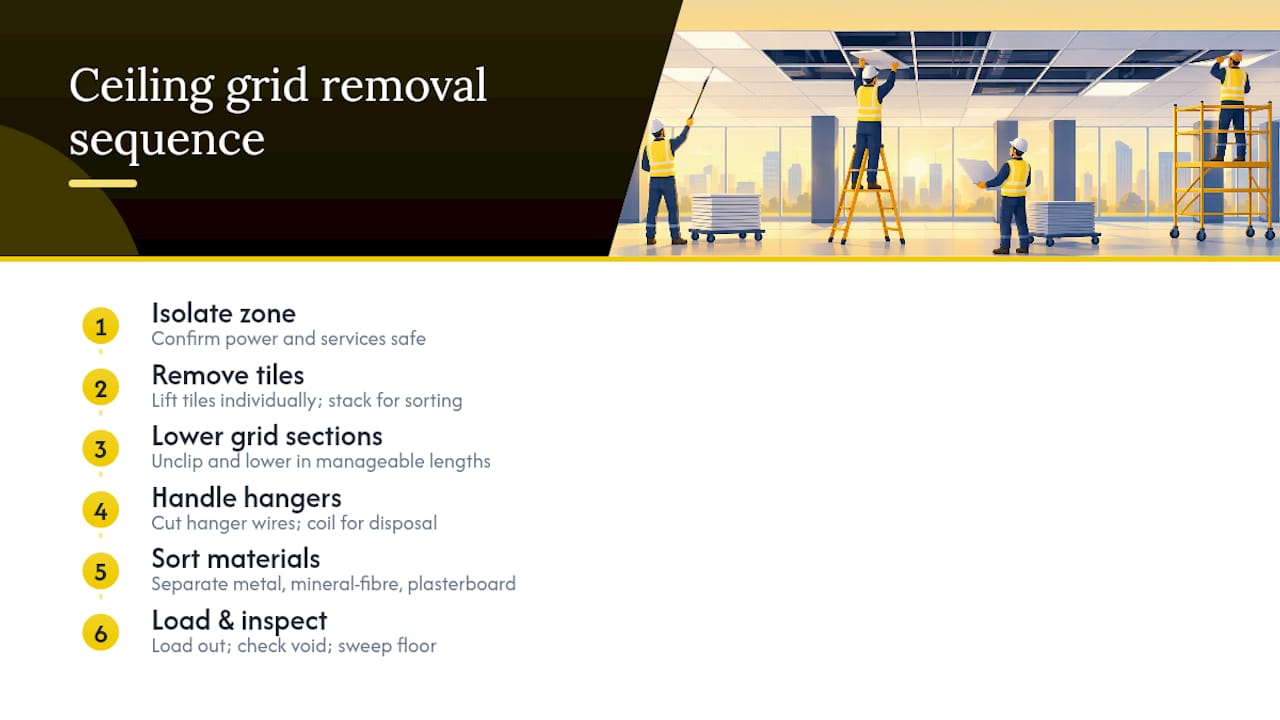
The final steps are loading, a check of the ceiling void for anything left behind such as old cabling or fixtures, and a sweep of the floor before the crew moves to the next area. On larger jobs this sequence repeats zone by zone, which keeps dust and disruption contained rather than spread across the whole floor plate at once.
Tools and equipment commonly used for ceiling grid removal
Ceiling grid removal does not need heavy machinery, but it does need the right small equipment to keep the job quick and safe. Podium steps or mobile scaffold towers are standard for reaching a typical ceiling height, and they are safer than a single ladder when a crew is working the same area repeatedly.
Hand tools carry most of the job: tin snips or grid cutters for the metal tee sections, wire cutters for hanger wires, and a stud finder or torch to check what is sitting above the tiles before they are pulled. Tiles themselves usually come out by hand once the grid is loosened.
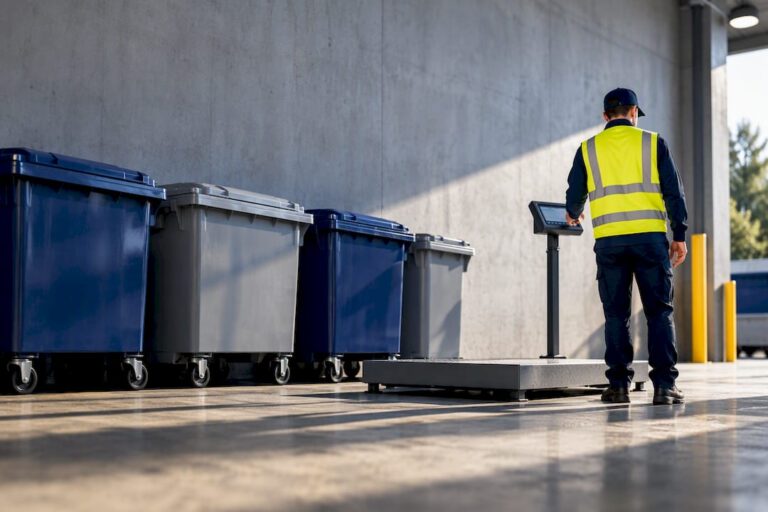
For clearing and transport, contractors use waste sacks or lined bins for mineral fibre debris, and stackable trolleys or cages to move grid sections to the loading point without repeated trips. Site sorting is easier with dedicated separation bins for each material stream on the floor, an approach supported by products such as the Keter waste separation bin, which keeps recoverable metal and fibre waste apart from general debris from the outset. A commercial vehicle fitted for palletised or bulk loads then handles the run to the disposal facility.
Precautions to prevent damage to existing structures during removal
Ceiling voids often carry more than the grid itself, sprinkler heads, smoke detectors, data cabling and sometimes structural bracing all sit in the same space… A careful crew identifies these before removal starts, rather than discovering them mid-pull, so nothing gets clipped or dislodged.
Protecting the floor and fittings below matters just as much. Drop sheets or protective boarding under the work area stop falling debris from marking floor finishes, and taping off adjoining zones keeps dust from settling on furniture or equipment that is staying in place. Where the ceiling sits close to glazing, partitions or feature joinery, edges are worked slowly rather than levered, since a dropped grid section can chip paint or crack plasterboard on the way down.
Structural bracing for the grid itself is checked before any large section is released, particularly on older installations where hanger wires may have corroded or been added to over the years. Removing a run in the wrong order can put unexpected load on adjoining sections, so experienced crews take down the grid progressively rather than cutting multiple hangers at once.
Handling and disposal of ceiling tiles that may contain hazardous materials other than asbestos
Asbestos gets most of the attention, but it is not the only material that needs careful handling in an older ceiling system. Some mineral fibre tiles were treated with fire retardants or coatings that require them to be kept separate from general construction waste rather than mixed in with plasterboard or metal offcuts. Water-damaged tiles can also carry mould, which is a handling and health issue in its own right even where asbestos is not a factor.
Fluorescent light fittings recessed into ceiling grids are another common hazard: older tubes and ballasts can contain mercury or other components that need separate collection rather than general disposal. A contractor familiar with ceiling strip-outs will flag these fittings during the site assessment stage rather than leaving them for someone to discover during loading.
The practical rule is the same one that applies to asbestos: when a tile or fitting looks different, damaged or unusual for its age, treat it as a separate stream until it is identified. Mixing an unknown hazardous item into a general skip risks contaminating the whole load and can affect whether the receiving facility will accept it at all.
Post-removal site cleaning and restoration procedures
Once the grid, tiles and any hazardous items have been cleared, the work area needs a proper sweep before it is handed back. This means clearing dust and small debris from the floor, checking for stray screws, wire offcuts or tile fragments in corners, and wiping down any surfaces that collected dust during the pull-down.
If the ceiling removal is part of a make-good or lease-end clearance, restoration might extend further: patching wall angle brackets left in place, making good any marks on adjoining partitions, and confirming services that were exposed in the void, cabling, ductwork, sprinkler pipework, are left tidy and accessible rather than hanging loose. A broom-clean finish should be part of the original quote rather than an extra charge added at the end.
For occupied buildings, timing this final clean matters as much as doing it well. Finishing the sweep before staff return to the area, or before the next trade starts work in the same zone, avoids dust being tracked further through the building and keeps the handover straightforward.
Potential safety hazards and protective gear recommendations for DIY removal
Ceiling void work carries more risk than it looks like from the floor. Falling debris, exposed wiring, sharp metal edges on cut grid sections and unstable footing on a ladder or podium step are all common causes of injury during ceiling work. Mineral fibre dust from disturbed tiles can also irritate the eyes, skin and airways even where no hazardous material is present.
Anyone attempting this without professional support should use safety glasses, a properly fitted P2 dust mask, gloves rated for handling sharp metal, and a hard hat if working below others on scaffolding. A stable platform, rather than a household ladder, reduces the most common cause of falls during ceiling work.
The bigger hazard is one gear cannot fix: not knowing whether the tiles or boards above contain asbestos. As the Asbestos Product Guide notes, disturbing this material without asbestos-safe methods is hazardous regardless of how careful the physical technique is. That is the point at which DIY removal should stop and a licensed assessment should take over, no amount of protective equipment substitutes for confirming what the material actually is before it is disturbed.
Why choose Melbourne City Rubbish for ceiling-grid removal and how to request a quote
Coordinating a ceiling grid removal alongside a strip-out, make-good or office cleanout usually means juggling more than one supplier. Melbourne City Rubbish handles general bulk rubbish removal, building strip out and construction waste removal as part of the same service, so removal, transport and lawful disposal are managed by one team rather than split across separate bookings. The business offers disposal options focused on environmental responsibility and aims to maintain punctual arrival times to avoid disruption during scheduled clearances.
When you request a quote, give the crew what they need to price it properly:
- Site address and floor level, plus lift or stair access details.
- Approximate ceiling area and grid or tile type, if known.
- Building age or any existing asbestos survey documentation.
- Occupancy status and preferred working hours.
- The finish you expect, including a broom-clean handover.
Ask for the quote in writing with the disposal destination named, in line with the checklist earlier in this guide. If the job overlaps with a broader clean-out, the office cleanout or office junk removal services can be scoped alongside the ceiling work in the same quote. Start with the quick quote form to get a written estimate before you commit a date.
Primary guidance and disposal resources
For the full legal detail behind this guide, see EPA Victoria’s waste obligations guidance, Safe Work Australia’s asbestos guidance, the Asbestos Product Guide on ceiling tiles, and the national asbestos disposal facility directory for site-specific acceptance rules and pricing.
Sources
- Understand your waste obligations and duties — EPA Victoria
- Asbestos — SafeWork NSW (Safe Work Australia guidance referenced)
- Ceiling tiles and panels — Asbestos Product Guide
- Find a local disposal facility — Asbestos Safety and Eradication Agency
FAQ
Do I need a licensed asbestos removalist for a ceiling grid job?
Only if the ceiling tiles or boards could contain asbestos, which is more likely in older buildings or where no prior survey exists. If asbestos is suspected, Safe Work Australia requires identification first and, in most workplace situations, removal by a licensed asbestos removalist.
What should a ceiling grid removal quote include?
A proper quote itemises labour, loading, transport, disposal fees, sorting, any stairs or lift access charges, and a broom-clean finish. It should also state the intended disposal destination in writing, which EPA Victoria recommends confirming before work begins.
How can I check the waste is going to a lawful disposal site?
Ask the contractor for written confirmation of the receiving facility’s name and location, and request a weighbridge docket or disposal statement once the job is done. Facility acceptance rules and pricing vary, so it is worth checking the asbestos disposal facility directory if asbestos is involved.
Can ceiling grid removal be combined with an office cleanout?
Yes, ceiling removal often forms part of a larger office cleanout or make-good, and scoping both together in one quote avoids duplicated site visits and access bookings. Melbourne City Rubbish can quote ceiling removal alongside broader office clearance work in a single job.
What materials besides asbestos should I watch for in old ceiling tiles?
Water-damaged tiles can carry mould, and older fluorescent fittings recessed into the grid may contain mercury or other components needing separate handling. Any tile or fitting that looks unusual for its age should be treated as its own stream until identified, rather than mixed into general waste.