Most of what comes out of an office or retail fitout can be reused or recycled, but only if it is separated while it is being removed. A mixed skip is usually the end of the line for recovery. The practical order is simple: keep what you can, remove intact what can be reused, send clean separated streams to processors, and record where every load goes.
This guide is for property managers, facility managers, tenants handling a make-good, and fitout and construction firms in Melbourne. It covers what is recoverable, how to sort on site, what needs specialist handling, and how to set a recovery target your contractor can be held to.
TL;DR
- Retain and reuse first, then recycle. Recycling is the last step of the hierarchy, not the first.
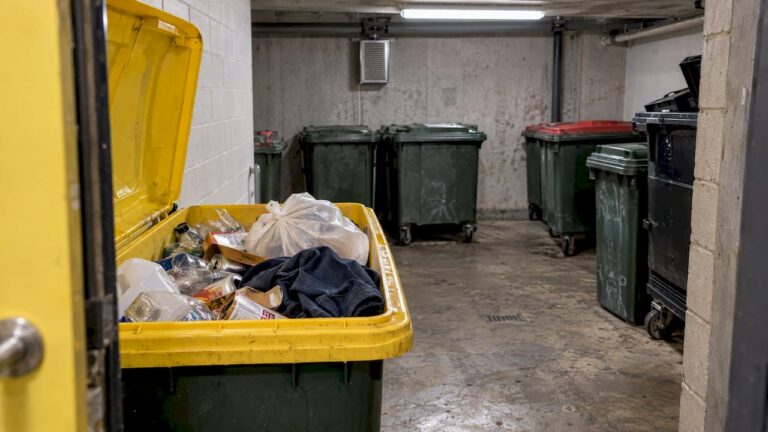
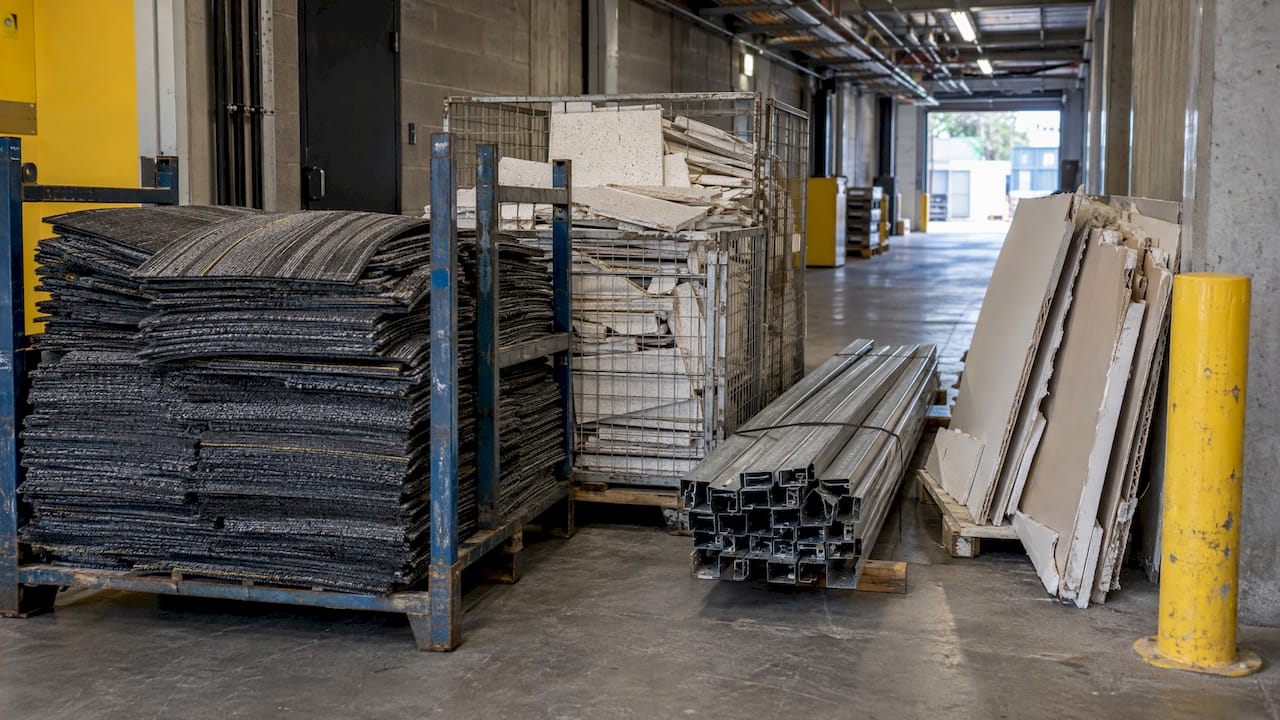
- Separate by stream as the fitout comes out (metals, timber, plasterboard, glass, carpet, ceiling tiles, furniture). Mixed skips cannot be unmixed at the tip.
- Asbestos is never recycled. Suspected material needs a licensed contractor and a licensed facility.
- Set a measurable recovery target in the contract (60% is the Australian best-practice minimum for office strip-out) and ask for weighbridge dockets.
- We at Melbourne City Rubbish handle strip-outs, make-goods and fitout clearances across Melbourne, with an opt-in carbon-neutral disposal option.
Table of Contents
- Why fitout waste deserves a plan
- Start with the hierarchy: retain, reuse, then recycle
- What can be reused or recycled from a fitout
- How to sort fitout waste on site
- What happens after collection
- Hazardous materials: asbestos is not a recycling stream
- Rules differ by state and council
- Set a recovery target and write it into the contract
- Practical steps for your next fitout or make-good
- How we help with fitout clearances in Melbourne
- FAQ
- Sources
Why fitout waste deserves a plan
Fitouts are short, fast and heavily scheduled, so waste is usually treated as an afterthought. The numbers show the cost of that. The Green Building Council of Australia’s fitout waste snapshot puts the average commercial fitout at 368.6 tonnes of waste, with around $105 per m² lost on materials that are bought, installed and then thrown away. The same document says 78% of materials end up in landfill.
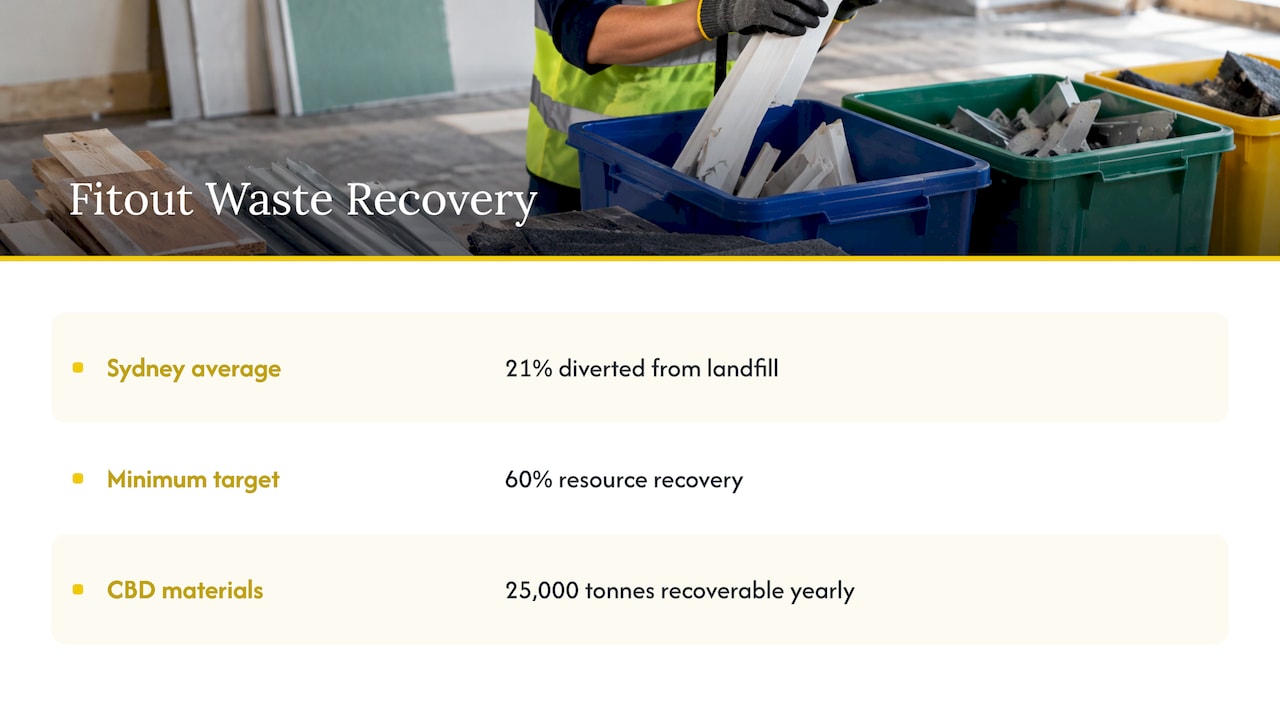
The Better Buildings Partnership (BBP) reports that an average of just 21% of fitout waste across Sydney is diverted from landfill. That is around 25,000 tonnes of glass, metals, plasterboard, ceiling tiles, carpet and furniture each year in Sydney’s CBD alone. The same body sets a best-practice minimum resource recovery target of 60% for office strip-out and refurbishment. Melbourne’s CBD buildings are comparable in age, layout and fitout style, so the gap between 21% and 60% is a fair picture of the opportunity for Melbourne tenants too.
There is also a direct cost angle. Landfill disposal carries a state levy per tonne, and what you do not send to landfill you do not pay that charge on. Levy rates are set by each state and change every financial year, so check the current EPA Victoria schedule when you budget.
Start with the hierarchy: retain, reuse, then recycle
Guidance written for Sydney retail and hospitality fitouts is blunt about the order. It asks contractors to retain or reuse existing walls, floors, ceilings, services, finishes, fittings, furniture and equipment wherever possible. Elements can be repaired, removed intact for reuse, resold or donated. Recycling comes after retention, reuse and value recovery.
For a Melbourne tenant, this changes the first question from “who will take the skip?” to “what in this space is still worth something?” That question is best asked at the design or make-good scoping stage, before demolition crews arrive. A walk-through with your strip-out contractor will usually identify reusable items in an hour.
What can be reused or recycled from a fitout
A practical list comes from a UK fitout industry presentation on reuse, which names raised access flooring, ceiling tiles, glass partitions, carpet tiles, lighting, doors, sanitaryware, loose and fixed furniture, cabling and ductwork as reuse candidates. The same material points to supplier take-back and remanufacture routes for items such as carpet tiles and ceiling tiles, and closed-loop recycling for flat glass where that is supported. Take-back availability depends on the supplier and the region, so ask the original supplier or your contractor what applies in Victoria.
Here is how the common streams usually play out in a commercial strip-out:
| Material | Best pathway | What decides the outcome |
|---|---|---|
| Office and loose furniture | Resale, donation, refurbishment, then recycling | Condition, and whether it is removed intact |
| Workstations, joinery, fixed furniture | Reuse if removed carefully, otherwise timber, metal and board recycling | Careful dismantling, not demolition |
| Carpet tiles | Take-back or remanufacture where offered | Must be lifted before plasterboard work to avoid contamination |
| Ceiling tiles | Take-back or remanufacture | Must come down intact and dry |
| Glass partitions | Reuse, or closed-loop glass recycling | Intact removal and separation from frames |
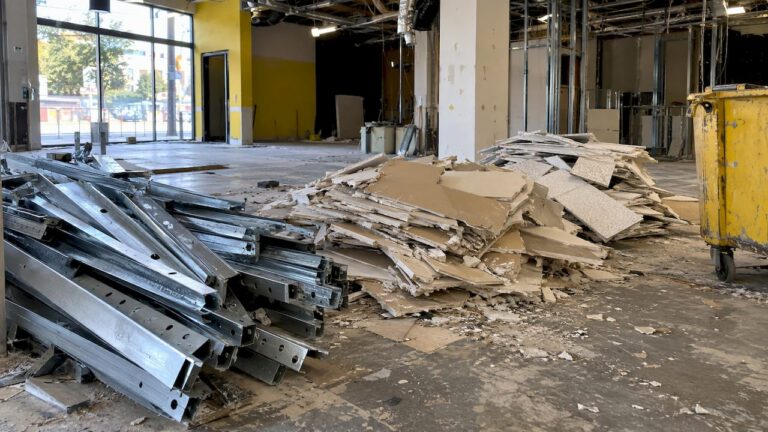
| Plasterboard | Recycled into new products | Must arrive clean, with low contamination |
| Metals (ductwork, framing, cabling) | Scrap metal recycling | Separation from other waste |
| Timber | Reuse or timber recycling | Free of paint, laminate and fixings where possible |
| Lighting and electrical fittings | Reuse, or e-waste recycling | Handled as electronic waste, not general waste |
If you have a pile of old desks, chairs and storage after a downsize, our furniture disposal and recycling service is built for exactly that situation.
Furniture is the easiest win
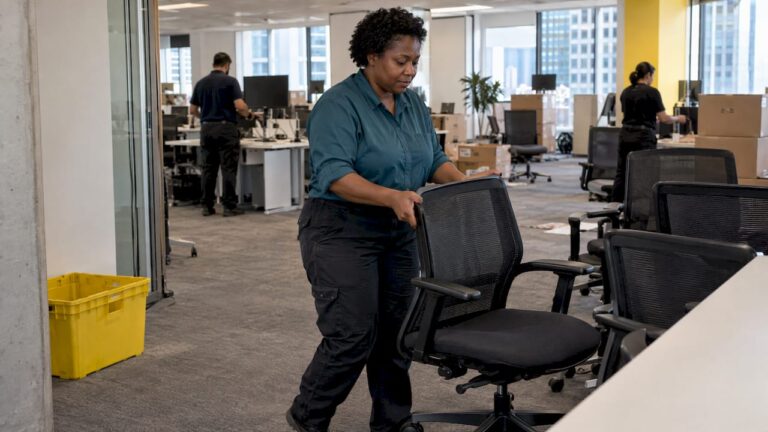
Furniture is bulky, visible and often still functional, which is why it is where most offices should start. If you are interested in how the wider industry thinks about keeping furniture in use, this piece on circular economy for furniture lays out the idea of cycles of reuse, repair and recycling. In practice, ask yourself whether each item can be reused by another office, donated, or at least broken down into clean metal, timber and board streams.
How to sort fitout waste on site
Sorting is where recovery is won or lost. The BBP’s strip-out guidance says materials should be removed by stream and stored or disposed of separately, according to the site’s material composition, the building’s context, timing and what the receiving facility needs.
Sequence the strip-out
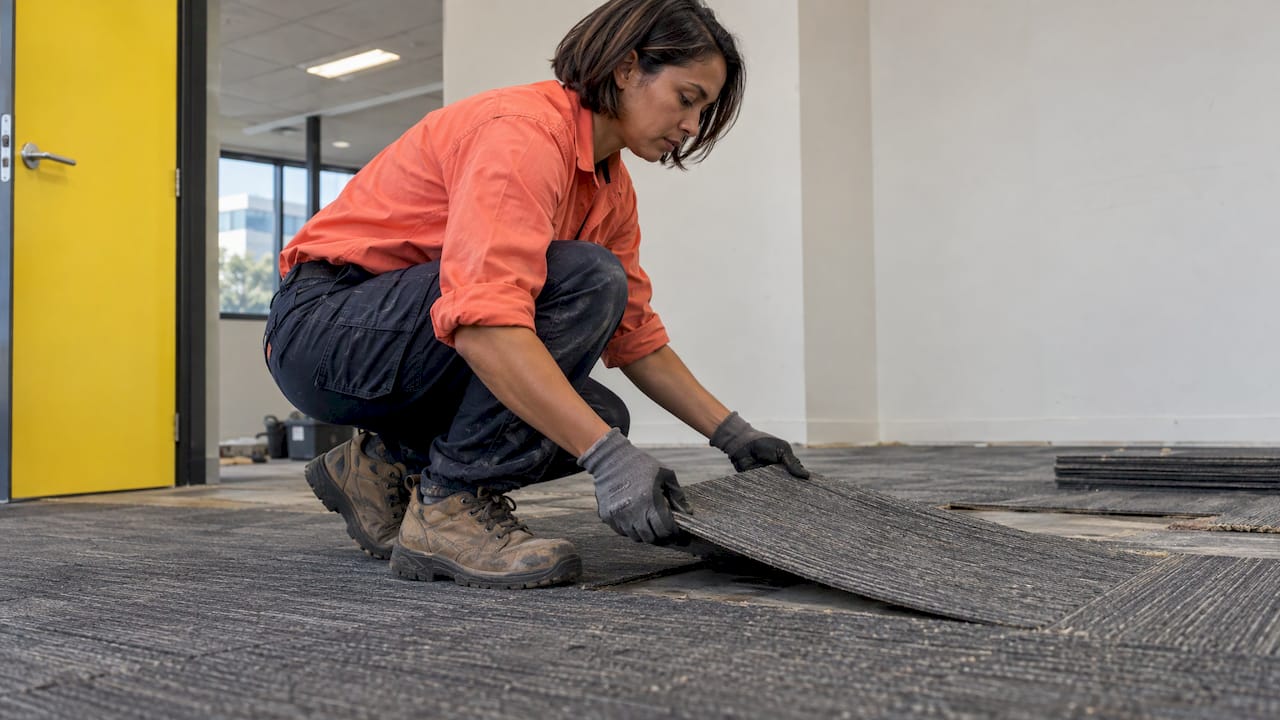
Order matters. The same BBP guidance gives a clear example: carpet tiles need to come out before any plasterboard, because plasterboard dust and debris cross-contaminating them will make the carpet useless for reuse. Plan the removal sequence on the drawings, not on the day.
Keep streams apart
A mixed skip is the single biggest cause of lost recovery. One fitout contractor’s strip-out guide explains that separation has to happen on the floor during removal, because a mixed skip cannot be unmixed at the tip and everything in it goes to landfill. That is a strong claim about a particular practice, and it is worth treating as the safe assumption when you plan a job.
Guidance for Sydney retail and hospitality sites lists the key streams to separate onsite: metals, timber, plasterboard, glass, plastic, and fixtures and furnishings. It also recommends avoiding mixed waste skips.
In a tight CBD tenancy, a few practical points help:
- Label every bin or zone. BESS sustainable design guidance advises that material streams should be clearly labelled and protected from contamination, wind and rain.
- Allocate a dedicated sorting space. The same guidance asks for dedicated storage that is easy to reach and close to waste collection points.
- Cover and mark reuse stock. The UNSW construction and demolition waste guideline says reuse materials should be kept in lined and covered piles marked with signage showing their uses.
- Protect salvage. The same guideline notes that source separation matters most for minimising damage to salvaged materials, and that waste separated at source can be sold directly into the marketplace.
For the day-to-day habits that keep a floor tidy while a project runs, these office waste segregation steps are a useful companion for facility teams.
When there is no room for multiple bins
City sites often have no space for five bins. The UNSW guideline accepts that offsite separation is an option where space is limited: everything goes into one bin and is delivered to a processing plant for mechanical sorting. Recovery rates from that approach depend on the processor and on what went into the bin, so it suits low-value mixed residue better than materials you want to reuse, like carpet tiles or glass.
A dedicated small-truck system can also work in tight spaces. A GBCA case study of a 6 Star Green Star interior in Perth reported only 0.35 kg per m² of construction and demolition waste sent to landfill, with more than 95 per cent of project waste recycled through a commingled bin collected only when full by a small rear-lift compaction truck. The team measured waste generation monthly and built a collection system designed for refurbishments with limited truck access.
What happens after collection
Separated loads go to their own processors or take-back pathways. Plasterboard is the clearest example of how fussy this is. One strip-out guide says plasterboard recycling depends on the material arriving clean with low contamination. Nails, screws, timber, steel, plastic and insulation can turn recyclable board into landfill. Glued-down carpet tiles and unrecovered ceiling tiles may also end up in landfill.
The BBP guidance adds a point about cost responsibility: if material fails gate checks at a facility because of contamination, it generally has to go to landfill at the contractor’s cost. Site supervisors should inspect regularly to keep loads within each reprocessor’s contamination limits. When you hire a strip-out contractor, make sure the contract says who carries that risk.
Paperwork that proves it
The strip-out guide describes weighbridge dockets and receipts that record load weight and material type, and reports that record each stream’s weight and destination. Site-level advice from the Sydney retail and hospitality guidance goes further: photograph or record materials as they leave site, and keep basic item counts or volume records.
This matters because headline diversion claims can mislead. GBCA has pointed to inconsistent reporting and what it calls broken waste systems in a 2025 report on building materials at risk of being wasted. It says Australia could waste up to $64 billion in construction materials over five years without action, and that the average building project wastes 141 kg per square metre. Tracking where materials actually go is the safeguard.
Hazardous materials: asbestos is not a recycling stream
Older buildings can contain asbestos in ceiling tiles, wall sheeting, floor coverings and lagging. Treat that as a safety matter first and a waste matter second.
- The City of Sydney’s asbestos guidelines state that it is illegal to dispose of asbestos waste in domestic garbage bins or to recycle it, that it must not go in general waste skips, and that it must go to a landfill licensed to accept asbestos waste.
- Brisbane City Council says only a licensed contractor should remove or break materials suspected of containing asbestos fibres, and that its resource recovery centres do not accept asbestos or asbestos-containing materials.
- Bayside Council’s technical specification expects a waste management plan to describe how asbestos and similar contaminants will be tested, removed, handled, transported, tracked and disposed of by authorised people, to authorised facilities.
Those are New South Wales and Queensland documents, and the principle is the same everywhere: do not break, bag or skip suspected asbestos yourself. In Victoria, confirm the current requirements with EPA Victoria and WorkSafe Victoria before work starts. If a building predates the asbestos ban, get testing done before strip-out begins. Our guide to strip-out versus demolition for property managers explains why asbestos surprises are best handled at the planning stage.
Rules differ by state and council
There is no single national rulebook for fitout waste. The Australian Government’s construction and demolition waste guide says that environmental management, including waste streams, is largely the responsibility of state and territory governments. It also notes that regulation sets minimum standards but is not enough alone to lift recycling and reuse rates.
The NSW EPA’s better practice guide makes a similar point for its own state: it does not supersede state or local planning control requirements. For a Melbourne project, that means three checks: your lease make-good clause, any building management rules about loading docks, hours and lift use, and Victorian EPA requirements for the waste you generate. Our article on recycling in the Melbourne CBD covers the local side.
Set a recovery target and write it into the contract
The BBP says the single most important thing when contracting strip-out services is to state a resource recovery target for the full de-fit of at least 60 per cent, aiming higher where the project allows. The contract should specify a measurable target and require performance reporting. The BBP’s guidelines also include contract clause templates and a directory of reuse and recycling facilities, and they are aligned with Green Star Interiors and Performance so they can serve as evidence for credits.
A short checklist for your contract or tender brief:
- A numeric recovery target for the whole job, not just “we will recycle where possible”.
- Stream-by-stream separation on the floor, with no mixed skips.
- Weighbridge dockets or receipts for each load, showing weight, material type and destination.
- Photos or counts for items sent for reuse, resale or donation.
- A named process for suspected asbestos or other hazardous materials.
- A clear statement of who pays when a contaminated load is rejected.
- A final report you can file for your lease handback or sustainability reporting.
BVN’s guidelines describe de-fit as an end-of-lease strip-out phase that is an opportunity to divert materials and assets from landfill and recover value through circular pathways. If you are a tenant facing a handback, the make-good scope is the moment to ask for that.
Practical steps for your next fitout or make-good
- Audit early. Walk the space and list what can be retained, resold, donated or removed intact.
- Test before you strip. Get hazardous materials checked in any older building.
- Sequence the removal. Carpet tiles and ceiling tiles before dusty work like plasterboard.
- Separate on the floor. Give each stream its own labelled zone or bin.
- Book collections by stream. Match each load to a processor or take-back route.
- Keep the evidence. Dockets, photos and counts, filed with the project.
- Review the numbers. Compare your result against the 60% benchmark and carry the lessons into the next job.
How we help with fitout clearances in Melbourne
We at Melbourne City Rubbish clear commercial and residential sites across Melbourne, including office strip-outs, make-good and de-fit work, construction debris and e-waste. Our strip-out work is done with experience in all types of Melbourne commercial buildings, with a no mess, no damage approach to property. You can opt in to carbon-neutral disposal, and we back punctuality with real-time notifications and a lateness credit.
If you already hold a written quote from another provider, we promise to beat it by 5%. For office-specific jobs, see our office strip out solutions or get a quick quote with the scope of your fitout and your building’s access details.
FAQ
Is recycling the first priority in a fitout?
No. Retention and reuse come first, then recycling. Sydney retail and hospitality guidance asks contractors to prioritise retaining, reusing and extending the life of existing elements before recycling or disposal. Recycling is the fallback for what cannot be kept or resold.
Why can’t I just put everything in one skip and let the tip sort it?
Because mixed skips generally cannot be unmixed at the tip, and everything in them tends to go to landfill. A mixed bin can be sent to a plant that sorts mechanically, but that route suits low-value residue. Reusable and high-value streams need separating on the floor.
What recovery rate should I aim for?
The Better Buildings Partnership sets a best-practice minimum of 60% resource recovery for office strip-out and refurbishment, and encourages going higher where possible. Put a measurable target in the contract and require reporting so you can check the result.
Can asbestos-containing fitout materials be recycled?
No. City of Sydney guidance says asbestos waste cannot be recycled or placed in general skips and must go to a landfill licensed to accept it. Suspected materials should be tested and removed by a licensed contractor. For Victorian requirements, check with EPA Victoria and WorkSafe Victoria.
Sources
- Green Star Fitouts for Building Owners (GBCA)
- BBP Stripout Waste Guidelines (Better Buildings Partnership)
- BBP Stripout Waste Guidelines, PDF
- Sydney Retail & Hospitality circular guidance
- Making reuse happen in fit-out (FIS)
- Strip out recycling: where office fitout waste goes
- BESS Sustainable Design Fact Sheets: waste and resource recovery
- UNSW Construction and Demolition Waste Management Guideline
- GBCA case study: a 6 Star Green Star interior that pushed waste boundaries
- GBCA: $64 billion in building materials at risk of going to waste
- City of Sydney Managing Asbestos Guidelines, December 2020
- Brisbane City Council: how to safely dispose of asbestos
- Bayside Council Waste Management Technical Specification
- Australian Government Construction and Demolition Waste Guide
- NSW EPA Better Practice Guidelines for Waste Management
- BVN De-fit Guidelines for Commercial Fitouts
- Circular economy for furniture (Keter Australia)
- Office waste segregation playbook