A truly zero waste office move is rare, but a move that sends very little to landfill is achievable if you start the audit early, give every item a destination before move day, and keep records of where it went. The work happens in four places: before the move (reduce and audit), during it (pack with less rubbish), at the old premises (make-good and fit-out materials) and afterwards (tracking). This guide walks through each one for a Melbourne business.
TL;DR
- Appoint one move coordinator and audit the office zone by zone at least two months out, so every item is tagged keep, reuse, donate, recycle or remove.
- Reuse inside your own business first, then sell or donate. Landfill is the last option, not the default.
- E-waste and batteries cannot go in general bins in Victoria. Use specialist recyclers and keep the certificates.
- Treat strip-out and make-good as a materials job, with a recovery target written into the contract.
- Keep manifests, certificates and weights by load. They are your proof for audits and ESG reporting.
Table of Contents
- What “zero waste” means for an office move
- Start with a coordinator and a schedule
- Audit what you own before you decide what to do with it
- Deal with e-waste, batteries and confidential paper
- Pack with less rubbish
- Fit-out, strip-out and make-good
- Check the Victorian rules that apply
- Track what you diverted
- A realistic split of responsibilities
- FAQ
- Sources
What “zero waste” means for an office move
In practice, zero waste is a direction rather than a guarantee. The usual definition is a very high diversion rate, with the small remainder understood and recorded. For an office move, that means you can say where almost everything went: moved with you, reused elsewhere, sold, donated, recycled, or disposed of lawfully with a record.
The biggest wins come early. NSW EPA guidance points out that building waste minimisation into everyday office habits, such as defaulting to double-sided printing and swapping disposable items for reusable ones, reduces how much waste exists before a move begins. Those habits are worth starting a few months ahead of the move, because every filing cabinet of paper you never print is one you never have to shred.
Start with a coordinator and a schedule
Moves go wrong when nobody owns the waste. An office relocation planning guide from the Oregon state government recommends a named move coordinator, a schedule with assigned responsibilities, and planned time for staff to sort out what they do not need. It is a US document, but the logic holds anywhere.
For a Melbourne office, a workable timeline looks like this:
| When | What happens |
|---|---|
| 8 to 12 weeks out | Appoint the coordinator, read your lease make-good clause, start the zone-by-zone audit |
| 6 to 8 weeks out | List surplus furniture and equipment for sale or donation, book e-waste and document destruction |
| 3 to 4 weeks out | Staff sort sessions, confirm packing and labelling rules, order reusable crates |
| 1 to 2 weeks out | Book removal for what is left, confirm strip-out and make-good scope with the landlord |
| Move week | Extra recycling containers at both sites, a flattened-box area, a checklist for the last walk-through |
| After the move | Collect certificates and weights, reconcile against the audit, report the diversion rate |
The weeks are a guide, not a rule. A small team in a single suite can compress this. A multi-floor tenancy with a fit-out to strip out should lengthen it.
Audit what you own before you decide what to do with it
The audit is the step that decides your result. A furniture audit guide from a relocation company recommends going zone by zone and recording each asset’s type, quantity, location, dimensions and condition, then deciding whether to move, store, refurbish, redeploy, resell, donate or recycle it. The same source suggests also noting how often each item is actually used, which quickly shows you the monitor arms and spare chairs nobody has touched in a year.
A simple tagging system keeps the decision quick. Another relocation guide suggests classifying assets as Keep, Reconfigure, Donate, Recycle or Remove. Put the tag on the item itself, and record it in a spreadsheet with a column for the destination and one for the date it left.
Reuse inside the business first
Internal reuse is often the most sustainable and cost-effective option. Before you list anything externally, ask whether the new space needs it. Desks that do not suit the new layout may suit a storeroom, a home-working allowance or a second site. A new tenancy often needs more meeting furniture, not less.
The public sector shows what scale is possible. NSW Government guidance on office reuse records that more than 14,000 pieces of surplus equipment were reassigned to public schools and TAFE campuses in a statewide response. You will not move 14,000 items, but the principle is the same: surplus for one organisation is useful stock for another.
Sell, then donate
Give selling a real window. One decommissioning guide advises listing items for sale at least 60 days before move-out. Anything unsold goes to donation, and Victoria has a large network for it: EPA Victoria’s market report notes the charitable reuse sector has around 650 stores and diverts roughly 190,000 tonnes from landfill a year.
Call charities early and ask what they actually accept. Most want clean, working, resaleable furniture, and many cannot take broken chairs, stained carpet tiles or oversized boardroom tables. If you are unsure about what to do with old pieces, our guide on how to donate or recycle old furniture before booking removal covers the options in Melbourne.
Deal with e-waste, batteries and confidential paper
This is the part of an office move where a legal obligation and a sustainability goal line up exactly.
E-waste
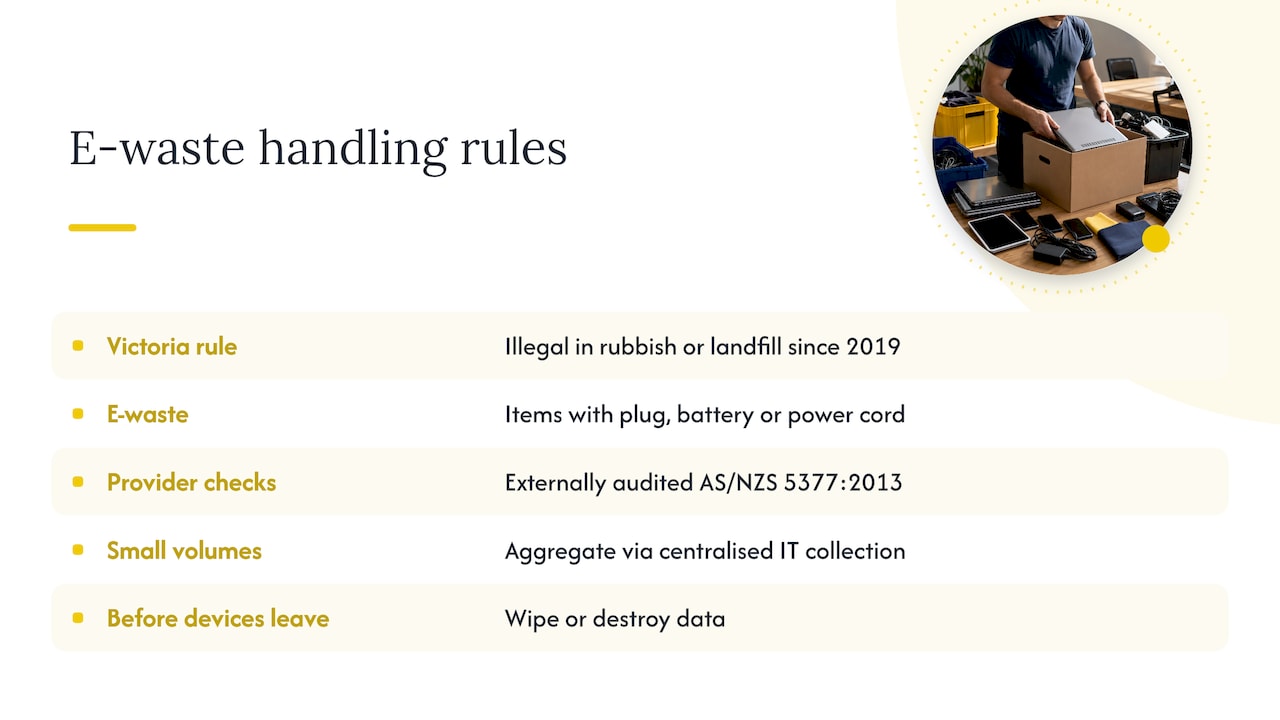
Since 2019 it has been illegal in Victoria to put e-waste in household rubbish or landfill, and the Victorian Government defines it as any item with a plug, battery or power cord. For an office that means computers, monitors, printers, phones, networking gear, kitchen appliances and the old desk fan. Sustainability Victoria’s workplace advice says that when you use a waste removal provider, look for externally audited certifications such as AS/NZS 5377:2013 or an EPA licence where relevant.
If you manage a building with many small tenants, the NSW EPA guidance suggests centralised IT equipment collection so small volumes can be aggregated for specialist recyclers. Our page on waste management for office building managers goes into how that works in a Melbourne building.
Wipe or destroy data before any device leaves your hands. Reuse and donation of laptops and phones is only responsible once the data is gone.
Batteries
Batteries do not belong in general bins. The same NSW guidance points businesses to specialist recyclers or product stewardship schemes such as MobileMuster. EPA Victoria’s battery guideline adds a handling point: take care to prevent puncture or damage and use cushioning to stop batteries shifting in transport. In practice, keep them in a sturdy labelled container, never loose in a general waste crate, and tape terminals on larger cells.
Confidential documents
Paper that contains client, staff or financial information should be securely shredded or destroyed in line with your data protection obligations. Use a provider who can issue a certificate, and, as the NSW EPA guidance recommends, use authorised waste transport providers who can issue certificates of recycling or disposal. Do the shredding before move week, so the last days are not spent feeding a machine.
Office plants
Plants are a reuse item people forget until the day. They are living stock, and they are easily damaged by a move. Guidance on protecting office plants in the first 72 hours after a move is worth reading for the facilities lead, and a separate piece on loading plants last and unloading them first covers the truck order. Taking the plants with you keeps them out of the skip and out of your replacement budget.
Pack with less rubbish
The Oregon guide’s move-day advice translates directly: give staff packing and labelling guidance, allow time to sort unnecessary items, place extra recycling and rubbish containers at both sites, and designate space for flattened boxes.
A few practical additions for a lower-waste pack:
- Use returnable crates rather than cardboard where you can. Hire crates are delivered, used and collected, with nothing to dispose of.
- Pack in what you already have. Soft items and spare paper cushion fragile equipment, so you do not need to buy bubble wrap.
- Label by destination, not just by room. A label that says “new level 3, finance” avoids re-handling. A second label for “donate” or “recycle” keeps sorted items sorted.
- Run a clear-desk day. Give each person a bin for personal clutter and a box for items going into the move. Anything in neither goes into a sort pile for the coordinator.
- Stage the exit. Park the e-waste cage, the donation pallet and the general waste bin in separate marked spots so staff do not default to one bin.
Fit-out, strip-out and make-good
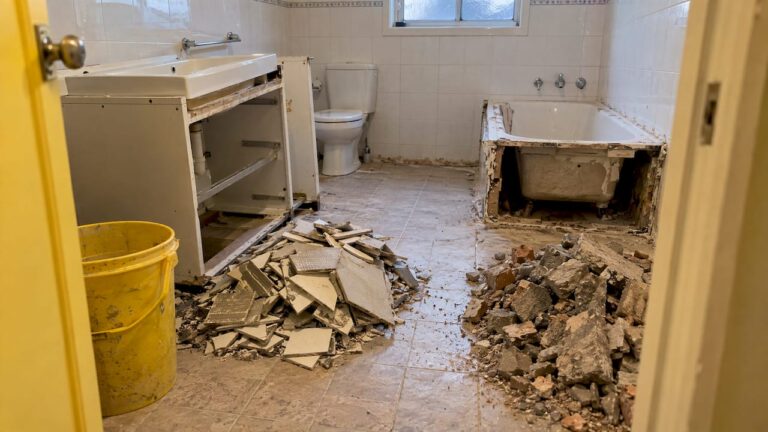
For a tenant leaving a leased floor, the bulk of the tonnage is rarely the desks. It is carpet, ceiling tiles, partitions, joinery, cabling and floor finishes. Your lease will usually say what has to be removed and what condition the space must be handed back in, so read that clause before you plan disposal, not after.
Set a recovery target in the contract
The Better Buildings Partnership’s Stripout Waste Guidelines give Australian projects a framework for procurement, measurement and reporting, and set a minimum recovery target of 60%. The same page notes that an average of 21% of fit-out waste across Sydney is diverted from landfill, which shows how much room there is to beat the norm. It also recommends contract clause templates, so the target sits in the agreement with your strip-out contractor and not in a good intention.
Look for what can stay
Sustainability Victoria’s circular design guidance says to keep products and materials in use at their highest value and consider reusing existing structures and materials. Its case study of the 500 Burke Street retrofit in Melbourne reports that over 85% of office equipment, around 15,000 pieces, was reused, refurbished or recycled, with reduced project costs compared to a new build.
A smaller example from a planning document for a NSW project notes that integrating fit-out with the base building can avoid removing finishes such as flooring or ceiling tiles. For a tenant that means asking early whether the landlord or incoming tenant wants to keep carpet, ceilings or kitchenettes. A negotiated handover removes work and waste at once.
How we handle it
Our team works on strip-outs, make-good and de-fit jobs, and on office cleanouts in Melbourne commercial buildings. We offer an opt-in carbon-neutral disposal option, and we aim to leave sites clean and undamaged. If your move involves clearing a floor, our office cleanout service is built for that, and our office junk removal page covers the loose furniture and equipment that is left over after your audit. For larger jobs, see the full list of building strip-out and make-good services. We provide a quote for each project, and we promise to beat any written quote by 5%. You can start with our quick quote form.
Check the Victorian rules that apply
Melbourne businesses have duties as waste producers, and a move is when you generate the most waste in the shortest time.
- Use an authorised place. Under EPA Victoria’s guidance for waste producers, you must take reasonable steps to ensure your waste is transported to and received at a place authorised to receive it.
- Know your waste type. The same guidance says controlled waste moved interstate may need consignment authorisation, and reportable priority waste must be recorded in EPA Victoria’s Waste Tracker. Most office waste is not in these categories, but old fluorescent lighting, chemicals, and some construction materials can be, so ask your contractor to confirm.
- Ask the council. Sustainability Victoria’s better practice guidance advises contacting the relevant council to find out whether planning scheme measures or standard permit conditions apply to waste and recycling. This matters especially for the new premises, where bin storage and collection access may be conditions of your occupancy.
- Check the building rules. Most CBD towers have loading dock bookings, lift protection requirements and rules on where waste can be staged. Book these before the removal crew arrives, not on the day.
We have put the Melbourne-specific steps into a compliance checklist for office relocation waste, and if you are moving out of the CBD, recycling in the Melbourne CBD explains what the local system accepts.
Track what you diverted
If you cannot show where it went, you cannot claim it was diverted. Set up the tracking sheet on day one and keep adding to it:
- One row per item or batch, with the audit tag.
- The destination: reused internally, sold, donated, recycled, landfill.
- The weight or count, taken from a scale ticket or collection docket.
- The certificate or receipt reference, filed in a shared folder.
- For anything sent to landfill, a short note on why it could not go elsewhere.
That last point is advice from a decommissioning checklist: reserve landfill for items that cannot be reused, resold, donated or recycled, and keep manifests or scale tickets by load, recording the rationale for ESG reporting and audits. For strip-out materials, the BBP guidelines offer a workbook framework for consistent measurement and reporting, so your figures can be compared with others.
When the move is done, divide the weight sent to landfill by the total weight removed. That is your residual rate. Share it with staff, set it as the baseline for the next move, and put it in your sustainability report.
A realistic split of responsibilities
No single party can deliver a zero waste move alone. A workable division looks like this:
| Task | Who usually owns it |
|---|---|
| Audit, tagging and staff communication | Move coordinator |
| Selling and donating furniture | Coordinator or facilities lead |
| Data wiping, IT asset disposal | IT team with a certified recycler |
| Shredding and certificates | Records or compliance lead |
| Strip-out, make-good, bulk removal | Contractor engaged under a written scope |
| Landlord handover, building access | Property or facilities manager |
| Diversion reporting | Coordinator, using contractor documents |
Put the diversion expectation in writing with every contractor, and ask what documents they will give you at the end.
FAQ
Is a zero waste office move actually possible?
A move with nothing at all sent to landfill is hard, but a very high diversion rate is realistic when you audit early, reuse and donate, and use specialist recyclers for e-waste, batteries and paper. The honest goal is to know where every item went and to have records that prove it.
How early should I start planning?
Start the audit at least two months before the move, and earlier if you have a fit-out to strip out. Selling surplus furniture needs the longest lead time, and one decommissioning guide recommends listing items at least 60 days before move-out.
Can I put old computers and batteries in the skip?
No. In Victoria, e-waste has been banned from landfill since 2019, and anything with a plug, battery or cord counts. Use a certified e-waste recycler or a removal provider who routes it to one, and keep the certificate.
What happens to furniture nobody wants?
Sort it into reusable, recyclable and unusable. Working pieces can be sold or donated, timber and metal frames can often be recycled, and the remainder goes to lawful disposal with a record of why. Our furniture disposal and recycling service handles the last two groups.
Do I need to tell the council or EPA about my office move waste?
Usually not for ordinary office waste, but you must use an authorised place for disposal, and some waste types have extra requirements. Check the EPA Victoria guidance for waste producers and contact your council about local conditions.
Sources
- Office Relocation Planning Guide, Oregon Department of Administrative Services
- Better Practice Guidelines for Waste Management, NSW EPA
- How to Run an Office Furniture Audit Before Your Office Move
- Sustainable Office Relocation Guide, Vector
- How to Plan a Sustainable Office Decommission
- Office reuse guidelines, NSW Government
- Office Decommissioning Tips and Asset Liquidation, Vector
- Circular Economy Market Report, EPA Victoria
- E-waste ban, Victorian Government
- Recycle e-waste, Sustainability Victoria
- Storage and management of waste batteries, EPA Victoria
- Protect plants in the first 72 hours after an office move
- Office plant relocation: load last, unload first
- BBP Stripout Waste Guidelines, Better Buildings Partnership
- What Works: circular design in the built environment, Sustainability Victoria
- Major project planning document, NSW Planning Portal
- Managing industrial waste: your duties as a waste producer, EPA Victoria
- Waste and recycling for commercial and industrial land use, Sustainability Victoria
- The Comprehensive Office Decommissioning Checklist