If your mattress is clean and intact, donate it. If it’s worn but usable, book your council’s bulk waste collection. If it’s damaged, stained, or mouldy, skip donation entirely and go straight to a specialised recycler or a paid removal service. Look for providers linked to the Australian Bedding Stewardship Council (ABSC) through its Recycle My Mattress initiative, and expect free council pickups versus private collection costing roughly $50 to $120.
TL;DR:
- Donating a mattress is only suitable if it is nearly new, clean, and free of stains, odour, and mould; otherwise, recycling or paid removal is necessary.
- Council bulk waste collections are free but limited to once or twice a year and may require weeks to schedule, making private removal faster but more costly.
- Recyclers separate mattress components like steel, foam, timber, and textiles, reducing energy use and environmental harm compared to landfill disposal.
- Private pick-up costs range from $50 to $120, and ensure the provider discloses whether the mattress is recycled or landfilled before booking.
- Recycling options linked to the Australian Bedding Stewardship Council are the most sustainable, but damaged or heavily stained mattresses must skip donation and go straight to certified recyclers.
Table of Contents
- Mattress recycling options: donate, council pickup, drop-off, or paid removal
- Preparing your mattress and vetting who picks it up
- What happens during mattress recycling
- Costs and timing: what to expect
- When donation isn’t an option
- Where a professional pickup fits in
- Where to check before you book
- Book a mattress pickup that actually gets recycled
- Sources
Mattress recycling options: donate, council pickup, drop-off, or paid removal
Most people default to dragging their mattress to the kerb and hoping for the best. That’s not always the smartest move, and it’s rarely the most sustainable one. Australians throw out about (https://www.theguardian.com/australia-news/article/2024/jul/13/sleeping-on-waste-how-to-recycle-a-mattress-in-australia-so-that-it doesnt-end-up-in-landfill-or-on-the-street) — a mattress takes up huge landfill volume and can take decades to break down. Here’s how to work out which route actually suits your situation.
Donation works only if the mattress is genuinely close to new. Charities generally accept mattresses that are clean, unstained, structurally sound, and free of odour, and most will refuse anything showing wear, mould, or sagging. Call ahead before you load it into a ute. Some charities collect directly; others need drop-off at a depot. If a charity can’t take it, sites like SnagMate offer practical tips for gifting furniture directly to someone in your community instead.
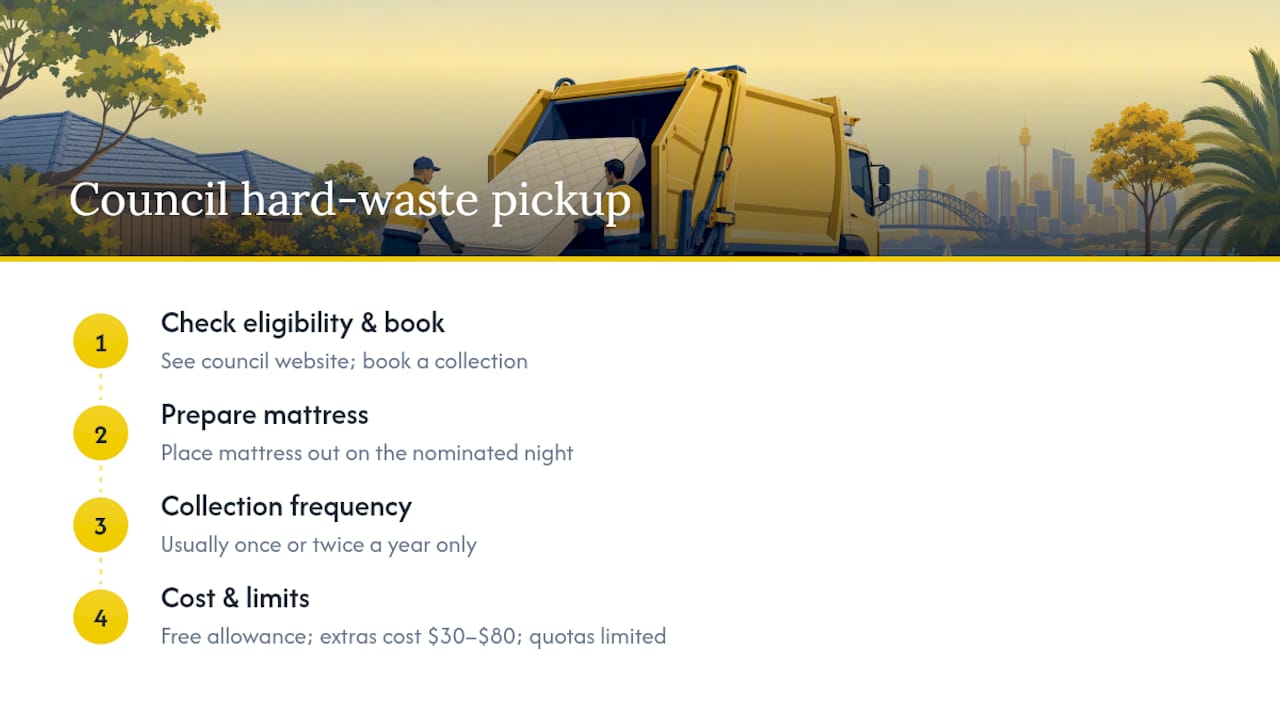
Council bulk or hard waste collection is the free option most councils offer once or twice a year, and it’s usually the first port of call for a mattress that’s simply past its prime. You’ll need to check your council’s website, book a collection date, and place the mattress out on the nominated night. Quotas are limited, though. Extra pickups outside your free allowance can cost $30 to $80 depending on the council.
Specialised recyclers and drop-off centres exist specifically to strip mattresses down into raw materials rather than bury them whole. Recycling Near You runs a postcode search that lists nearby options, which is the fastest way to find one without guesswork.
Private paid pick-up suits anyone who needs the mattress gone now, rather than on the next council collection date. Before booking, ask where the mattress actually ends up. A legitimate operator should be able to tell you whether it’s headed to landfill or to a recycling facility.
Preparing your mattress and vetting who picks it up
A few minutes of prep saves a wasted trip or a rejected pickup. Before you book anyone, gather these details:
- Mattress dimensions and type — single, queen, king, spring, foam, or hybrid.
- Access details — stairs, narrow hallways, or tight parking that might affect collection.
- Condition — note any stains, odour, or mould so you can be upfront with a charity or council.
- Recycling destination — ask the provider directly whether the mattress goes to landfill or a certified recycler.
- Fees and inclusions — confirm the total cost before the truck turns up, not after.
Wrap the mattress in plastic or a mattress bag if it’s been stored outdoors or shows any dampness, both for hygiene and to stop it soaking up moisture on the truck. Ask for a receipt or confirmation of where it was processed. It’s a small ask, and any reputable recycler will provide one without hesitation.
Pro Tip: Photograph the mattress before you call a charity. Most will ask you to describe its condition over the phone, and a photo saves you from a wasted trip if it gets knocked back at the door.
What happens during mattress recycling
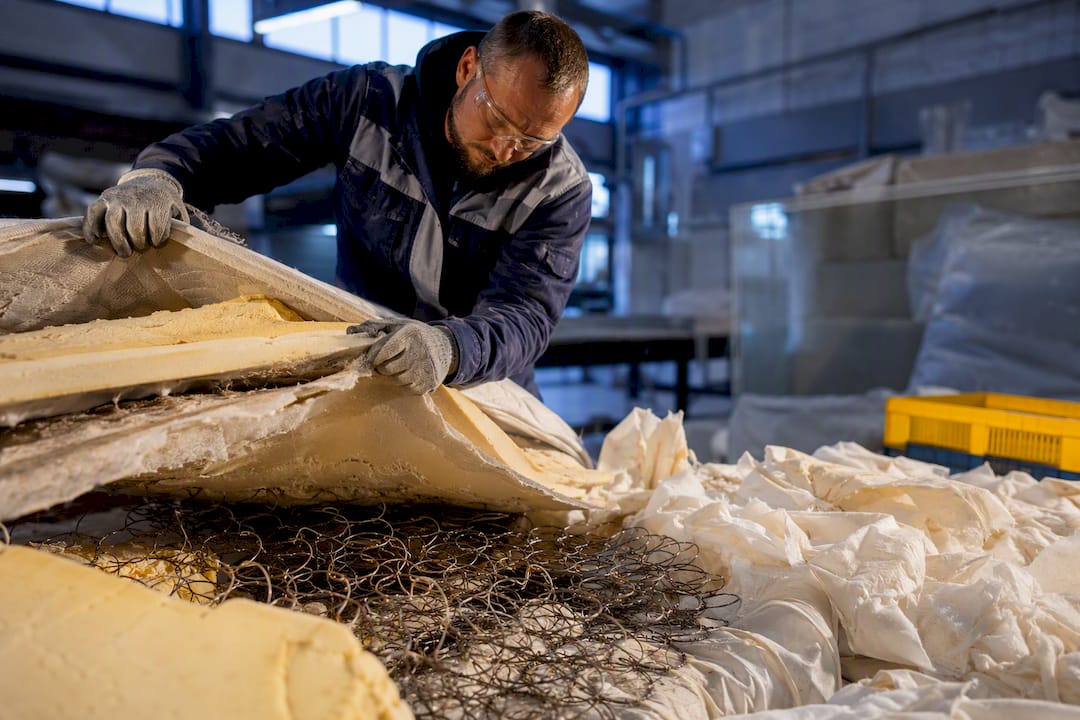
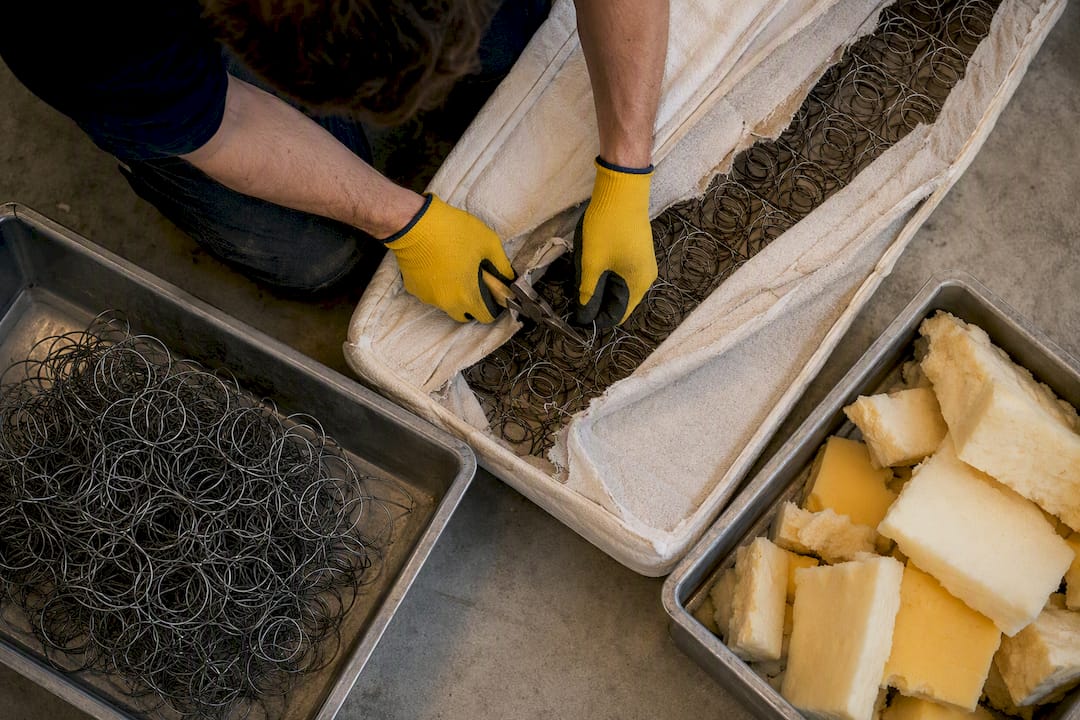
A mattress isn’t one material, it’s several bundled together, and that’s exactly why proper recycling matters more than most people realise. At a processing facility, workers deconstruct the mattress by hand, separating:
- Steel springs, which get baled and sent to metal recyclers
- Foam, often shredded and repurposed as carpet underlay
- Timber frames, chipped for mulch or particleboard
- Textile covers, sorted for reuse or insulation material
Specialised processors recover around 20 to 25 kg of usable material per mattress, and recycled steel alone uses about 75% less energy than producing new steel from scratch. That’s not a minor efficiency gain, it’s the difference between a mattress rotting in landfill for decades and its steel showing up in a new product within months.
There’s a safety reason to leave this to professionals too. Mattresses often contain flame retardants and adhesives that need careful handling, and industrial recyclers manage that risk properly rather than exposing untrained handlers to it. Some recyclers operate as social enterprises, employing people who face barriers to mainstream work while dismantling mattresses by hand to maximise recovery.
Costs and timing: what to expect
Council bulk collection is free, within your annual quota, but you’re on their calendar, not yours, and bookings can take one to three weeks depending on demand. Private pick-up moves faster, often within a day or two, and typically runs $50 to $120 depending on access and location.
A few numbers worth knowing:
- Retailers often charge around $50 to $75 for mattress collection when you buy a new one.
- The ABSC has proposed a $10 levy per mattress to help standardise funding for recycling and education.
- Bundling a mattress with other bulky items in a single paid removal often works out cheaper per item than booking separate trips.
Ask your retailer about take-back schemes when buying new. Increasingly, that fee already covers responsible disposal of the old one.
When donation isn’t an option
Charities set the bar high: clean, dry, structurally sound, and usually no more than a few years old. Anything stained, mouldy, torn, or sagging gets refused almost every time, and turning up unannounced wastes everyone’s time.
- Call ahead and describe the condition honestly.
- Send photos if the charity allows it.
- If it’s damaged or soiled, skip donation and go straight to a recycler or paid removal. It’s the more responsible choice for a mattress no one else can reuse.
Where a professional pickup fits in
Melbournecityrubbish handles mattress collection alongside furniture, office junk, and construction debris, directing each item toward the right recycling or disposal channel rather than a single landfill run. Clients can opt into carbon-neutral disposal, and every written quote gets beaten by 5%. When booking, confirm the disposal destination and ask for proof of diversion. It’s a fair question for any operator handling your waste, not just this one.
Where to check before you book
Start with Recycling Near You for a postcode search of local recyclers and drop-off points. The ABSC’s Recycle My Mattress pages explain the accreditation behind the scheme, and your council’s own bulk-waste page will confirm booking dates and quotas. Melbourne residents can also check local CBD recycling rules before scheduling a pickup.
Book a mattress pickup that actually gets recycled
Council quotas run out, charities knock back anything less than pristine, and a damaged mattress left on the nature strip too long becomes someone else’s problem before it’s ever someone’s fix. Melbournecityrubbish picks up mattresses alongside couches, office fit-out debris, and green waste, and routes each load toward genuine recycling rather than the nearest tip. If you’ve already tried council bulk collection and missed the window, or the mattress is too far gone for any charity to touch, that’s exactly the gap this service fills. Get a quick quote and have it gone this week, not next month.
Sources
- Mattress recycling: Australian state-by-state guide — Koala
- Four reasons why every mattress should be recycled — Australian Bedding Stewardship Council
- Draft determination — ACCC on Australian Bedding Stewardship Council ‘Recycle My Mattress’ scheme — ACCC