You can move out of a building with no loading dock. It takes four things: written approval from the building manager, a lawful place for the truck to stop, a measured carry route from your door to that spot, and a lighter load. Most problems on move day come from skipping one of these, not from the missing dock.
This guide covers the Melbourne specifics: lifts and strata rules, kerbside stopping, council permits, safe handling, and how to cut the volume you carry before the truck arrives.
TL;DR
- Contact the building or strata manager at both addresses early. Confirm move hours, lift bookings, notice periods and protection rules in writing.
- Without a dock, the truck loads from the nearest lawful kerb spot. Check signs, loading zones and, in some council areas, a temporary permit.
- Walk and measure the whole route: doors, lift, corridors, ramps, steps and the distance to the truck.
- Use mechanical aids such as trolleys and pallet jacks before relying on people to carry heavy items.
- Remove unwanted furniture and rubbish before move day, so there are fewer trips through the lobby.
Table of Contents
- What “no loading dock” really changes
- Step 1: Get building approval at both addresses
- Step 2: Find a lawful place for the truck
- Step 3: Walk and measure the whole route
- Step 4: Use equipment, not just muscle
- Step 5: Protect the building and your belongings
- Step 6: Cut the load before move day
- Sequencing the day
- Need a truck and crew for waste?
- FAQ
- Sources
What “no loading dock” really changes
A loading dock gives a truck a dedicated bay off the street, usually with a goods lift close by. Without one, the move runs through the lobby and a legal place for the van. Buildings on laneways, or with no off-street space at all, mean walking items out to wherever the van can lawfully sit and planning the carry around that.
Three things now decide how long the move takes and what it costs in effort:
- Building access: when you can use the lift and the lobby.
- Kerb access: where the truck can stop, and for how long.
- Distance: how far every box and item travels between the two.
The rest of this guide works through each in order.
Step 1: Get building approval at both addresses
Start with the building manager, strata manager or owners corporation. Do it at the address you are leaving and the one you are going to. Guidance for Australian apartment moves is consistent on what to ask: permitted days and hours, lift booking, designated loading areas, insurance documents and common-area protection requirements.
Strata buildings often set a notice period. One building management firm reports that advance move notification, often around 14 days, is commonly required, and that buildings may specify truck parking, underground car park height limits, and dedicated lifts and hallways. The same source notes that building managers typically record the building’s condition beforehand, supply lift blankets and check floor protection is used. Ask what your building expects before you book anyone.
For commercial moves, the list is longer. A Melbourne office-move guide recommends confirming goods-lift size, weight limits, exclusive-use windows, vehicle heights, waiting restrictions, insurance documents, inductions and after-hours security procedures.
Get the answers in writing and record the confirmed slot, the contact person and any conditions. A useful rundown of building access on move day covers what to arrange before the movers arrive, and it makes a handy checklist to tick off against your building’s answers.
What to put in your access brief
Whoever is moving you will do a better job with a short brief. Include:
- The building manager’s name and phone number.
- The confirmed lift booking and move window.
- Photos of the lobby, lift, corridors, ramps and any awkward turns.
- The planned truck position and the walking distance from it.
- Any unresolved questions, such as whether the car park height suits the truck.
Step 2: Find a lawful place for the truck
This is the part that catches most people out. In Victoria, a vehicle cannot stop wherever it likes just because it is loading furniture. Loading zones are the obvious option, but they are narrower than they look. RACV explains that a loading zone lets eligible vehicles pick up or deliver goods close to the destination, that a default limit of 30 minutes applies where no time is displayed, and that other drivers must not stop there even if they are loading or unloading. Whether a particular truck is eligible depends on the vehicle and the sign, so read the sign.
At least confirm these before the day:
- Read every sign at the proposed spot, including clearway and no-stopping times.
- Check vehicle height and length against any basement or driveway limits.
- Check the walking distance from the spot to the building entrance.
- Do this at both addresses. The destination often has the tighter kerb.
One caution if you read interstate advice: rules differ by state. The NSW Government, for example, says you can stop for less than 2 minutes if you stay within 3 m of your vehicle while loading or unloading, as set out in its parking rules. That is a NSW rule, not a Victorian one, so do not rely on it in Melbourne. Check the Victorian rules and your local council instead.
Do you need a council permit?
Sometimes. Councils differ, and there is no single Melbourne-wide moving permit. A Melbourne roundup reports that only a few councils publish a permit that clearly covers a removal truck on moving day: the City of Melbourne with reserved parking permits, the City of Port Phillip with a free temporary relocation permit for up to three days, and Yarra City Council with a parking bay occupation permit. Port Phillip asks applicants to apply at least five days ahead, so do not leave it to the week of the move.
Fees, lead times and conditions change, so use your council’s own page for the current process. If you live in the CBD, South Melbourne, Port Melbourne or West Melbourne, you may fall under the City of Melbourne or the City of Port Phillip. Check which one covers your street.
Step 3: Walk and measure the whole route
Do not rely on a single measurement of the lift. The route is the full path from each item’s starting point to the truck and from the truck to its final position. Removalist guidance suggests walking it before the day and including gates, slopes, steps, thresholds, tight corners, doors, car park sections and shared corridors. Photograph anything difficult.
For the carry, check:
- Blocked doorways, narrow turns, stairs, slippery paving and trip hazards.
- Lift size, including the door opening and interior, against your biggest items.
- Bollards, low branches, intercoms, gates and keys.
- Long carrying distances between the lobby and the kerb.
Measure the largest items first: couch, wardrobe, desk, fridge, mattress. Compare them with clear doorway openings, lift doors, corridor turns and landings. Dismantling may be needed where the building allows it.
A quick worked example
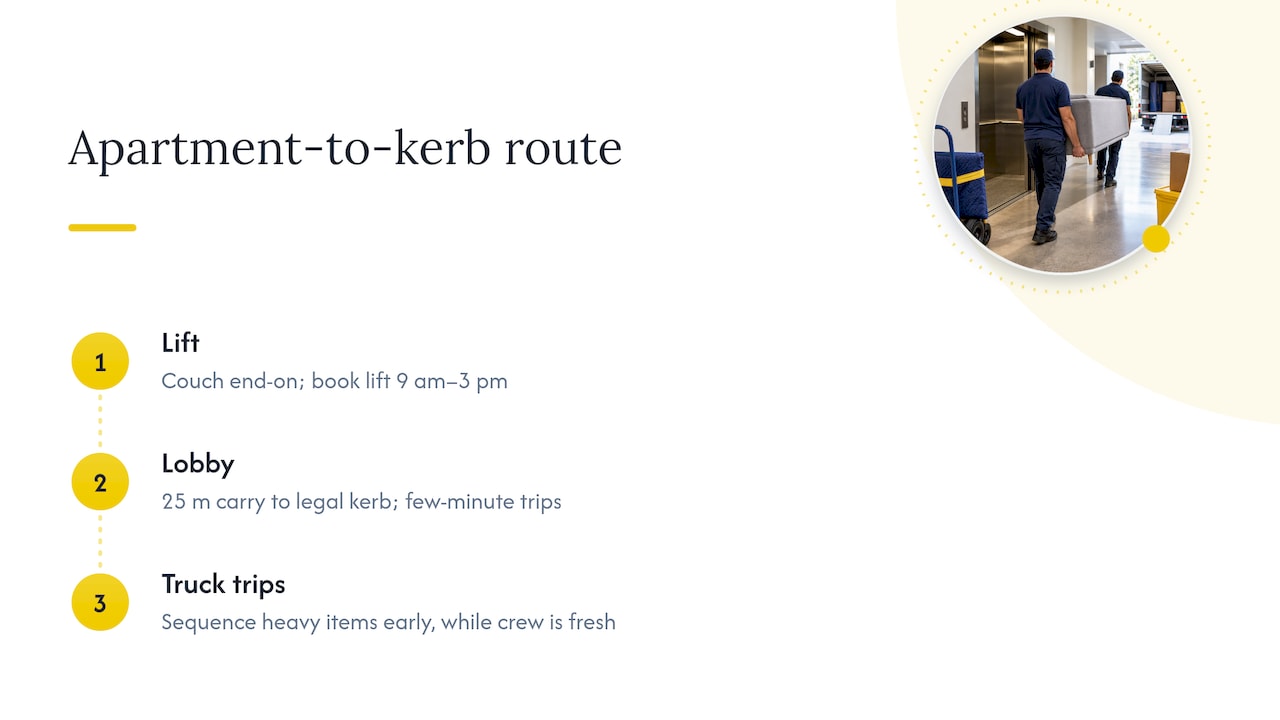
Say you are leaving a CBD apartment on a laneway. The lift fits a standard couch only on its end, the lobby is 25 m from the nearest legal kerb space, and the building allows moves between 9 am and 3 pm. That tells you three things. Book the lift for the full window. Plan the couch to travel on its end, or let it go. And expect each trip to the truck to be a few minutes, so sequence heavy items early while the crew is fresh. None of this shows up until you walk the route.
Step 4: Use equipment, not just muscle
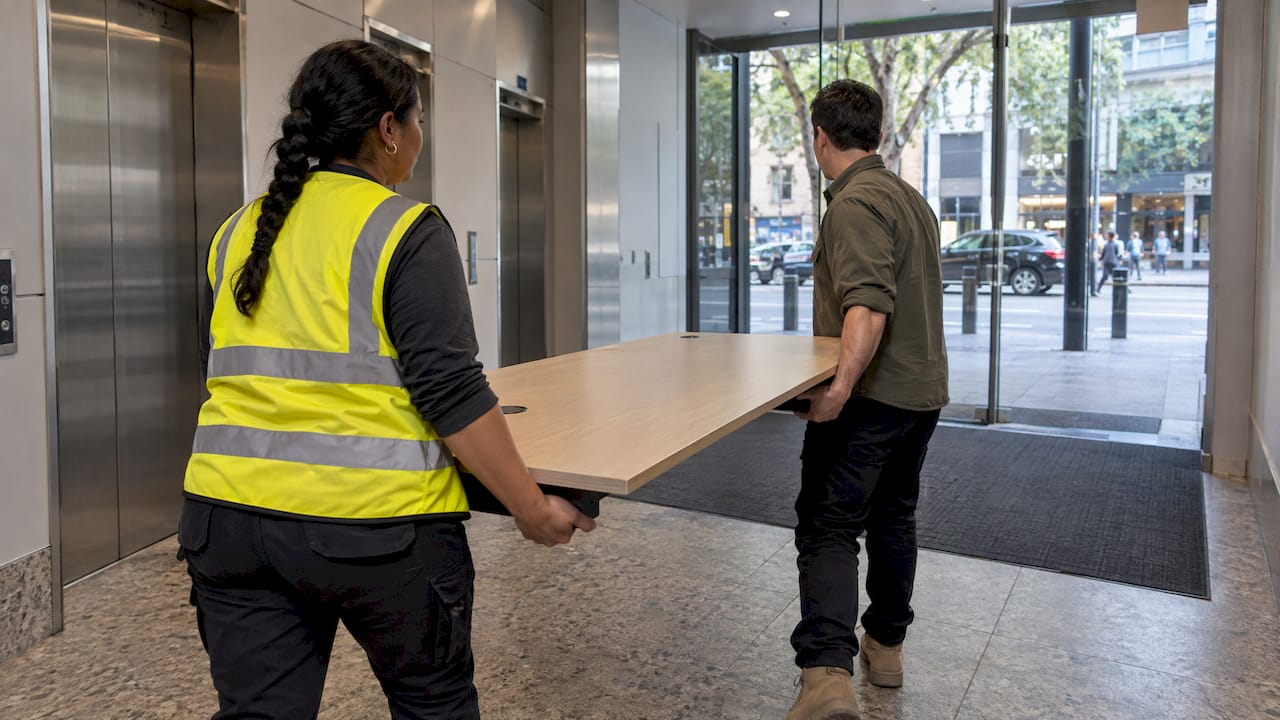
Lack of a dock does not mean everything gets hand-carried. WorkSafe Victoria’s guidance on large, bulky or awkward items recommends powered mechanical aids first, then trolleys or hand pallet jacks where necessary. Team lifting ranks lower and needs planning, information on weight and centre of gravity, training and supervision.
In practice for a no-dock move:
- Use a trolley or appliance dolly for the long run from lobby to kerb.
- Use a hand pallet jack for stacked boxes where the floor is smooth and the route is flat.
- Keep a lift runner or board for thresholds and ramps.
- Pack boxes to a weight one person can carry safely.
Safety checks before anything heavy moves
WorkSafe Victoria lists the factors to consider when moving objects: size, weight and handling instructions, equipment condition and suitability, floor condition and clutter, available help, and adequate time. It also warns that large, heavy, bulky or awkward objects, and repetitive lifting, pushing, pulling, bending or twisting, can cause strains, sprains, fractures and soft-tissue injuries.
Safe Work Australia’s definition of a hazardous manual task is a useful test. It covers lifting, lowering, pushing, pulling, carrying, moving, holding or restraining objects involving repetitive movement, sustained or high force, awkward postures or vibration. A long carry from a lobby to the kerb with a heavy item meets that description. If your move involves oversized items, steep stairs or fewer people than the load needs, that is the point to bring in professional movers and see a licensed professional for anything heavy you cannot handle safely. If you move staff or an office, treat it as a workplace task and put it in your risk register, as above.
Step 5: Protect the building and your belongings
A move through a lobby is a move through shared property. Protect it and the building will be easier to deal with next time. Agree protection before the day: runners, cushioning or boards for the floor finish, a check of wheels and runners for grit, and corner guards, blankets and padding for door frames, wall corners and lift interiors.
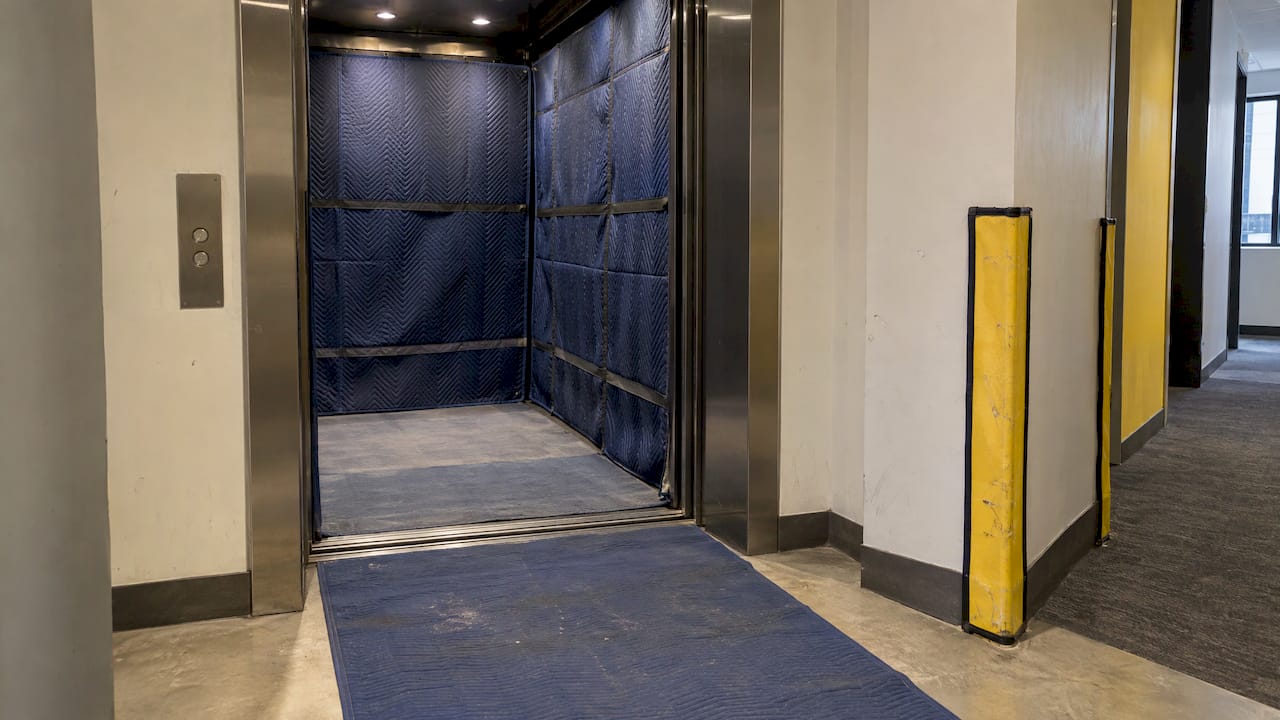
Lifts are often the weak point. Schindler Australia, for example, describes a lift moving package with flame-retardant padded wall mats, operating-panel covers and an independent service mode. Your building manager will know whether something similar is used in your building.
Keep loading and unloading areas clear of guests and unnecessary foot traffic. Photograph the lobby and lift before you start, so the condition is recorded.
Step 6: Cut the load before move day
In a building with no dock, every extra item costs you a trip through the lobby, a lift booking minute and a carry to the kerb. The simplest way to shorten the day is to move less.
Before you pack, sort everything into keep, donate and dispose. Old couches, mattresses, broken office chairs, desks and bulky packaging are the usual culprits. They are the items that are hardest to get down a lift and the least worth moving.
We take care of that part. Melbourne City Rubbish removes unwanted items across Melbourne for homes, offices and buildings. For furniture, our furniture disposal and recycling service covers removal. If the couch is the problem, see our page on couch disposal in Melbourne. Check our rubbish removal preparation checks first so nothing is rejected on the day.
If you are clearing an apartment building or a shared area, our apartment building rubbish removal page explains what we do in CBD buildings. We have experience working in Melbourne commercial buildings, and we aim to leave no mess and no damage to property.
Moving an office with no dock
Offices bring volume: desks, filing cabinets, screens and e-waste. Our office relocation waste checklist sets out what to plan for, and office furniture removal handles the pieces you are not taking. For a full clear-out, see office cleanout. If the lease ends and the space must be returned stripped, our what we do page covers make-good and strip-out work.
Our approach is built around punctuality, with real-time notifications and a lateness credit. That matters most in a building where the lift booking is a fixed window and a late truck can eat into it.
Sequencing the day
A no-dock move works best as a short, tight sequence.
- Night before: confirm the lift booking, the contact number and the truck position.
- Early: protect the lift, lobby floor and door frames, and photograph them.
- First loads: move the heaviest and bulkiest items while the lift is free.
- Middle: run boxes in steady batches, with one person at the kerb watching the truck and the signs.
- Last: remove protection, check the lobby and lift, and tell the building manager the move is finished.
A CBD apartment guide published in October 2026 gives the same order of operations for Melbourne: contact your building manager to book the lift and loading dock, ask about moving rules and time slots, measure large furniture, and check where the truck can legally stop, and then do the same at the other address.
Need a truck and crew for waste?
If you are carrying out more than you are moving, such as an office strip-out or a heavy clear-out, we also offer truck and driver hire in Melbourne. Tell us about the building, the lift and the access, and we will quote the job. For a fast quote, use our quick quote page. We also promise to beat any written quote by 5%.
FAQ
Can I use a loading zone for a removal truck in Melbourne?
Only if the sign and the vehicle allow it. RACV says loading zones are for eligible vehicles picking up or delivering goods, with a 30-minute default limit where no time is shown. Other drivers must not stop there even to load or unload. Read the sign on the day and, if unsure, ask your council.
Do I need a permit for a moving truck without a dock?
It depends on your council and your street. If the truck cannot legally park under ordinary street rules, you may need a temporary permit. The City of Melbourne, the City of Port Phillip and Yarra City Council publish relevant permits. Apply well ahead, since the City of Port Phillip asks for at least five days’ notice.
How early should I tell the building manager?
As early as you can, and before booking movers. Strata buildings commonly ask for around 14 days’ notice, and lift windows can fill up. Confirm the time, lift booking and protection rules in writing at both addresses.
How do I get rid of bulky furniture before the move?
Book a rubbish removal service ahead of move day, so the items are collected before the lift is needed for your own belongings. Our team can remove old furniture, mattresses and office items across Melbourne. Check our preparation checks first to avoid rejected items.
Sources
- Handback: how big items leave a CBD building
- AuServin: apartment moving tips, lifts, loading and parking
- Building Managers Australia: moving into and out of strata buildings
- Brilliance Removals: planning an office move in Melbourne
- Move Craft: building access on move day
- RACV: Victorian road rules for parking and stopping
- NSW Government: parking rules
- Best Local Cleaners: removal truck permits in Melbourne by council
- JB Removals: apartment moving access checklist
- WorkSafe Victoria: handling large, bulky or awkward items
- WorkSafe Victoria: moving or lifting objects
- Safe Work Australia: lifting, pushing and pulling
- JB Removals: protecting floors and walls
- Schindler Australia: moving package for elevators
- Quick ‘n’ Slick Removals: moving into a Melbourne CBD apartment