Hire a specialist that can prove RAID-aware data sanitisation, per-drive Certificates of Destruction and a documented chain of custody, not a generic scrap-metal collector. Before you sign anything, confirm they’ll deliver a full asset inventory, serialised drive tracking, a sanitisation method that matches NIST 800-88 or IEEE 2883, safe handling for UPS batteries, and a recycling report you can hand to an auditor. If a quote skips any of these, keep looking.
TL;DR:
- Proper server rack disposal requires detailed tracking of all components, especially drives in RAID arrays, with serial numbers captured before removal.
- Chain of custody and formal release approval are essential to meet compliance, including signed Certificates of Destruction matched to asset tags.
- Costs vary significantly based on drive quantity, hazardous battery handling, and on-site destruction options, with timelines ranging from one day to over a week.
- Australian e-waste regulations mean organizations must verify their recycler’s licensing, standards adherence, and battery segregation practices to avoid compliance gaps.
- After sanitisation, hardware can be reused, recycled, or disposed of with full transparency on recovered material endpoints, critical for sustainability and audit requirements.
Table of Contents
- What server rack disposal actually includes
- Why chain of custody and formal release actually matter
- What Australian e-waste rules mean for your rack
- How a compliant server rack removal job actually runs
- Choosing a server rack disposal provider: what to check
- What server rack disposal actually costs and how long it takes
- What happens to your equipment after sanitisation
- How Melbourne City Rubbish handles server rack removal
- Sources
- FAQ
What server rack disposal actually includes
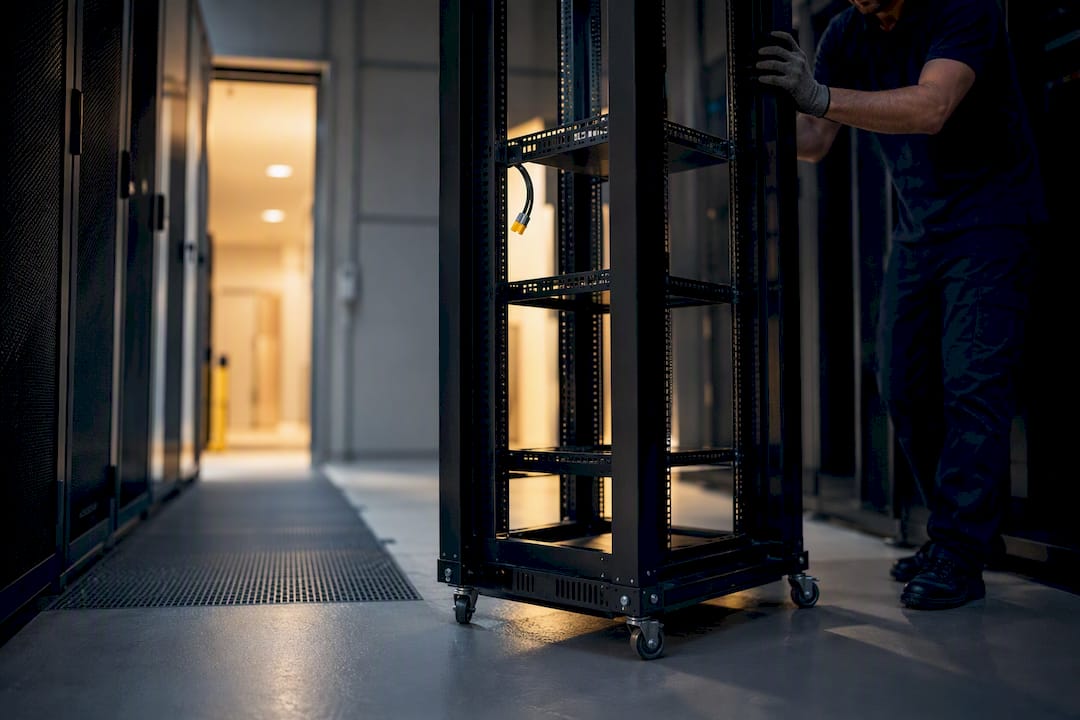
A server rack disposal job is never just “the rack.” It’s every component bolted, slotted, or cabled into it, and each one needs its own line in the paperwork.
A proper scope covers the physical frame and rails, but the real risk sits inside the boxes. Storage arrays running RAID configurations often hold many drives per unit, and every single one needs individual tracking. A provider that quotes “server disposal” without asking how many drives are in each array hasn’t scoped the job properly.
The full inventory a competent provider should capture:
- Rack frames, rails, and mounting hardware
- Servers, blade enclosures, and storage arrays (with per-drive serial capture for RAID units)
- Network switches, routers, and patch panels
- Power distribution units (PDUs) and associated cabling
- UPS units and their batteries, flagged separately as hazardous
- Controller cards, management modules, and RAM/CPU components where removed
- Peripherals, KVM switches, and loose cabling
Site surveys and asset inventories should record serial numbers, CMDB identifiers, and physical location for every item before anything is powered down or moved, according to the Australian Signals Directorate’s equipment guidelines. This isn’t paperwork for its own sake. If a drive goes missing between the server room and the sanitisation bench, you need a document trail that shows exactly where the gap opened up.
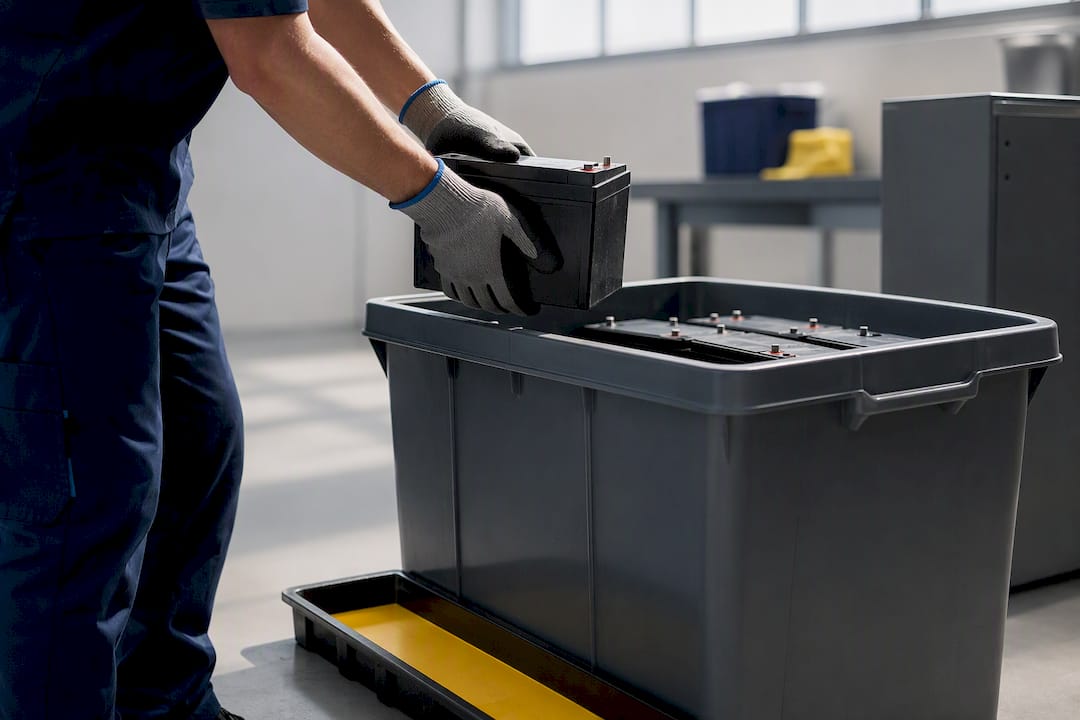
UPS batteries deserve their own callout here because they’re the item most often mishandled. They contain reactive metals and flammable electrolytes, and tossing them into a general e-waste skip with servers and cabling can breach transport rules depending on your state. Ask your provider how batteries are segregated before you ask about anything else on the inventory.
Why chain of custody and formal release actually matter
Data destruction isn’t the finish line. It’s step one of a two-part governance process, and skipping the second part is where most organisations get exposed.
Chain of custody means every storage device is logged by serial number the moment it’s pulled from the rack, and that log follows the drive through sanitisation, destruction, and final reporting. A serialised Certificate of Destruction for each drive is what lets your compliance team reconcile the paperwork against your CMDB months later, rather than trusting a single blanket “disposed” receipt covering an entire pallet.
Governance callout: the Australian Signals Directorate’s guidelines specify that identifying labels should only be removed after inventory data is captured and an authorised approver signs off on release. Sanitised hardware still needs that formal administrative approval before it leaves your organisation’s control.
That last point trips up a lot of IT teams. You can wipe every drive to spec and still be out of compliance if nobody with the authority to approve release actually signs off before the truck leaves. It’s a governance step, not a technical one, and it exists because sanitisation alone doesn’t eliminate residual security risk once equipment re-enters general circulation.
What to ask a provider for as evidence:
- Per-drive Certificates of Destruction, serialised and matched to your asset tags
- Written confirmation of the sanitisation standard applied, referencing NIST 800-88 or, for SSDs, IEEE 2883
- A documented start point for chain of custody, ideally from the moment of drive extraction
- Confirmation that a named, authorised person signed off release before equipment left site
Treat these as the entry bar for any conversation about pricing, not a nice-to-have upgrade.
What Australian e-waste rules mean for your rack
Assuming the free household recycling scheme covers your server room is one of the most common and costly mistakes IT managers make.
The National Television and Computer Recycling Scheme gives households and small businesses free drop-off access for computer equipment, but it was never built for commercial rack decommissions. A typical load of servers and switches usually sits outside its normal free collection routes, which means you’re contracting a recycler or ITAD provider and paying for the service, not relying on a government scheme to absorb the cost.
State rules add another layer. Western Australia banned regulated e-waste from landfill from 1 July 2024, and federal product stewardship schemes don’t override state or territory requirements. If your organisation operates across multiple states, don’t assume one recycler’s compliance in Victoria automatically satisfies obligations elsewhere.
Before booking, verify three things with any recycler or removal service:
- Current licensing to handle e-waste in your state, not just a general waste-collection permit
- Alignment with AS 5377, the Australian Standard covering traceability, storage, transport, and treatment of electronic waste
- A written “no landfill” downstream policy for anything they can’t reuse or recover
Battery and UPS transport is the sharpest edge here. Loose lithium or lead-acid batteries mixed into a general scrap load can trigger hazardous-classification rules, and scrap-metal operators are specifically warned about reactive metals and flammable electrolytes in mixed loads. If your provider can’t describe how they’ll segregate and transport batteries separately, that’s a compliance gap you’ll inherit.
How a compliant server rack removal job actually runs
Most rack decommissions fall apart at the scheduling stage, not the technical stage. Here’s the sequence a properly run job follows, from first site visit to final sign-off.
- Site survey and inventory cross-check. A technician walks the rack row, records serial numbers, and cross-references every asset against your CMDB before anything gets touched.
- Controlled power-down. Equipment is sequenced offline in an order that avoids disrupting live services still running on adjacent racks, coordinated with your facilities and network teams.
- Storage-media extraction and logging. Every drive comes out individually and gets logged by serial number. This is where chain of custody formally begins.
- Sanitisation or destruction. Depending on classification, this might mean on-site witnessed wiping to NIST 800-88 standards, IEEE 2883 methods for SSDs, or physical shredding and degaussing for high-classification drives that can’t leave site intact.
- De-racking and safe movement. The empty frame, rails, and remaining hardware are broken down and moved, with batteries segregated into their own transport stream throughout.
- Transport to approved processors. Materials head to licensed recycling or ITAD facilities, batteries and hazardous items handled under separate manifest from general e-waste.
- Final reconciliation report. You receive certificates, an updated asset register, and confirmation matching what left your building against what was disposed of, recycled, or recovered.
Pro Tip: Ask whether on-site witnessed destruction is available for your most sensitive drives. Watching a shredder physically destroy a drive that held financial or health records is often the fastest way to satisfy an auditor who’s asking hard questions about your handback conditions.
That witnessing option matters more than most IT managers expect going in. For APRA-regulated entities or anyone with strict contractual handback clauses, same-day Certificates of Destruction issued after witnessed on-site destruction can be the difference between a clean audit and a drawn-out compliance headache six months later.
Choosing a server rack disposal provider: what to check
Two quotes that look identical on price can represent wildly different levels of actual compliance. The gap shows up in the paperwork, not the invoice.
Start by asking for credentials, not promises:
- ISO/IEC 27001 certification or an equivalent information-security management framework
- A sample per-drive Certificate of Destruction so you know exactly what evidence you’ll receive
- A written statement of alignment with AS 5377 for handling and traceability
- Confirmation of whether destruction happens on-site (witnessed) or off-site, and what that means for your chain-of-custody start point
Then push on the details that pricing tables often hide:
- Whether asset recovery and resale value get reconciled back against your quote, or handled as a separate line
- Extra charges for battery handling, restricted-access buildings, or after-hours work
- Named downstream processors for recovered materials, at least at a category level
A few red flags should end the conversation immediately. Vague paperwork that just says “disposed” with no serial-level detail is one. Quotes using only “scrap metal pickup” language for equipment that clearly holds sensitive data is another; that phrasing usually signals a provider working under Australian Standard AS 5377 isn’t part of their process at all. And any provider planning to load batteries in with general e-waste in the same transport run, rather than segregating them, is telling you they haven’t read the handling requirements for reactive and hazardous materials that apply in most states.
What server rack disposal actually costs and how long it takes
Pricing on rack decommissions swings hard depending on a handful of factors, and understanding them helps you compare quotes that are actually comparable.
The biggest driver is usually drive count, since per-drive sanitisation and certification is a labour-intensive process regardless of how big the rack itself is. A rack with six servers and forty drives across its storage arrays will often cost more to process than a rack with twenty servers and minimal onboard storage.
Other cost drivers worth asking about upfront:
- On-site destruction equipment (mobile shredders or degaussers cost more to deploy than off-site processing)
- Battery and UPS handling, which often carries a separate line item given hazardous-transport requirements
- Building access constraints (loading dock availability, lift bookings, after-hours work)
- Transport distance to the nearest licensed processing facility
Timelines vary just as much. A small job with witnessed on-site destruction can wrap in a single day. A full data centre decommission involving off-site sanitisation, multiple racks, and reconciliation reporting typically runs three to ten business days from first site visit to final certificate delivery.
Asset recovery can offset a meaningful chunk of the invoice. Working servers, switches, and storage hardware still under a few years old often have resale value, and a provider who factors recovery credits into the quote upfront, rather than treating it as a separate afterthought, usually gives you a more honest total cost.
What happens to your equipment after sanitisation
Once drives are wiped or destroyed, the hardware itself still has a second life ahead of it, and where it goes matters for both your sustainability reporting and your compliance file.
Processing generally splits into three streams: equipment fit for reuse gets tested and resold, material suitable for recovery goes through disassembly and mechanical preprocessing, and hazardous components like batteries move through separate treatment entirely. Some of the recovered material fractions get processed domestically; others are exported for specialist metal recovery that isn’t commercially viable at smaller Australian volumes.
Lifecycle analysis from ANZRP’s TechCollect program found e-waste processing combines manual disassembly with mechanical preprocessing, and that a meaningful share of certain fractions gets exported for specialist recovery rather than processed locally. That’s not a red flag on its own. It reflects the reality that some recovery processes only make economic sense at scale, and Australia’s volumes don’t always support every step domestically.
What matters is whether your provider will tell you where the material actually went.
| What to request | Why it matters |
|---|---|
| Recovered material fraction breakdown | Confirms what proportion was reused, recycled, or landfilled |
| Downstream processor identification | Lets you verify licensing independently if needed |
| Final reconciliation against original inventory | Closes the loop between what left your building and what was processed |
A provider unwilling to share even a category-level breakdown of where materials ended up is one you should question further before your next contract renewal.
How Melbourne City Rubbish handles server rack removal
Once the data destruction and certification side is sorted, someone still has to physically get the empty rack, cabling, and packaging out of your building without disrupting the rest of your office. That’s where Melbournecityrubbish comes in, as a Melbourne-based option for the removal side of the job that sits alongside your ITAD or sanitisation provider.
Melbournecityrubbish handles commercial office rubbish removal across Melbourne, including the physical clearance of decommissioned IT hardware, packaging, and general office waste that comes with a server room clear-out. Its team works with an option for carbon-neutral disposal for businesses that want their clearance job counted toward sustainability reporting, and it operates with real-time notifications and a lateness credit built in, so a rack removal doesn’t blow out your team’s working day. If you’ve already got written quotes from other removalists, Melbournecityrubbish will beat them by 5%.
For the parts of the job that fall outside data sanitisation itself, browse the full range of services or get a fast, no-obligation number through the quick quote page before you finalise your decommissioning schedule.
Sources
Keep these on hand when you’re briefing procurement or preparing for an audit:
- Cyber
- National Television and Computer Recycling Scheme (NTCRS) — DCCEEW
- Waste management — e-waste landfill ban (WA government)
- Potential environmental benefits of e-waste recycling in Australia — ANZRP FY24 LCA report
FAQ
What can I do with old servers besides throwing them out?
Old servers can be sanitised and resold through asset recovery channels if they’re still functional, or recycled through a licensed e-waste processor once data has been destroyed and certified. Never place them in general waste. Batteries and UPS units need separate hazardous handling regardless of which path you choose.
What electronics should never be thrown away with general waste?
Anything containing a battery, circuit board, or stored data, including UPS units, servers, switches, and storage arrays, should never go into general waste or a standard skip bin. These items usually require licensed e-waste handling and, for hardware that held data, sanitisation before disposal even begins.
Do hardware stores still take electrical items for recycling?
Some retail take-back programs accept small household electronics, but they’re not designed for commercial rack-level equipment like servers, switches, or UPS units. Commercial IT hardware needs a contracted recycler or removal service such as Melbournecityrubbish that can document chain of custody and destruction.
What happens to old computers when a business recycles them?
Functional units are typically tested for resale or reuse, while non-functional hardware is disassembled and processed for material recovery, with hazardous components like batteries treated separately. A compliant recycler should be able to report what fraction of your equipment went to each stream rather than issuing a single blanket disposal receipt.
How much does server rack disposal typically cost?
Cost depends heavily on drive count, battery handling, and whether destruction happens on-site or off-site, so there’s no single fixed figure across the industry. Melbournecityrubbish provides quotes based on the specifics of each job through its quick quote page, with pricing available on request.