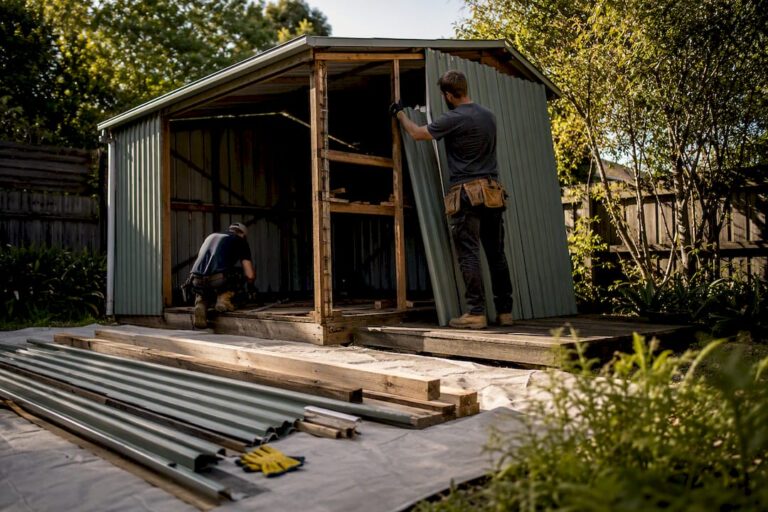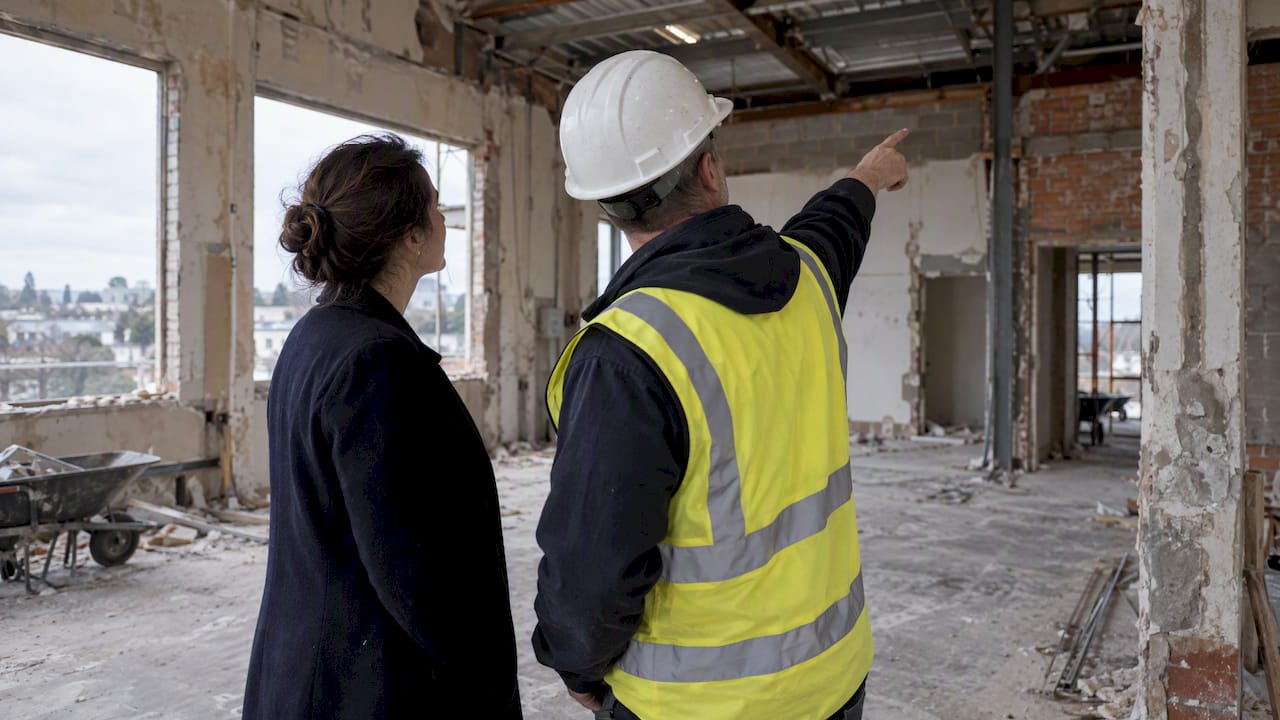
Strip out removes non-structural finishes, fixtures and services; demolition removes structural elements or whole structures. The deciding factor is whether the work affects structural integrity or disturbs asbestos, because that’s what shifts a job from a routine refit into construction work with higher regulatory duties. If you’re unsure which category a job falls into, get marked-up scope drawings and a structural or asbestos assessment before you sign off on a quote.
TL;DR:
- A scope scope with marked-up drawings and an asbestos register is essential to accurately define whether work is a simple strip out or qualifies as demolition, affecting legal obligations.
- Demolition involves higher risks such as structural collapse and asbestos disturbance, requiring specific controls like engineered plans, licensed operators, and specific permits.
- Separate the sequence of interior strip-out and structural demolition in contracts, ensuring asbestos removal and regulatory notifications occur before demolition begins.
- Waste and hazardous materials must be sorted on-site early, with proof of lawful disposal, to avoid environmental and legal violations that can delay the project.
- Request detailed documentation from contractors—including scope drawings, licenses, insurance, and waste plans—before finalizing quotes to prevent scope creep and unanticipated costs.
Table of Contents
- The difference in plain English: the boundary managers should use
- What a strip out usually covers (checklist for quotes)
- What demolition covers: types, risks and required controls
- When a project includes both strip out and demolition: sequencing and contracts
- Approvals, licences and notifications: practical checklist
- Asbestos and hazardous materials: required steps before any strip-out or demolition
- Waste, reuse and recycling planning: avoid environmental and legal risks
- Cost and programme differences: what drives price and schedule variation
- How to choose the right scope and contractor: documents to request and red flags
- How Melbourne City Rubbish supports strip-out and demolition projects
- Authoritative guidance to consult (regulators, codes and EPA guidance)
- Sources
- FAQ
The difference in plain English: the boundary managers should use
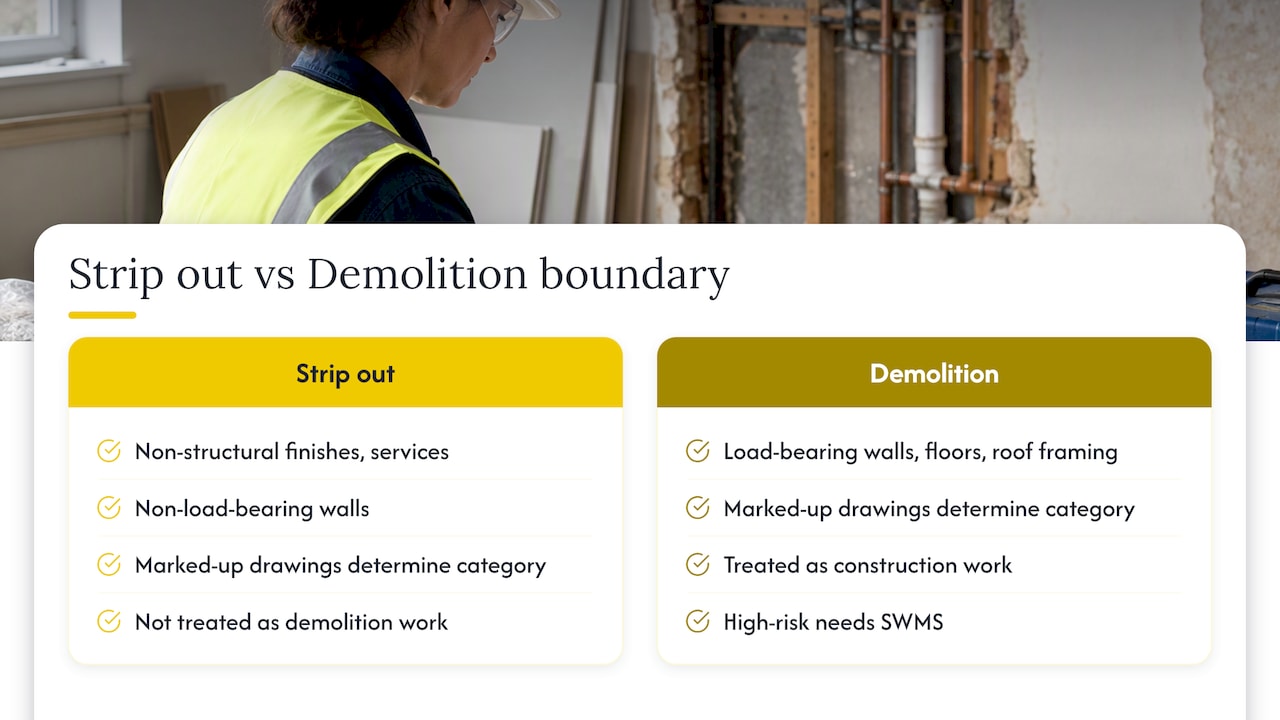
The practical boundary is structural integrity. Non-structural finishes, walls that carry no load and services that aren’t part of the building’s structure fall under strip out. Load-bearing walls, structural floors, roof framing and anything connected to the building’s overall stability fall under demolition.
A contractor’s quote describing a job as a “strip out” doesn’t settle the question. Wording on a proposal is a sales description, not an engineering assessment. Marked-up drawings showing exactly which elements come out are what actually determine the category, and they’re what a building surveyor or structural engineer will want to see.
This matters because the model code of practice for demolition work treats demolition as construction work, which carries its own duties, and high-risk demolition requires a Safe Work Method Statement before anyone starts.
What a strip out usually covers (checklist for quotes)
A strip out clears the inside of a space while leaving the structural shell intact. When comparing quotes, check they cover:
- Joinery, cabinetry and built-in furniture removal
- Floor coverings, ceiling tiles and wall linings
- Non-structural partitions and internal fit-out elements
- Disconnection of fixtures and agreed minor services work
What a strip-out quote typically excludes is just as important: structural walls, major service rerouting through the building’s core, concealed asbestos behind linings, and any council-related external works. These sit outside a standard strip-out scope and can turn into separate line items or trigger a different approval path entirely.
Before accepting a price, ask for marked-up drawings showing exactly what’s coming out, and a stated waste-destination plan. A contractor who can’t produce either is guessing at scope, and you’ll be the one who pays for the guess.
What demolition covers: types, risks and required controls
Demolition ranges from partial removal of a structural element to full demolition of a building, and occasionally induced collapse for larger structures. It also splits by method: mechanical demolition using excavators or cranes, versus manual demolition where workers dismantle elements by hand, often where access or adjoining structures limit machine use.
The risks scale with the structural work involved: collapse of weakened or partially demolished elements, falling debris, plant operating near overhead services, workers or equipment on suspended floors that weren’t designed for that load, and the disturbance of asbestos hidden in older materials.
Because of this, demolition work typically requires a Safe Work Method Statement, engineered demolition plans showing sequence and bracing, licensed operators for specified demolition work, exclusion zones to keep people clear of the work area, and site-specific personal protective equipment. The model code sets out a hierarchy of controls for exactly this reason: demolition has more ways to go wrong than a strip out, and the paperwork reflects that.
When a project includes both strip out and demolition: sequencing and contracts
Many refits involve both. Interior finishes and services come out first under a strip-out scope, then a structural wall, mezzanine or extension gets removed under demolition rules.
Separate the two in your scope documents rather than bundling them into one vague “fit-out removal” line. Sequencing matters: asbestos removal and regulatory notifications usually need to happen before structural demolition starts, not alongside it.
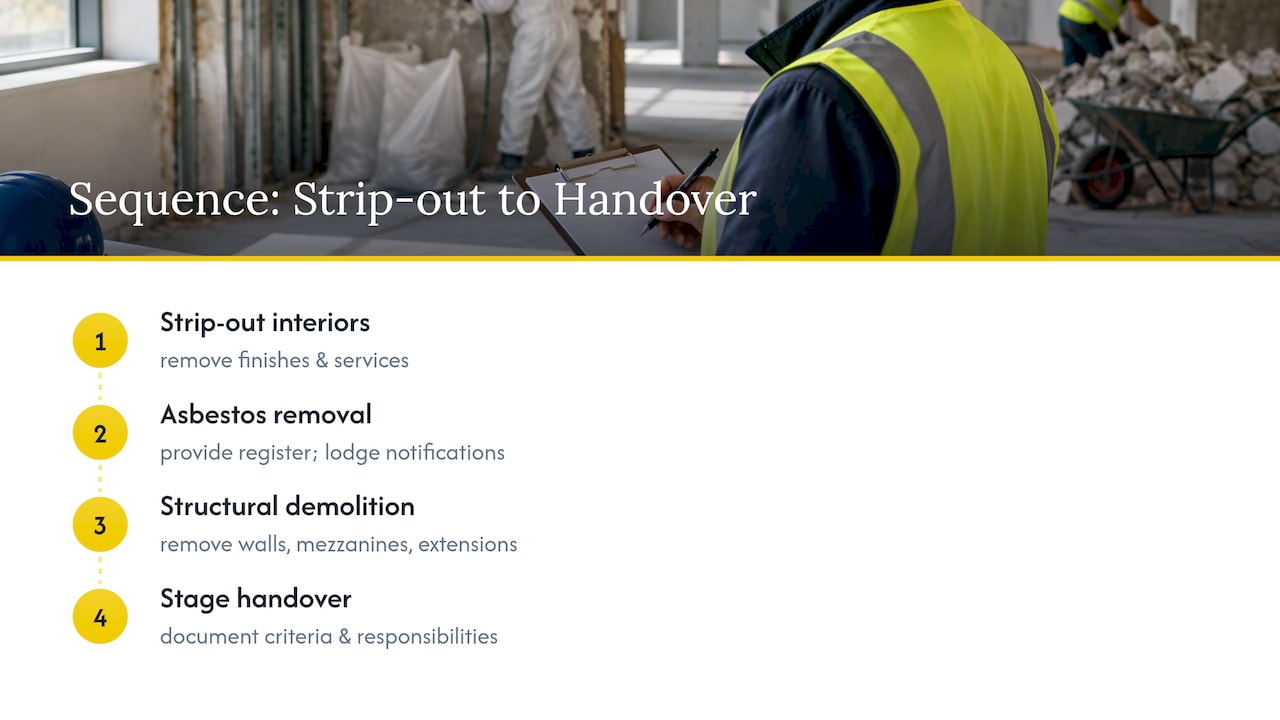
Your contract should state who provides the asbestos register, who lodges any required notification, and what the handover criteria are for each stage, so there’s no dispute about who was responsible when something was missed.
Approvals, licences and notifications: practical checklist
Notification and approval aren’t the same thing, and mixing them up causes delays. Work through these in order:
- Check whether your job is “specified demolition” under WHS model rules: demolition of load-bearing elements over a certain height, use of load-shifting machinery on suspended floors, or use of explosives are common triggers. WorkSafe Queensland’s demolition notification guidance describes a typical five-calendar-day notification window ahead of specified demolition work.
- Confirm local building and planning triggers separately. In Victoria, certain demolition work needs Section 29A report and consent, and a planning permit may also apply, for example for facade demolition or cumulative demolition exceeding half a building’s volume over three years.
- Talk to a building surveyor early, confirm the correct state regulator forms for your job, and lodge notifications with enough lead time that they don’t become the thing holding up your start date.
Notifying a regulator gets you past the WHS trigger. It doesn’t replace a building permit or a council planning approval, and treating the two as interchangeable is one of the more common scheduling mistakes on these jobs.
Asbestos and hazardous materials: required steps before any strip-out or demolition
Before work starts, the person controlling the workplace has a duty to review the asbestos register and give it to the contractor. SafeWork NSW’s guidance on asbestos registers states that asbestos likely to be disturbed should be identified and removed where reasonably practicable before refurbishment or demolition begins.
Licensed asbestos removal is required for most bonded and all friable asbestos work, and the licensing thresholds vary by state, so check the relevant regulator’s rules rather than assuming a default. Staged access for removal is generally permitted, which lets asbestos come out ahead of the main works without stopping the whole job.
A competent survey up front costs far less than discovering asbestos midway through a strip out. Low-ball quotes that skip the survey are the ones most likely to blow out once hidden materials turn up.
Waste, reuse and recycling planning: avoid environmental and legal risks
Strip-out and demolition jobs generate a mix of masonry, timber, metal, plaster, electronic waste and sometimes hazardous materials, and segregating these on site from day one protects both your budget and your compliance position.
EPA Victoria’s guidance on renovation and construction waste recommends identifying waste streams early, using authorised receivers and keeping records, which supports recovery value and avoids illegal disposal. Mixed loads are harder and more expensive to recycle than separated ones, so ask your contractor for a stated waste-destination plan and proof that materials went to a lawful, authorised receiver. Reusable joinery, timber and even wall panelling can sometimes be salvaged rather than binned, including through specialist suppliers of commercial wall panels who take reclaimed materials for reuse.
Cost and programme differences: what drives price and schedule variation
Cost is driven mainly by where the scope boundary sits. Structural work costs more than finishes removal, and asbestos discovery or removal adds cost and time that a plain strip-out quote won’t include.
Plant hire, traffic management permits, disposal fees and the effort needed to separate waste streams properly all move the price up or down between otherwise similar-looking jobs. On the schedule side, the real risks are latent surprises: concealed services, unexpected asbestos, or permit delays waiting on a regulator response.
Ask for itemised quotes rather than one lump figure, get exclusions stated clearly in writing, and build in a contingency allowance for the unknowns that only show up once walls come down.
How to choose the right scope and contractor: documents to request and red flags
Before you commit to a contractor, ask for the paper trail that shows they’ve actually planned the job, not just priced it.
- Marked-up scope drawings showing exactly what comes out
- The current asbestos register and management plan
- A Safe Work Method Statement for any structural work
- Licences and current insurance certificates
- A stated waste-destination plan with proof of lawful disposal
Ask who’s lodging any required notification, who’s managing the waste stream, how they’ll handle an unexpected asbestos finding, and what sequence they’re proposing. A vague scope, reluctance to show licences or insurance, no waste plan, or a flat price with no allowance for unknowns are all signs to walk away.
Pro Tip: Get the asbestos register and scope drawings before you ask for final pricing, not after. It stops low quotes from being low only because they’ve skipped the hard parts.
How Melbourne City Rubbish supports strip-out and demolition projects
Getting the waste side sorted shouldn’t be the hold-up on a strip-out or demolition job. Melbourne City Rubbish handles building strip out, construction waste removal and structural demolition debris, with a carbon-neutral disposal option for clients who want their waste stream handled sustainably.
- Staged support across strip out through to post-demolition clean-up
- Quick quoting so waste planning doesn’t delay the rest of the job
- Coordination around staged handovers between trades
If you need an itemised waste plan or a quote for a staged strip-out and demolition package, get in touch with Melbourne City Rubbish to line it up before works start.
Authoritative guidance to consult (regulators, codes and EPA guidance)
Check Safe Work Australia’s model code, your state WHS regulator’s demolition and asbestos pages, and EPA Victoria’s waste guidance before finalising scope, and confirm local council planning triggers with a building surveyor.
Sources
- Model code of practice: demolition work (Safe Work Australia)
- Asbestos registers and management plans (SafeWork NSW)
- Home renovation and construction waste guidance (EPA Victoria)
- Demolition notifications (WorkSafe Queensland)
- Section 29A consent for proposed demolition (City of Melbourne)
FAQ
What are the three types of demolition?
Demolition is generally grouped into partial demolition (removing part of a structure), full demolition (removing an entire building) and induced-collapse demolition for larger or more complex structures. Which type applies affects the controls and notifications required under the model code of practice.
Is it better to demolish or deconstruct?
It depends on the building, timeline and what you want to recover. Deconstruction prioritises salvaging materials for reuse and tends to take longer, while demolition is usually faster but recovers less value from the structure itself.
What is the cheapest way to demo a house?
Keeping the scope tightly defined, separating waste streams for recycling, and avoiding late discoveries of asbestos or hidden structural elements are the biggest levers on cost. A proper survey before quoting prevents the expensive scope changes that blow out an initially cheap-looking price.
Is a building permit required for demolition?
Often, yes, alongside any WHS notification. In Victoria, for example, some demolition work needs Section 29A report and consent, and a separate planning permit may also apply depending on the scale of the work.
What’s the difference between notifying a regulator and getting approval for demolition?
Notification tells the WHS regulator that specified demolition work is happening, typically within a set window before work starts. It doesn’t replace a building permit or council planning approval, which are separate processes that may still be required.