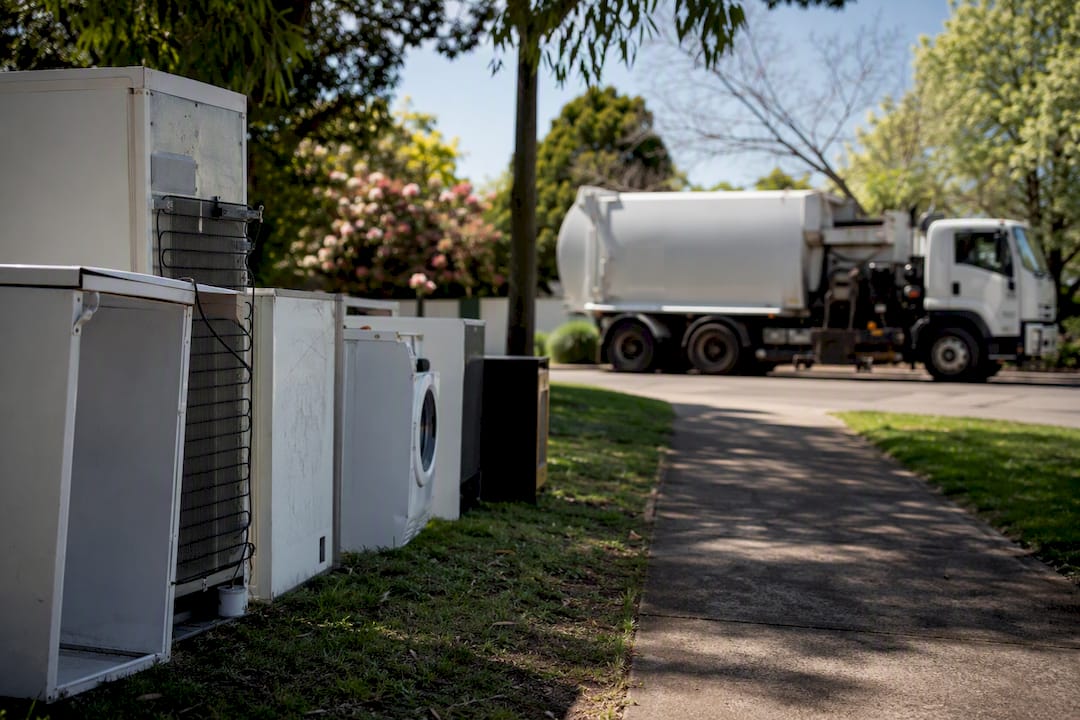
If your fridge, washing machine or old microwave still works, donate it or sell it before anything else. If it doesn’t, check your council’s bulk collection or drop-off service first. Fridges and freezers are the exception to every rule: they must be degassed by a licensed technician before anyone scraps them, so don’t attempt this yourself. When you need a hand shifting something heavy, book a removal service that hands you a disposal receipt and confirms the appliance went through licensed handling.
- Still working? Donate to a charity, list it for free pickup, or sell it.
- Not working, small to medium item? Book council bulk collection or drop it at a resource recovery centre.
- Fridge or freezer? Refrigerant must be recovered by a licensed technician before disposal, no exceptions.
- Need it moved? Choose a removal company that documents where the appliance ends up.
Key Takeaways
Safe white goods disposal means matching the appliance to the right pathway and never letting refrigerant handling happen without a licensed technician.
| Point | Details |
|---|---|
| Reuse before you recycle | Donate or sell working appliances rather than sending them straight to scrap. |
| Fridges need licensed degassing | Never let anyone remove a fridge or freezer without confirmed refrigerant recovery. |
| Prep before pickup | Defrost, unplug, tape doors and note dimensions at least a day ahead of collection. |
| Ask for paperwork | Request a disposal receipt and chain-of-custody documentation from any recycler or remover. |
| Melbournecityrubbish handles compliance | Melbournecityrubbish removes appliances across Melbourne with carbon-neutral options and documented licensed handling. |
Where to check next
- DCCEEW’s recycling drop-off guidance for verifying a recycler’s credentials.
- RecyclingNearYou’s whitegoods finder for accepted items and nearby drop-off points.
- SSROC’s product stewardship review for the regulatory background on large appliance recycling.
Table of Contents
- Preparing your appliance for pickup or drop-off
- Where should you actually take a white good?
- Why does refrigerant handling matter so much?
- Finding a recycler or drop-off point near you
- Book a removal that handles the compliance for you
- Sources
Preparing your appliance for pickup or drop-off
Getting a fridge or washing machine out the door safely takes ten minutes of prep, and skipping it is the main reason collections get delayed or refused at the kerb.
- Confirm whether the appliance still works, and wipe any personal data or saved settings from smart fridges, ovens or washing machines with digital displays.
- Unplug it and let it sit disconnected before moving day.
- Defrost fridges and freezers at least 24 hours ahead so melting ice doesn’t flood the truck or your driveway.
- Tape doors shut and stick a label on with your name and collection date.
- Remove or secure loose shelves, trays and hoses, and jot down the appliance’s dimensions and weight for the booking.
- Take a quick photo of its condition, useful if there’s ever a dispute about damage.
- Tell whoever is collecting it about any batteries, gas cylinders or other hazardous components built in.
Pro Tip: Keep the power cord taped to the appliance itself rather than left loose. Loose cords are the number one tripping hazard removalists report on pickup day.
Where should you actually take a white good?
Four real pathways exist for getting rid of an old appliance, and picking the wrong one usually costs you either money or a compliance headache.
Council bulk collections and resource recovery centres handle the bulk of household white goods disposal in Australia. Most councils run scheduled kerbside bulky waste pickups a few times a year, alongside permanent drop-off points at resource recovery centres. Brisbane City Council’s e-waste recycling program is a good example of how these run: book ahead, check what’s accepted, and expect either a free annual allowance or a small fee once you exceed it. Check your own council’s calendar before assuming the service is free.
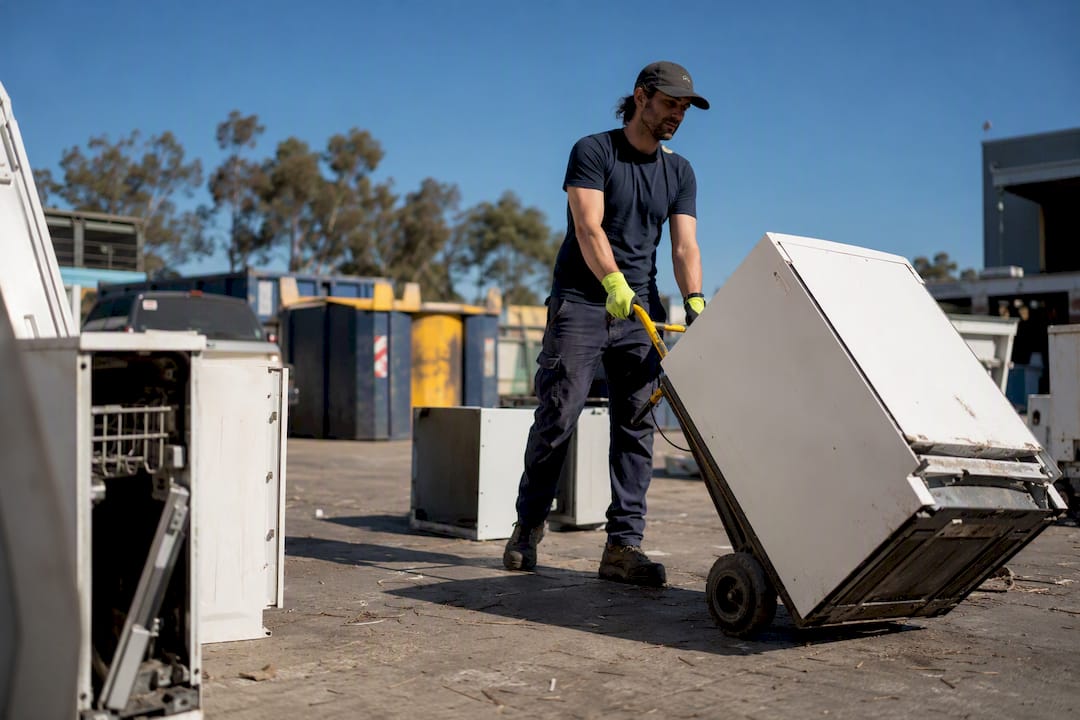
Retailer take-back and trade-in schemes work when you’re buying a replacement. Many appliance retailers will haul away your old unit when they deliver the new one. It’s convenient, but ask exactly where the old appliance goes afterwards. Not every retailer partner runs a genuine recycling process, some simply pass it along the chain.
Licensed recyclers and e-waste facilities are the right call for hazardous items or when you’re clearing several appliances at once. These operators can issue certificates of destruction or recycling, which matters if you need proof for insurance, a body corporate, or a workplace audit.
Private removal services suit anyone without a trailer, anyone facing a strict moving deadline, or anyone clearing multiple appliances from a rental or renovation. Before booking, ask for:
- A written disposal receipt naming where the appliance was taken.
- Confirmation of chain-of-custody if the job needs it for compliance or reporting.
- Proof the operator subcontracts refrigerant recovery to a properly licensed technician.
Why does refrigerant handling matter so much?
Fridges, freezers and some air conditioners hold refrigerant gases that are potent greenhouse contributors when released into the atmosphere. Venting them, even accidentally, is illegal and dangerous. This is the one part of white goods disposal you genuinely cannot DIY.
Look for ARCtick licensing, or your local equivalent, before letting anyone near a fridge with an angle grinder. A compliant process means the refrigerant gets properly recovered, then reclaimed or destroyed, with paperwork to match. Informal scrap collectors who offer to “take it off your hands for free” are the biggest red flag in this entire industry. Skip anyone who can’t produce a licence number on request.
Industry reporting on end-of-life appliances notes that refrigerant management and licensed handling remain the central bottleneck for safe appliance recycling, with many collected fridges still holding refrigerant at the point of pickup.
Some councils and recyclers have responded by building refrigerant recovery clauses directly into collection contracts, or running mobile degassing units that meet trucks at the kerb.
Finding a recycler or drop-off point near you
Two national tools do most of the legwork for you. RecyclingNearYou lists accepted whitegoods and drop-off locations across the country, and Planet Ark’s Recycle Mate covers similar ground for a broader range of household items.
- Search RecyclingNearYou or Recycle Mate first to see what’s accepted locally.
- Check your council’s bulky waste calendar and resource recovery centre page for booking windows and any fees.
- Before you commit, ask the recycler or remover for their licence details, any relevant permits, and a written disposal receipt.
The DCCEEW’s recycling drop-off guidance is worth a bookmark too, particularly if you want the government’s own steer on verifying a recycler before you hand anything over.
What happens to a fridge after it’s picked up?
Once collected, most facilities assess whether the appliance can be repaired and resold rather than scrapped outright. If reuse isn’t viable, hazardous components, refrigerants and oils, come out first. What’s left gets shredded and sorted into material streams.
- Metal makes up most of an appliance’s weight and is the easiest material to recover.
- Plastics and refrigerant-containing insulation are harder to separate cleanly and often have lower recovery rates.
- Local processing capacity varies a lot, and gaps in producer responsibility mean not every material stream gets fully recovered.
Government materials-flow analysis suggests hundreds of thousands of domestic refrigeration units reach end of life across the country each year, putting real pressure on council and recycler capacity.
What to expect from a compliant removal service
A properly run removal service takes the guesswork out of white goods disposal, particularly for households juggling several items at once or businesses clearing out a whole floor.
- Full-service appliance removal covering fridges, washers, dryers and microwaves across Melbourne, with carbon-neutral disposal options available.
- Written confirmation that refrigerant handling is subcontracted to a licensed technician, not skipped.
- Chain-of-custody documentation and a disposal receipt you can file for insurance, strata records or workplace reporting.
- Booking flexibility for one-off pickups or larger multi-appliance and renovation clean-outs.
Before you sign off on any booking, ask what licences and receipts the company provides, it’s the fastest way to separate a genuinely compliant operator from someone with a ute and a trailer.
Book a removal that handles the compliance for you
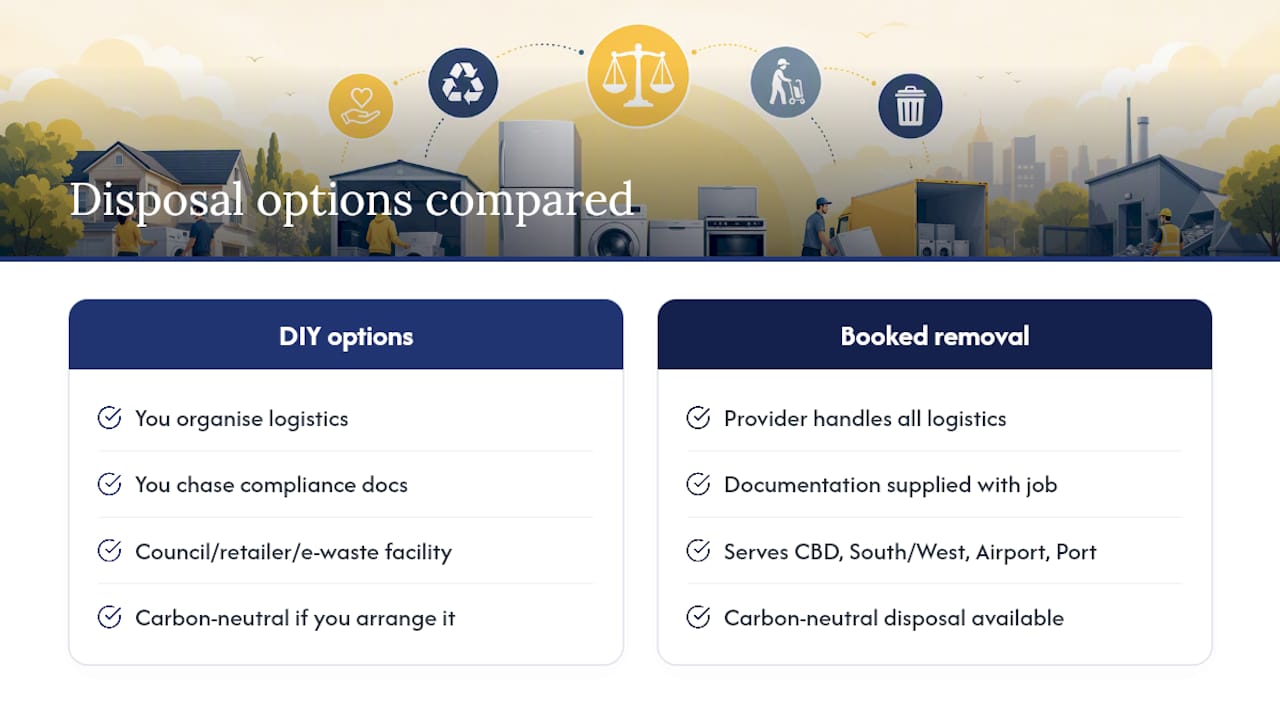
There are other routes worth trying first: council drop-off, a retailer trade-in, or a licensed e-waste facility if you’re happy to organise the logistics yourself. But if you’d rather not spend a Saturday loading a fridge into a hired trailer, Melbournecityrubbish gives Melbourne households and businesses a booked, compliant alternative that handles the whole job in one visit.
Melbournecityrubbish removes fridges, washing machines, dryers and other large appliances across CBD & South Melbourne, Melbourne Airport, Melbourne City, Port Melbourne and West Melbourne, with carbon-neutral disposal options for households that want their old appliance handled with a lighter footprint. It suits anyone clearing a single fridge, a full kitchen upgrade, or a strata building’s worth of old white goods in one go, and every job comes with the documentation you’d otherwise have to chase yourself.
If you’re managing a building-wide clear-out rather than a single appliance, the strata rubbish removal service is built for exactly that. Otherwise, get a quote through the main booking page and ask for written confirmation of licensed refrigerant handling before the truck arrives.
Sources
- Beyond bulky waste: Australia’s growing end-of-life appliance challenge | HVAC&R News
- Desktop review of product stewardship and EPR laws for large appliances (SSROC / Product Stewardship Centre of Excellence)
- End-of-life domestic refrigeration and air conditioning equipment in Australia (DCCEEW)
- Recycling white goods | RecyclingNearYou (Planet Ark)